@theisorlando@50k_frw Exactly, why the idiotic laughter? Completely inappropriate to the video. The video’s interesting, sure, but not remotely humorous.
@edwinofficially@philhuwedwards@JohnCleese O’Donoghue is totally blind. He’s a political correspondent. He just happened to be at an election rally in Butler that day when the shooting started. This is not remotely comparable to the Bowen/Ukraine video.
@toadmeister .@toadmeister But it’s not lawful, he was celebrating political violence and in related posts he was encouraging such violence. This is beyond the legal norms of free speech.
@darrengrimes Dear @darrengrimes, the word is “rape”, not “r*pe”. Why employ euphemism and facade to discuss such issues? The unfortunate victims certainly don’t get to enjoy the luxury of such genteelism.
@FrankCurzio@EconguyRosie What? So, a drop in aggregate demand occasioned by a Canadian boycott would lead to *increased* US production? How’d you figure that out? Why would US producers suddenly make more stuff when nobody was buying it?
@LondonEconomic I think you're missing the point. Piers always lets his guests have free reign on the "Uncensored" interviews, rarely interrupting when the guest is speaking. The clue is in the name!
@LeechCaroline@K_Walthall Correct, hitting an unyielding solid object is highly injurious, and so too is a high-speed head-on impact. Summing the speeds is a convenient shorthand way of describing the overall energy involved. It's not saying that 50v50=100 into wall, however, just that 50v50 is severe.
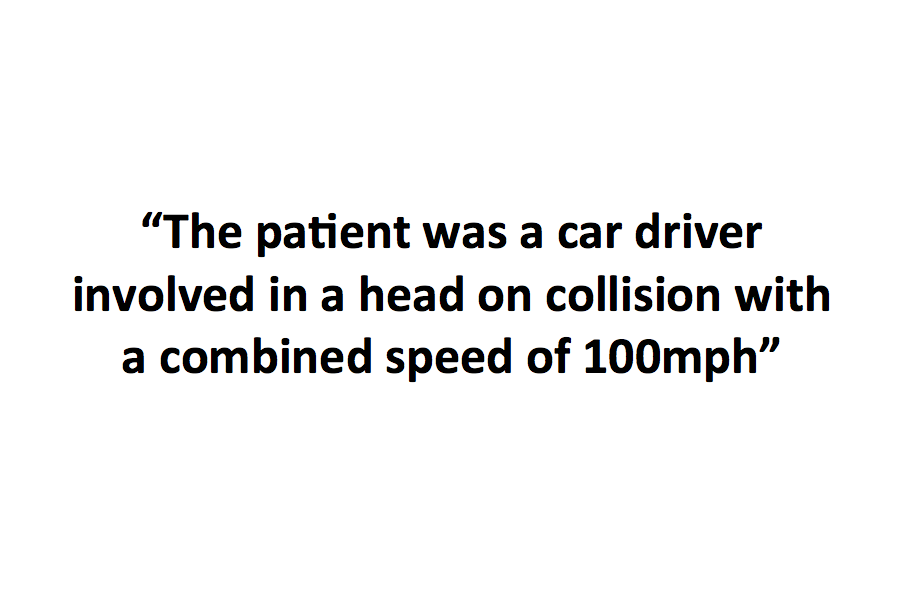
Oh dear, lots to unpick here @K_Walthall . Combined speed of a frontal impact RTC is very useful. Two cars hitting head-on at 50mph each are not the same as one car hitting a stationary car from 50mph, as @LeechCaroline suggests. Short thread: 1/7
Why it may not be helpful to describe RTC mechanism as a combined speed of impact....
If you hear this handover, what does it tell you about the mechanism of injury and the forces applied to the patient? Can you predict their severity of injury based on this information?
@LeechCaroline@K_Walthall That's right, hitting an oncoming 50mph car is tantamount to hitting a brick wall, so, it can't be compared with hitting a stationary vehicle, which involves much lower energy. So, you must take account of the speed of both vehicles in head-on impacts.
@LeechCaroline@K_Walthall No, the experiment's fine, but you've misinterpreted the results. A 50mph crash into a wall is huge, much bigger than a 50mph crash into a stationary vehicle, that's the important point here, so you must take into account if the other vehicle was heading towards you at 50mph.
@LeechCaroline It's simply the transfer of energy from the moving vehicle to the stationary vehicle. That's why, for example, your stationary vehicle is shunted forwards during a rear-end shunt, hence whiplash injuries etc, as your vehicle absorbs some of the energy from the moving vehicle.
@LeechCaroline@K_Walthall Yes, this confirms one of my points: two cars colliding head-on at 50mph each are similar to one car hitting a brick wall at 50mph, which is a massive impact. That's not the same as one 50mph car hitting a stationary car, which is a much, much lower energy impact.
So, yes, it’s important to take combined speeds of head-on impacts into account, as the energy of both vehicles contribute to the resultant g-forces sustained by the occupants. Pre-hospital physicians ought to be aware of this. 7/7
Hitting unyielding objects like brick walls, and especially those that concentrate the force into a small area, like a tree or a lamppost, is the highest energy impact you can have in an RTC. But head-on collisions at high-combined speeds are similarly high risk. 6/7