I just went through this article which bring building SLM ( Small Language Model) closer to me than the way I understood it before.
It cover the Technical Implementation of how SLM can built.
You might find it interesting as I did.
https://t.co/PwVDsQzk2y
People think memorizing system-design diagrams is enough to get hired.
It’s not.
In 2026, if you want to stand out as a Sr. backend or systems engineer, you need demonstrable skill, not recycled buzzwords.
Here’s what actually gets you hired:
1. You must know how to build real systems.
HTTP, APIs, CRUD, caching, async, concurrency, idempotency.
If you can’t explain your hot path on a whiteboard, nothing else matters.
2. Databases and Storage
SQL mastery, data modeling, indexes, transactions, replication, partitioning, consistency models.
Plus at least one NoSQL store (Redis, DynamoDB, Mongo, Cassandra).
3. Distributed Systems Fundamentals
Load balancing, queues, event-driven architecture, CAP trade-offs, retries, backpressure, rate limiting, and SLOs.
This is where teams separate juniors from engineers they can trust.
4. System Design Thinking
Latency budgets, failure domains, SLAs, scaling reads vs writes, multi-region patterns, caching layers, and bottleneck isolation.
5. Cloud & Infra Basics
AWS/GCP/Azure, containers, Kubernetes fundamentals, VPC networking, monitoring, and autoscaling.
6. Observability
Metrics, logs, traces, alerting.
You must prove that you can debug a production incident without guessing.
And then the part everyone ignores:
A project that proves you can do the work.
Not a to-do app.
A real system.
System design isn’t about who talks smartest.
It’s about who reasons clearly.
Key Evaluation Checks:
Calibration: predicted prob = actual freq
Confidence: when to show predictions
Direction tests: e.g., price ↑ with size
Evaluation separates academic from production ML
Day 23 : Beyond Accuracy - Robust & Fair Model Evaluation
Final day on Model Development! Your model has good accuracy - is it ready for production? Probably not. Let's talk about proper evaluation. #MachineLearning#ResponsibleAI
Slice-based Evaluation:
Overall accuracy hides everything!
Model A: 98% on majority group, 80% on minority → 96.2% overall
Model B: 95% on both groups → 95% overall
Which is better? Model B is fairer and more reliabl
Huge thanks to @sysconf_ ! Two sessions instantly leveled up my knowledge:
@HAKSOAT on making LLMs fly with inference optimizations.
@allenakinkunle on demystifying data encryption & key management.
Now I understand how these methods drive high-throughput inference in engines like vLLM, Ollama, drastically reducing latency and boosting performance.
AutoML Reality: Architecture search is computationally expensive (Google, OpenAI scale). But results like EfficientNet show the potential.
Most teams: Stick with hyperparameter tuning for now.
Coming Next: The crucial art of model evaluation beyond accuracy.
Day 22: Scaling & Automation - Distributed Training & AutoML
Scaling ML to massive models and datasets. Distributed training and the exciting (terrifying?) world of AutoML. #DeepLearning#A
AutoML - The Promise:
"Instead of paying 100 ML engineers, use that compute to search for optimal models."
Soft AutoML: Hyperparameter tuning (random search, Bayesian optimization)
Hard AutoML: Neural architecture search, learned optimizers
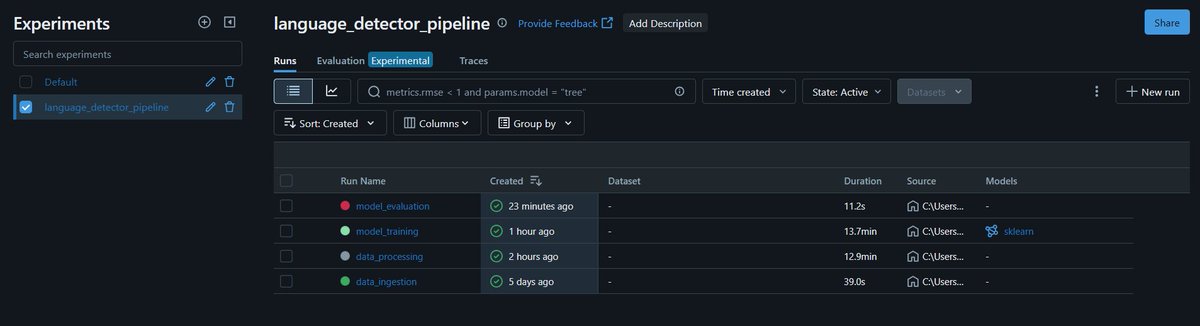
🚀 Big milestone achieved! Just successfully integrated #MLflow into the early stages of my model pipeline. Now tracking all experiments, parameters, and metrics from day one. The foundation for reproducible ML is set 💪
#MachineLearning#MLOps#DataScience#AI#BuildInPublic
Debugging Tips:
Start simple, add components gradually
Overfit a single batch (proves implementation works)
Set random seeds for reproducibility
Tomorrow: Distributed training and AutoML.
Day 21: The ML Engineering Grind - Tracking, Versioning & Debugging
The engineering discipline behind successful ML projects. Experiment tracking, versioning, and the painful art of debugging ML models. #MLOps#AIEngineering
Debugging ML Models is HARD:
Fails silently (code runs, predictions are wrong)
Slow feedback loops (hours to retrain)
Cross-functional complexity (data, labels, features, code, infra)
"Debugging should be both preventive and curative."