One neutron hits one nucleus. It splits and releases two or three more.
Too far apart, they escape. The chain dies out, every time.
Same atoms. Nothing added. Only the distance changed.
It was never about how much.
It was about how close.
https://t.co/lLZmCDXSmj
In Nature’s 2025 survey of more than 3,700 PhD students, about half said their supervisor spent less than an hour a week with them. Students who met their supervisor more often were more likely to be satisfied with their PhD. A separate survey of 2,279 graduate students found anxiety and depression far above general-population levels, and a clear link to mentorship. Here is what the data shows, and what supervisors and students can do.
https://t.co/ZcpAjEDG27
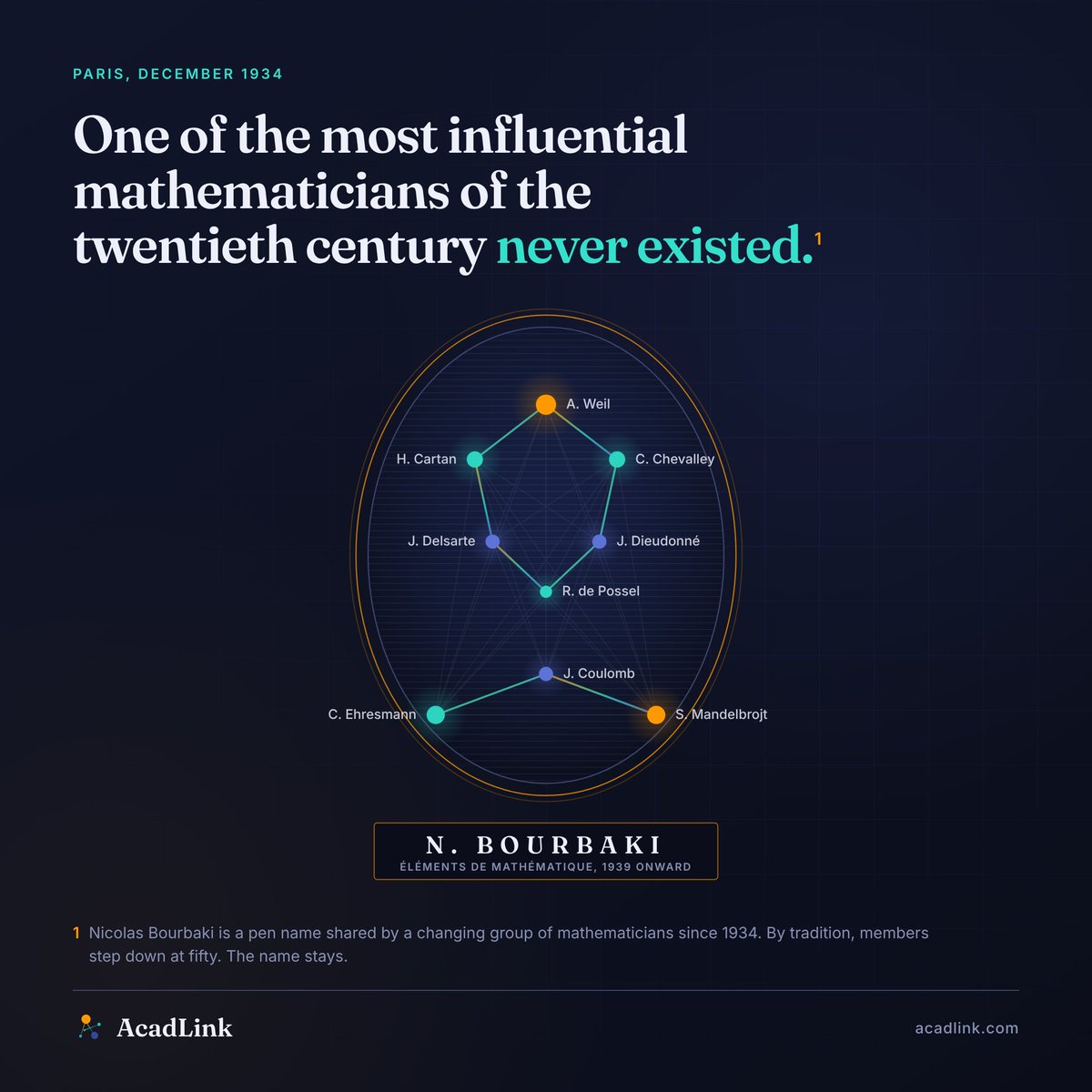
In December 1934, a handful of young mathematicians met in a Paris café and agreed to rewrite the foundations of mathematics together. They published under a single name: Nicolas Bourbaki, a person who never existed.
The circle included Weil, Cartan, Chevalley, Delsarte, Dieudonné, and their peers. Members rotated through the collective and stepped down at fifty by tradition. The name outlived every founder, and their Éléments de mathématique shaped how modern mathematics was taught for decades.
Bourbaki succeeded because the infrastructure remained constant while the people changed: shared drafts, vigorous debate, and an unbroken record of what was decided.
That continuity is what we built AcadLink to preserve.
AcadLink brings students, researchers, and faculty into a shared workspace for cross-institutional research. It unifies documents, tasks, and discussion so that institutional memory endures long after teams rotate.
https://t.co/UV8730W95A
The disappearing evidence: data on request, and links that die https://t.co/DgY3nBgfcj
Of 1,792 authors who promised to share data on request, only 123 did. One in five science papers suffers from link rot. How evidence vanishes, and the fix.
Why everything in research takes longer than planned?
In 1994, three psychologists asked 37 students a simple question: when will you finish your honours thesis? The average answer was 33.9 days. The students were then asked for a best case, if everything went as well as it possibly could, and a worst case, if everything went as poorly as it possibly could.👇
https://t.co/ALC9EpxenE
Some ideas are too bright to keep inside. 🎃
No mind should work alone, especially on Halloween.
Happy Halloween from the AcadLink team 🧡
🔗 https://t.co/lLZmCDXkwL
#AcadLink#HappyHalloween2026
AcadLink is now live.
A platform where students, instructors and researchers across universities find collaborators, run projects together and discover academic opportunities.
There was only ever one room!
https://t.co/lLZmCDXkwL