Tailored Excellence for Every Researcher: proofreading, language editing, manuscript review, formatting, statistical analysis, and scientific video editing.
Scientific video accuracy depends on four synchronized tracks: narration, on-screen text, visuals, and captions. Each should preserve the same numbers, units, timeframe, comparison, terminology, and claim strength as the source evidence.
#academicperfection#ScientificVideo
Different within-group significance does not prove subgroup effects differ. Credibility depends on interaction evidence, prespecification, rationale, multiplicity, sample size, effect estimates, and uncertainty.
#academicperfection#SubgroupAnalysis#InteractionTest#PeerReview
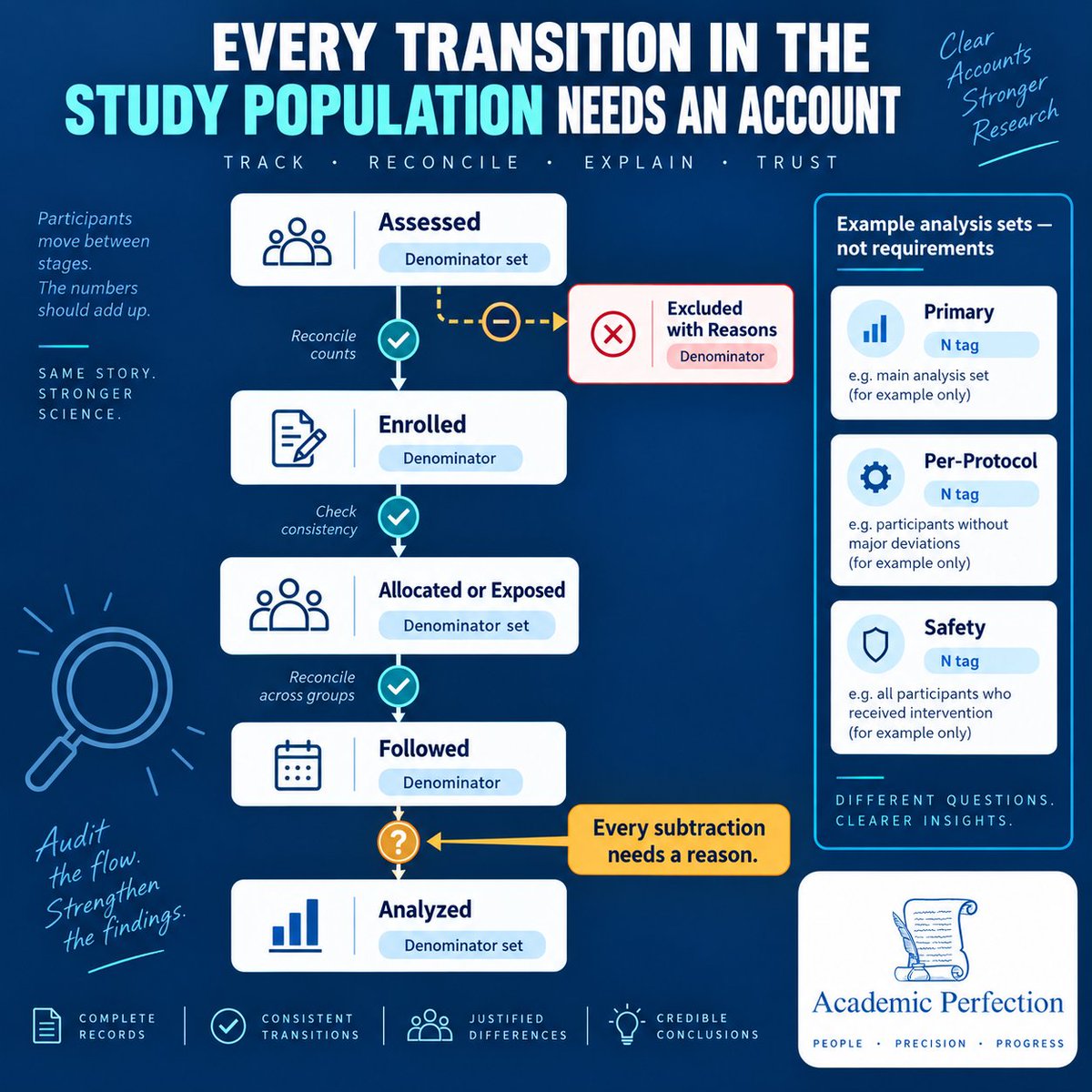
A participant flow diagram is a numerical audit, not decoration. Every transition should reconcile; exclusions need stage-specific reasons; analysis populations need clear labels; and final denominators must agree with methods, tables, and results.
#academicperfection#CONSORT
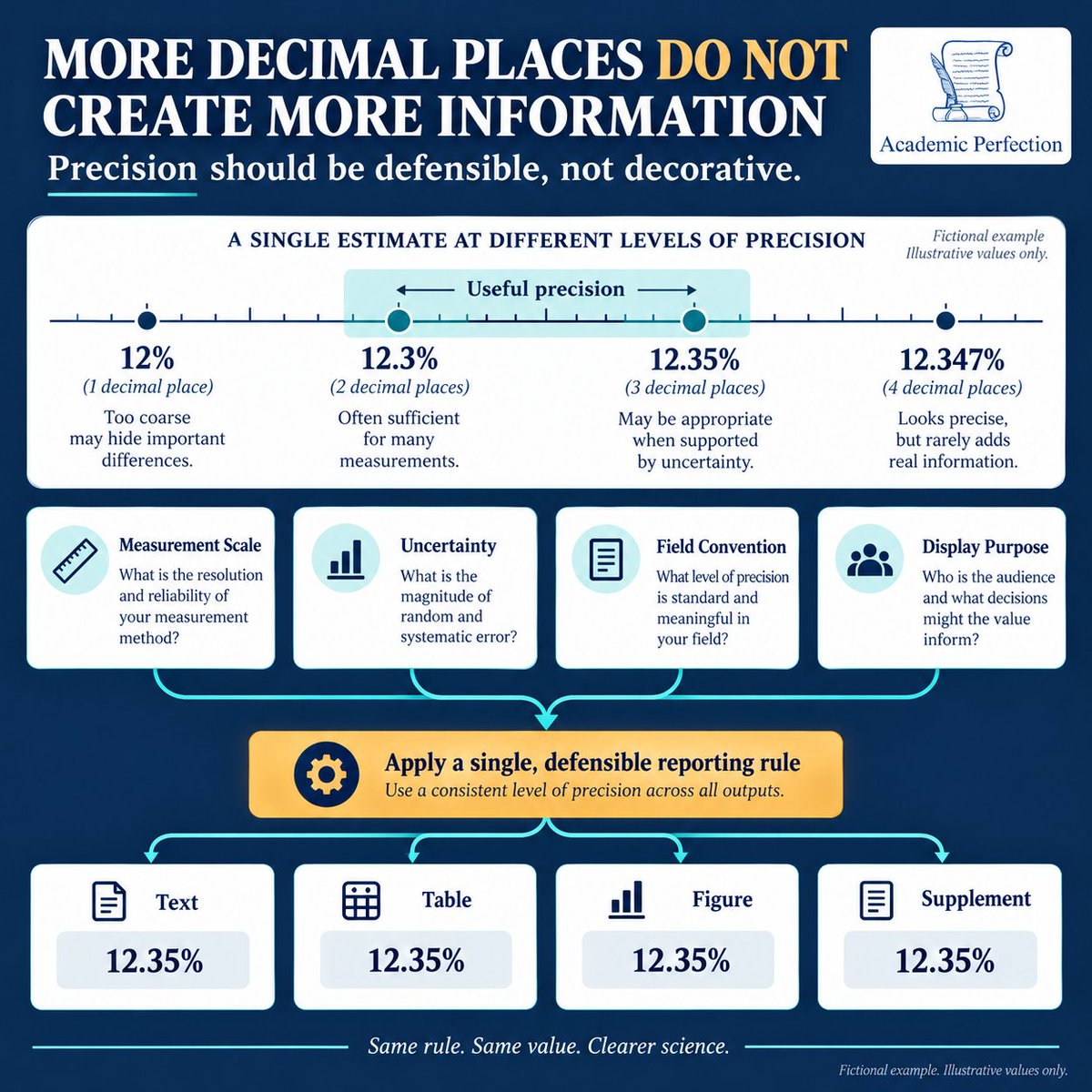
Extra decimals do not create extra evidence. Rounding should reflect the measurement scale, uncertainty, field conventions, and display purpose. The chosen rule then needs to remain consistent across text, tables, figures, and supplements.
#academicperfection#Rounding
Every repeated result needs traceability. Sample sizes, denominators, units, time points, rounding, reference groups, and adjustment labels should reconcile across the abstract, text, tables, figures, captions, and supplement.
#academicperfection#ManuscriptAudit
Precision is not importance. A narrow interval may surround a trivial effect; a wide interval may include both negligible and meaningful effects. Interpretation needs magnitude, uncertainty, units, timeframe, and a justified context for what matters.
#academicperfection
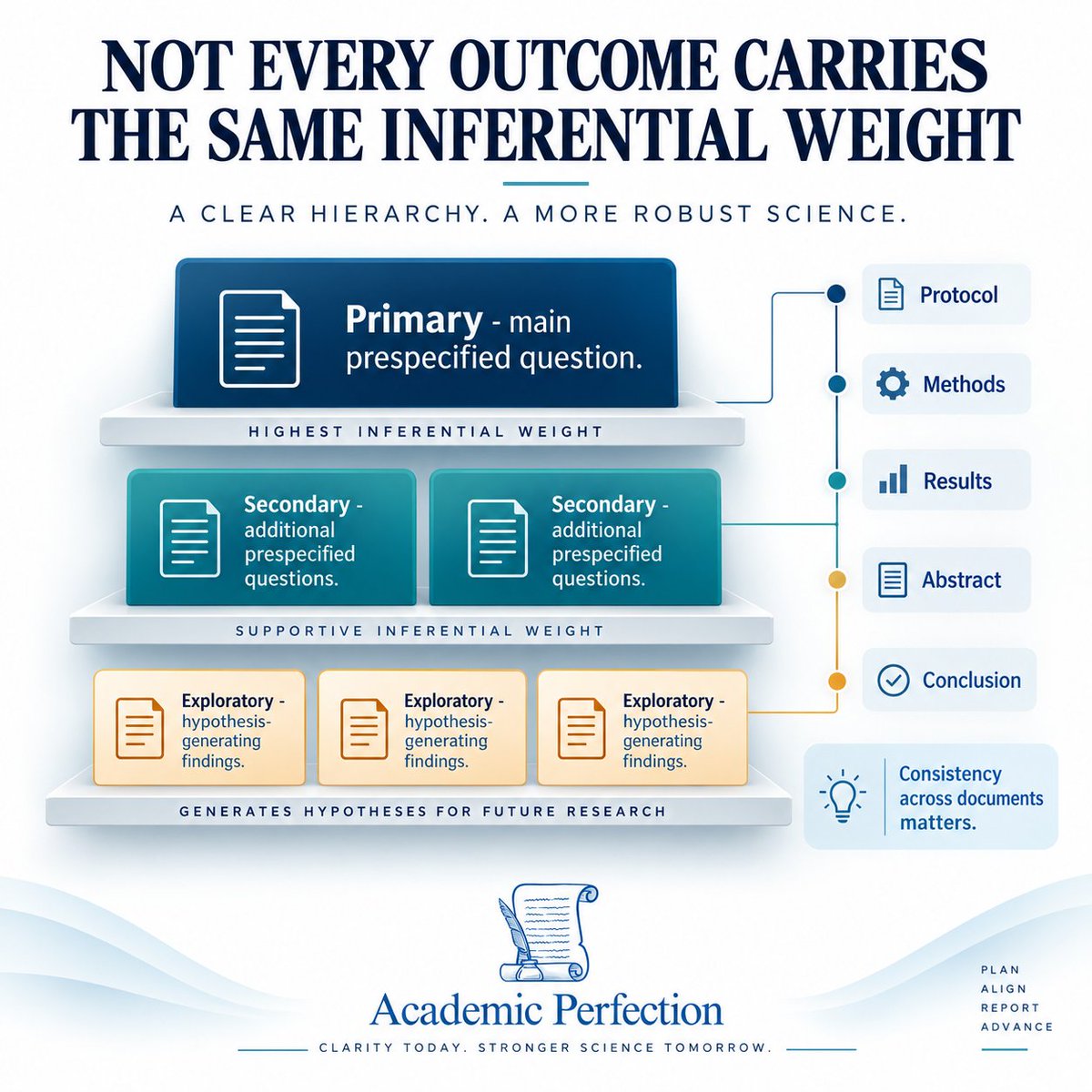
Primary, secondary, and exploratory outcomes should remain identifiable from protocol to conclusion. The labels tell readers which question anchored the study, which were additional, and which findings are hypothesis-generating rather than confirmatory.
#academicperfection
Rows are not always independent participants. Eyes within patients, visits within people, and patients within hospitals may be correlated. Reporting the observation, intervention, randomization, and analysis units makes the sample structure visible.
#academicperfection
Eligibility criteria define the population behind a study's claim. A strong manuscript keeps the enrolled sample, intended population, and wider real-world population distinct, then explains where generalization is reasonable and where uncertainty remains.
#academicperfection
Language editing should improve grammar, clarity, flow, and terminology while preserving meaning, uncertainty, and author voice. When meaning is unclear, an editorial query is safer than a confident rewrite.
#academicperfection#LanguageEditing
The design sets the ceiling for the conclusion. Descriptive studies describe; observational studies estimate associations; prediction studies predict. Causal verbs require causal evidence. Precision is not weakness.
#academicperfection#ScientificWriting
Reproducibility needs a traceable path from raw data to final tables: definitions, cleaning decisions, code, software versions, models, outputs, figures, and revision history. A result should be reviewable, not mysterious.
#academicperfection#ReproducibleResearch
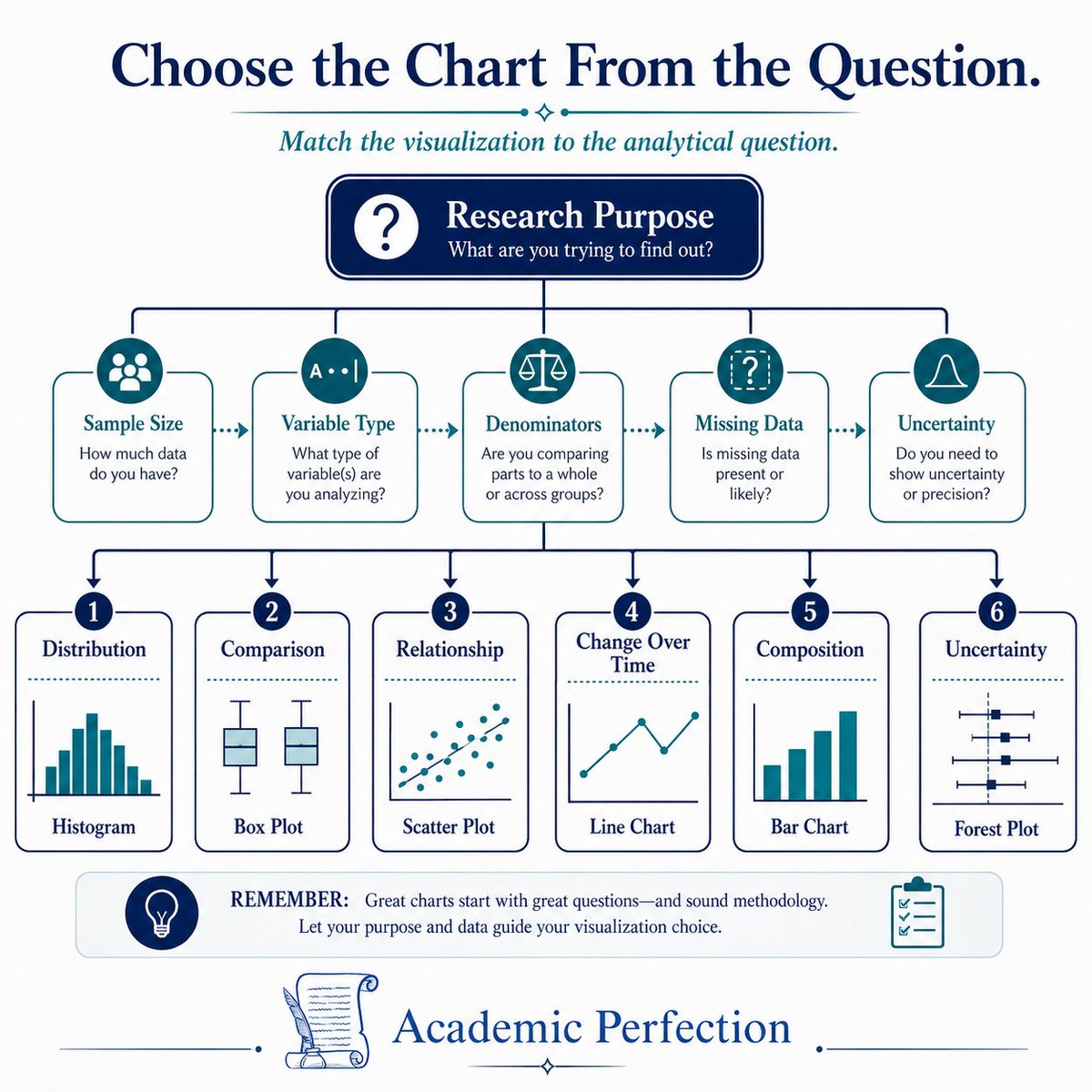
Choose the chart from the question: distribution, comparison, association, time, composition, or pooled effects. Variable type, denominators, missing data, scale, and uncertainty should guide the design.
#academicperfection#DataVisualization
AI may assist writing or analysis workflows, but humans must verify facts, citations, numbers, methods, interpretation, confidentiality, and disclosure. AI cannot approve the final manuscript or take accountability.
#academicperfection#ResponsibleAI
A response to reviewers should show the comment, the reasoning, the exact change, and where it appears. Respectful disagreement is valid when evidence or methods support it. “Corrected” alone is not a revision record.
#academicperfection#PeerReview
A cover letter should explain the manuscript’s question, contribution, journal fit, and required declarations without copying the abstract or overstating novelty. It must remain consistent with the paper’s evidence boundary.
#academicperfection#CoverLetter
Journal fit starts with scope, audience, article type, design, and evidence level—not one metric. Verify current limits, policies, fees, indexing, and recent content. Past publication patterns do not guarantee acceptance.
#academicperfection#JournalSelection
Authorship is credit plus accountability. Contribution statements should reflect real work in design, methods, data, analysis, drafting, revision, visualization, or supervision, and align with journal authorship criteria.
#academicperfection#PublicationEthics
A citation should support the exact claim beside it—not just the same topic. Verify source type, scope, date, metadata, corrections, and retractions. Citation density cannot replace citation fit.
#academicperfection#ReferenceChecking
Limitations are not apologies. They define how selection, measurement, missing data, confounding, sample size, assumptions, follow-up, or setting may affect bias, precision, generalizability, and inference.
#academicperfection#ResearchIntegrity