We help brands identify, reach and convert more of their ideal customer personas (ICPs), resulting in lower CAC, higher engagement and supercharged growth.
Sure... most "AI tools" can answer questions. Some dashboards can show you what changed, and a few platforms can even help you create segments or content.
We decided to build something different. Something that brings the full growth workflow into one intelligence layer: performance data, customer intelligence, Brand DNA, personas, strategy, content, creative, and activation. All in one place.
That means your team doesn't just move faster. They move with context. They understand the why behind performance shifts, meet the real people behind the numbers, create on-brand outputs automatically, and turn insights into launch-ready work without bouncing between tools.
This is what makes AccessFuel more than a database or chat assistant. It's an AI-native Growth Operating System built for teams that need clarity, precision, and measurable outcomes. Full breakdown at the link in the comments.
Your AccessFuel console just got faster and more creative.
We've upgraded AIRA to GPT 5.5 and added GPT Image 2 directly into the console.
For users, that means:
- Roughly 40% faster responses
- Better reasoning across Brand DNA, content, strategy, and segmentation
- Faster, and more stunning image generation/editing inside AIRA
- A smoother path from insight to campaign-ready activation
The real unlock is simple. You can talk to your data, understand what matters, generate brand-aligned strategy and assets, then create supporting visuals without leaving your AccessFuel console.
From question to answer to activation. That’s the kind of AI eCommerce teams actually need.
Learn more or book a demo at the link in the comments.
AI is no longer an optional feature layer. It's becoming operating infrastructure. For eCommerce brands, that changes the question.
Not: “Do we have AI?”
Rather: “Do we have an intelligence layer?”
Most brands have added tools:
- AI creative tools
- AI dashboards
- AI chatbots
- AI campaign assistants
- AI reporting features
Useful? Yes. Connected? Usually not.
And disconnected AI does't create compounding advantage. It creates faster fragmentation.
The brands that win the next cycle will be the ones that connect customer data, behavioral understanding, and agentic execution into one operating layer.
May 20th made the shift impossible to ignore.
The work now is building for it.
Wondering what's changed? Read the full article below.
Your analytics stack isn't giving you analytics. It’s giving you access.
Access to sales data, campaign data, email data, customer data.
Helpful? Yes.
Enough? Not if your team still has to spend hours stitching it all together just to answer one growth or ops question.
The future of ecommerce analytics isn't another dashboard with more tiles. It’s a conversation.
Ask your business what happened, why it happened, and which customers were behind it.
Ask where new opportunity is hiding and what personas to build next.
Find out what's changed QoQ and how to prep for the coming term.
While other dashboards give you muddied insights, your AccessFuel console unifies your channels into a single source of truth for you to speak with like a colleague.
And with the latest console upgrade, powered by GPT 5.5, that conversation is now more natural, more flexible, and even more effective.
Your team doesn't need to learn another reporting workflow or marketing approach.
They need a faster path from question to answer to action. That’s what talking to your data should feel like.
Learn more at the link in the comments.
Every brand we talk to lately is asking the same question:
"How do we lower CAC?"
Wrong question.
CAC is an output. You do not control it directly. You influence it through the quality of your targeting, the depth of your retention, and the density of your revenue per customer. The brands winning this year aren't the ones with the lowest CAC. They are the ones who built a system where rising CAC does not kill profitability.
Here is what that system looks like:
Gear 1: Acquisition Precision
Stop acquiring broadly and hoping for the best. Start with your highest-value segments and build audiences from there. A $40 CAC customer who buys 6 times is worth more than a $25 CAC customer who never returns.
Gear 2: Retention Depth
Measure retention by cohort, by channel, by segment. Not as a single blended number. A 5% improvement in retention at the right lifecycle stage can be worth more than a 20% reduction in CAC.
Gear 3: Revenue Density
For every retained customer, how much are they spending per transaction and per year? This is the gear most brands ignore, and it is the one that gives you the most room to absorb rising acquisition costs.
The real problem is not that CAC is too high. The real problem is that most brands can't see these three gears at the segment level. They are stuck making decisions on blended averages.
You don't have a CAC problem. You have a visibility problem.
Learn more about building a profitable growth model at the link in the comments.
Some of you won't want to hear this, but most "AI-powered brands" are actually producing the most generic content they've ever shipped.
The tool isn't the problem. The context gap is.
If your AI doesn't know your archetype, voice spectrum, vocabulary rules, and audience — it writes for *everyone*. Which means it writes for no one.
Brand DNA solves this. One-time configuration. Applied everywhere. Living, not static.
The question isn't whether to use AI.
It's whether your AI knows who you are.
Discover your Brand DNA at the link in the comments.
If you’re an ecomm brand, you’re probably drowning in useful data.
Question is: Are you interrogating it?
There's a difference between watching your numbers and asking your numbers hard questions. The brands compounding in 2025 are doing the latter.
We put together the 10 questions every ecommerce store should be asking their data right now:
1. Who are our best customers --> and what do they have in common?
2. What is our true CAC --> by channel?
3. Where does our repurchase rate break --> and why?
4. What does revenue look like --> net of returns and discounts?
5. Is our AOV growing, or just floating?
6. Which products are high revenue, low margin?
7. What does cohort data tell us about our trajectory?
8. Where in the funnel are we losing the most value?
9. Are we measuring ad spend with ROAS or MER?
10. What does our data NOT know?
Each question maps to a decision. Each decision maps to a lever.
Read the full breakdown and learn how to answer these questions for your brand at the link in the comments.
We get it. You have too much data and too little intelligence.
Shopify. Klaviyo. GA4. Your ad platforms. Each one technically accurate. None of them talking to each other.
And what do you get? A collection of partial pictures. Your email team optimizes in one silo. Your paid media team optimizes in another. And your marketing strategy becomes a patchwork of disconnected channel decisions, rather than a unified, customer-informed approach.
That's the data fragmentation problem. And it's costing you more than you think.
Data enrichment is what closes the gap. It's not about having more data, it's about connecting the data you already have, layering in behavioral and psychographic context, and creating a single picture of who your customers actually are.
When you can see the reason behind a purchase, not just the demographic profile of the purchaser, your marketing gets fundamentally different. More targeted. More resonant. Faster to optimize. Flat out better.
Brands that invest in enriching their customer data see longer retention, higher repeat purchase rates, and larger average order values. Not because they're spending more. Because they're spending smarter.
That's the difference between a marketing team that's guessing and one that's growing.
→ Read the full breakdown at the link in comments.
@SeaOtterClassic 3/3
If you're at Sea Otter, come say hello. Coffee's on us!
No pitch. Just a real conversation about what growth looks like for cycling brands in 2026.
→ Learn more about what we're building for the industry at https://t.co/XvYVC6zVbC
1/3
We're at @SeaOtterClassic this week. Not to sell, but to listen.
Our founder is a cyclist who built AccessFuel because he saw cycling brands stuck: great products, broken data, gut-check marketing.
The industry averages 10–15% return customer rates. That has to change.
@SeaOtterClassic 2/3
One cycling brand we partnered with was burning Meta budget with zero clarity.
30 days with AccessFuel:
- CAC ↓ 71%
- ROAS ��� 320% (3.8x)
- CVR ↑ 285%
- Monthly purchases ↑ 7x
Clarity > guesswork. Every time.
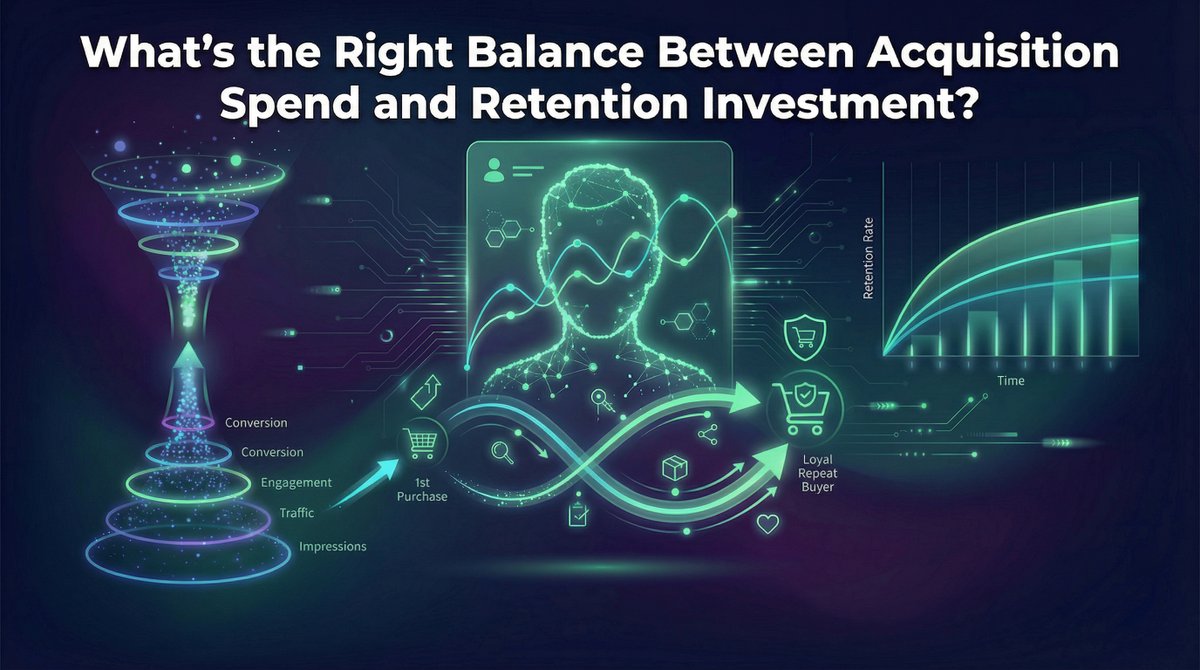
Most brands are losing the acquisition vs. retention debate before it begins. Not because they chose the wrong side. Because they framed it as a choice at all.
Acquisition and retention are not competing budget lines. They are two phases of the same growth engine. One fills the funnel. The other determines whether that investment compounds or evaporates.
Here is what the data-driven version of this decision actually looks like:
Stage matters. Early-stage brands should weight acquisition heavily. Growth-stage brands should start reading their cohort data and shifting the balance. Scale-stage brands that are not investing in retention are paying full CAC for customers they already own.
LTV determines the ceiling. If your retained customers spend 4x what your one-time buyers spend, retention investment at even a high cost-per-outcome is likely your best ROI. If that gap is narrow, acquisition may still be the right engine.
CAC trends tell you when to diversify. Rising acquisition costs are a signal, not just a problem. They mean it is time to build owned revenue through retention before the margin gets squeezed further.
The brands that get this right do not pick acquisition or retention. They know their customers precisely enough to know when to do more of each.
That is the clarity that compounds.
Full breakdown on the blog. Link in comments.