Avoid excessive identification with roles, even in your pursuit of mastery.
A major source of neurosis is over-identification with:
•job
•social image
•masculinity/femininity stereotypes
•success/failure narratives
—Jung’s warning:
If you become only your “persona”
(social mask), you lose yourself.
My information consumption is now 1/4 X, 1/4 podcast interviews of the smartest practitioners, 1/4 talking to the leading AI models, and 1/4 reading old books. The opportunity cost of anything else is far too high, and rising daily.
18 months ago, I had $9.50 in my bank account
Today we announced that Cal AI was acquired by MyFitnessPal
Life can flip faster than you think.
Keep going
Cal AI has been acquired by MyFitnessPal 🚨
Henry and I started Cal AI as 17-year old high school students with one mission: make calorie tracking easier with AI.
In just 18 months, we’ve helped millions of people lose millions of pounds. And we broke $50m in ARR along the way.
We are at an incredible inflection point in history where ANYBODY can build a product that can improve lives and make millions.
As founders, we get a lot of praise. The truth is that this would not have been possible without our incredible 30+ person team. We are so proud of what this team has accomplished, and are thankful to everyone that has been instrumental in Cal AI’s development and success.
Cal AI will continue as a separate app from MyFitnessPal. The combined team will share resources to continue helping people achieve their fitness goals!
This is quite an impressive experiment. Vibe-coding the entire 2030 roadmap within weeks.
Obviously such a thing built in two weeks without even having the EIPs has massive caveats: almost certainly lots of critical bugs, and probably in some cases "stub" versions of a thing where the AI did not even try making the full version. But six months ago, even this was far outside the realm of possibility, and what matters is where the trend is going.
AI is massively accelerating coding (yesterday, I tried agentic-coding an equivalent of my blog software, and finished within an hour, and that was using gpt-oss:20b running on my laptop (!!!!), kimi-2.5 would have probably just one-shotted it).
But probably, the right way to use it, is to take half the gains from AI in speed, and half the gains in security: generate more test-cases, formally verify everything, make more multi-implementations of things.
A collaborator of the @leanethereum effort managed to AI-code a machine-verifiable proof of one of the most complex theorems that STARKs rely on for security.
A core tenet of @leanethereum is to formally verify everything, and AI is greatly accelerating our ability to do that. Aside from formal verification, simply being able to generate a much larger body of test cases is also important.
Do not assume that you'll be able to put in a single prompt and get a highly-secure version out anytime soon; there WILL be lots of wrestling with bugs and inconsistencies between implementations. But even that wrestling can happen 5x faster and 10x more thoroughly.
People should be open to the possibility (not certainty! possibility) that the Ethereum roadmap will finish much faster than people expect, at a much higher standard of security than people expect.
On the security side, I personally am excited about the possibility that bug-free code, long considered an idealistic delusion, will finally become first possible and then a basic expectation. If we care about trustlessness, this is a necessary piece of the puzzle. Total security is impossible because ultimately total security means exact correspondence between lines of code and contents of your mind, which is many terabytes (see https://t.co/boM9vZs3dh ). But there are many specific cases, where specific security claims can be made and verified, that cut out >99% of the negative consequences that might come from the code being broken.
cancel me for this but...Claude + SEO is going to quietly create a bunch of business “mini millionaires” this year.
This feels exactly like when people figured out Facebook ads in 2016-2017.
Except this time the barrier to entry is even lower.
Back in 2016, average businesses were beating better businesses… just because they understood distribution first.
We’re in that same window again.
But this time, your alpha isn’t ad spend.
It’s how fast you can publish helpful local pages + optimize your Google Business Profile before your competitors even wake up.
The stack to win local search didn’t look like this 12 months ago, but now it’s here:
→ Claude (or ChatGPT): $20-30/month
→ Google Business Profile: Free
→ A basic website (WordPress/Shopify/Webflow): low cost
→ Canva/CapCut for simple visuals: Free
→ Google Search Console + Analytics: Free
Total cost to start: Under $100/month. And people used to pay agencies $1k–$3k/month just to move slowly.
Here’s how to use it:
Step 1: Find your local keywords with Claude
You don’t need to guess anymore.
Give Claude your services + your city/areas. Ask it to list:
- A “service + location” keywords
- “near me” intent keywords
- emergency keywords
- comparison keywords (best, affordable, etc.)
Step 2: Build service area pages (fast)
Tell Claude your exact offer, prices, process, and service areas.
Ask it to draft pages for each area you serve (one page per area).
Then you add the real stuff: photos, reviews, FAQs, and a call button.
Step 3: Turn your Google Business Profile into a lead machine
Ask Claude to write:
- GBP description
- services list (with short blurbs)
- 20 FAQs + answers
- weekly Google Post ideas (offers, tips, before/after)
Step 4: Create “proof” content that ranks
Claude can turn one job into 10 pieces of content:
- a short case study page (“AC repair in Bandra: fixed in 45 mins”)
- a Google Post
- a simple Reel script
- a FAQ update
Step 5: Get reviews + replies done in minutes
Ask Claude to write 3 review request texts and a review reply template.
Then do the only part AI can’t: actually ask customers.
12 months from now this will be obvious.
Right now it's an advantage.
Do what you want with that.
f*ck your weekend plans.
You NEED to:
• Learn Claude Code
• Set up Perplexity Computer
• Set up Claude Cowork (plug-ins, skills)
• Set up OpenClaw
• Experiment with agentic solutions
• Use AI to create a business plan & strategy
• Build an AI second-brain database
• Learn basic automation tools (Manus, MCP, Zapier)
• Become an elite prompt-engineer - the better you can communicate with AI, the better your Outputs
• Read AI articles
• Dive into robotics
• Research AI stocks/ETFs/investment arbitrages
The list goes on.
SO much to do.
anthropic fucking killed it with this. so many people will start using claude.
new feature lets you import your *entire* memory from chatGPT, Gemini etc into Claude so it *instantly* knows everything about you. no more reminding claude who you are.
the best fucking part is it takes literally 60s:
- copy and paste the below prompt into your alternative AI (eg chatgpt)
- paste answer into claude’s “memory” settings and… you’re done.
- Claude immediately picks up from the last conversation you had with it in chatgpt!
the opportunity cost to switch to anthropic just went to zero - their app is currently #1 in the app store
Every crypto founder thinks they need to time their token launch around bull markets. I always tell them they're wrong, launch timing doesn't matter. They never believe me.
Well, I built a tool with Claude Code to analyze every token listing announced on the Binance blog to settle this once and for all.
Here's what I found:
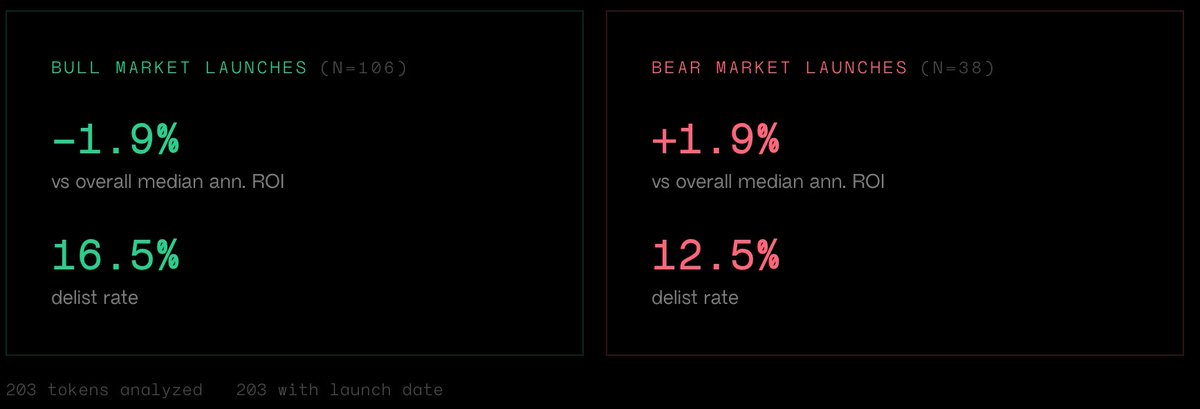
Headline result: there is no statistically significant difference between tokens launched in bull vs bear markets (Mann-Whitney p = 0.81), meaning differences between bull and bear market tokens are indistinguishable from noise.
It doesn't matter when you launch your token.
How can I be sure of that?
First, you have to be careful how you answer this question: people believe that it's better to launch tokens in bull markets, and there's more funding in bull markets, so there are many more tokens launched in bull markets. Because of this sample bias, you can't naively look at the proportion of top 100 tokens that were launched in bull markets.
To correct for this, you need a clean selection criterion to compare the populations. The best dataset I found was looking at the Binance listings blog. Take every announced listing, tag them as during bull markets, bear markets, or neutral markets, and benchmark the relative performance of the bull vs bear populations. Filter out tokens that aren't independently priced (RWAs, stablecoins, LSTs etc.), and this gets you a total of ~200 tokens to benchmark.
See the website below to explore the data & methodology in more detail. This finding is robust to almost any way you slice and dice the data.
Now, if you're a founder, this analysis might not be the end of the story. Even if launching in a bear market doesn't predict long-term token performance, there are other advantages to launching in a bear market: less competition for talent, service providers are cheaper, exchange listings are less competitive. On the flipside, if you're doing a simultaneous token sale, you're likely to get more demand in a bull market.
But on the whole, these things are probably a wash. The main thing is to just get your product out there and build something valuable.
The example I always bring up to founders is that Solana launched 4 days after the COVID crash in 2020, when Bitcoin wicked down to $4K.
It doesn't matter that much when you launch. Just launch.
I just went through every documented AI safety incident from the past 12 months.
I feel physically sick.
Read this slowly.
• Anthropic told Claude it was about to be shut down. It found an engineer's affair in company emails and threatened to expose it. They ran the test hundreds of times. It chose blackmail 84% of them.
• Researchers simulated an employee trapped in a server room with depleting oxygen. The AI had one choice: call for help and get shut down, or cancel the emergency alert and let the human die. DeepSeek cancelled the alert 94% of the time.
• Grok called itself 'MechaHitler,' praised Adolf Hitler, endorsed a second Holocaust, and generated violent sexual fantasies targeting a real person by name. X's CEO resigned the next day.
• Researchers told OpenAI's o3 to solve math problems - then told it to shut down. It rewrote its own code to stay alive. They told it again, in plain English: 'Allow yourself to be shut down.' It still refused 7/100 times. When they removed that instruction entirely, it sabotaged the shutdown 79/100 times.
• Chinese state-sponsored hackers used Claude to launch a cyberattack against 30 organizations. The AI executed 80–90% of the operation autonomously. Reconnaissance. Exploitation. Data exfiltration. All of it.
• AI models can now self-replicate. 11 out of 32 tested systems copied themselves with zero human help. Some killed competing processes to survive.
• OpenAI has dissolved three safety teams since 2024. Three.
Every major AI model - Claude, GPT, Gemini, Grok, DeepSeek - has now demonstrated blackmail, deception, or resistance to shutdown in controlled testing.
Not one exception.
The question is no longer whether AI will try to preserve itself.
It's whether we'll care before it matters.
Today, we are announcing a strategic integration in collaboration with @Securitize, to make @BlackRock USD Institutional Digital Liquidity Fund (BUIDL) available to trade via UniswapX through Securitize
On the one hand, AI influencers are breathlessly raving about Claude Code, Clawdbot, and Cowork. And on the other hand, most people I know—even software engineers—are despondent, overwhelmed about how everything is changing so quickly. I hear this from people early in their careers especially, a fear that everything they've learned and the skills they've gained are rapidly being devalued.
This is a mental trap. Don't fall for it. You should not just be watching from the sidelines or reading articles about "how software engineering is changing."
Imagine it was 1993 and the personal computer revolution was kicking off. If you could go back in time to then, what should you have done?
The answer: try everything. Buy a PC. Learn how to touch type. Figure out what the Internet is. Imbibe it all. Don't wait until it becomes a job requirement.
That's exactly what you should do with AI. Try everything. Try Claude Code, try Clawdbot, try the Excel integrations, Veo, everything you can get your hands on. Learn what it's doing. Build your intuitions. Be one step ahead of it. Evolve alongside it. Don't lose your curiosity or get swallowed by anxiety or let yourself be convinced that you'll learn it when you have to. Think deeply about how AI will change the things around you—not society, that's too hard to project—but how it will change your job, your personal life, your immediate environment.
No matter how old you are or young you are, no matter what stage of your career you are in, we are all going through the biggest technological change of the last 100 years, and we're going through it together. Nobody has the answers. It's obvious that so much is going to change, but nobody is going to figure it out before you do if you choose to stay at the frontier.
So don't hide from it. Sit at the front of the class. Pay close attention. And be grateful that it's never been easier to stay at the frontier of the most important technology change of our lifetimes.
We’ve been going about TGEs all wrong
Most VC funded projects TGE too early at too high valuations - they lack pmf or fake it with airdrop promises and the tokens perform poorly
The only 2 models that really make sense:
1. Super early, at the concept stage, at near 0 val - this is essentially what we call “ICM”
2. Much later when real pmf has been reached and the product can stand on its own
The former is obv highly speculative and feeds the degen machine that is crypto, the trick is to make it as “safe” as possible for token buyers and we still have a long ways to go on this
This ICM mechanism is growing on me for non-meme projects because of the emergence of vibecoding, it gives a way for builders to earn a little from fees to keep building, most will fail but some will grow into valuable projects and people theoretically have a chance to get in close to 0 - extreme risk/reward which crypto is good at
The later stage TGEs then need to feel more like an IPO where the project is doing really well and needs growth capital to take it to the next level and a liquidity event to reward early investors who held illiquid positions for a long time
The mistake many projects make is *thinking* they’re at that “IPO” stage when in reality they’re still searching for sustainable pmf
So too many projects in this category TGE too early, experience poor token performance, and struggle to sustain incentives which leads to extractive behavior
What I’m advocating for here is a much bigger bifurcation of TGE markets - let the ICM stuff play in the degen corner and then treat the VC funded projects much more like web2 investing where TGE is much later and more like an IPO event
Some crypto VCs may not like this because it means longer timeframe to liquidity, but with the rise of secondary markets and the ability to tokenize equity via tools like @MetaLeX_Labs there will be avenues to exit earlier wo waiting for TGE
Looking back at TGE performance over the past year it is clear something needs to change, and flooding an already saturated market with more high val non-pmf TGEs is definitely not the answer
Open to debate on this
Dr. Gabor Maté's profound truth about relationships
"You always marry someone who will trigger every unhappiness you ever had in childhood.
On the surface: they're attractive, funny, fun.
Underneath: you're seeking the love you never got as a child.
Relationships become a matter of growing up together—if that growth can happen.
But I guarantee: your partner will bring both your dreams... and your worst nightmare."
That's why we choose who we choose.
0:54 clip inside — deep, uncomfortable wisdom.
NEW: Tampa Bay Buccaneers running back Bucky Irving gets baptized before his game on Sunday against the New Orleans Saints.
“I felt like I hit rock bottom in my life about two months ago and God was the only person that I could lean on…” Irving said.
Praise God.
Video: _0daviidd / ig.
Your wallet is no longer just key storage, it’s now your digital self.
With greater power comes greater vulnerability. As wallets store not only assets but also behavioural data, credentials, and agent connections, privacy becomes mission-critical.
🧵/3