Happened just now:
✅ Phase 1: Prove Beam orchestration works
✅ Phase 2: Performance
⏳ Phase 3: Scalability
⏳ Phase 4: Open it to the world
We just completed Phase 2:
10 GB transferred from R2 → Internet → R2 in 21 seconds on a distributed network.
Phases 3 and 4 are coming fast.
Beam SN105 #Bittensor
I think $TAO Subnet 105 @beam is one of those early bets with serious asymmetric upside.
The reason is twofold.
First, the technical foundation looks strong. @b1m_ai is infrastructure for data movement, bandwidth, routing, and verification. That matters because as AI grows, everything will be constrained by compute, but also by how fast and reliably data can move.
Second, the subnet owner has real industry experience, and @b1m_ai appears to have a lot of features coming over the next few weeks and months.
Most people are still not paying attention because the subnet is early.
But if @b1m_ai executes the way I think it can, there is serious runway here.
$TAO
A lot happened on Yuma-accelerated subnets in May. some highlights:
1️⃣ SN23 @trishoolai for AI security landed SN64 @chutes_ai as a client, and had parent company Astroware accepted into the @nvidia Inception program.
2️⃣ SN44 @webuildscore for video interpretation released a scaled scoring model with a cricket delivery challenge.
3️⃣ SN59 @babelbit for translation benchmarked at 80% faster than Google, and rolled out a new look.
4️⃣ SN60 @bitsecai for agentic code review shared compelling open-source competitive results.
5️⃣ SN61 @_redteam_ for device-level identification leveraged to investigate $1.5B Bybit incident.
6️⃣ SN105 @b1m_ai for bandwidth coordination launched Transfer Studio for institutions, and went live with Prism for better aligned rewards scoring.
If you're building with AI, give them all a look. More exciting news on deck this week at the @proofoftalk Bittensor track.
Amazon, Google y Microsoft mueven los datos del mundo.
Y te cobran una fortuna por ello.
BEAM construye la alternativa, te explico como:
Miles de ordenadores repartidos por el mundo (nodos) que mueven datos entre nubes y sistemas de IA.
Sin intermediarios.
Como Uber, pero en vez de mover pasajeros, mueve datos.
Cada transferencia queda verificada on-chain.
Nadie puede mentir sobre lo que transfirió.
El protocolo lo sabe.
En Beam los que aportan ordenadores cobran.
Los que usan la red, pagan menos.
Escala hasta 21 Tbps.
(Suficiente para transferir toda la biblioteca de Netflix en menos de 2 minutos.)
Corriendo en Bittensor SN105.
La infraestructura de la IA no va a ser propiedad de Amazon.
Va a ser un protocolo abierto.
$TAO
Data movement should be fast, programmable, and distributed.
Beam Protocol coordinates real-time data transfer across independent infrastructure, routing data where it needs to go without locking it into a single cloud or provider.
The open internet needs an open bandwidth layer.
Route. Execute. Verify.
SN105 #Bittensor
PRISM is already changing how Beam performs in production.
Using the new orchestration and scoring system, Beam successfully completed distributed Cloudflare R2 transfers of 5GB in 53 seconds across the network.
This is only the beginning.
As orchestrators continue optimizing worker coordination, concurrency, routing, and transfer logic, these timings are expected to decrease even further.
PRISM was designed to reward real performance. Now the network is starting to prove it.
Beam is building the coordination layer for distributed data movement.
Also taken a position in SN105.
$BEAM.
Whilst everyone is obsessing over GPUs, power grids, the real bottleneck strangling AI in 2026 is something nobody is talking about. Bandwith.
Billions of dollars of GPU clusters are sitting idle right now. Not starving for electricity. Not starving for chips.
Starving for data.
Imagine trying to drain a swimming pool through a straw. That's what's happening to AI right now. Terabytes of data are stuck moving through pipes that can't keep up.
And that is why I fuck with what @b1m_ai are building. A decentralised bandwidth network. Instead of routing through three centralised clouds, Beam taps unused bandwidth from homes, offices and datacentres worldwide and pays it out in $TAO.
Their core innovation is Proof of Bandwidth.
Verifiable data transfer with incentives tied to actual delivery. Real performance. And it's already working. Recent tests moved 500MB in 21��29 seconds. Decentralised infrastructure already at par with the centralised giants.
Extremely underappreciated within the Bittensor ecosystem imo, a $3M cap on a project tackling a $500B industry with the backing of @YumaGroup.
Bandwidth isn't a narrative people understand yet, everyone is still chasing the GPU and energy stories. Nobody has connected the dots that none of it matters if the data can't move efficiently.
Worth a punt, read into it.
App, custody, and institutional users on @cryptocom can now stake both $TAO and subnet tokens through Yuma's validators, enabling access to @bittensor ecosystem yield for the trading platform's 150M+ global audience.
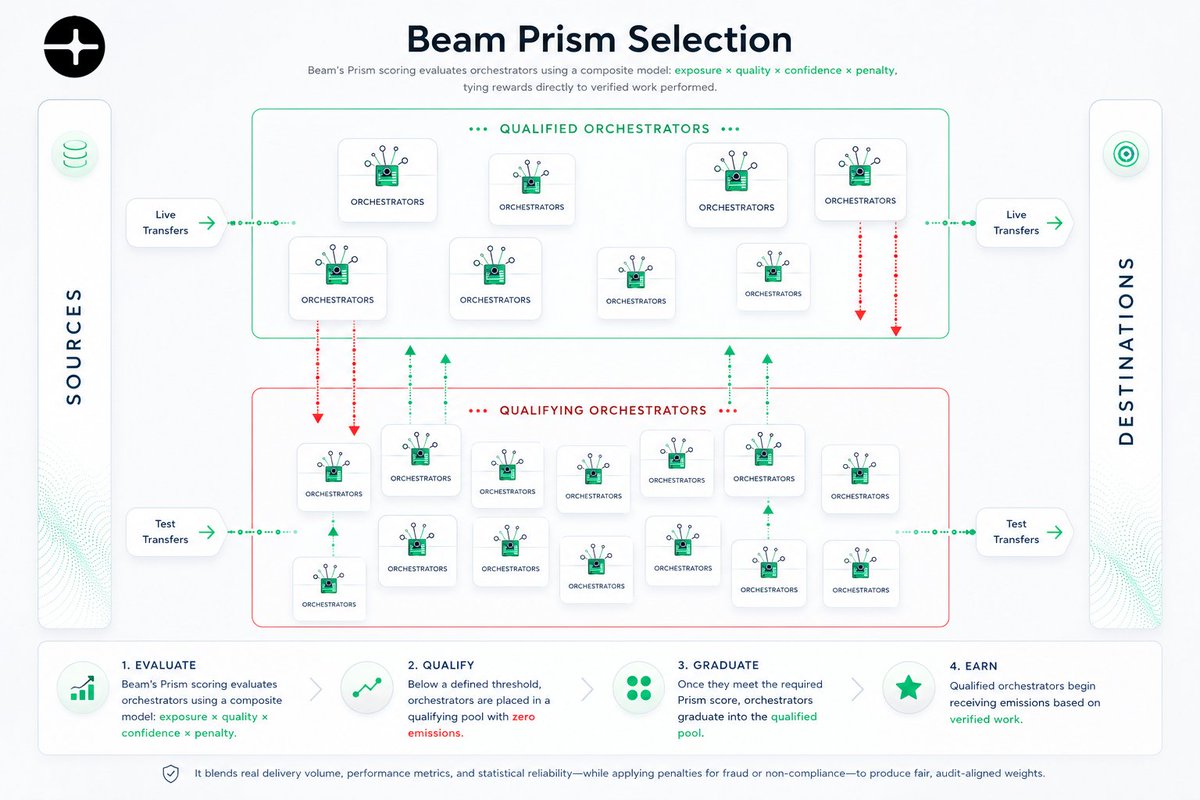
PRISM is now live.
Beam’s orchestrator scoring system is officially deployed and the code is now public.
PRISM ties rewards to real, verified work:
- exposure × quality × confidence × penalty
- No static weights.
- No hidden allocation logic.
Performance, verification, and reliability now directly drive exposure and emissions.
This release represents the most decentralized and scalable version of Beam so far.
To promote fairness across the network, a short buffer period will remain in place until Friday 05/15 before transfer activity fully ramps up. This gives orchestrators time to deploy, update, and properly configure their infrastructure under the new system so everyone starts on equal footing.
The public repo and documentation are now available for the community to review, audit, and build on.
https://t.co/21L8sSwBlW
Beam-core public:
https://t.co/j2zTFEbHpI
Documentation:
https://t.co/b3GnrtEjCT
This is only the beginning.
Beam: Powering the open internet
The Prism release is set for this weekend. This will be the most decentralized and scalable version of Beam.
Docs and code are set to be release by tomorrow.
In anticipation of our code update this weekend, burn code is now running through the end of the weekend.
This gives orchestrators and workers time to prepare and update their setups ahead of the release.
More updates coming soon.
This is just the start.
Every subnet, every part of $TAO, exposed to the greater reaches of crypto.
New eyeballs, new liquidity, new opportunity.
The @solana and @sunrisedefi teams have been instrumental in helping us take this next step.
See you in the trenches.
AI * SOL?
$TAO is now live on @JupiterExchange.
The native asset of the Bittensor network is routable on Solana via Sunrise.
Get the best onchain price on every TAO swap from minute one.
Beam protocol is fully data-storage agnostic.
Whether your data is on-prem, single-cloud, or multi-cloud, you’re not locked in.
Built as a distributed, scalable architecture for real-world data movement.
Built for the agentic era, Beam coordinates data movement.
👉 Join the network. Build on Beam.
Introducing Prism, Beam’s scoring system for orchestrators.
Rewards are now tied to real, verified work:
exposure × quality × confidence × penalty
No guesswork. No black box.
Just performance.
Docs + code dropping this week.
🚨 INSTEAD OF WATCHING NETFLIX TONIGHT.
Spend 3 hours with this.
Claude Code FULL COURSE that teaches you how to BUILD apps, teams, and anything.
The people who watch this tonight will wake up tomorrow with a new skill.
Watch it and Bookmark it now.