Adult Speech and Language Therapist in Independent practice, Senior Lecturer @saphp_cccu, @CanterburyCCUni, PhD in Global aphasia, advocate for Diversity in SLT
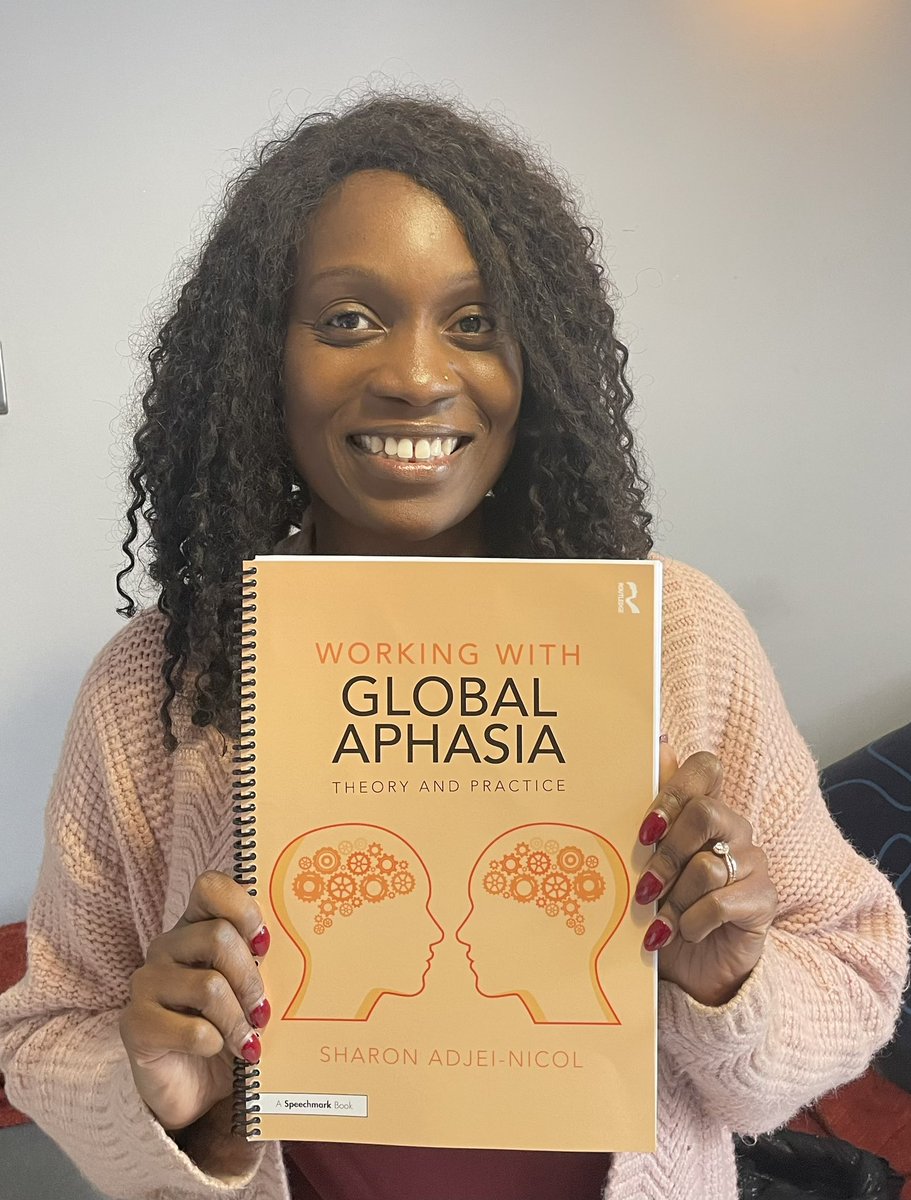
Reflecting on the many times I have doubted my place in SLT, when doing a PhD, when moving into academia, when writing this book..because I never saw someone that looked like me doing those things. So, this photo is for any minoritised SLTs and students in that place of doubt.
Good question. The 2 year degrees are way more intense, the summer break is no where near as long as I remember in my 4 year BSc. There’s also a degree of assumed knowledge in Masters level students (esp if they come with some background relevant to SLT) that allows some of the more generic content we teach to be condensed a little eg professional studies, academic writing, research skills etc. We also expect a lot more independent reading/learning and might pack more into lectures.
Not long left to register for my one-day hybrid course: Assessment and Treatment of Global Aphasia.
Join online or in-person at the National Hospital for Neurology and Neurosurgery, London on Tuesday 1st July.
For Info & registration: https://t.co/QGphS0aBwu
The symposium in cognitive communication disorders is open to anyone interested in this field on the 12th & 13th June this year in Coventry.
A hybrid event with keynotes Jacinta Douglas, Susan Howell & @LeanneTogher
Register today: https://t.co/CXWhHpo4hE
@AcquireSLT Right place, right time for me I think. Glad that you have taken on the role of advocating, researching & teaching about global aphasia.
Looking forward to returning to the National Hospital for Neurology & Neurosurgery on 1st July to deliver a one day hybrid course on global aphasia. More information here:
https://t.co/Jp3vXzfaKi
@aphasiologist1 That’s positive but it makes me wonder why they were so under-researched and neglected if potentially there were more cases decades ago. Those affected by global aphasia now even if fewer in number are in need of targeted research & approaches-way overdue
@aphasiologist1 I haven’t seen a significant decrease in incidence. Equally I don’t hear of that many people who are appropriate for/have had early treatments like thrombolysis. Might just be my caseload. From the no. of queries I get, global aphasia still seems to be a challenge for therapists.
In an ideal world we would want a direct rather than proxy outcome measure but as the population are so under-researched we don’t have a functional communication measure suitable for their level. Next steps possibly? We did also find improvements in semantics and for some auditory comprehension. 2/2
Excited to finally see my PhD study findings published- positive functional communication outcomes for people with #globalaphasia after a new non-linguistic cognitive intervention. Hope this inspires more research with this group @UCLLangCog@SAPHP_CCCU https://t.co/GPCzbbHWr1
@aphasiologist1@BCAphasia@UCLLangCog@SAPHP_CCCU A relative/friend completed the ASHA-FACS and there were improvements in social communication and communication of basic needs eg ability to understand facial expression/gesture, make functional choices as well positive change in communication partner burden 1/2
Evaluating the effect of a non‐linguistic cognitive intervention on functional communication in global aphasia: A case series study - Adjei‐Nicol - 2025 - International Journal of Language & Communication Disorders - Wiley Online Library https://t.co/XcjQ3MJ4hy
We are delighted that this evening's #AVisionFromTheMargin event is now underway at @MyBCU Seacole Campus. Photo (L-R): Facilitator, Aydan Suphi @Inclusionista33 and authors Melanie Packer, Iman Virji and Simon Bedeau @SimonSLT.
I’m looking for an SLT student or assistant to work with a client with global aphasia under my supervision once a week for at least 6 months. Client is in Hertfordshire. Please DM me if interested. Will be paid for time and travel!