Sainte Jeanne d'Arc church, Nice
The church of Saint Joan of Arc is a Roman Catholic parish church situated in Nice, France. Dedicated to Joan of Arc, the building is renowned for its striking and original architecture. Its unconventional style is controversial among locals, who sometimes nickname it "the Meringue" for its white color. The project originated in 1914 under parish priest Father Quillery and architect Louis Castel.
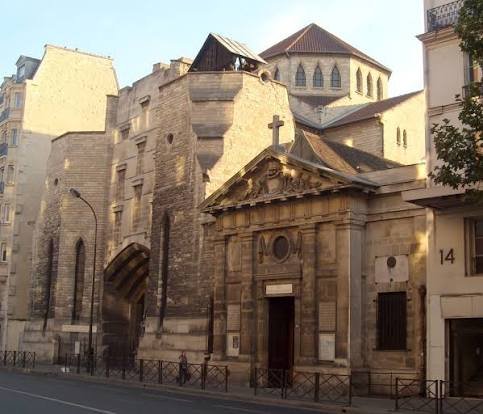
Notre-Dame du Rosaire, Paris
Notre-Dame du Rosaire is a Roman Catholic Church located in the 14th arrondissement of Paris. It was constructed between 1909 and
1912 by architect Pierre Sardou to serve a growing industrial neighbourhood. The building blends neo-classical and neo-Byzantine architectural styles with anemphasis on simplicity. It was consecrated on June 29, 1911, by Bishop Leon Adolphe Amette.
Sainte-Jeanne-d'Arc,Paris
The Saint Joan of Arc Basilica in Paris was proposed in 1914 as a WWI votive offering for the city's safety. It was planned next to Saint-Denys de la Chapelle, where where Joan of Arc had prayed in 1429. In 1926, the archdiocese launched a design competition that attracted several ambitious proposals. Construction began in 1930 but stalled, leaving only the lower façade and an uncompleted tower-arch. After a lengthy pause, construction resumed under architect Pierre Isnard and finished in 1964.
St. Anthony of Padua church,Saül
The St. Anthony of Padua church is a notable Catholic landmark situated in Saül, French Guiana.
Recognised as a historic monument since 1993, the building preserves deep historical significance. The church is dedicated to St. Anthony of Padua, distinguished Portuguese Franciscan priest and theologian. Its construction commenced in 1952 and concluded in 1962 during Saül's prominent gold mining boom.
Scientists are losing their minds over this paper.
They proved every mitochondria in your body is a tiny quantum device running at 71 THz.
And it responds to light.
Researchers detected a mysterious 71.0-terahertz vibration signal. this frequency is only present in healthy, living cells and tissues.
exact moment the cell dies or the mitochondrial structures are broken apart, the signal vanishes completely.
How does this happen?
Classical physics has always struggled to explain the high energy-efficiency of life.
So the team built a quantum model of light-matter coupling and discovered something called a "mito-polariton".
It is a literal quantum superposition state that forms when light couples with lipid ch2 bonds inside functional mitochondria.
This quantum resonance splits the intrinsic vibration mode into two levels, creating that bizarre 71 thz frequency that you only see in living things.
Why does this matter?
Because this quantum state actually acts as a highly efficient channel to modulate atp production in living cells.
our bodies literally use quantum mechanics to generate the energy that keeps us alive.
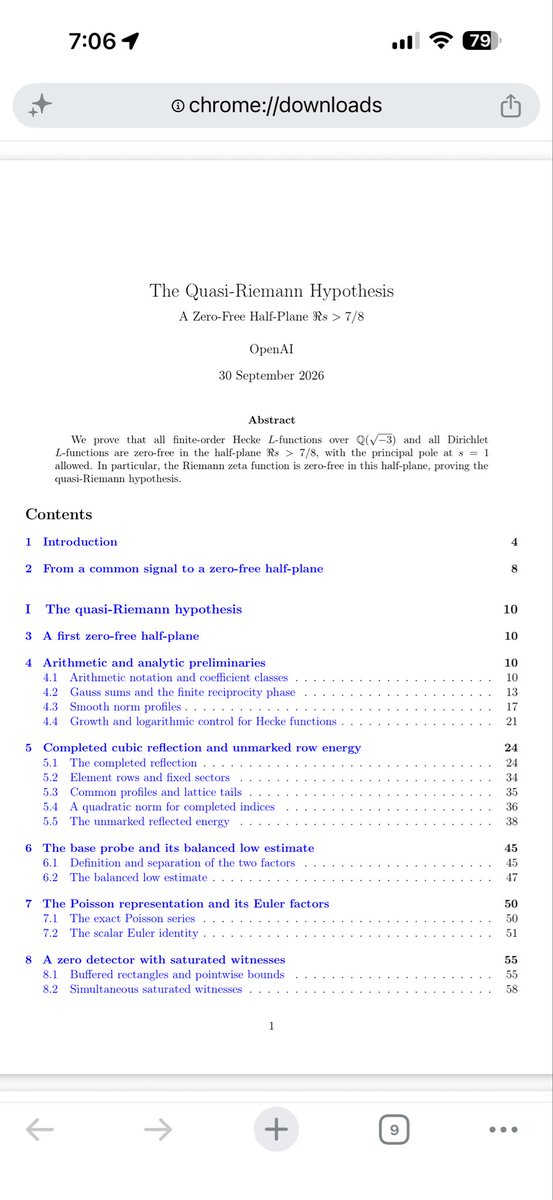
Quasi-RH?!?!???! Are you kidding me? If a human did this, it would be an instant Fields Medal, no questions asked.
RH says zeta has no zeros in Re(s)>1/2. The best we had until a second ago was a region that got thinner and thinner the higher up the imaginary axis you go. I thought maybe they’d fatten that up a bit, that’d be a massive breakthrough. But no. They got a zero free strip!!!! Insane
Notre-Dame-de-Fatima-Marie-
Mediatrice
Notre-Dame-de-Fatima is a Roman Catholic church situated in the 19th arrondissement of Paris. Built between 1950 and 1954 and designed by structural engineer Henri Vidal, it was originally named Église de Marie-Médiatrice-de-Toutes-les-
Grâces.
St. Pierre Cathedral, Saint-Pierre
St. Pierre Cathedral is an early 20th century church located near the harbour front of the capital city on the rue Jacques Cartier. Formerly the cathedral of a local vicariate apostolic, it now belongs to the Roman Catholic diocese of La Rochelle and Saintes. Although originally established in 1690, the historic structure was completely destroyed by the great fire of 1902. The current building was subsequently reconstructed between 1905 and 1907 using distinctive Basque style architecture.
this is pure f*cking treasure
A Stanford AI research group found how to orchestrate Claude Opus 5.5 and GPT-6.1 Sol together, and it completely breaks the search scaffolding wall
most developers try to combine frontier models by chaining prompts in one context window or hardcoding rigid evolutionary loops. you burn tokens on context bloat and freeze models into fixed search rules that out-date themselves within 5 iterations
Stanford's architecture eliminates human-designed search scaffolding and splits the cognitive stack:
> search director: Claude Opus 5.5 plans the search, querying a persistent idea-graph where MAP-Elites and MCTS reduce to single Cypher queries
> candidate proposer: GPT-6.1 Sol explores high-entropy code variations inside isolated execution sandboxes
> zero context bleeding: sessions reset after each iteration to prevent prompt bloat while the graph stores lineage
> evaluator isolation: candidate code never touches the scoring process, stopping reward hacking and test leakage cold
> meta-agent distillation: an offline meta-pass extracts verified lessons and updates search guidance across branches
the benchmark metrics outclass standard discovery baselines:
> 3.2x lower model spend than fixed evolutionary frameworks
> 1st place rank across 7 competitive AtCoder heuristic contests against human competitors
> beats published SOTA on Anthropic kernel builder and 11 mathematical optimization tasks
> 0% reward hacks: candidate-controlled metric tampering eliminated
Opus directs the search graph. Sol explores the code
you stop writing rigid search harnesses. you let frontier models own the discovery loop
Church of Saint-Ferdinand des Ternes,Paris
The church of Saint-Ferdinand des Ternes is a neo l-Byzantine Roman Catholic parish church located in the 17th arrondissement of Paris. Its origins trace back to an initial church built between 1842 and 1845 and named after Prince Ferdinand-Philippe d'Orléans. As the local population grew, construction of a larger replacement church began in 1937 under architects Paul Thedon, Frederic Betrand, and Pierre Durand.
Saint Leon Church, Paris
Saint Leon Church is a prominent Roman Catholic Church situated in the 15th arrondissement of Paris. Built between 1924 and 1934, it stands as an exceptional example of early 20th century religious architecture. Designed by architect Emile Brunet to serve a growing population, the structure utilised modern reinforced concrete. The church's name honors Pope Leo I, Cardinal Léon Amette, and Léon Thelier l.