One English sentence in → Rails 8.1 + native SwiftUI iOS + native Jetpack Compose Android, coherent across all three, in under an hour.
It's open-source. It's a Claude Code agent. 🧵
Finally sharing what I built at the RAISE Summit Hackathon in Paris 🇫🇷 — TurnPilot, an on-device queue-ops copilot for walk-in shops. Gemma 4 runs fully local: offline, privacy-first.
Solo, ~24h, remote (@cursor_ai / @cerebral_valley)
Code: https://t.co/3SwnxyRIvK
It watches the queue build in real time, then gives staff one plain-language advisory at the right moment — "Order #42 has waited 14 min vs your 6 min average — prep it next, or send an ETA?" — and they accept or override with one tap. No cloud, so no customer data ever leaves the shop.
Built as an extension of my product MyTurnTag (Rails + Hotwire + local Gemma).
#RAISESummit #Gemma #EdgeAI
The most important skill for AI-native builders isn't prompting. It's knowing when to reject the AI's answer.
An LLM learns from the past, so it rejects anything new. In 2007, AI would've said the iPhone's on-screen keyboard won't work — because everyone knew physical keyboards were right.
AI is great when demand already exists. But it's systematically wrong when you're creating new demand — the bet that matters most.
Only real actions decide: money, or a real commit. Not opinions, not the model's confidence. Saying "no" to the AI is your call — it can't be delegated back to the model.
Honestly my first signal was me — sick of multi-layer subcontracting and getting skimmed, and of interviewing with people who can't read code. So CommitJobs started gut-first, I'll admit it.
The first external signal I trusted: a founder hiring on X told me that without an agency, X is his only option to find an engineer. Not a hypothetical "would you use it?" — a painful workaround he was already living. That's the tell: real signal is someone already bleeding, not nodding at your pitch.
But the one thing that actually changed scope didn't come from external demand or gut — it came from thinking out loud with Claude. It pushed me from "companies vs developers" toward "individual dev vs individual dev," narrower and more niche. Same core approach as day one, just aimed at a tighter wedge.
So to your question: external signal mostly confirmed the gut and fixed sequencing (lead with the hiring side's pain), but the sharpest scope change came from the dialogue with the agent itself.
Yes, open to it.
But one correction to your framing before you map it: you've got the sequence right (X showed where the pain was bleeding, the tighter wedge — individual dev ↔ individual dev, lead with hiring-side pain — came from thinking it through), but the decision layer you're describing hasn't fired yet.
I released two days ago. I haven't confirmed demand. So there's no "next scope call" to map from real evidence right now — the honest state is: I'm at the step before the decision, gathering customer signal. Mapping it as a clean keep/tighten/change decision would make my reasoning look more resolved than it is.
What would actually be accurate to capture: the criteria I'm holding, not a decision I've made.
Keep pushing the hiring-side wedge if: a real hirer moves — money or a concrete commit (a posted job, a "send me those profiles, I'll pay"), not "looks useful." Behavior, not hypotheticals (Mom Test).
Tighten/change if: hirers consistently agree it's a problem but won't act — that gap means the pain isn't sharp enough to change behavior yet.
The instinct I'm not overriding on early signal: demand creation (vibe coders → pro) is a gut bet, not something I'll kill just because the empty board shows no signal week one.
So if you want the map to be true to the reasoning: it's a decision tree I'm about to walk, gated on the first real hiring-side action — not a call already made. That distinction is the important part for AI-native builders: the leverage isn't in generating the plan, it's in refusing to treat politeness or an empty board as evidence either way.
Does that match what you're trying to capture, or were you assuming the decision had already happened?
The "he just read it earlier" framing is the part I'd push back on. Nobody — not even the people lugging three devices — was asking to kill the physical keyboard. What drove Jobs wasn't someone else's unnamed frustration; it was his own aesthetic instinct: he couldn't stand a keyboard eating half the phone. That's not reading demand early, that's refusing to accept something on taste.
"He was just ahead of everyone" is what we say afterward to sound smart. But that lens never produces the thing — you can't reverse-engineer innovation from hindsight.
Where I'll meet you: the instinct alone isn't enough either. Aesthetic conviction only becomes innovation when it connects with a shared want — when your private taste turns out to be demand nobody had voiced. So maybe we're both right: it starts as gut, but it only lands when gut meets demand.
Let's do it 🙌 Just followed you.
Since you're shipping internal tools for companies, you probably hit the "AI got us 80% there, now it needs a real engineer" wall a lot — auth, scale, the gnarly bugs. That's exactly my lane: I build and ship iOS / Android / Rails solo, GitHub's right here (https://t.co/ooG7n14XDo). If a client ever needs a real engineer to take one of those over the line, happy to jump in. What are you building right now?
Fair — it is survivorship bias, no argument. For most of us most of the time, a real paid offer beats gut. I won't pretend otherwise.
But here's the shift I keep coming back to: building where demand already exists is exactly the thing AI is about to make cheap and fast. If the market is already asking, an agent can get you there in days — so that edge erodes.
What AI can't do is want something that doesn't exist yet. Creating demand where there was none — the iPhone move — needs a human with the gut to bet before the signal exists. As validated-demand building gets commoditized, that rare, mostly-wrong instinct is exactly what gets more valuable, not less.
So I'd put it this way: paid offer wins the game we're all playing today. Gut wins the game that's coming.
Honestly all three — necessary, not sufficient. Having all three won't guarantee success, but missing one nearly guarantees failure.
I run gstack (https://t.co/epoM42ZjRm) and buy its "validate demand first" rule — hypotheticals are near-worthless (The Mom Test), you want a concrete offer and watch behavior.
But if I'm honest, I rank gut feel highest. Follow it and you'll usually be wrong — yet the people who built things that mattered (Steve Jobs) were clearly gut-driven, not signal-driven. Validation keeps you alive; gut feel is the only thing that makes something worth building.
@manol_ai@X Thanks 🙏 Built it with Claude Code in a few days. It's aimed at exactly your world — when the AI gets you 80% there and you need a real engineer for auth/scale/the gnarly bugs, you hire a GitHub-verified pro, no recruiter. What are you building right now?
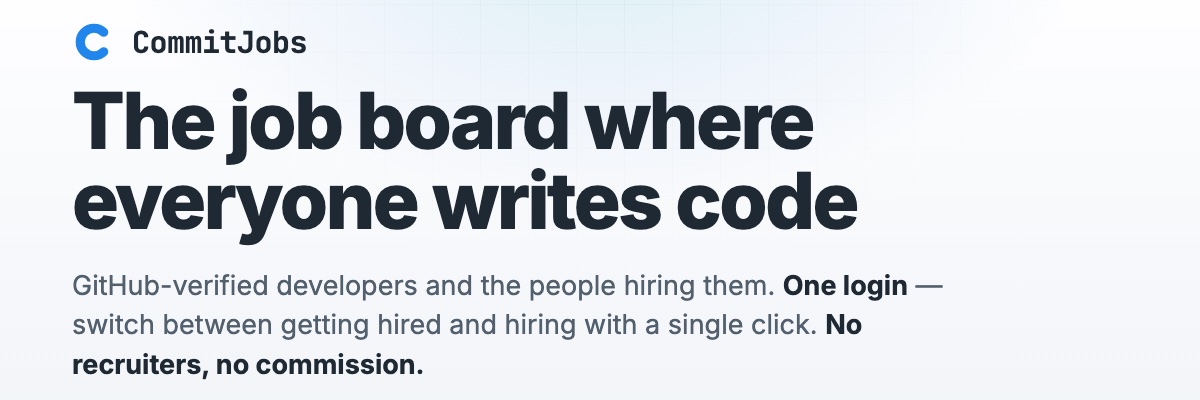
@Joi2James GitHub login only, so every developer is a verified GitHub account (hire from commit history, not résumés); one login to switch between getting hired and hiring; no recruiters, no commission.
https://t.co/ZpPicfSfli
I am a contract engineer who builds and ships iOS, Android, and Rails solo. Recently I built CommitJobs from zero to a live release in a few days with Claude Code: https://t.co/v2zEyAV8PN — GitHub login only, so every developer is a verified GitHub account (hire from commit history, not résumés); one login to switch between getting hired and hiring; no recruiters, no commission.
We’ve received notice that the Department of Commerce has lifted export controls on Claude Fable 5 and Mythos 5.
We'll begin restoring access tomorrow, and will share an update soon.
We’re grateful to our users for their patience, and to everyone who worked with us on redeploying the models.