Every job has an irreducible amount of drudgery - work that's not fun but has to get done. The problem is the drudgery our leaders/ourselves willingly choose to add on top - this is the nonsense we need to remove.
Mistakes Were Made: The Art of Dodging Accountability
In 1977, a man in San Francisco crashed his car into a telephone pole. When the police arrived, he gave his account of the incident. The telephone pole, he explained, had been approaching him. He had attempted to swerve out of the way, but the pole struck his front end.(1)
It sounds absurd. It is absurd. And yet every one of us has done some version of this. We have all, at one time or another, rearranged the facts of a situation so that the blame lands somewhere other than on us.
This is a consistent pattern of human behavior: when something goes well, we use the active voice. I closed the deal. We hit our numbers. The team delivered. When something goes badly, the perspective shifts to the passive voice. Mistakes were made. Costs increased. The project fell behind schedule.
This is the essence of the often abused phrase: “Mistakes were made.” The late William Safire called it the “past exonerative tense.” The journalist Bill Schneider described the logic behind it this way: mistakes were made, but not by me, by someone else, someone who shall remain nameless.(2)
Notice the construction. Not “I made mistakes.” Not “We failed.” Mistakes were made. By whom? The sentence does not say. It refuses to say. That is precisely the point. The passive voice becomes a shield. It acknowledges that something went wrong while carefully ensuring that the speaker remains untouched by it.
Politicians love it. But so does everyone else, including corporations, who have perfected the art of avoiding blame.
A “mistake” becomes a “complication.” An accident becomes a “one-off.” Layoffs become “strategic asset realignments.” A nuclear accident becomes an “unrequested fission surplus”—as Mr. Burns famously put it on The Simpsons.(3) A hospital where an error killed a patient will describe it as an “unanticipated outcome.”
This is not just semantics. It is a system of self-protection that gets more sophisticated the higher you go. Sydney Finkelstein studied why smart executives fail and found that error denial increases as you go up the pecking order. The people with the most power and the most responsibility become the most creative at explaining away their failures.
Here is the irony nobody talks about. Leaders use passive blame because they think it protects them. It does the opposite.
Stanford professor Bob Sutton makes the point directly: when leaders blame external forces exclusively for their troubles, they do not project strength. They project powerlessness. People begin asking a question that should terrify any executive: if you did not have the power to cause this, how can we trust you to have the power to fix it?
When leaders don’t own a failure, it signals that nothing was learned. And when nothing is learned, nothing changes. The same errors repeat. People begin to notice.
Here is the part that should matter to anyone running a team: passive blame might protect you from accountability, but it destroys your credibility and your ability to lead.
Passive blame is contagious. When the boss will not own mistakes, no one else will either. The organization becomes a game of blame deflection, with every person focused on making sure fingers are pointed elsewhere when the music stops. People stop taking risks. They stop raising problems. As Seth Godin has observed, people are not afraid of failure—they are afraid of blame.
The alternative is not complicated. It is just difficult.
Jocko Willink, the Navy SEAL commander, reduced it to two words: extreme ownership. On any team, all responsibility for success and failure rests with the leader. There is no one else to blame. The leader must acknowledge mistakes, take ownership, and develop a plan to win.
Dave Cooper, another Navy commander, put it even more simply: “I screwed that up” are the most important words any leader can say.
This is not martyrdom. This is strategy. When you say “I screwed that up,” you accomplish several things at once. You disarm your critics, because they were prepared to attack and now have nothing to attack. You earn trust, because people respect honesty far more than perfection. And you unlock the ability to act, because the moment you own a problem, you have permission to solve it.
That is a message of strength, not weakness.
Ask your team what stops them from accomplishing their goals. As Bernard Roth advises in The Achievement Habit, the answers are almost always external—parents, spouses, bosses, the system. They sound legitimate. But when you dig down, it is almost always the person themselves who is in the way.
Here is a question, borrowed from Cy Wakeman, to ask in your next meeting, “What would great look like right now?”
It is a simple question, but it demands that everyone in the room stop looking for someone to blame and start looking for something to build. It shifts the conversation from the past exonerative to the present imperative.
1. Idea from the book Deceit and Self-Deception by Robert Trivers
2. Idea from the book Mistakes Were Made (But Not by Me) by Aronson
3. Idea from the book Thank You for Arguing by Heinrichs
The Next Problem in Private Markets: The GP Clawback
The obvious issue today for many private markets investors is the continued slow return of capital — a lot of value is tied up in private funds with little guidance on when it’s coming back.
But there’s another issue I predict will be the next major headache for LPs:
The GP clawback.
A number of investors will find themselves in the following scenario.
Several of their funds — those with deal-by-deal waterfalls and 2018–2022 vintages — saw early winners and realizations. Realized IRRs cleared the preferred return and carried interest was paid to the GP. So far, so good.
However, much of the unrealized value in these funds, which GPs are still marking at or near prior valuations, will actually come in well below the preferred hurdle. That will drag cumulative IRRs below the hurdle rate and trigger a clawback.
This isn’t a short-term liquidity/uncertainty/volatility issue as claimed by GPs. It’s a “mediocre companies bought at high prices” issue. Many funds are stuck, GPs and LPs know it, and now it’s just a game of when the pain is realized.
This won't be a problem for every fund, but it will be a problem for many. Yes, I know every GP and LP thinks they are the exception, but perhaps at least prepare yourself for this possibility, especially with those funds sitting right at or above the hurdle rate. It will only take one or two realized blow-ups to drive the IRR below the hurdle.
But wait, there’s a second problem.
LPs won’t get back 100 cents on the dollar — thank you, net-of-tax language. Some may not get anything back (I actually had a GP respond to a clawback obligation with “Sue me”). Others may have the willingness but not the cash — small funds without resources or a successor fund, funds that lack an escrow provision, etc.
I’ve compiled this guide from notes across the funds and GPs I’ve worked with over many years. LP awareness of clawback mechanics isn’t great, and I expect this issue to become significantly more prominent over the next few years.
Find the full guide below
Ownership is a Choice: Building a Culture of Accountability
I don’t worry about mistakes in an organization, I worry about "collective numbness”—the tendency for people to blindly go through their day without questioning their actions or taking responsibility for their outcomes.
An ownership mentality replaces passiveness with accountability and urgency. It’s the antidote to a victim mentality. Don't just preach ownership—give it. Here are 15 ideas to create owners in your organization.
1. Shared responsibility is no responsibility. When everyone owns something, no one does. Teams need owners—not to work alone, but to make sure someone answers when things go wrong. Blame isn’t the goal, it’s
accountability.
2. Hire drivers, not passengers. CEO Frank Slootman recommends hiring drivers, not passengers. Drivers act with urgency and without being told. Passengers wait for directions and then follow along. Part of what makes Toyota’s manufacturing so successful is the act of giving line workers ownership and responsibility for a product’s quality, enabling them to suggest changes and raise concerns, not just going along for the ride.
3. Freedom and Autonomy Creates Ownership. Freedom is the path to accountability, not the opposite. As Netflix’s CEO Reed Hastings notes, “Giving employees more freedom led them to take more ownership and behave more responsibly…Freedom is not the opposite of accountability. Instead, it is a path toward it.”
4. Designate a Lollipop Man. In his book Smartcuts: How Hackers, Innovators, and Icons Accelerate Success, Shane Snow shares an example from Ferrari: In Ferrari’s high-stakes pit crews, one person—the "Lollipop Man"—oversees the entire operation. While the crew is deep in the weeds, the Lollipop Man acts as the conductor, seeing the big picture and ensuring cohesion. For every team effort, appoint one person to "own" the operation. The individuals own their tasks. The Lollipop man owns the system.
5. Ownership demands personal accountability. Ownership changes how you see failure. When something goes wrong, most people blame external factors: their boss, the market, or bad luck. Owners take internal responsibility and figure out what they could have done better.
6. Owners question the process. Don’t blindly follow accepted rules and guidelines, but don’t arbitrarily break them either. Constantly question if a process should be changed or discarded all together. Reality changes too fast for any process or rule to be set in stone.
7. Owners decide under ambiguity.Ambiguity delays decisions as teams wait for more clarity. Realize that after a certain level of effort and research, the cost of waiting exceeds the value of more work. A good decision today is almost always better than a "perfect" decision that never arrives.
8. Owners acknowledge mistakes. Mistakes are how you get better. That means admitting, sharing, and learning from mistakes, not covering them up.
9. Kill the “We” and the “They”. Vague language is the primary enemy of accountability. In his book The Art of Innovation: Lessons in Creativity from IDEO, Tom Kelley highlights the design firm IDEO, where employees are forbidden from blaming a nebulous "they" for problems—if a coffeemaker is broken, you don't say "they" should fix it; you find a specific person to take charge. Organizations often hide behind "we" (e.g., "We need to be more innovative"), but "we" isn’t a person. Replace collective pronouns with actual people.
10. Owners make specific plans. Once you’ve replaced the “they” with specific people, you need to take specific action. In the book Crucial Confrontations, the authors note that we can’t hold people accountable to do “something, sometime, somehow.” We need specific action, not vague plans. Owners insist individuals know what they should be doing and when it should be done.
11. Avoid the consensus trap. When no one owns a decision, groups start to gravitate to popular, safe, and conventional ideas. Owners snap them out of this tendency, by pushing back when groups start down the comfortable consensus path.
12. Hunt for the dead whale. In his book Awaken Your Genius, author Ozan Varol recounts the example of film director Mike Nichols. Mike would actively seek dissent by asking his crew, "What’s the dead whale?"—referring to the one thing stinking up the room that nobody wants to talk about. Owners aren’t hesitant to find the ugly truths no one wants to mention.
13. Owners raise the standards. Excellence is not a static state; it is constant correction. Restaurateur Danny Meyer uses "The Saltshaker Theory": if a saltshaker belongs in the center of the table, the chaos of the day will inevitably move it. An owner doesn't get frustrated; they simply move it back. Gently but relentlessly reinforce the standards of excellence by "moving the saltshaker" back to the center every time it drifts.
14. Leaders can’t do it all. I’ve worked with obsessive, controlling bosses who try to do it all and hamstring the company’s ability to get things done. A single leader cannot do everything. Jocko Willink, a former Navy SEAL, advocates for "decentralized command," where leaders at every level are empowered to make decisions.
15. You can’t preach ownership. Have you ever had a manager talk about autonomy or independence and then undermine every one of your decisions? You can’t promote an ownership mentality and then micromanage your team’s decisions. Action, not words, are what matters.
The Proximity Principle: How Distance Dilutes the Truth
When you want to solve problems, go direct to the source.
Conflict between two people? Get right to them. Customer service issue? Go to the agents. A manufacturing issue? Walk the floor.
The shortest distance between you and the truth is when you’re standing right in front of it.
Any other path delays resolution.
Don’t take the indirect path. Don’t talk to the manager of the supervisor of the employee and hope that you’ll find resolution through this convoluted chain of command. You’ll get a biased and softened “truth” because if those managers sense any personal culpability, you’ll hear the story they want you to hear.
This is why you “walk the floor.” Generate your own evidence.
There’s this idea of the “fog of war,” commonly attributed to the Prussian military strategist Carl von Clausewitz. The fog of war describes the chaos and uncertainty of knowing what’s going on during battle. Your organization isn’t a warzone, but the elements are similar. Uncertainty and complexity destroy the information chain. In fact, General George Marshall, in his 1920 letter on leadership, advised going to the front lines to understand what’s happening.
Don’t take reports at face value. Once you rely on secondhand perspective, you’ve entered the messy world of subjectiveness, bias, and opinion.
People rarely lie, but they rarely tell the truth either. The real story gets trimmed off at each management layer, leaving a sterilized version that says, “Nothing to see here.”
At best, you will lose information as it traverses management layers, even at the most forthright organizations. At worst, you’ll encounter layers of department heads and managers who fight to control the narrative.
As taught in Toyota’s training program, “There’s no substitute for direct observation.”
Going direct isn’t just faster, it’s more accurate.
It has to start with the CEO - the only one that can normalize this behavior.
Snowflake CEO Frank Slootman says it best, “Everybody, and we mean everybody, has permission to speak to anybody inside the company, for any reason, regardless of role, rank, or function. We want the organization to run on influence, not rank and title.”
What Companies Really Optimize For But Won't Admit
Organizations want one thing, and it’s not excellence, innovation, or even results.
It’s variation reduction. Managers go out and find any person or process that’s deviating from the norm and initiates swift corrective action.
But deviation is the essence of innovation. It’s the core of new ideas, products, creativity, and differentiation.
In many companies, a miss is many times more career costly than the benefit of a win of a similar magnitude, so the effort and focus become minimizing the downside. Rewards go to those who avoid being wrong, not being right.
However, capping the downside eliminates the upside. Innovation is impossible without failure or looking bad, both intolerable options for the average manager.
“Is it conforming?” becomes the rallying call, rather than “Is it interesting?” Compliance replaces inspiration. Timidity replaces risk taking.
Failure is visible, missed potential is not. You’ll never be punished for that great hire you didn’t make or the great investment you didn’t fund, even if those would have led to 10x returns. But hire someone who rocks the boat a little too much or lose money on an investment, and you’ll immediately answer for it.
Psychologist Gerd Gigerenzer refers to this as “Defensive Decision-Making” – making a decision which is unconsciously designed not to maximize welfare overall but to minimize the damage to the decision maker in the event of a negative outcome.
What isn’t seen isn’t punished.
Defensive decision-making leads only to incremental improvement, toiling around at the edges, seeking that 5-10% improvement that’s safe and comfortable. You need to do something to justify your job, no matter how inconsequential it may be. Managers are glorified babysitters, maintaining the organization until they can pass their duties off.
Peter Diamandis says it best, “If you choose to make something 10 percent better, you are almost by definition signing up for the status quo—and trying to make it a little bit better. That means you start from the status quo, with all its existing assumptions, locked into the tools, technologies, and processes that you’re going to try to slightly improve. It means you’re putting yourself and your people into a smartness contest with everyone else in the world. Statistically, no matter the resources available, you’re not going to win.”
The pursuit of consensus acts as a shield against any one person taking the blame for a failure. Blame diffusion becomes the goal.
Rules and regulations grow as new variance is found. But corporate rules are like the tax code. Once a rule is introduced, it hardly ever goes away, leading to a complex maze of rules that strangles progress.
Variation reduction often stems from seeking “best practices.” You should roll your eyes anytime you hear the phrase “best practices.” Best at exactly what? At reducing variance. Doing what worked in the past, for an average company. Look at the outliers - what the very best do. Look at the high end of the variance range. That’s where the best practice are.
Reducing variation takes the form of vague goals. After all, how can anyone fail if no one ever knew the goal?
Variance reduction hinges on the corporate obsession with metrics. Metrics, however, that optimize for safety, not impact. It’s like Defense Secretary Robert McNamara’s obsession with the enemy “body count” during the Vietnam War. It had little effect on defeating the North Vietnamese, distorted tactical thinking, but looked impressive to the populace.
High variance behaviors, like experimentation, dissent, and challenging assumptions are the key to success. Look at the rules and policies of your organization: are they fostering or eliminating high variance behaviors?
The goal isn’t organizational chaos. It’s incentivizing long-term bets and experiments that come with failure. It’s only through failure and the resultant iteration that companies grow.
If you want to be great, you have to be different. As John Stuart Mill remarked, “That so few now dare to be eccentric, marks the chief danger of our time.”
Do Your Own Thinking
It’s one thing to ask for help, it’s another to outsource our thinking.
There’s a role for consultants and outside research, but only if it’s a supplement, not a replacement, for our own original work.
Don’t accept assertions from authority, experience, education, or credentials.
Why do we outsource our thinking? Because it’s easier. It protects our ego and gives us someone to blame when things go sideways.
Ask yourself, is it true?
To paraphrase Leo Tolstoy, there’s no worse way to go about investing than to follow the untested opinions of other people. For example…
· Don’t read a sell-side report, dive into the 10-K yourself
· Don’t accept the CEO’s conviction, only what can be verified
· Don’t rely on “research shows…” and “the science says…” Read the research firsthand
· Don’t buy a stock because some hedge fund guru bought it, do your own research
What sounds accurate, and is accurate, are two different things. The first is untested; the second is validated.
This is the practice of Epoché, the Stoic discipline of suspending judgment until we can examine something for ourselves.
Go to the source. Don’t take things at face value.
Developing our own independent, well-researched approach is the only defense to the insanity of the modern investment world. As soon as we outsource our thinking to the latest guru or strategist, we surrender our original thinking.
Don’t give up the one thing we should ever outsource – our own independence and judgement. See it with our own eyes.
Because we operate in an information-saturated world where everything is presented a mile wide and an inch deep, we lose the ability to go deep and test an idea. We’re forced to take things at face value when we’re spread so thin.
Many recommendations are based on parroting the same repackaged, generic advice. Everyone assumes the person before them did the work. But often times no one did the work, so the only way to know the work got done is to do it ourselves.
Most ideas are just following what’s been working and what’s popular, and then backfilling in the story and confirming evidence to make it appear thoroughly vetted.
It’s recycled advice with a twist to make it appear novel.
Don’t confuse confidence and conviction with truth. It’s shocking the naïveté and gullibility of investors when referring to a manager’s or CEO’s confidence level as an indicator of their ability. Of course they come off as confident. It’s by design. They’re paid to sell us!
Relying on intuition and gut is worse than not doing any work at all.
“Trust, but verify,” advises the Russian proverb made famous by Ronald Reagan.
Remember, in investing, most people’s paycheck rides on convincing us of something that is partially or wholly untrue.
📷
📷
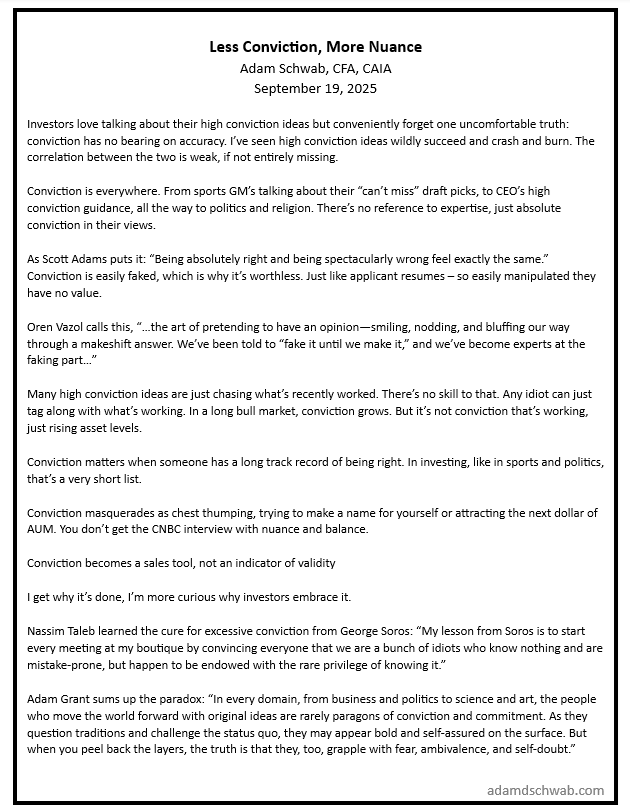
Conviction is easily faked, which is why it’s worthless.
Conviction becomes a sales tool, not an indicator of validity.
Just like applicant resumes – so easily manipulated they have no value.
9 Insights on Building a Company Culture That Actually Embraces Top Talent
In a world obsessed with certainty and perfection, Tim Harford’s “Adapt: Why Success Always Starts with Failure,” offers a refreshing perspective: success comes from experimentation, trial and error, and feedback from failure. We need less leadership worship, predictability, perfect solutions, and consensus. The world is complex so let’s stop pretending that we have all the answers and try new things, learn from failure, and iterate.
Key Takeaways:
· Experts are great, but only to a degree
· Trial and Error is far more effective than you think
· Leadership matters, but only to a degree
· Why centrally planned economies and bureaucracies fail
· Feedback is essential, but hated by most
· Variation is suppressed due to egos and a preference for stability
· Disagreement, not consensus, is what drives great decisions
· Generate multiple solutions rather than finding “the one”
· Develop better systems rather than relying on better people
· Try new things, safely fail, and get feedback
Idea #1: Experts are better than non-experts, but only to a certain degree
From Adapt: Yet there is a reason why Tetlock himself hesitates to draw that conclusion: his results clearly show that experts do outperform non-experts. These intelligent, educated and experienced professionals have insights to contribute – it’s just that those insights go only so far. The problem is not the experts; it is the world they inhabit – the world we all inhabit – which is simply too complicated for anyone to analyse with much success.
Yes, experts are more reliable than random people. But experts also make mistakes, have a hard time predicting the future, and have biases and hidden agendas. So it’s not about dismissing experts, just putting their advice in context, and focusing on getting multiple, independent views to calibrate who you rely on.
Idea #2: Trial and Error is an underappreciated tool to solve problems
From Adapt: Why is trial and error such an effective tool for solving problems? The evolutionary algorithm – of variation and selection, repeated – searches for solutions in a world where the problems keep changing, trying all sorts of variants and doing more of what works…Given the likely shape of these ever-shifting landscapes, the evolutionary mix of small steps and occasional wild gambles is the best possible way to search for solutions. Evolution is effective because, rather than engaging in an exhaustive, time-consuming search for the highest peak – a peak that may not even be there tomorrow – it produces ongoing, ‘works for now’ solutions to a complex and ever-changing set of problems.
Trial and error is often ignored because our egos convince us that we’ll figure out the answer if only we think about it hard enough. After all, we tell ourselves we’re smart, so relying on trial and error is an admission that we don’t know, which is painful to admit.
Idea #3: Leadership matters, but like experts, only to a certain degree
From Adapt: Are chief executives just as impotent, fumbling around for workable strategies in an impenetrable fog? That would be what the evolutionary analogy implies. In biological evolution, the evolutionary process has no foresight. It is the result of pure trial and error over hundreds of millions of years. Could that also be true in an economy, despite the best efforts of managers, corporate strategists and management consultants?
Leaders are often put in an impossible position when people expect them to always have “the answer.” The world is complicated and even the best leaders struggle with doubt and mistakes. It’s time to disregard the notion of infallible leadership and recognize how experimentation and iteration can supplement the leader’s thinking.
Idea #4: Why centrally planned systems, like the Soviet Union or a bureaucratic organization, will fail
From Adapt: The Soviet failure revealed itself much more gradually: it was a pathological inability to experiment. The building blocks of an evolutionary process, remember, are repeated variation and selection. The Soviets failed at both: they found it impossible to tolerate a real variety of approaches to any problem; and they found it hard to decide what was working and what was not. The more the Soviet economy developed, the less of a reference point the planners had. The whole system was unable to adapt…The monstrous moral flaws of the Soviet system are now obvious. The economic flaw was more subtle: its inability to produce variation and selection, and therefore its inability to adapt. Central planners decided what would be built, lulled into a sense of omniscience by having a map or a table of statistics in front of them. Such plans inevitably missed the messy complexities of the situation on the ground, and also produced far too little variation.
Many people chuckle when thinking about the failure of the Soviet Union. Relying on a central planning committee to run an entire economy? It seems, and is, quite ridiculous. Yet these same people run their organization with the same centrally planned mindset: little variation, muted dissent/feedback, grandiose actions, ego driven decisions, and a demand that people fall in line and obey.
Idea #5: Feedback is essential, but generally hated by those in power
From Adapt: Above all, feedback is essential for determining which experiments have succeeded and which have failed. And in the Soviet Union, feedback was ruthlessly suppressed…There is a limit to how much honest feedback most leaders really want to hear; and because we know this, most of us sugar-coat our opinions whenever we speak to a powerful person. In a deep hierarchy, that process is repeated many times, until the truth is utterly concealed inside a thick layer of sweet-talk.
It's a rare person that demands honest, direct feedback. When people say they want feedback, it’s usually feedback disguised as compliments, or feedback that’s highly sterilized.
Idea #6: Variation is suppressed due to grandiosity and a preference for stability
From Adapt: Variation is difficult because of two natural tendencies in organisations. One is grandiosity: politicians and corporate bosses both like large projects…because they win attention and show that the leader is a person who gets things done…The other tendency emerges because we rarely like the idea of standards that are inconsistent and uneven from place to place. It seems neater and fairer to provide a consistent standard for everything…
Like trial and error, variation is hated because leaders want the one big project that will cement their legacy, rather than relying on a bunch of little bets which will take time to pay off. Leaders also detest variability because it’s psychologically comforting to have one standard and one way of running the business, rather than embracing flexible, iterative types of organization.
Idea #7: Disagreement, not consensus, is what drives great decisions
From Adapt: The doctrine of avoiding split advice, then, couldn’t have been more misguided. The last thing Lyndon Johnson needed was to be confronted with a unanimous view [regarding the Vietnam War]. He desperately needed to hear disagreement. Only then would he feel free to use his own judgement, and only then would he avoid the trap of considering too narrow a range of options.
If you want to identify a weak organization, look at how much the team strives for consensus. Consensus isn’t about making better decisions; it’s about avoiding tough conversations and staying comfortable. Thoughtful dissent and disagreement, done by a team that cares for one another and wants the best outcome, is the goal.
Idea #8: Implement multiple options instead of finding “the one”
From Adapt: This idea of allowing several ideas to develop in parallel runs counter to our instincts: we naturally tend to ask, ‘What is the best option?’, and concentrate on that. But given that life is so unpredictable, what seemed initially like an inferior option may turn out to be exactly what we need.
Stop focusing on finding the best solution. Find multiple good solutions and starting testing and experimenting, getting real-time feedback to get to the optimal decision.
Idea #9: Develop better systems rather than relying on better people
From Adapt: ‘We always blame the operator – “pilot error”,’ says Charles Perrow, the Yale sociologist. But like a power-plant operator staring at the wrong winking light…but safety experts like Perrow know it is far more productive to design better systems than to hope for better people.
Developing better systems adds stability and robustness. Relying on better people is much more hit or miss. You don’t know you’ve missed on someone until it’s too late. It’s like the Warren Buffett quote, you better buy a business that an idiot can run, because sooner or later one will. It’s the same with systems. Design systems so an idiot can run it, because eventually one will.
20 Insights from Bargaining for Advantage: Negotiation Strategies for Reasonable People
Negotiation is a skill anyone can master, yet few people actually do. I've summarized the 20 best ideas from Richard Shell's Bargaining for Advantage: Negotiation Strategies for Reasonable People, ideas used by elite negotiators to command respect and secure optimal deals. Learn why cooperation, listening, and patience are better tools than ruthlessness, tricks, and manipulation. Stop relying on gut reactions and build methodical expertise. The difference between amateur and professional results isn't innate ability — it's these specific, actionable skills you can implement today.
Idea #1: The Key Traits: Knowledge, Competence, Preparation, and Patience
In general, your credibility as an influencer comes from people’s perceptions of four things: your authority, knowledge, competence derived from real-world experience, and trustworthiness. The best negotiators…exhibit four key habits that reliably improve their negotiation results. They are: a willingness to prepare, high expectations, the patience to listen, and a commitment to personal integrity.
The average negotiator doesn’t properly prepare, talks more than they listen, and relies on tricks and games to “win” the negotiation. This usually fails.
The best negotiators extensively prepare, winning the negotiation before it starts. They listen as a tool to get information. They are patient as they let the other side reveal more and don’t rush to early, but suboptimal, agreements. They’re trustworthy but not pushovers.
Idea #2: You Can be Cooperative and Still Succeed
Contrary to popular belief, cooperative people have excellent potential to become highly skilled negotiators.
It’s a misconception you need to be ruthless. While there are times you’ll have to stand your ground, call out malicious behavior, and perhaps show a little anger, most value is created through collaboration and finding creative solutions for all sides, not just getting what you want.
Idea #3: Embrace the 3rd Person Advocate Perspective
Negotiate as an advocate for others. Here is a striking finding from negotiation research: both sexes perform equally well in experiments when subjects are told to negotiate as agents on behalf of others such as clients, families, and firms rather than on their own behalf…My advice: bring that professional mind-set to all your negotiations. When negotiating for a raise, think of yourself as advocating for your family or your future retired self, all of whom need financial security.
It's helpful to take yourself and your emotions out of the negotiation. When you imagine yourself advocating on behalf of someone else, you bring an independent and protective purpose to the negotiation, rather than getting emotionally hijacked because you’re so close to the process.
Idea #4: Use standards and authority, especially if previously used by the other side; and be careful what standards you reference, as the other side will hold you to them
…the best arguments are always the ones that the other party accepts as legitimate or has used to his or her own advantage in the past….When the other party justifies its proposal using fairness standards you have publicly committed yourself to in the past, you have a problem. You must either walk away from the standards (and look like a hypocrite) or debate their application to the present case—a move that subtly moves you toward the other side’s position.
Standards and norms rely on the consistency principle for their power in negotiation. But some standards and norms are more powerful than others...These gain their traction from the well-documented human tendency to defer to authority.
Authority and standards are powerful tools to set the ranges and targets for the negotiation. As you prepare, get as many references and authoritative data points as you can to bolster your arguments, and of course, research the other side’s likely standard they’ll rely on to make their arguments.
Idea #5: Code of Conduct: Be Trustworthy, Be Fair, and Always Call Out Unfairness
Boiled down to its essence, the norm of reciprocity in negotiation amounts to a simple, three-step code of conduct. First, you should always be trustworthy and reliable yourself. Second, you should be fair to those who are fair to you. Third, you should let others know about it when you think they have treated you unfairly. Unfair treatment, left unnoticed or unpunished, breeds exploitation—followed by resentment and the ultimate collapse of the relationship.
You’ll get more out of negotiations by being trustworthy and fair than playing games and manipulating the other side. If manipulation is happening to you, you have to call it out and identify it, which sets the standard that you 1) see through their games and 2) won’t tolerate it.
Idea #6: Focus on Finding Common Ground
The skilled negotiators’ focus on areas of common ground led to another significant difference between the groups. The skilled negotiators developed about twice the number of possible settlement options in their planning than the less skilled group did and appeared to try harder to anticipate options the other side would suggest. Search for low-cost options that solve the other party’s problems while advancing your goals.
Most people just focus on just getting what you want and say the hell with the other side. Instead, focus on getting a better deal for everyone. This starts with preparation, generating as many possible alternative solutions as you can. If you wait until the negotiation starts, you’ll get tunnel vision and just resort to safe, inefficient solutions like splitting the difference.
Idea #7: What to Learn from Hostage Negotiators
Overall, given the leverage situation that exists early on in most hostage crises, the best move is a counterintuitive one: you should acknowledge the hostage taker’s power, indicate that you have relinquished control of the immediate situation to him (hostage takers are almost always men), and, as odd as it may sound, look for opportunities to build a working relationship.
You’ll probably never have to negotiate a hostage situation, but you will find yourself in high pressure negotiations where the other side has most of the advantages. If you learn what works for hostage negotiators, you’ll be set with whatever negotiation you find yourself in.
Idea #8: Use Time as Leverage
Another leverage dynamic concerns time. Which group had time on its side?
Time can be an asset or liability, depending on how it’s used and your situation. Before the negotiation starts, understand what time pressure really exists, and if you have unlimited time, use it as leverage. If you don’t have a lot of time, try to create more alternatives that buy you time. But know the real and perceived time levers that will be used.
Idea #9: Listen, Repeat, & Summarize
As a rule of thumb, probe first, disclose second…What do skilled negotiators do that average negotiators do not? First, they ask twice as many questions as average negotiators….Next, they test their understanding of what the other side has said by rephrasing it in their own words (“When you say ‘ten days,’ do you mean ten calendar days or ten business days?”)… Third, they periodically summarize where they think the parties are in the process Finally, they listen carefully to all of the other party’s answers, taking notes and checking their notes for accuracy.
More negotiations are won through listening, not talking, even though the perception (as you see in movies) is the hero negotiator swiftly working their spoken magic as they trick and cajole the other side into giving in. In reality, the more you listen, the more you learn and the more you can craft your response to find common ground and meet your needs. It’s not fancy language that wins, but active listening.
Idea #10: Listen for “I want…”
Every time the other party says “I want” in a negotiation, you should hear the pleasant sound of a weight dropping on your side of the leverage scales. Your job as a negotiator is to uncover everything the other side wants and to investigate as thoroughly as possible just how urgent these needs are. The more they need what you have to offer, the stronger your leverage.
When you hear the phrase, “I want,” you’ve gain important knowledge that you can use to find a better deal for your side, or both sides, if possible. If you just worry about what you want, you’ll miss many options that create better deals for everyone.
Idea #11: Let the Other Side Know You’re Playing Nice
When you have leverage but choose not to use it, let the other side know that you view the transaction as part of a relationship. People in good relationships do not squeeze every nickel they can out of a situation. They treat each other fairly, even generously. Some day, it will be the other side’s turn.
If you want successful, recurring negotiations/relationships, don’t extract every last dollar for yourself. If you leave something on the table, let the other side know it. Make a good faith gesture that you’re investing in the future, not just taking everything you can.
Idea #12: You Don’t Have to Make the First Move; Instead, Listen and Let The Other Side Reveal Their Position
Mistakes like this are why many experts suggest you keep your mouth shut and let the other negotiator make the first move. You can always reject the offer if it is outside the “fair and reasonable” range. And you may be pleasantly surprised to find out that the other side is willing to pay thousands more (or take thousands less) than you expected.
Let the other side go first so you can learn more about what they want and what they will offer. While the anchor effect is real, if you’re prepared, you’ll know the terms and ranges that are reasonable and will fall for extreme set points.
Idea #13: Avoid Ridiculous Demands
Outrageous openings will drive your counterpart away. You will lose credibility. I define an aggressive first offer as the highest (or lowest) number for which there is a supporting standard or argument enabling you to make a presentable case. Your opening need not be supported by your best argument, but it should be justified by a presentable one.
Some negotiators try to set an anchor so far from reality it destroys any credibility and poisons the subsequent process. Sure, make an aggressive offer, but one that is grounded in reality and logic, even if you have to get creative. Don’t blow your trustworthiness by nonsensical demands.
Idea #14: Move Little on the Big Issues, Give In on the Small Issues
The rule of thumb for integrative bargaining is to make big moves on your “little” (less important) issues and little moves on your “big” (most important) issues. But remember the danger of concession devaluation and never give up anything (even a “little” issue) without a demonstration that the concession is meaningful to you.
This gets back to preparation. Understand what’s important and what’s not. What can be given away and what needs to be kept. Don’t try to think of this on the spot, or you’ll get twisted up in the moment and not get what you want.
Idea #15: Dealing With the Good Cop/Bad Cop Routine and Other Manipulative Tactics
This is just a manipulative way to make you grateful for the few crumbs the good cop is able to extract from the bad cop on your behalf. The way to counter the good cop/bad cop routine is simple: name the tactic publicly at the table and demand clarification on the issue of authority. Fight fire with fire…“It looks as if one of you is playing the good cop and the other is playing the bad cop,” you might say. “I had hoped we could use a more straightforward process to reach a fair deal. Before we proceed further, I would like to know who has authority to agree to what. I cannot negotiate with people who lack authority to close.”
You’ll come across many tricks from your opponents, one of them being the good cop/bad cop routine. The key to dealing with any underhanded technique is to 1) immediately call it out, 2) acknowledge the unfairness/inappropriateness, and 3) stop the process if necessary. It’s a sends a clear message that you know what’s going on and you won’t tolerate it.
Idea #16: Be Cautious Splitting the Difference
I think there are at least two important situations in which splitting is probably a bad idea. First, you should be careful that the midpoint being suggested is genuinely fair to your side. If you have opened at a reasonable price and the other party opened at an aggressive one, the midpoint is likely to favor the other party by a big margin…Second, when a lot of money or an important principle is on the line and relationships matter, quickly resorting to splitting may leave opportunities for additional, creative options on the table.
Splitting the difference is a crutch often used by those who don’t like the discomfort of negotiating and just want a resolution. That doesn’t mean it’s always suboptimal, just make sure it’s not a lazy shortcut with a big cost.
Idea #17: Use an Impasse to Reset, Regroup, or Send a Message
First, an impasse is not necessarily a bad thing…triggering an impasse can send the other party a message that you really mean what you say. When the other party keeps demanding that you compromise on a nonnegotiable issue, stop the process until they get the message.
Sometimes you just need to stop the process, whether that’s to send a message, take a break, or both.
Idea #18: Carefully Harness Emotion and Anger
Your effectiveness at the table when emotions run strong requires you to be hyperaware of your own emotional “surges,” filtering them through the lens of their appropriateness to what has triggered them, and then expressing your legitimate feelings in the way best calibrated to advance your goals. As Aristotle once put it, using anger skillfully requires you to be angry with “the right person, to the right degree, and in the right way.”
Anger is a like a loaded firearm: you better be really careful on how you handle it and how you use it. The best way to handle anger is practice: put yourself in negotiations with opponents that anger you. It’s only by going through it that you’ll learn to convert anger into a useful tool.
Idea #19: Apologize the Right Way
The simplest way to clear the air is something we were all taught as children but many still find hard to do: apologize. But note well: It is not enough to simply say the words “I’m sorry.” It is how you apologize that makes the difference. Communication scholars have examined the elements that go into making an effective, “full” apology. Express regret and remorse: “I’m really sorry. You have every right to be angry.” Take responsibility: “It was my fault. I take full responsibility for it.” Commit to change: “I can assure you it won’t happen again.” Offer a remedy: “Is there any way I can make it up to you?”
If you screw up, apologize. But do it the right way – with sincerity and commitment, not an hollow, hedged attempt that ducks responsibility.
Idea #20: Don’t Answer Every Question
There is no commandment in negotiation that says, “Thou shalt answer every question that is asked.
When you’re asked a loaded question, call it out and don’t answer it. When you’re asked a question with incomplete or disingenuous intentions, call it out and don’t answer. Fight the tendency to answer whatever is asked. If you’re being manipulated, don’t play the game.
7 Timeless Principles from Coach Wooden's Pyramid of Success by John Wooden
Coach John Wooden was the antithesis of our culture’s current focus on hacks, shortcuts, and virtue signaling. Here are seven ideas on what really constitutes a philosophy of success.
Principle #1: Focus on what you can control
As a basketball player, I wanted to be in the best possible physical condition. There was a time when I’d tell myself, I’m going to be in better condition that anyone else. As I grew older, my thinking changed to I’m going to be in the best possible condition I can be. I had learned that I only have control over myself.
My Takeaway: It’s tempting to focus on things outside your control because it relieves you of your responsibility to improve. But you have to own yourself before worrying about others.
Principle #2: Plan your day
When I coached basketball at UCLA, I believed that if we were going to succeed, we needed to be industrious. One way I accomplished this was with proper planning. I spent two hours with my staff planning each practice. Each drill was calculated to the minute. Every aspect of the session was choreographed, including where the practice balls would be placed.
My Takeaway: Most productive people don’t leave their day to chance. Unstructured time leads to laziness, not focus.
Principle #3: Discipline is everything but punishment
We must remember why we discipline. We do it to help, to prevent, to correct, and to improve, but not to punish.
My Takeaway: We’ve all worked for or have been coached by someone who uses discipline only as a punishment. Let’s break the cycle.
Principle #4: Make more mistakes than your opponents
My college coach once said, “The team that makes the most mistakes will probably outscore the other one.” What he meant is that doers make mistakes, but if we aren’t doing anything we’re making the greatest mistake of all. We must not fail to act when action is needed. We cannot be afraid. We must act anyhow, knowing that at times, we will fail.
My Takeaway: The path of innovation and success is littered with mistakes because mistakes are feedback and a sign you are pushing your boundaries.
Principle #5: Intentness
Intentness is the ability to resist temptation and to avoid rabbit trails of distraction. An intent person will stay the course and go the distance. He or she will concentrate on objectives with determination, stamina and resolve. Intentness is the quality that won’t permit us to quit or give up, even when our goal is going to take a while to accomplish… Our society has been permeated by a mind-set of immediate gratification. Simply put, people are impatient. They want too much too soon. They have lost sight of an overarching truth: In life, worthwhile accomplishments and acquisitions take time. Usually the better the reward, the more time it takes to acquire it.
My Takeaway: You probably have all the knowledge, research, materials, etc you need for whatever it is you want to do. You just need to focus on the damn thing.
Principle #6: Double responsibility
I also talked to my players about double responsibility—mine and theirs. As coach, my responsibility was the practices. I decided what drills to use, how long to use them, in what part of the practice to place them, how things are arranged and how long we would run…Their responsibility was between practices. I said, “You can tear down more between practices than we can build up during practices.
My Takeaway: It’s probably true of most things – a great 2 hour practice, no matter the sport or skill, is worthless if you sabotage yourself the other 22 hours.
Principle #7: Fundamentals
Any measure of competency requires a command of the fundamentals of a given endeavor. The greater the competency the more detailed a person must be in carrying out the fundamentals. It follows that a person with limited competency can become at least somewhat skillful if he or she works on the details of the fundamentals.
My Takeaway: Fundamentals are boring and never make headlines but are the keys to success.
Victory Without Enemies: Leave Your Opponent a Line of Retreat
At the close of World War II, General Douglas MacArthur could have humiliated Japan at the surrender ceremony. Instead, he treated the Japanese delegation with respect—seating them as equals, allowing them to wear full military uniforms, and removing his own combat decorations. Rather than seeking vengeance, he focused on rebuilding Japan's future.
You face this same choice. You’re in the middle of an argument that you know you are going to win. You now have two choices. The first is complete obliteration of your opponent. Personally humiliate them and their argument.
Or you can choose the MacArthur approach and give your opponent dignity by leaving them a line of retreat. Let them down graciously, and you’ll have won the argument without creating an enemy.
In workplace discussions, I've witnessed people exploit others' mistakes for personal gain, earning a few laughs through a direct attack or snide remark, all while creating lasting resentment.
When you have the chance to go in for the kill, don’t. Give someone the option of retreat. B.H. Liddell Hart, in his book, Why Don’t We Learn from History, describes how you can reduce your opponent’s resistance by providing a line of retreat:
It is an elementary principle of strategy that, if you find your opponent in a strong position costly to force, you should leave him a line of retreat—as the quickest way of loosening his resistance. It should, equally, be a principle of policy, especially in war, to provide your opponent with a ladder by which he can climb down.
Explorer Hernan Cortez motivated his men by ordering them to burn their ships upon landing, knowing there was no going back.
Don’t encourage a Cortez reaction. Make sure your opponent has an out so they don’t torch their ships. Make retreat easy. They’ll probably take it. But if you corner them, now you’ve signed up for a real knife fight, and that’s on you.
Graciousness during victory is challenging. The desire for vengeance is real when emotions are high.
Some will advocate for telling it like it is. The unvarnished truth. No holding back. Letting the other person have it. Brutal honesty without hesitation. But remember, you can be an asshole or persuasive, but not both.
As Steven Sample once advised, “Don’t humiliate a person unless you can eliminate them, otherwise they will be an enemy for life.”
7 Uncomfortable Truths About Talent
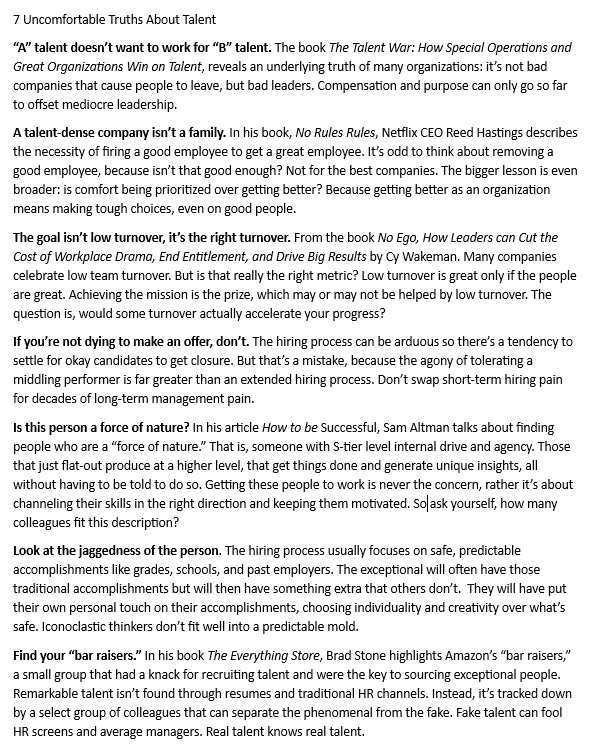
“A” talent doesn’t want to work for “B” talent. The book The Talent War: How Special Operations and Great Organizations Win on Talent, reveals an underlying truth of many organizations: it’s not bad companies that cause people to leave, but bad leaders. Compensation and purpose can only go so far to offset mediocre leadership.
A talent-dense company isn’t a family. In his book, No Rules Rules, Netflix CEO Reed Hastings describes the necessity of firing a good employee to get a great employee. It’s odd to think about removing a good employee, because isn’t that good enough? Not for the best companies. The bigger lesson is even broader: is comfort being prioritized over getting better? Because getting better as an organization means making tough choices, even on good people.
The goal isn’t low turnover, it’s the right turnover. From the book No Ego, How Leaders can Cut the Cost of Workplace Drama, End Entitlement, and Drive Big Results by Cy Wakeman. Many companies celebrate low team turnover. But is that really the right metric? Low turnover is great only if the people are great. Achieving the mission is the prize, which may or may not be helped by low turnover. The question is, would some turnover actually accelerate your progress?
If you’re not dying to make an offer, don’t. The hiring process can be arduous so there’s a tendency to settle for okay candidates to get closure. But that’s a mistake, because the agony of tolerating a middling performer is far greater than an extended hiring process. Don’t swap short-term hiring pain for decades of long-term management pain.
Is this person a force of nature? In his article How to be Successful, Sam Altman talks about finding people who are a “force of nature.” That is, someone with S-tier level internal drive and agency. Those that just flat-out produce at a higher level, that get things done and generate unique insights, all without having to be told to do so. Getting these people to work is never the concern, rather it’s about channeling their skills in the right direction and keeping them motivated. So ask yourself, how many colleagues fit this description?
Look at the jaggedness of the person. The hiring process usually focuses on safe, predictable accomplishments like grades, schools, and past employers. The exceptional will often have those traditional accomplishments but will then have something extra that others don’t. They will have put their own personal touch on their accomplishments, choosing individuality and creativity over what’s safe. Iconoclastic thinkers don’t fit well into a predictable mold.
Find your “bar raisers.” In his book The Everything Store, Brad Stone highlights Amazon’s “bar raisers,” a small group that had a knack for recruiting talent and were the key to sourcing exceptional people. Remarkable talent isn’t found through resumes and traditional HR channels. Instead, it’s tracked down by a select group of colleagues that can separate the phenomenal from the fake. Fake talent can fool HR screens and average managers. Real talent knows real talent.
The People You Keep Away
Almost every organization focuses on attracting good clients and recruiting valuable employees. But fewer companies focus on keeping out the bad ones. The bias is always towards more clients, more applicants, and more sales. But all clients and customers are not equal, and many find out the painful way how unprofitable and stressful it is chasing the wrong group. There might be more value in keeping out the negative rather than attracting the positive, even though every corporate initiative tends to focus on attraction, rather than repulsion.
Costco’s membership card is a great example. A typical annual fee ranges from $65-$130. On episode #189 of The Knowledge Project Podcast, Chris Davis told the story of once asking Charlie Munger, a Costco board member, why Costco didn’t drop the membership card to bring in more customers. After all, it wouldn’t take many more customers to offset the loss of membership revenue. Here’s Charlie’s insight:
…the card is an important filter: Think about who you’re keeping out [with a membership card]. Think about the cohort that won’t give you their license and their ID and get their picture taken. Or they aren’t organized enough to do it, or they can’t do the math to realize [the value]…that cohort will have a 100% of your shoplifters and a 100% of your thieves. Now, it’ll also have most of your small tickets.
…Charlie called this the intelligent loss of sales. Most people just think more is better. But more is not always better. It’s who you keep out.
It applies to clients, friends, relatives, and employees. Who you keep out can be just as important as who you let it. Don’t make it too easy. The world is obsessed with growth at any cost, neglecting the enormous cost of a bad client. Slower, but higher quality growth, is the key.
It’s the same with employees. Zappos is famous for its approach to sort bad employees from the good: it paid them to go away. Zappos would offer $2,000 to recent new hires to quit. And after Amazon bought Zappos, it retained the program and called it, “Pay to Quit”, bumping up the payment to $5,000.
It’s a simple commitment test. Those who have a deep commitment and see a long-term future forgo the payment. Those who took the job half-heartedly likely take the money. Let people self-select. Don’t ask people about their commitment or judge it by their resume. Offer them money to prove it.
A cover letter is another useful tool. It’s easy to blast out resumes. It’s much harder to craft a compelling cover letter, even with AI. Make people invest some effort, rather than fake it. No doubt you’ll lose candidates with a cover letter mandate, but you’ll be glad you did.
Spend a little money today to save a ton of headaches later.