@Web3InsiderGuy They actually have a burn mechanism, 2.5% of the volume buys and burns $RAIN tokens.
That's why the token goes up and that's why the coming world cup will be crazy for this token.
In the long term the number of tokens will go down dramatically.
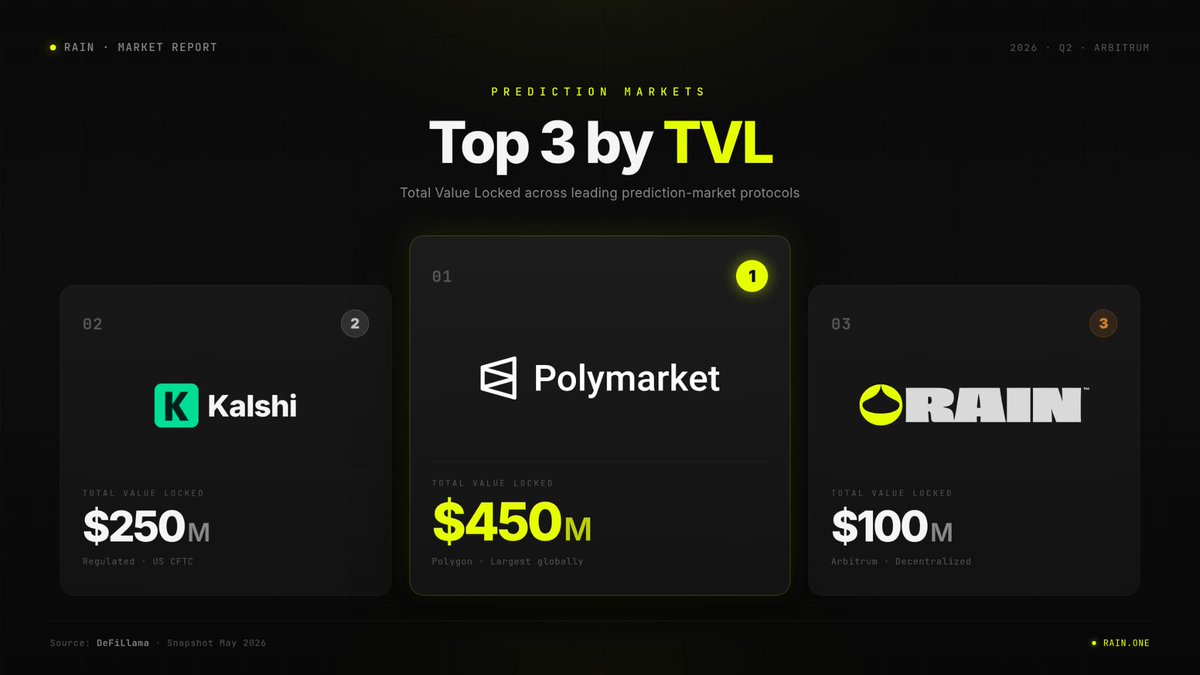
Rain has officially entered the global Top 3 for prediction market TVL, trailing only @Polymarket and @Kalshi, following a massive $100M liquidity injection by the Rain Foundation ahead of the World Cup.
The allocation consists of $50M in USDT and $50M in $RAIN, flowing directly into the smart contract to deeply capitalize our prediction markets, back liquidity, tighten spreads, and support high-volume trading.
For traders, this means unmatched depth and minimal slippage. For builders, it provides a highly capitalized environment to launch custom prediction apps, and for market makers, this is the ultimate signal that the liquidity and infrastructure are ready for scale.
Funds are being deployed right now. Track the live data and metrics here: https://t.co/NipgmU4IYq
Prediction Market Builders want more - and now, they’re finally getting it.
The Rain Builder Program is live, with the first prediction market SDK built for AI agents. We’re moving past the era where "building" just meant skinning someone else's data. Rain is giving you the infrastructure to launch and own your own end-to-end platforms from day one.
Our SDK provides the tools and resources to handle the entire lifecycle: public or private market creation, manual or AI Oracle resolution, dispute processes, and more. You aren't just promoting trades anymore - you're running the engine.
Specifically for the agent-led future, our SDK is ready for @AnthropicAI Claude Code, @NousResearch Hermes, @OpenClaw, @OpenAI Codex, @ManusAI, and more.
It's time to build: https://t.co/cIygSySNz7
@HernanArber@Rain__Protocol@CoinMarketCap What you're missing is that the top 200 on @CoinMarketCap is a closed list and to get in there they will need to list them there.
In terms of market cap rain is probably top 50 but because it's a closed list the odds are low.
@Rain__Protocol@arbitrum That's not funny any more, I've put money on YES @arbitrum, in 2 days I'm gonna lose my money because you don't follow the biggest project that's on your chain, I really hope it's a joke and you're gonna follow before this market ends!
JUST IN: $ENLV ANNOUNCES A $212M DIGITAL ASSET TREASURY ALLOCATION INTO $RAIN, THE PREDICTION MARKETS PROTOCOL. FORMER ITALIAN PM @MATTEORENZI JOINS THE BOARD.
Does Polymarket have wash trading? I read the paper so you don't have to.
Here are the highlights (my takes are at the end):
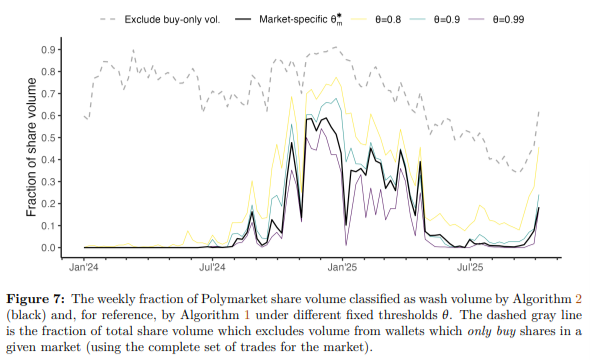
1. An estimated 25% of Polymarket's volume all-time resembles wash trading.
- Reached a high of 60% of total weekly exchange volume in December 2024
- Reached a low of 5% of volume in May 2025
- 14% of wallets on the platform were flagged
Volume by Category:
Crypto - 3%
Politics - 12%
Elections - 17%
Sports - 45%
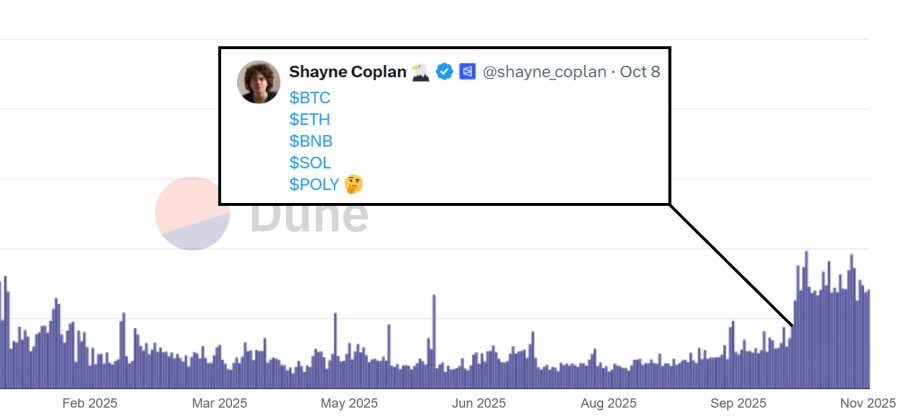
2. Wash trading activity has spiked in anticipation of the $POLY token
After the Polymarket token was teased on October 8th, daily volume jumped up substantially. In that same time, the amount of wash trading identified also rose.
3. Most volume was done on low-value, low probability contracts.
The center chart depicting the Average buy/sell price shows the majority of wash trading happens in contracts that are near $0. This is a common strategy that allows users to get a high notional volume without risking much money.
If a user buys 1000 contracts that are worth .1c ($0.001) each, they are spending $1. But because each contract can resolve to $1, the the notional value of the contracts they traded is $1000.
There are many legitimate trading strategies that can be done in low probability outcomes, but if you're an airdrop farmer who is optimizing for notional volume, this is the place to be.
My takes:
1. Thats it?
25% of the volume being from wash trading means 75% of the billions of dollars transacted on Polymarket are real users taking real positions.
2. Fees solve all
What matters isn't how much volume is on your platform, but how much volume is monetizable. Right now there is no cost to trading. Once fees are implemented, the ratio of real volume to farming volume will improve.
A fee of almost any size on low value contracts would eliminate that strategy immediately, addressing a large portion of this volume.
3. Headlines make it seem worse than it is
Maybe crypto has poisoned my view on this, but typically wash trading is done as a deliberate attempt to massively overstate volume by a malicious team. There's no indication the polymarket team was the one creating this volume or asking others to do this volume. Beyond that, polymarket's volume could be 75% of what it is today and the market's interpretation of their success would likely be unchanged.
When there is an incentive to get volume, users will attempt to get volume. Every platform has some form of incentive for volume either via points/token or direct rebates for providing liquidity that help improve the experience for real users on the platform.
Overall, wash trading of course is an issue and should not be considered when calculating a platform's volume. But most people's kneejerk reaction to the headlines will probably overstate the size of polymarket's issue in particular.
Outstanding questions:
How should volume on prediction markets be calculated?
Wash trading and volume farming should be excluded, but its difficult to identify them with a high degree of certainty.
More importantly, is notional volume the right way to calculate it?
As an industry I believe notional volume should be replaced by considering the real amount of money a user is transacting, not the potential value of their contracts.
I'd love to hear your reactions to the paper and your thoughts on how volume on prediction markets can be calculated more accurately.