Andrej Karpathy spent 8 years at OpenAI and Tesla
Last week, he condensed everything he knows into one free 2-hour lecture
Agents → Loops → Harness → Self-Improving Systems
People pay $14K for bootcamps that teach less than this
This lecture beats most paid AI engineering courses
You probably don't have 2 hours right now
Don't let this disappear from your feed
Watch it
Then read the article below
Ex-NVIDIA engineer who built Unsloth explained RL, kernels, reasoning, quantization, and agents in 2 hours 42 minutes - better than $5000 fine-tuning bootcamps.
pick the base model -> write triton kernels for 2x faster fine-tune -> quantize to 4-bit -> run GRPO/DPO -> ship a reasoning model on your single GPU.
That loop is why Unsloth is the default way to fine-tune Llama, Qwen, Gemma, and Phi on hardware you already own.
Unsloth + Triton kernels + 4-bit quantization + GRPO/DPO + single-GPU fine-tuning - that's the stack.
Watch and save it, then fine-tune your first model tonight.
Andrew Ng just dropped a 3-hour course on how to become an AI Engineer in 2026:
• 00:00 - How to build agentic AI systems
• 04:25 - Future of AI engineering
• 23:38 - AI Prompting full course
• 2:52:17 - Creating an app with AI in 30 minutes
This 3-hour watch could replace 10 AI engineering courses on the internet.
Watch it today, then read how to run a self-improving system in the article below.
> be Andrej Karpathy
> born in Slovakia, move to Canada at 15
> start coding at 15. instantly obsessed
> become YouTube famous... for Rubik's cube tutorials
> get PhD at Stanford under Fei-Fei Li
> co-found this tiny startup called OpenAI
> Elon calls you "arguably #2 in computer vision in the world"
> go build Tesla Autopilot for 5 years
> leave. come back to OpenAI. leave again
> coin the term "vibe coding" casually in a tweet
> it ends up in the New York Times
> build an AI education company
> 9.3M people watch your next move
Today he joined Anthropic to lead pretraining research. The man never stops.
Teleop is so 2025. Ever since we unveiled EgoScale and the dexterity scaling law, it's been clear to us and the ecosystem that behavior cloning directly from humans is the way to break the curse of teleop. 2026 is all about scaling robot learning without robots.
The COMPLETE AI/ML Roadmap (2026 Edition)
From Zero → Production Systems
📚 1. FUNDAMENTALS (Build Core Thinking)
• Hands-On ML (Géron)
• Data Engineering with Python
• Storytelling with Data
📊 2. TIME SERIES (Predict the Future)
• Modern Time Series Forecasting
• Applied Time Series Analysis
⚙️ 3. SYSTEM DESIGN (Think Like an Engineer)
• Designing ML Systems (Huyen)
• AI Engineering (Huyen)
• Solutions Architect’s Handbook
• Practical ML for Computer Vision
🤖 4. GENERATIVE AI (Build What’s Next)
• LLM Design Patterns
• Generative AI with LangChain
• Generative Deep Learning
• AI Agents in Practice
• Architecting AI Systems
💼 5. PRODUCT & STRATEGY (Make It Profitable)
• The Profitable AI Advantage
• Your AI Survival Guide
�� Building Products with GenAI
🧠 Outcome:
→ Build real ML systems
→ Ship GenAI products
→ Think like an AI engineer
→ Monetize your skills
⚡ This stack = 0 → AI Engineer (No fluff)
🔖 Bookmark this before it disappears
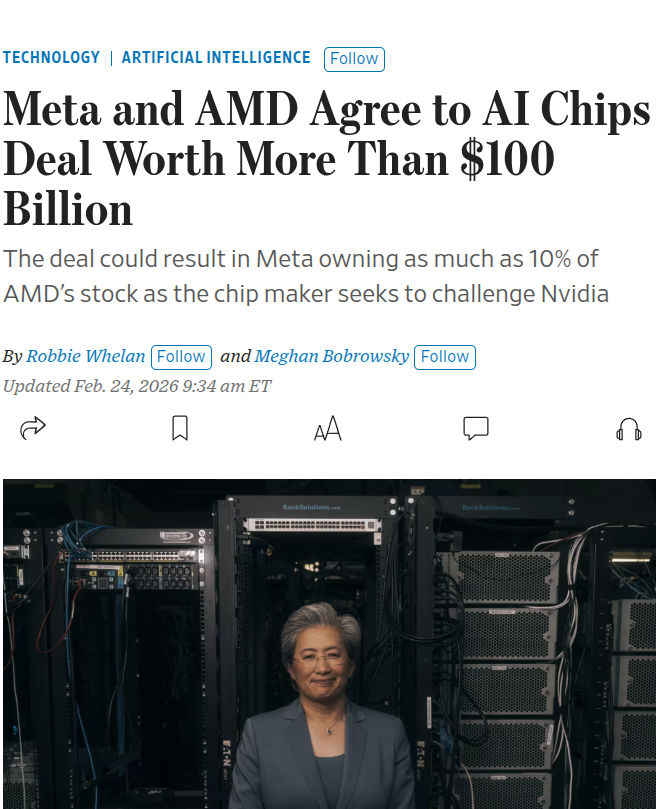
🚨 BREAKING: Meta is spending over $100 billion to buy a massive amount of AI chips from AMD over the next 5 years. WSJ reports.
Meta can buy 10% of AMD for just $0.01 per share once they successfully purchase all 6 GW of AI chips. The full stock award is conditional on AMD’s share price, which would need to hit $600 for Meta to receive its final tranche
AMD is currently trading at $196.60, which means it has to more than triple in value to reach the $600 milestone. So it is a high bar to clear, but it gives Meta a massive reason to keep buying AMD chips instead of switching to a competitor.
This setup makes sure that both companies win only if AMD becomes a dominant force in the AI market over the next 5 years.
This clever strategy essentially turns AMD’s biggest customers into part-owners who are financially motivated to help the company succeed and grow its stock price.
Meta plans to use the latest MI450 series chips to run its AI models and improve its digital advertising system.
AMD is giving Meta special warrants to buy 160 million shares for just $0.01 each if the stock price hits $600.
The MI450 chips are unique because they use chiplets, which are tiny pieces of silicon linked together instead of one large block.
This design makes it easier for Meta to customize the hardware for inference.
Meta is also buying millions of chips from Nvidia to make sure it has enough total power for its Meta Compute project. By working with AMD, Meta avoids relying on just one company for the hardware that powers its most important software.
Meta is expected to start using the first gigawatt of this new power later in 2026.
To note here, OpenAI has a nearly identical deal from October-25 that allows them to own 10% of AMD as long as they meet the same hardware buying goals and stock performance targets.
---
wsj .com/tech/ai/meta-and-amd-agree-to-ai-chips-deal-worth-more-than-100-billion-9c7fd06b
$400K in under a month.
This OpenClaw setup on Polymarket is averaging:
• ~$5 per second
• ~$300 per hour
• ~$7K per day
Proof:https://t.co/Kd1ZlAL0pB
Copytrade → https://t.co/GNQBeFgIre
And it kept running even after Polymarket removed the 500ms delay.
What it does:
• Trades only 5-minute BTC Up/Down markets
• Buys YES + NO during the first ~4 minutes
• Enters when combined price drops below $1
• Locks the spread before expiry
6,823 trades.
Pure arbitrage structure.
No directional bias.
It compounds tiny inefficiencies again and again —
increasing size as balance scales.
Not prediction.
Not narratives.
Just automation + pricing gaps.