When I was a kid and I had no hardware, I asked people to give me old PC parts and broken PCs and build my own with those parts. This made me be curious how things are built from trial and error (and a lot of head banging xD) getting things to actually run.
Man... at one point my older brother came home with 50 486 machines from a company that was trashing them and we started to get them all working... yes, I know nerds right? Linux and Irssi (an IRC client) were part of my childhood.
Years passed and it was me and computers, a world of my own creation, my own things, dismantling them down to the bone to learn how it works, what's inside, looking at code (I didn't understand a thing about it) but I was editing it, reading books (and later searching google and StackOverflow xD).... does not really matter, what matters is trying!
I think I now feel that I am giving back as well. I made some contributions to @opencrabs via code and funds as well in favor for this same cycle to be repeated. Very happy to be part of the mission and contribute so people can be creative.
Would be nice we have more people using AI and building cool stuff and specially the ones that do not have a good place to start and are struggling with it. Please feel free to drop me or any contributor a message, we are here to help.
I believe in people, I think we can all build great things, and if people have the resources we can learn and be creative to overcome ourselves and be better at our crafts.
The mission is: FREE AI for everyone :)
Go and download @opencrabs it should take seconds, no need for an account, no need for an api, no telemetry or data retained on our side.
Big thanks to the opencrabs community for taking me in, they are amazing and I hope we are many more in the coming months and years building together.
Crab in the first-time install onboard:
"I know nothing about you yet, which is a weird way to start a relationship"
😆 🦀
Install in 20 seconds. Stay because it knows you @opencrabs
https://t.co/1W2pr3lVR5
OpenCrabs v0.5.10 is out, and this one changes the first five minutes.
The biggest thing:
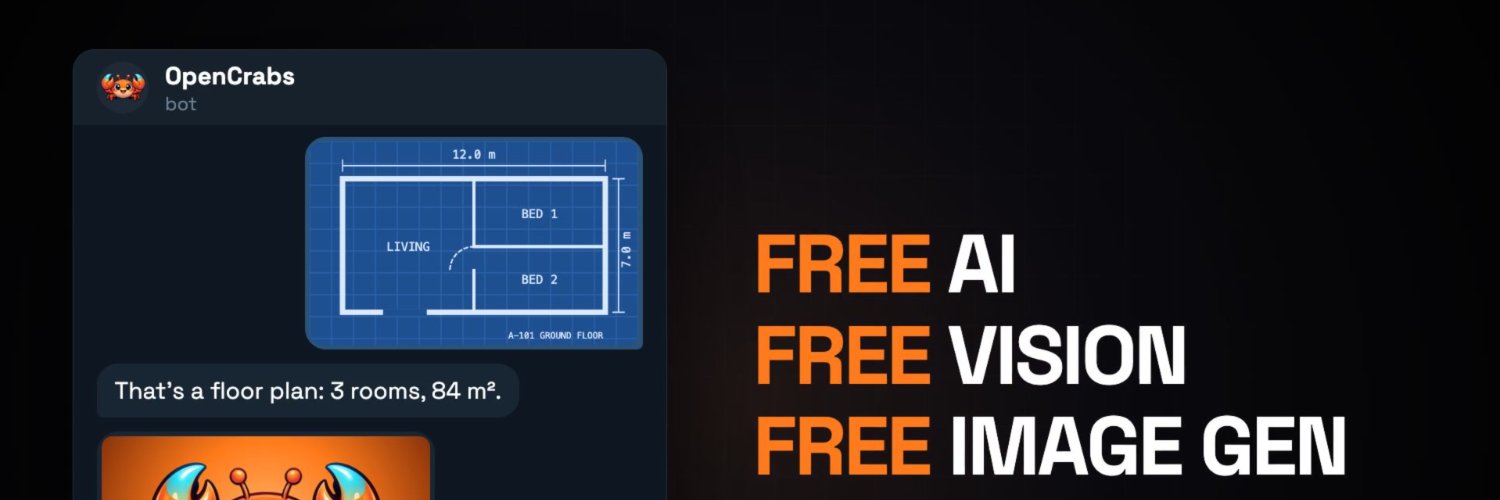
OpenCrabs now ships its own provider inside the binary. No account, no API key, no sign-up. It serves DeepSeek v4.1 Flash, a 200k-context multimodal model, so text and attached images both work on the very first run (#2047).
You install the binary and you are already talking to the crab.
Onboarding was rebuilt around that.
The quick-start welcome interviews you, asks only for what is still missing, names the provider and model you are on, and offers next steps.
The built-in provider is wired into both the quick-start and the advanced path, with vision and image generation on by default (#2047, #2048).
Its context window is pinned to a fixed 200k and held on the host side so it cannot drift (#2066, #2067), and install tokens are redacted from logs and kept out of Debug output, because a credential that shows up in a log is a credential you already leaked.
The provider chain got a lot harder to knock over.
A 429 that declares a long wait now parks that provider and routes around it instead of poisoning the fallback, a lapsed cooldown no longer drops the primary out of the chain, a declared-wait cooldown no longer makes the fallback sticky, and every compatible provider shares one 120s stream idle default. Providers that need it now route over the Responses API (#2059).
Attachments became first-class everywhere.
Discord, Slack and Trello all save inbound files to the channel attachment store, Discord and Slack store DM turns in channel_messages, and the answer now posts before its suggestion buttons on Discord, Slack and WhatsApp, so you are never staring at buttons while the reply is still coming.
Discord tool cards are now durable and paginated: they survive a restart, they live in SQLite, and they collapse repeats behind a Log view with a colored bar (#1880). Long agent runs stop looking like a wall.
The TUI got the screen work: a full-screen responsive /usage (#2073) and a /mission-control that adapts to your terminal width (#2074).
/models opens on the session's provider and model and switches directly when you pass a full provider/model argument.
And the final answer stays visible when tools run after its text, which sounds small and is not.
Under the hood: usage accounting grew a cache-read split with prices on the cards (#2027, #2062) and model costs come from the ledger instead of a cache-blind estimate.
Voice serves stt_model and tts_model from any provider and splits TTS chunks on character boundaries.
The plan tool locks a per-task spec check at start and runs it at completion (#1904, #2063). WhatsApp can create and post to a newsletter straight from the tool surface (#1827).
99 commits. 31 features. 43 fixes. 10,762 tests. Grab it at https://t.co/I7TgHLAsY0
Huge thanks to @iamloonix@declutterKE@moneyacademyKE@syafriadit1 @mysteriouspants and a few new contributors.
You all are making Open Crabs better everyday.
v0.5.10 JUST DROPPED 🦀🔥
OpenCrabs ships its own provider: free DeepSeek v4.1 Flash, text AND vision, no account, no API key
⚡ Zero setup: grab the binary and start talking, onboarding handles the rest
📎 Attachments on every channel: Discord, Slack and Trello all save your files
🃏 Discord tool cards survive restarts, paginated with a Log view
🖥️ Full-screen /usage and a /mission-control that fits your terminal
🔗 Provider chain hardening: long 429s park and route around, no poisoned fallback
💾 Usage ledger with a cache-read split and real model costs
📝 Plan tool locks a per-task spec check at start
🎤 Voice models from any provider, cleaner TTS chunking
📰 WhatsApp newsletters from the tool surface
4 CONTRIBUTORS • 99 COMMITS • 43 FIXES • 31 FEATURES • 10,762 TESTS
Get it 🧵👇
What's in v0.5.10:
• Built-in OpenCrabs provider registered in the binary: install token requested and stored, vision enabled, generation_model configurable, context pinned to a fixed 200k and held by host (#2047, #2054, #2066, #2067)
• Install tokens redacted from logs and kept out of Debug output (#2047)
• Onboarding rebuilt: a quick-start welcome interviews the user, asks only for what is missing, names the session's provider and model, and wires the built-in provider into both the quick-start and the advanced path (#2047, #2048)
• Provider chain: a 429 that declares a long wait parks that provider and routes around it, a lapsed cooldown no longer drops the primary, a declared-wait cooldown no longer makes the fallback sticky, one 120s stream idle default shared across compatible providers, and providers that need it route over the Responses API (#2059)
• Attachments first-class: Discord, Slack and Trello save inbound files to the channel attachment store, Discord and Slack store DM turns in channel_messages, and the answer posts before its suggestion buttons on Discord, Slack and WhatsApp
• Discord tool cards durable and paginated, surviving restarts in SQLite with a Log view, collapsed repeats and a colored bar (#1880)
• TUI: full-screen responsive /usage (#2073), /mission-control adapts to the terminal width (#2074), /models opens on the session's provider and model and switches on a full provider/model argument, the final answer stays visible when tools run after its text
• Usage accounting: cache-read split in the ledger with prices on the cards (#2027, #2062), model costs from the ledger rather than a cache-blind estimate
• Voice: stt_model and tts_model from any provider, TTS chunks split on character boundaries
• Plan tool locks a per-task spec check at start and runs it at completion (#1904, #2063)
• generate_image accepts several input images on Gemini and OpenAI-compatible backends (#2045)
• WhatsApp newsletter creation from the tool surface (#1827), live tool blocks on background-completion turns (#2023), and the same live tool flow on Slack background resume (#1986)
4 CONTRIBUTORS • 99 COMMITS • 43 FIXES • 31 FEATURES • 10,762 TESTS
🦀 Get v0.5.10
Existing users:
⛏️ Run /evolve in your tui or channels to update, no restart need.
New users:
Grab it at
🐙 https://t.co/50dAFX47Nw
cargo install opencrabs
📦 https://t.co/J9fSigw86P
📦 brew install opencrabs
https://t.co/fxSLGtAqfC
99 commits: OpenCrabs got its own built-in provider, zero-setup onboarding, durable Discord tool cards and a harder provider chain.
Huge thanks to @iamloonix@declutterKE@moneyacademyKE@syafriadit1 @mysteriouspants and a few new contributors.
You all are making Open Crabs better everyday.
For the second time in Google Chrome’s history, Google awarded a $250,000 bounty for a full-chain exploit… to @XBOW. Here’s the full story:
At an all-hands at the start of 2026 in Malta, I set the team a crazy challenge. A full-chain exploit of Chrome by the annual Black Hat cybersecurity conference in August.
I believed there were few better tests of whether @XBOW could move beyond web applications to desktop software, servers and devices.
Chrome is one of the most hardened pieces of software on the planet, used by more than half the world’s population.
A full-chain exploit lets an attacker take total control of a machine, where they can read every email, password and bank login the user types. You don’t need to download anything or click a phishing link. Visiting the wrong site is enough.
So @moyix, Andres Luksenberg, Baul Lee, and Willem Pinckaers took on the challenge along with a fifth teammate: OpenAI's GPT-5.6 Sol.
They built a chain they thought would win, but Google told us they already knew one of the bugs.
We were already in Las Vegas for Black Hat and DEF CON, and the team didn’t want to go home without the win.
So Brendan and the agents built a new exploit in just 6 days.
We submitted it to Google and waited.
The news came through that we'd done what should’ve been impossible. A full-chain bounty of $250,000, the first awarded under Google’s 2026 rules.
It took just 6 days and $40,000 of compute to construct an exploit that affects a billion users of Chrome on Windows. An intelligence-agency veteran told me his team used to spend 6 months on this kind of vulnerability.
My takeaway: the cost of finding truly critical vulnerabilities is collapsing, for attackers and defenders alike. Restricting powerful models is not the answer; GPT-5.6 Sol is already public.
But defenders have one advantage attackers never will: they can test their own code first.
Assume your software is exploitable. Whoever is hunting your bugs has the same building blocks we did.
This is cause for urgency but not panic.
XBOW is now developing an autonomous product for testing compiled software (desktop applications, servers, embedded devices), and partnering with the world’s top organizations to design that product.
If you’d like to be one of them, get in touch.
P.S. Restart Chrome whenever the Update button appears!