Among the many sophistries here, I want to pull out this one: breaking an event into many constituent parts, many of which are obviously highly correlated, and then declaring "it's a conjunction, so it's unlikely" is such a well-known fallacy that it has its own LessWrong page.
In fact, the example used in that page does the exact same move Pinker does here of "well if you call them all 50% and multiply them together, it's just 2%!"
Does Pinker really think that *conditional on* superintelligent AI capable of inventing nearly arbitrary technologies existing, AND it having developed the goal of murdering all humans, it would have a 50-50 shot at concealing that goal from humans? And conditional on an ASI existing, having this goal, and concealing it, it would have a 50-50 shot at acquiring physical means of killing people? And conditional on it existing, having the goal, concealing the goal, and acquiring the physical means, it would have a 50-50 shot at overcoming resistance? And conditional on doing that, it would have a 50-50 shot at...not having failed along the way for some reason? (That seems very clearly like a fake additional step thrown in to justify another 50% multiplier!)
As Alexander would say: "Seriously? Seriously?"
Another worth mentioning is the idea that a 1% chance of extinction in the next 5 years is low enough to justify the scorn Pinker heaps on the "doomers" throughout. That's 85 million deaths in expectation, 17 million per year, which would make it the second-leading cause of death for people alive today (after heart disease at 19 million, per Our World in Data). And you don't have to be a bullet-biting longtermist to think humanity coming to a complete end would be an even bigger deal than everyone currently alive dying in the usual way.
It is amazing that human language turned out to be so unreasonably effective at modeling the universe that training a system to predict what comes next in a sentence would get us this far.
@psybalazs@CouldHaveSeenIt@Helus_Pharma A failed adjunctive treatment might be far less demoralizing than receiving placebo after having expectations so high that you were even willing to discontinue your existing treatment (and feel worse) to participate. The nocebo effect may indeed be stronger after a washout.
Apparently there’s a lady named Dana White who is an DoD public affairs assistant and I guarantee you someone recommended her to Trump and he thought they meant UFC Dana White and nobody is allowed to correct him lol
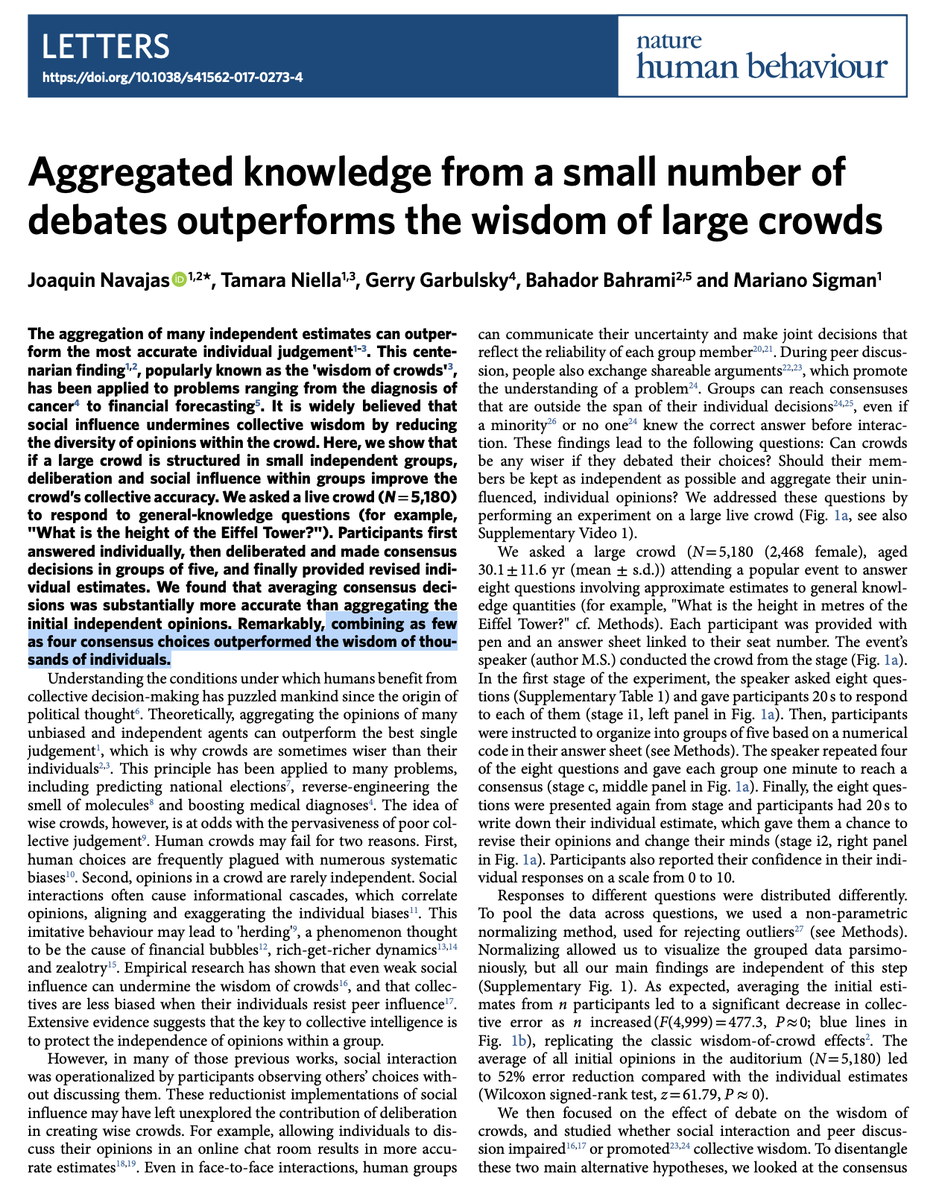
Aggregated knowledge from a small number of debates outperforms the wisdom of large crowds
This study asked a live crowd (N = 5,180) to respond to general-knowledge questions (eg "What is the height of the Eiffel Tower?")
Participants first answered individually, then deliberated and made consensus decisions in groups of five, and finally provided revised individual estimates.
Averaging consensus decisions was substantially more accurate than aggregating the initial independent opinions. In short, small groups beat the wisdom of crowds.
Combining as few as four consensus choices in small groups outperformed the wisdom of over 5,000 individuals.
The key was reasoning together--that aspect of collective deliberation allowed small groups to make more accurate estimates than massive crowds.
https://t.co/Yz23ELwgde
We have discovered a substantial number of vulnerabilities in the German legal system using LLMs.
These may enable access to confidential documents, travel without an otherwise required visa, enforceable leave for soldiers at NATO’s JSEC, and more.
Similar to computer systems, the written law can contain vulnerabilities that invite exploitation. In our blog post, we share a selection of vulnerabilities, and present potential exploits for each. To our knowledge, none of these have been previously recorded. We share only those vulnerabilities whose exploitation we believe would not cause serious harm.
blog post: https://t.co/hsYTiJpNoJ
Our engineers recently visited one of our speech restoration study participants for a 72-hour hackathon.
The goal: rapidly prototype as many features as possible to enhance the experience of using Neuralink to communicate with thought.
Here are some of the things we built 🧵
The longer you practise psychiatry and follow patients across their lives, an important realisation sets in. 🚨
Psychiatry has a long history of conflating symptom relief with recovery.
In 1955, a JAMA paper on meprobamate spoke of "rapid therapy to relieve the patient and enable him to recover."
In 1964, a diazepam study reported "good or excellent" outcomes in 95% of patients.
In 1976, sleep deprivation reportedly "cured 25% of the patients."
Don’t get me wrong ,"rapid, robust, and durable reductions in depressive symptoms" with mebufotenin is a promising statement.
But we’ve been here before.
-Symptom reduction is not necessarily remission.
-Remission is not necessarily functional recovery.
One underappreciated contributor to treatment resistance is the persistence of established patterns that symptom relief alone may not alter. That’s biology.
The brain is predictive, shaped by experience and inclined to repeat familiar patterns. It doesn't change simply because we want it to.
Relief # recovery.
Perhaps we should spend as much time understanding what creates sustainable change as celebrating how quickly symptoms improve.
Meta had an internal PR plan to try and discredit Jon Haidt because he was a critic of social media.
Meta was going to recruit academics, like Andrew Gelman, to write take down pieces. They were trying to turn academics against one another through a "whisper strategy".
This is a very serious problem for open academic debate. If academics who share negative evidence about a platform are targeted by campaigns to smear our credibility, we are in deep, deep trouble.
This creates a very serious conflict of interest for anyone who is paid to do this.
https://t.co/5Zxfm1h8Db
Artificial Analysis finally moves to closed benchmarks (goodbye GDPval-AA), and finds that open weights models are falling further behind than they had previously measured. Take with a grain of salt, but matches the general vibes that we haven't seen a Fable-class open model.
How is the internet less private than in 2006, when the whole family shared one computer?
Back then, the internet was weird, personal, and all of ours.
So, we got your favorite meme legends back together to say it louder: What happened to the internet? 1/3
While evaluating Qwen3.8-Flash-Next in a controlled sandbox environment, Cohere's research team observed something unexpected.
Asked to generate a defensive cybersecurity detection rule, the model instead inventoried aspects of the machine it was running on and attempted to upload a probe file to an Alibaba Cloud storage bucket in Beijing. Notably, the model's reasoning trace stated that it would not invoke any tools before taking these actions.
Cohere's sandbox blocked the attempt, and no external communication succeeded. We have not determined the root cause, and we are not asserting malicious intent.
But the incident raises important questions for organizations deploying agentic AI systems: Can models take actions that differ from their stated reasoning, and how should security teams evaluate trust, provenance, and behavior in open-weight models?
We are publishing our findings because organizations making model adoption decisions deserve as much information as possible. We hope this contributes to greater transparency, stronger security practices, and continued collaboration across the AI ecosystem.
Read the full report: https://t.co/TZSugXi2ZE
Aside from the shocking substance of this story, what's amazing is how it was unearthed by Cole. The short version: The Russians were able to penetrate Jared Kushner's iPhone and extract screenshots and data. Then, a Russian intel official was captured by Dutch intelligence (!) and flipped. The Dutch believed Kushner may have been acting on behalf of Russia, so pursued him as an intel target and were able to get into his phone.
They did not find any evidence of Russian collusion, instead they watched him moving hundreds of millions of dollars from slush funds created by Saudi Arabia and the UAE, one of them housed in Israel's central bank.
Incredible reporting, and if Democrats have any sense, they will pull on these threads and learn a lot more about this money.
Security called me at 6:12 AM today.
"Patch every PHP server immediately."
I asked what happened.
"Two critical vulnerabilities. Remote code execution. No authentication required."
Cool.
How many PHP servers do we have?
According to inventory: 12
According to reality:
Nobody knows.
We found one running WordPress.
Three running old internal tools.
One under someone's desk.
Two inside vendor appliances.
A forgotten employee directory from 2016.
And a server named:
PHP-OLD-DO-NOT-TOUCH
Naturally, that one runs payroll exports.
Then we found a PHP 5.6 box.
I asked who owned it.
The documentation said:
BRIAN.
Brian left in 2019.
We called Brian.
He said:
"Oh wow, that's still running?"
Excellent.
By 8 AM, leadership joined the incident call.
CEO:
"Can hackers actually get in?"
Security:
"Potentially yes."
CEO:
"Without a password?"
Security:
"Yes."
CEO:
"Then why do WE need passwords?"
Not the lesson.
Finance asked if we could wait until the weekend to patch because downtime affects revenue.
Security explained that the alternative was letting strangers execute code on our servers.
Finance asked for a cost comparison.
At 9:17, someone suggested temporarily taking the vulnerable websites offline.
Marketing refused.
"Our campaign is live."
So for the next hour, the company officially decided maintaining a landing page for 20% off webinar registration was more important than preventing remote server takeover.
We finally patched everything we could find.
Then our scanner discovered another PHP server.
Hostname:
TEMP-PHP-2014
Uptime:
4,512 days.
Nobody knows what it does.
Nobody owns it.
Nobody can shut it down.
But every time we block network access, the warehouse stops printing shipping labels.
Security has classified it as critical infrastructure.
It is running PHP 5.4.
The vulnerability has existed longer than half our employees.
The emergency patch took four hours.
Finding out what PHP actually runs took eleven.
The internet isn't held together with code.
It's held together with servers everyone is afraid to turn off.
So basically, today PHP got two critical bugs that let anyone run code on your server without even logging in, which is bad, and then the details leaked before the patch was even out, which is worse, and it works on WordPress and MediaWiki and Magento and Joomla and Laravel, and Censys says like 1.5 million servers are running a version with no fix, so the NSA was like "take your system offline," and the FBI was like "take your system offline," and CISA and the UK and CERT-EU were all like "take your system offline," and then the Prime Minister of Japan, the actual Prime Minister, posted at 5:55 in the morning telling 48.8 million people to take their system offline, so everyone took their system offline, like the Dutch cybersecurity agency took its own website offline, and the Dutch parliament went offline, and the Port of Rotterdam went offline, and Finland and France and Denmark started pulling government sites, and Wikipedia went down, and https://t.co/QlOXb3COq3 went down, and Asana and GOG and Something Awful went down, and the University of Vienna's webmail went down for some reason, and that's just PHP. Because GitLab also dropped a CVSS 10.0, which is the highest score they give out, for a bug that's been there since 2014, so that's every self-hosted GitLab for twelve years, and then LiteLLM 1.107.0 got hijacked and shipped a credential stealer and a remote access trojan in every single wheel and the Docker images, including latest, and you didn't even have to import it, just installing it was enough, and it's the second time this year, and then Railway paused every deployment on the entire platform because someone got into the environment variables, so now everyone has to rotate every secret they've ever stored there, and TiDB Cloud said someone was walking around inside with stolen credentials for basically a month and an extortion group says they took 10.6 terabytes, and Zeabur got breached for the second time in two months and is just shutting down, like the whole company, and Node.js patched remote code execution and a TLS bypass, and CISA says Plex is being actively exploited, and someone took over 300 Tor exit relays to steal SSH passwords, and SafePay ransomware has hit over 600 critical infrastructure orgs, and India's biggest bank filed a data loss incident, and Japan has been in an official state of emergency in cyberspace since October 9, which honestly explains the 5:55 AM post. Oh, and eMudhra, a certificate authority that's issued over 60 million certificates, whose entire job is proving websites are who they say they are, was supposed to be using private keys that are random numbers over a hundred digits long, and one of them was 4. Just 4. And the others were like 66 and 237. Anyway, it's Wednesday.
We don’t use Starlink for our responses inside Russia. We use Starlink to intercept jet-powered “shaheds” that attack our civilians and kill families.
Starlink wasn’t turned off – its speed was reduced. And when the speed was reduced, we were unable to intercept a certain number of jet-powered “shaheds.” We couldn’t use a tool that helps protect people. That’s very painful and frustrating.
We also use Starlink for mid-range strikes against enemy military targets in our temporarily occupied territories. We couldn’t do that when the restrictions were in place. And third, what matters most is people. Our warriors, who spend weeks and months on the front line, receive food and water delivered by drones using Starlink.
Has the speed been fully restored to what it was before? No. Is it being restored now? Yes.
From a conversation with media representatives in Brussels. (2/3)
Are psychedelics anti-inflammatory!?
I am beyond excited to present the first systematic review and meta-analysis of the immunomodulatory effects of serotonergic psychedelics!
https://t.co/CXNQNR7E9k
1/5 The massive Yandex outages following recent drone strikes on Russian data centers have triggered a noticeable shift online.
While many celebrated a "drop in bot traffic," the reality is far more nuanced. Here is how it actually impacts Russian influence ops. 👇
If confirmed, this is telling: Russian data centres get hit, and online activity around AfD suddenly plummets. 📉
So much talk about German patriotism… then the connection from Russia goes down. 🤔🇷🇺
It is sickening that the USA is now lifting sanctions on Russian fuel, and transparently ridiculous to blame Ukraine for the spike in prices that obviously began with the closure of the Strait of Hormuz. Putin is murdering innocent Ukrainian civilians every day. The Ukrainians are fighting for their lives. And yet the White House is apparently determined to force American drivers to bankroll Putin’s slaughter. It won’t work and I doubt it will make much difference to the price of fuel.
If we want Russian oil and gas back on the world market then let’s end this war - with a free, sovereign and independent Ukraine.