A number of you know that I’ve been working on a dissertation for some time now, at points taking a year or more off in between drafts and revisions.
I’m happy to report that the manuscript is now done, and yesterday I successfully defended Askēsis and Perception: Philosophy as a Way of Life to my committee. I’d describe it as the longer, more technical version of the work I put out here.
I’ve included my presentation notes for the oral defense below.
📢 NEW: Website Design Tools on Substack
Today we’re launching new website design tools that give you more control over how your Substack looks and feels.
Start with one of the preset themes in the Mini-Editor, then choose from a wide range of combinations to match your brand and reflect your style. Feeling lucky? Click the dice to try a random combo.
Want to fine-tune? The Full Editor lets you precisely shape the appearance of your Home page, Welcome page, Post pages, and more.
With these new tools, you can benefit from Substack's discovery network that helps you grow, while also building a home online that's truly yours.
🆕 New essay by me in Asterisk:
Since the Romantic revolution of the 1790s, one of the most time-tested ways to combat disenchantment has been to assert that humanity is the ultimate purpose of cosmic evolution.
But can evolutionary humanism stand up to the challenge of AI?
Have current events left you depressed and in need of a pick me up? Or are you thrilled and want the good times to keep rolling? Either way, the end you seek arrives early next year!
Perception is about what comes to presence for us through appearance. Phenomenology, in turn, brings to presence that act—intentionality—which makes things present to us in the first place.
What I wanted to do in this piece was to make this process explicit. I am interested here less in the initial sense in which intentionality operates and more in what kind of space we are in when we attend to the process or structure of intentionality as such.
I didn’t use this language in the piece, but I want to suggest that this space is well characterized as a theoric or contemplative space (that is, a receptive space), one in which the intentional process still issues forth but where, to speak spatially, our attention is guided upstream in the attempt to witness what it is intentionality is doing as it occurs (much as we find in Husserl’s account of epochē), so that we might understand how to act on—and, ultimately, shape—the resolution at which intentionality occurs.
I believe such a practice can disclose to us—again, in a contemplative and receptive way—the manner in which the “transcendental” apparatus is in some sense shapeable through practice.
There is much else I wanted to say along these lines but didn’t have time to sort out before presentation time. Husserl on sedimentation. Mary Carruthers on the craft of thought and inventio. Bergson on memory.
Sense settles like silt through habit.
Practice both loosens and lays down new sediment.
Memory is made to transform us; it lays down new pathways for future perceiving.
More to come.
I wrote about how I think intelligence and attention hang together in perception. The paper was presented as part of the @AvalonInst Exposition, an arts and humanities conference ongoing in Berkeley, CA this weekend.
Drawing on Husserl, Illich, Hugh of St. Victor, and others, I’m continuing my exploration of intellegere as a mode of attentive choosing within perception organized by our aims and values. AI is the obvious backdrop to this discussion, and I wanted to lay out these claims so that we might look at what intelligence actually is and entails.
I read Husserl in the context of more contemporary debates in phenomenology and the philosophy of mind (e.g., the Dreyfus-McDowell debate), and I draw on Alva Noë’s account of the concept as a skill of perception to advance a specific understanding of how things come to presence for us in perception.
From there, I look at Hugh’s and Illich’s work on contemplative medieval reading practices, with the implication that perception is itself a kind of practiced and interpretive reading, one that at times needs to be guarded. The paper closes with some reflections from the Republic.
Come for the epochē, stay for the prosochē. Link to follow.
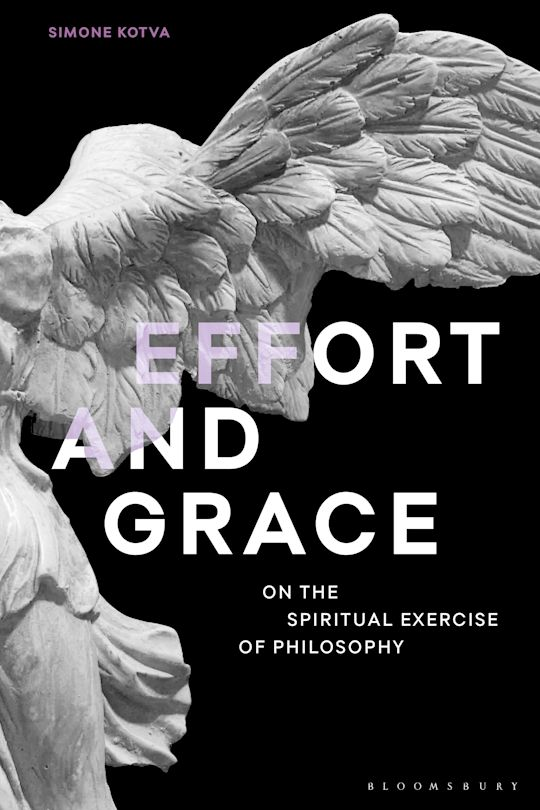
My book, Effort and Grace: On the Spiritual Exercise of Philosophy (2020), has been selected as the 2026-2027 winner of the inaugural E. Jane Doering Prize awarded by the American Weil Society for excellence in Weil Studies in connection to literature and/or French studies:
"The professional reader, the scholar, or the pandit becomes the agent of a novel form of concentration: indeed, he not only collects, he turns himself into a collection, a person filled up with knowledge that moves to and fro between internal and external memories. He survives as homo humanus by coming to terms with his existence as the state of being held out into the space between the inner memory and outer archive. A humanist is a person who can say: I am human, nothing written down is strange to me."
— Peter Sloterdijk
I’ve been reading Husserl for the first time in a long while, and, if I’m reading him correctly, his transcendental phenomenology leaves us with an interesting set of claims about perception: a perception can be non-discursive (“pre-predicative”) but still rational, and it can be rational but not true.
For Husserl, pre-predicative perception is itself pervaded by rationality (i.e., rationality is present in perception before I can make verbal or logical claims about what is happening in perception), but this sense of perception being rationally pervaded does not entail that perception is always truth pervaded.
In other words, the true and the rational are not the same thing, and my taking a stance of rationality pervading perception does not mean I think our perceptions are always veridical (i.e., true); it just means that we take things to be a certain way—endowed with a certain meaning and significance—and that way could be wrong, but this taking-things-to-be-a-certain-way should nevertheless be considered rational. In this sense, rationality is necessary but not sufficient for truth; truth is what rationality aims at, but the aiming can miss or fall short.
In my view, this is why cultivated perception is necessary—if the true and the rational were one and the same, then our rational perceptions would be perfect as they are, but they very clearly aren’t, as we can see from any number of examples where our perception is fooled, in error, or otherwise misses the mark of what is happening in the world as it comes to presence for us in perception. This cultivation amounts to a training of receptivity and responsiveness, to our becoming more present to the events unfolding before us in perception.
Truth is in the event itself and comes to presence for us through the askēsis of perception.
“It is from within this context of the natural attitude and of regular flowing life that any understanding of phenomenology must begin. Phenomenology steps sideways to observe the flow of life, rather as the cinema buff having initially been absorbed in the flow of the story on screen, then shifts her gaze to the flow of givenness, the manner in which shots are taken, how long they are, etc. Ultimately, for Husserl, the whole ‘world’ becomes understood not as static ‘being in itself’ but as the harmonious flowing, consolidating, and confirmation of experiences in their respective contexts and horizons. The world’s habitualities are revealed as correlated and in tune with the habitualities of human subjects. We experience the world in a typical manner, the world has an ongoing and enduring significance for us.”
— Dermot Moran
Soliciting more philosophical confidence along these lines:
"By means of phenomenology, I reveal the transcendental sense of I, we, and world; while doing this, I do not only gain access to myself in my ultimate truth, but, by means of this knowledge, I am also individually another than who I was."
— Edmund Husserl
“We cannot factor experience into a conceptual part and a raw experiential part in such a way as to allow us to make sense of the intactness of that experiential part in the absence of its conceptual framing. Capacities for experience and thought go hand in hand and are in a sense one. Creatures acquire capacities for experience as they actively explore and begin to think about the world.”
— Alva Noë