Our app is making $3,000/day
on average 🤯
Feels crazy but
It took months of trial and error
Here’s what we would do in 3 steps
If we had to start over :
1. Mass produce content yourself
Reactions + demos work really well
( I’ve generated 6M+ views myself just dancing on TikTok this alone can get you to $5k or $10k/mo )
2. Find a viral format in your niche and mass generate reels with AI
Apps are making $200k/mo
using only AI UGC
It’s the future of marketing and low cost
I break it down in depth
in the quoted article
3. Hire real UGC, $15/vid
30 or 60 vids/mo
It’s best to do real UGC only once you have a repeatable viral format.
Otherwise just wasting money
Apply these 3 things to your app
And thank me later.
JUST IN: Scientists say AI has decoded communication patterns in mice, dolphins, apes, birds, whales, & cuttlefish — could eventually lead to humans communicating directly with animals.
World Labs CEO Dr. Fei-Fei Li: "The world is not made of words."
"Language models have given machines an extraordinary command of concepts, vocabulary, and reasoning, but the physical world, virtual or real, runs on a different substrate."
"Where language models learn the statistical structure of text, world models learn the statistical structure of space and time: how light falls on a surface, how a garden looks from an angle no camera has captured, how objects respond to force and follow the laws of physics."
"Language gave machines a way to talk about that world. World models are how machines will finally come to understand, imagine, reason and interact with it."
Full piece: https://t.co/C9qOJg5wuc
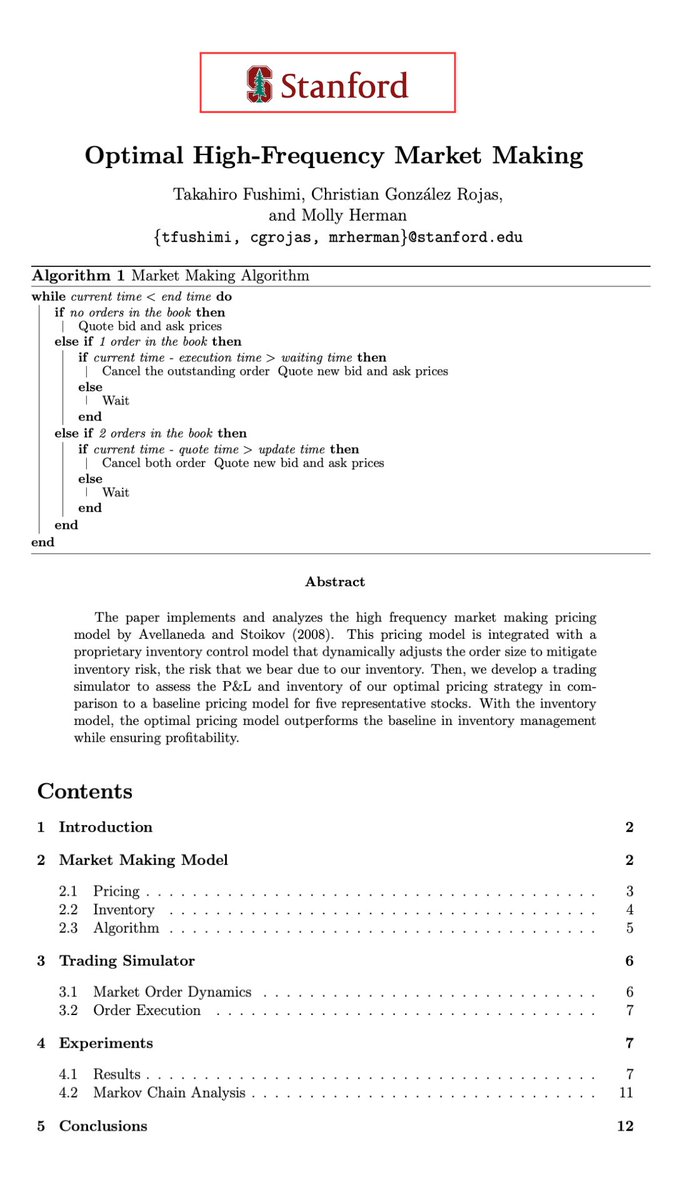
As someone who builds institutional level quant systems, this Stanford paper on Market Making is the closest thing to an HFT desk I have ever seen publicly shared.
19 pages. Hedge Fund level Market Making Algorithm. Bookmark & get this before someone takes it down.
It's official.
MicroStrategy, $MSTR, is now facing its biggest unrealized loss in history, at -$10.8 billion.
In other words, after 6 years of buying Bitcoin, the company is now down -17% on its position.
By comparison, the S&P 500 is up +116% over this same timeframe.
Since MicroStrategy sold 32 Bitcoin at $77,135 per coin, their positions has lost -$11.8 billion in value.
This puts MicroStrategy's stock, $MSTR, down -77% since its record high.
Bear market is an understatement.
🚨Michael Burry says Nvidia has 3 big customers and if they stop buying the whole thing is over.
Those 3 customers now account for 64% of Nvidia's entire accounts receivable.
In 2020 that number was 33%. It jumped 8 percentage points in a single quarter.
Nvidia's revenue is not spread across a broad market. It is almost entirely dependent on a handful of buyers.
Burry's argument is about why those buyers may slow down or stop entirely.
He calls it the "bezzle." The bezzle is not that AI is fake. It is that a massive portion of current AI spending is coming from companies that are benchmarking models, testing systems, and competing on AI leaderboards.
That activity is temporary. It will end. But it is being counted and financed today as if it is permanent growing demand.
He says: "They are just flying empty airplanes around."
When that benchmarking phase ends those 3 concentrated customers have far less reason to keep ordering chips at the current pace.
And because Nvidia's revenue is this concentrated even a partial slowdown from those buyers creates a massive hole in its numbers.
Now here is where it gets more alarming.
Microsoft, Amazon, Alphabet, Meta, and Oracle together have $662 billion in off balance sheet AI commitments according to Moody's.
Standard accounting rules allow companies to keep this completely hidden from their reported numbers.
To fund this infrastructure private equity firms have been buying life insurance companies.
But why?
A PE firm owns illiquid investments that need financing. It buys an insurance company which collects premiums from ordinary policyholders. That insurance company then invests those premiums into the PE firm's own illiquid assets.
The PE firm then sets up a captive reinsurer in Bermuda with lighter capital requirements and pushes the insurance risk onto that offshore balance sheet.
Burry's point is that all of this is connected. The same PE firms own the insurance companies funding the AI debt. The same Bermuda structures hold the risk.
If any major hyperscaler walks away from a data center commitment everything hits at the same time because every counterparty in the chain is linked to the same underlying assets.
The AI boom is being measured during the most artificial phase of the buildout.
Nobody knows what real demand looks like when the benchmarking phase is over and $662 billion in hidden commitments needs to be serviced.
Google is raising $80 billion of equity a week before SpaceX is trying to raise $75 billion a few months before Anthropic and OpenAI are trying to raise $100 billion from investors and you’re laughing???
This is a cataclysmic exit liquidity avalanche
Claude Code creator:
"Now I don’t prompt Claude anymore - I have loops that are running. My job is to write loops."
In this 30-min speech, Boris revealed his actual Claude setup for daily coding.
Claude Code + loops + dynamic workflow
Worth more than a $500 vibe-coding course
Anthropic’s last round was apparently a bloodbath behind the scenes. A GP at a prominent fund had dinner with Dario three times before their allocation was slashed to zero. At least four other tier-one funds got pulled at the last minute.
Their crime? Passing on the Series B, the hardest round Dario ever had to raise (led by Spark). In venture conviction is all that counts.
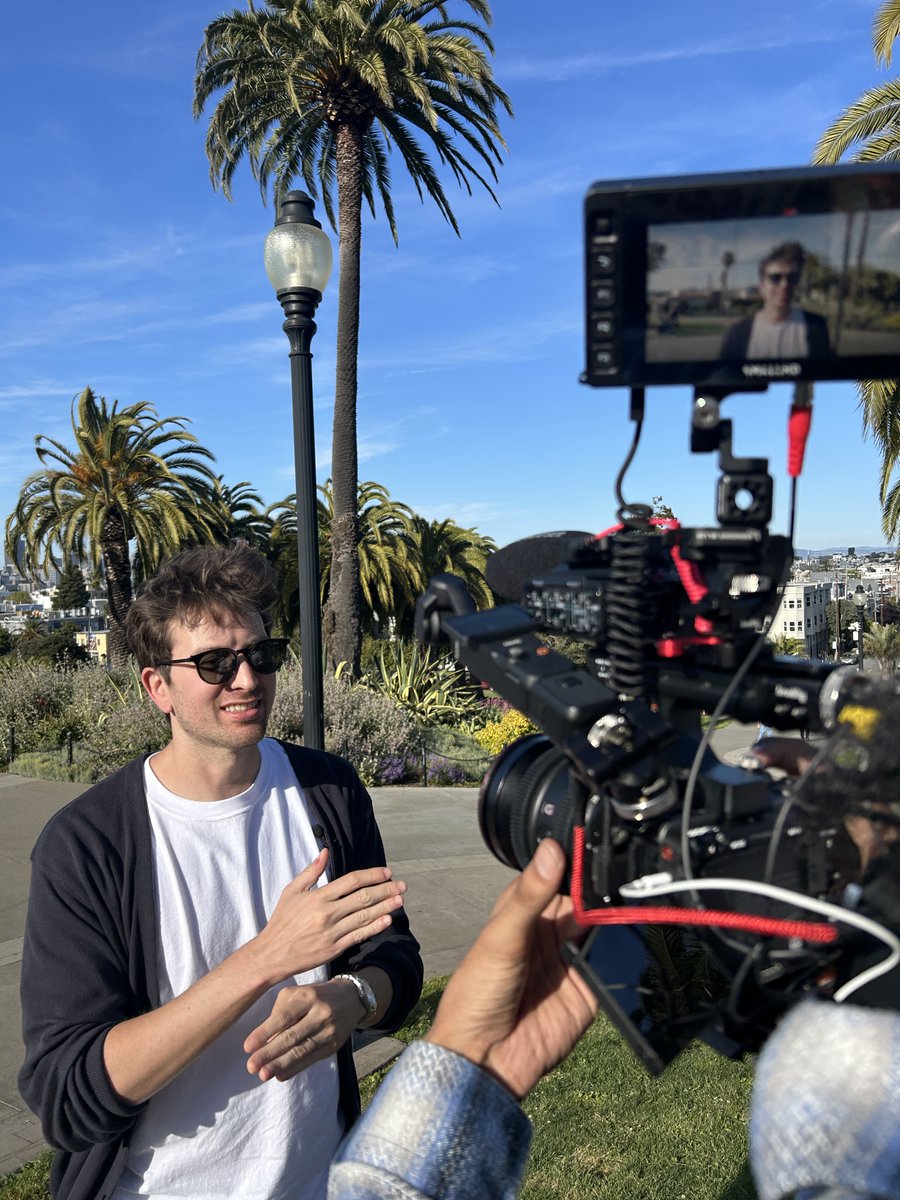
I just got back from SF and I FEEL INSPIRED.
I spent 5 days with frontier AI model teams, AI startup founders, and 3 billionaires.
My takeaways:
1. I had lunch with 3 billionaires. All of them are buying SaaS companies and rebuilding them agent-first. They were deeply inspired by Bending Spoons and Ryan Cohen's eBay deal. Buy the company, cut the headcount, rebuild the tech, add agents, add features, make more valuable experience, raise prices.
2. The frontier model companies are hungry for usage data from the field. They can see API calls and token counts. They can't see the actual workflows. If you're deep in a niche using these models in ways the model companies haven't seen, that understanding is incredibly valuable. Usage intelligence is the new alpha.
3. Consumer AI is massively underbuilt. Every billboard in SF is either B2B inference infrastructure or vertical agent companies. The entire city is optimized for enterprise. Meanwhile you have companies like Cal AI doing $50M ARR in 18 months as a consumer app. I met with a cool few teams doing consumer AI (@paulscherer / @ekuyda)
4. MCP came up in literally every conversation. The companies exposing their product as MCP endpoints are getting pulled into deals they never pitched for. The ones that aren't are becoming invisible to agents. This is the new SEO. If agents can't find you, you don't exist. Building products for agents is the new zeitgeist in general.
5. Not uncommon for hot seed rounds to be $25-50 million valuations. I saw a Series A at $450 million
6. If I had a dollar every time someone mentioned "forward-deployed engineer" this trip I could have funded a seed round. It's the hottest role in SF right now. The person who sits between the agent and the customer, making sure everything actually works.
7. The mood around open source shifted. A year ago it felt like open source was chasing the frontier models. Now founders are telling me Gemma and DeepSeek are good enough for 80% of what they need at a fraction of the cost. The "which model do you use" conversation is being replaced by "which model for which task." Model loyalty kinda feels dead.
8. Voice agents came up more than I expected. Multiple founders told me voice is the interface for the next billion users. The billion people who will never type a prompt will absolutely talk to one.
9. The Obsidian community in SF is weirdly intense. Multiple founders showed me their vaults unprompted. Like showing someone your home gym. It's a flex now. The quality of your knowledge base (second brain?) is becoming a status symbol among builders.
10. Maybe it was just the people I met but the age of the founders is shifting. I met more founders over 40 this trip than any trip before and more founders under age 21 than ever before. Founders getting older and younger at the same time.
11. I spoke to a lot of fast-growing startups, VCs and frontier models who are hiring content creators right now.
12. The restaurant scene in SF is actually better than it's been in years. Founders are going out more. Alcohol is out, not surprisingly.
13. SF doesn't feel like the only place anymore. We all have access to the same frontier models. We all read the same X feed. A founder in NYC or Lagos is calling the same APIs as a founder in SoMa. So in the past it felt like SF was always lightyears ahead, doesn't feel that way anymore. It's okay not to live in SF and have BIG DREAMS.
14. The coworking spaces in SF are half empty but the coffee shops are packed. People want to be around people. I had a few startup ideas here....
15. Walking around the Mission I noticed something: the street-level businesses, the taquerias, the barbershops, the laundromats, none of them use any AI at all.
16. I heard the phrase "agent debt" for the first time. Like technical debt but for agents. When you hack together an agent workflow fast and never clean it up, the system prompts conflict, the memory gets polluted, the tools overlap. 6 months later the agent is doing weird things and nobody knows why lol.
17. Met a few people who carry two phones now. One for personal. One that's basically an agent terminal running Telegram or iMessage connections to their agent fleet.
It's always amazing to get that dose of inspiration in SF. I FEEL INSPIRED.
But I'm so happy to be back home, locked in and building.
We're 12-18 months into a shift that will take 15 years to play out. The urgency in every conversation was real.
What an incredible time to be building.