Your LTV and repeat purchase rate is everything.
Most brands obsess over lowering CAC.
But if you improve your LTV, you can scale while breaking even or even losing money on the first order.
So work on improving your product quality, faster shipping with local 3PL, better customer support, and proper post-purchase email flows for product education.
The better your customer understands what they bought, the more likely they are to use it consistently and buy again.
But this only works if your product quality is actually good.
Most agencies treat email as just a retention channel.
They focus only on LTV and keep pushing strategies around repeat purchases and customer retention.
But the goal of your email flows and campaigns should not just be LTV. It should also help improve your CVR, increase AOV with upsells and cross-sells, and boost the ROAS of your acquisition campaigns.
Email is a channel that helps you in both acquisition and retention.
Everyone starting in ecom thinks finding a winning product and acquiring new customers to get to the first few thousand in revenue is the hardest part.
That’s not the hard part.
The hardest part is turning your one-time customers into repeat buyers.
Most people keep switching products and can never build something that lasts long because they never fix their retention and LTV.
One of the most important things many brands ignore is testing offers.
Make sure you keep testing new offers for your product and not just new ads.
If you change your offer and price point it gives Meta signal to target different cohort of customers, just by doing that you will find new audience for your ads.
Different offers attract different types of customers. AOV of $60 will attract different group of people than AOV of $120, Meta will go and find those audience for you you just need to give it right signals.
Even with a good product most brands still have really bad Trustpilot reviews. The reality of Trustpilot is unless you explicitly ask people to leave reviews and give them incentives for positive reviews, your Trustpilot will still be bad even when your product is good.
Even brands like Nike and Apple have bad Trustpilot reviews.
But that doesn’t mean you should leave Trustpilot as it is.
One of the easiest ways to get good reviews on Trustpilot is to create a post purchase flow sent after certain days of delivery depending on your product.
Create a simple flow on Klaviyo that triggers every time someone places an order and send the email after a 5 to 30 day delay after receiving the product. Test different time delays and see which one works best for your brand and product, and incentivize people to leave reviews.
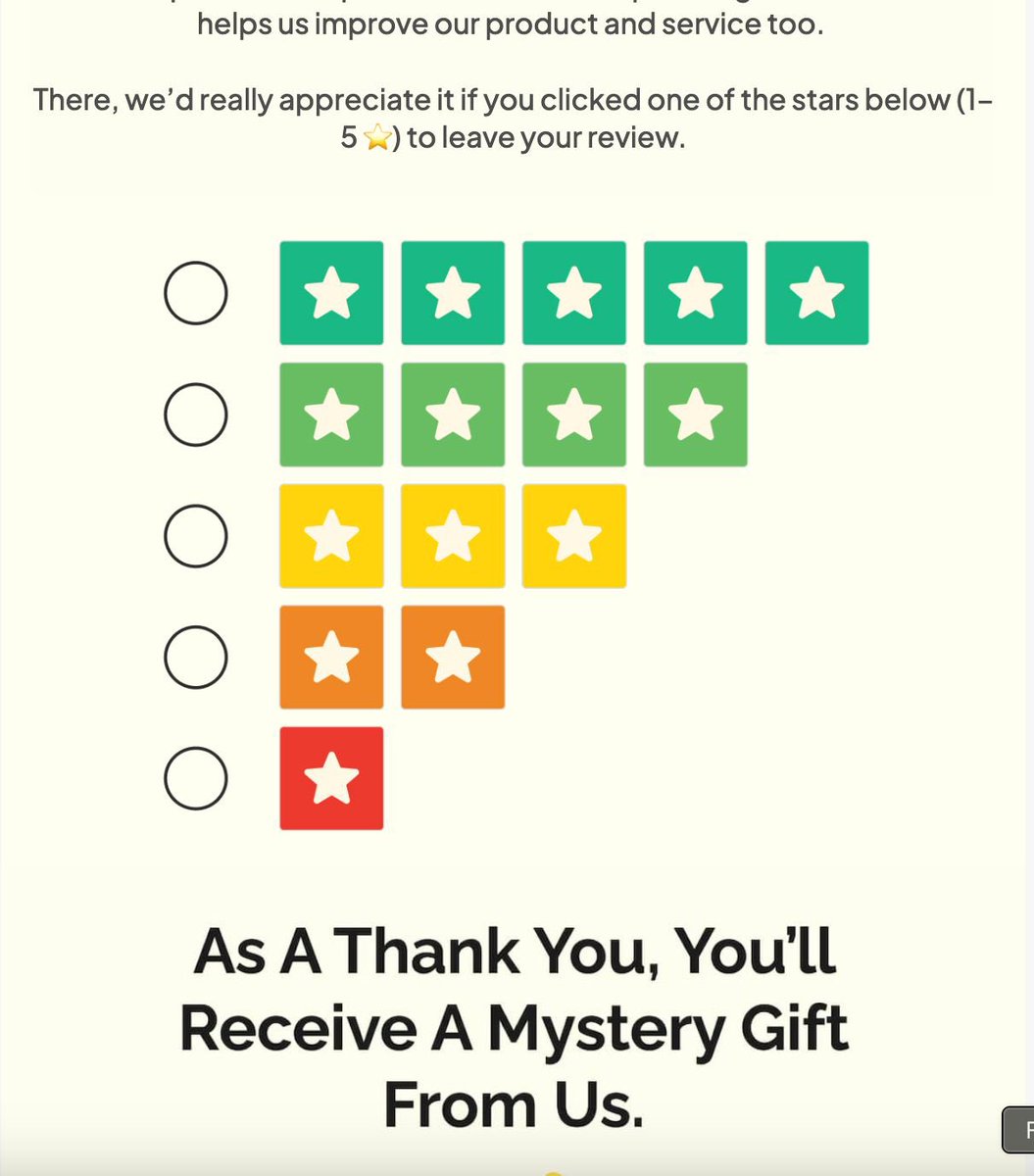
Show them an option to click 1 to 5 stars like in the image below.
If they click 1 to 3 stars, send them to a Google Doc or internal website review page.
If they click 4 to 5 stars send them to Trustpilot.
The most important thing in email marketing is segmenting non-purchasers and purchasers and treating them differently, because the messaging you send to people who have never bought from you should be different from the messaging you send to people who have already bought from your brand.
Non-Purchasers
For non-purchasers, the goal is to handle any objections they might have after seeing the ad.
Even if you promise that your product will help them achieve their desired outcome, they will still have objections such as:
• Trust in the brand
• Pricing
• Offer value
• Shipping time
• Maybe they tried other products that didn’t work for them
• They might think your product will be the same
• Safety concerns about using products (for example, supplements)
Because of this, we need to convince them how your product is different. We can do this by:
• Showing reviews and testimonials
• Clearly explaining shipping times
• Highlighting your refund policy
• Addressing safety concerns
• Showing the unique mechanism or differentiator of your product
There are general objections like the ones mentioned above, and then there are other objections specific to your avatar, which we can only find after properly researching your product and market.
All messaging in pre-purchase flows and campaigns for non-purchasers should focus on:
• Building trust
• Addressing objections
• Positioning your brand as credible
• Helping customers visualize the desired outcome they will get after using your product
Purchasers
For purchasers, they already trust your brand. If their buying experience is good and the product works well, they will buy again without much effort.
For them, we usually try to:
• Upsell or cross-sell other products related to the same main hero product
• Offer products that work together with the main product to solve the same problem
If it’s something people will buy repeatedly, like supplements or beauty products, we don’t always need to push upsells aggressively. Many times, we can simply encourage them to buy the same product again with better pricing or better messaging.
If you are running products that people will buy again and again, or running a subscription offer, the main messaging in emails sent to purchasers is not only to upsell or cross-sell, but also to:
• Help them adopt the product as part of their daily routine
• Show the long-term benefits of using the product
• Show the impact if they stop using the product