Mauritius issues an official emergency border closure due to the Ebola outbreak, making our travel physically & legally impossible this Sunday. Is this @British_Airways standard policy now? Holding a family’s 40th birthday trip hostage during a public health crisis is shocking.
@British_Airways Hey @British_Airways, your customer service team just told us "not our problem" that Mauritius legally banned our family due to the emergency June 5 Ebola travel mandate. You expect us to board a flight this Sunday to a country that will legally deport us?
Ironically, difficult markets often create some of the best opportunities... but the difference is that those opportunities usually require preparation.
Don't wait until the market opens before deciding what you're going to do.
Plan beforehand!
Here's how I narrow things down:
My process usually starts with 30-75 names.
By the time I'm done, I only want 3-5 names that I'd be looking to buy tomorrow.
1. Weekly chart first.
This is non-negotiable.
If the weekly chart isn't supportive, I don't care what the daily chart looks like.
Questions I like to ask myself are...
- Is it above the 9/21 week EMAs?
- Is it near a major weekly pivot?
- Is it breaking out of a multi-month base?
- Is it transitioning Stage 1 → Stage 2?
- Is it one of the strongest names in its group?
If the weekly doesn't excite me, it's gone.
2. Then I rank relative strength.
This is where most names get eliminated.
I want stocks that...
> Closed green while the market was red
> Pulled back less than their sector
> Are preferably sitting near highs
- Continue holding moving averages
- Have shown RS for multiple weeks, not multiple hours...
The strongest names almost always make my final list.
3. Then I look for compression.
1) I don't want extended.
2) I don't want emotional and/or erratic PA.
I want TIGHTNESS.
The tighter the stock becomes...
- The smaller my risk
- The clearer my invalidation
...which breads an asymmetric opportunity.
If I can't clearly identify where I'm wrong, I move on.
4. Then I identify exactly where I would buy it.
Not "I like the chart."
Actual levels.
Examples:
> Pullback into the daily 9/21EMA
> Weekly pivot reclaim
> 15/30min pivot reclaim of XYZ
EMA crossback
If I don't know exactly where I'd enter, it doesn't make the list.
5. Then I ask 1 question:
"If the market is green tomorrow, which stocks do I want to own first?"
That question alone eliminates a lot of names...because not every good chart is a leader. I want the names institutions are most likely to continue accumulating.
By the end of the process, my watchlist usually contains:
Tier 1: The 3-5 names I'd actually buy.
Tier 2: Names that need another day or two of tightening.
Tier 3: Names I like but would only buy if the market improves.
Then when the market opens, I'm not searching for names... but rather I'm waiting.
This makes a HUGE difference.
I'm spending the first hour seeing whether the names I already prepared are confirming my thesis. That's where patience becomes a competitive advantage.
Don't just take my words as truth, you must do the hard work yourself.
Trying to catch bottoms is probably costing you a lot of $$. The highest-probability entry comes AFTER the panic.
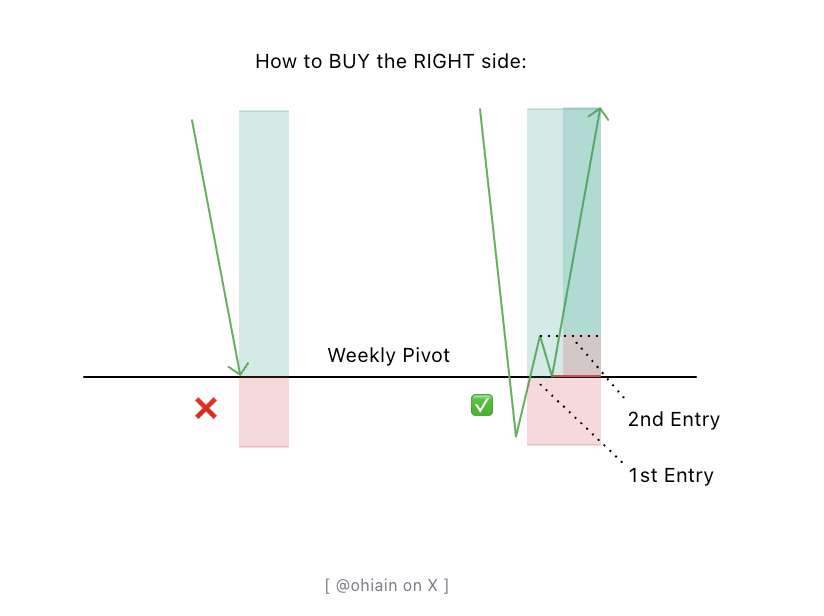
This is how I enter leadership on weakness instead:
1. Identify a leading RS stock.
2. Wait for sellers to flush it into a major weekly pivot (9EMA, 21EMA, prior breakout, weekly high/low, etc.).
3. Let the weak hands panic.
4. Watch for buyers to defend the level.
5. Enter on the 15/30min pivot reclaim.
6. Risk against LOD.
I'm not buying because I "hope" it bounces...
...I'm buying because buyers have already started proving they're willing to defend the area.
That's how I consistently buy the right side of the V with tight risk + asymmetric upside.
Save/bookmark this post!
Example:
Trading clicked for me when I stopped trying to buy the exact bottom & started FOCUSING on "buying the right side of the move."
Want better entries? STOP trying to catch the low.
This is how I consistently find asymmetric entries in leading stocks:
When I first started, I thought the best traders were the ones catching every low tick perfectly. The reality is that trying to time bottoms is incredibly difficult because when a stock is flushing lower, nobody actually knows where it's going to stop.
What I've learned is that I don't need to be the first buyer. I just need to participate when the odds start shifting back in my favor.
That's why I love seeing sellers push a stock into a major pivot that I'm already interested in. Maybe it's the 9EMA, the 21EMA, a weekly high, a prior breakout level, or another area where institutions have previously shown demand. When price starts moving into those areas, I become interested...but I don't buy immediately.
I simply wait.
I want to see how price reacts once it gets there.
The way I think about it is that the left side of the V is controlled by fear. People are selling because they're nervous, locking in profits, or reacting emotionally to the pullback. The right side of the V is where buyers start taking control again. That's where confidence begins returning to the stock...and you can visually see it!
This is why I use 15 and 30minute pivots so heavily. Once price flushes into a key level, I start looking for signs that selling pressure is drying up.
> Is the stock stabilizing?
> Are buyers stepping in?
> Is it holding the pivot?
Once I see that process begin, I'll often use the 15 or 30minute pivot high as my trigger. At that point I'm no longer buying because I "hope" the stock bounces. I'm buying because buyers have already started proving they're willing to defend the area.
This gives me extremely tight risk, with my invalidation pivot being LOD.
Could I occasionally get a better entry trying to catch the exact low? duh, of course.
But I'd much rather sacrifice a few percentage points of entry price in exchange for confirmation. The strongest trends don't care if you missed the first 1-2%. If the stock is truly a leader, there is usually plenty of opportunity ahead...
That's why so many of my trades look the same.
I identify leadership...
2) wait for controlled weakness into a major pivot.
3) watch sellers exhaust themselves.
4) then enter as momentum begins turning back up.
It sounds simple, but that single adjustment changed everything for me because my goal isn't to buy the lowest price. My goal is to put myself in positions where I can define risk clearly and participate when the probabilities start leaning in my favor.
I'd rather buy strength off weakness than weakness hoping for strength.
My 2 cents.
As simply put... I believe a leader is a stock that consistently behaves better than both the market + its peers.
A lot of people think leadership starts with indicators, but I actually think it starts with BEHAVIOR.
For example, if the market pulls back 3 days in a row and a stock barely moves, holds the 9EMA, tightens up, and then immediately makes new highs when the market stabilizes, that's leadership to me.
Some things I personally look for:
> Relative strength vs the market
> Relative strength vs its sector/group
> Trading near highs while others are pulling back
> Tight consolidations after big moves
> Strong earnings/sales or a powerful narrative
> Volume expansion on upside moves
> Respecting key moving averages repeatedly
> Quick recoveries after weakness
> Insitutional Sponorship
I think I've come to the recent realization that leaders almost feel "annoyingly strong." They don't give you the pullbacks you want & they don't stay weak for long. They keep finding buyers...
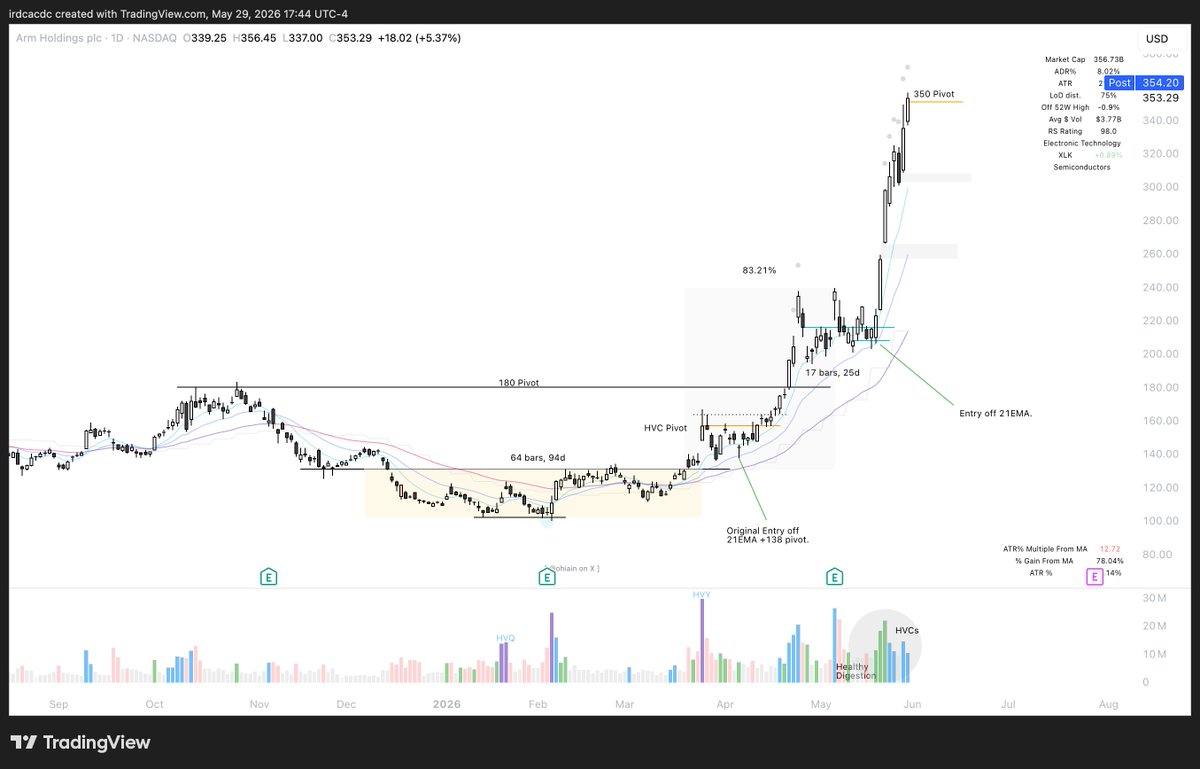
Take a stock like $ARM earlier this year. The market would have red days, and it would still close green. Then when the market turned back up, it exploded. That's the exact type of behavior I'm looking for.
I've stopped asking, "What stock can go up?" and started asking, "Which stock is already proving it's the strongest in the Market?"
Leaders usually tell you long before they make their biggest move, and every day I try to listen and react to PRICE!
"If there is no tightness, there is no trade."
This 1 concept is the biggest reason I've had my best month of 2026 so far, + I've attached 4 recent positions I've added in the last 2weeks as examples:
When people ask what I've been focused on recently, the answer is simply identifying Stage 1 → Stage 2 transitions + big bases & finding names that are compressing tightly underneath major pivots, and waiting for that tension to release.
Just look at some of my newer adds over the last 2 weeks... $RDW, $ORCL, $TEAM, $ARM.
> different industries.
> different narratives/themes
> different personalities.
Yet the charts all shared one thing in common.
TIGHTNESS.
Before the move, each name spent time compressing, absorbing supply, frustrating traders, and building energy (tension).
Most traders hate this phase because it feels boring...but I personally love this phase.
Think about a spring...the tighter you compress it, the more potential energy gets stored. Stocks behave the exact same way.
The longer a stock can:
- hold key support
- trade in a tight range
- absorb sellers
- build higher lows
- stay near highs
...the more attention I pay.
Why?
Because institutions cannot build massive positions in a single day. They accumulate over weeks and months.
The footprints they leave behind are usually...
- tight ranges
- volume contraction
- failed breakdowns
- higher lows
- repeated support at important pivots.
That's why I care so much about Stage 1 → Stage 2 transitions.
"The bigger the base, the bigger the potential move."
Not because the stock "has to" go higher...
...but because longer bases allow more supply to get absorbed, more weak hands to get shaken out, and more institutional ownership to develop before the next expansion phase begins.
Then once momentum returns (right side of V)...
BOOM. Tension → release.
and/or...
Compression → expansion.
And that's exactly what we've been seeing recently across software, AI infrastructure, defense, quantum, and other leading groups.
My process is pretty dang simple.
1. Find leading names.
2. Trade the strong groups/themes.
3. Wait for tightness.
4. Wait for controlled weakness into support.
5. Buy on the right side of the V using 15/30min pivots.
6. Let the winner work.
The market constantly rotates from one theme to another, but the behavior of leadership rarely changes.
The names change, but the process doesn't.
And right now, my process is working incredibly well!
Chart: $TEAM, $ARM, $ORCL, $RDW.
I am trying to align myself with the strongest stocks in the strongest groups while they are already proving institutional demand through price.
1) I am not looking for cheap stocks.
2) I am not looking for broken charts.
3) I am not trying to be early in names that have shown me nothing.
I want strength that is already visible, then I wait for a controlled entry where I can define risk.
My process always starts with leadership.
Before I care about the setup, I ask myself: is this name actually leading? Is it outperforming the market? Is it outperforming its sector? Is it holding up on red days? Is it reclaiming moving averages quickly after pullbacks? If the answer is no, I usually lose interest fast.
Relative strength first.
Setup second.
After that, I look at the group. 1 strong stock is interesting, but multiple strong stocks in the same theme usually means institutional rotation. That is why I constantly track semis, AI infrastructure, power, defense, quantum, software, crypto, and any group where money is clearly flowing.
Then I look for structure.
Momentum alone is not enough for me... I need tightness & I need compression. I need a place where risk makes sense.
If a stock already made a strong move, I do not want to chase the emotional candle. I want to see it pause, digest, pull into the 9/21EMAs, build higher lows, absorb sellers, and start tightening again.
That is where the opportunity forms.
The move higher creates attention + the pullback shakes out weak hands. The tightness stores energy, and once price starts reclaiming pivots again, the next move higher can happen fast.
This is why so much of my trading revolves around:
> Stage 1 → Stage 2 transitions
> 9/21EMA pullbacks
> undercut/reclaim setups
> 15/30min pivot entries
> weekly breakout structures
> tight flags after expansion
> relative strength names on weakness
The actual entry is where I get aggressive.
If a leading stock pulls into support, undercuts a key level, then reclaims and starts turning back up on the 15/30min timeframe, that is one of my favorite entries. I can place my stop near LOD or the support pivot, know exactly where I am wrong, and participate right as momentum starts returning.
If I am wrong, I lose small.
If I am right, the stock should start working almost immediately.
Momentum trading is not buying random green candles.
It is finding true leadership, waiting for structure, entering where risk is tight, and then having the patience to let the winner work.
Most of my trades are small losses, breakeven trades, or small wins.
The outlier winners pay for everything.
Simple... but NOT easy.
The big money in the market is usually made from understanding the SMALL nuances most traders completely ignore when selecting stocks.
I struggled with this exact same thing for YEARS.
When you first start improving as a trader, the hardest part almost becomes that you suddenly start seeing “setups” everywhere. Every chart starts looking interesting, every breakout feels buyable, every dip feels like opportunity… and before you know it, your focus becomes completely scattered.
What helped me the most was realizing that my edge was never going to come from trading more names.
It came from getting significantly more intentional about which names deserved my attention in the first place.
1) That’s why my process today starts with relative strength FIRST.
Before I even think about an entry setup, I ask:
- Is this stock outperforming the market?
- Is it outperforming its sector/group?
- Is it holding moving averages while others fail?
- Is volume confirming accumulation?
- Is there a strong narrative/theme backing it?
- Are institutions clearly involved?
- Is this a potential Stage 1 → Stage 2 transition?
- Is the group itself showing signs of leadership?
That immediately cuts down 90% of the names for me.
There are ALWAYS going to be “setups” on random charts...but not every setup deserves your capital or your mental energy.
2) The next thing that helped me massively was building watchlists with INTENTION.
I stopped trying to watch 100 names equally.
Now I usually have:
> a few true leaders I deeply understand
> a few emerging themes/groups
> a smaller handful of names actively setting up
And then I basically stalk those names all day waiting for MY entry model:
controlled weakness into support, 9/21EMA pullback, 15/30min pivot, undercut/reclaim, tightness, volume contraction, momentum turning back up.
Once I simplified things down like that, conviction naturally started increasing because I actually understood WHY I was taking trades instead of randomly reacting to candles all day.
And another thing���
Confidence usually comes AFTER repetition.
A lot of traders think confidence magically appears first, but for me confidence came from seeing the SAME setup work repeatedly over hundreds of examples.
That’s why I constantly preach backtesting and studying prior winners. The more intentional screen time you get, the easier it becomes to recognize:
“Okay… THIS is real leadership.”
vs.
“This is just random participation.”
So if you feel overwhelmed right now, that’s normal. It probably just means your eyes are improving faster than your process is narrowing things down.
The solution usually isn’t finding MORE setups.
It’s learning how to become dramatically more selective.
1) “Is this stock going up?”
2) “Is this stock a true market leader?”
There’s a massive difference.
Most stocks can bounce, but very few become leaders.
A leader is a stock institutions continuously come back to. It outperforms the market, holds trends longer than expected, respects key moving averages, attracts volume on expansions, and consistently gets bought on pullbacks.
These names almost feel “easy” during strong environments because demand stays persistent continuously.
For me, relative strength is the #1 starting point.
When the market is weak, I’m watching which names refuse to break down. If $SPY and/or $QQQ are red and a stock is holding flat or green, that immediately gets my attention. Strong stocks tend to act like beach balls underwater...the longer they resist pressure, the harder they move once market conditions improve.
And that’s leadership.
I also pay close attention to how a stock behaves around key moving averages, especially the 9EMA, 21EMA, and 50day. True leaders don’t usually give you deep, emotional pullbacks during strong trends. They pull into support, tighten up, volume dries up, and then buyers step back in aggressively.
Weak stocks feel heavy, and leaders feel supported.
Another huge tell is how the stock reacts after earnings or catalysts. A lot of stocks can gap up one day. Very few can hold those gains for weeks while continuing to build tight consolidations near highs. That’s usually institutions defending positions, not retail traders randomly buying candles!
I’m also obsessed with Stage 1 → Stage 2 transitions because that’s where many future leaders first emerge.
I focus on large multi-month bases because they represent accumulation. The larger the base, the more potential energy gets built for a move higher. Once supply finally gets absorbed, those names can trend for months longer than most people expect.
And honestly, one of the most underrated parts of identifying leaders is simply studying thousands of charts.
Through time, you begin recognizing certain characteristics:
-tight price action
-strong closes
-pullbacks get bought up
-persistent relative strength
-expanding volume on breakouts
-orderly consolidations instead of erratic PA
Leadership leaves clues, and the mistake I made early on was trying to force laggards because they “looked cheaper” or “hadn’t moved yet.”
In reality, the best traders I studied kept buying the strongest names in the strongest sectors over and over again.
That felt uncomfortable to me at first.
But eventually I realized institutions don’t care if something already doubled. If the story, flows, and demand continue strengthening, they keep buying. That’s why true leaders often go much further than people think is rational.
Now my entire process revolves around finding those names early, managing risk tightly, and pressing when the market confirms I’m aligned with real leadership.
Because stock selection is everything!
A mediocre trader in a true leader often outperforms a great trader stuck in weak names.
If you’re a beginner or even a 1 or 2 years in, and you’re not obsessed with drawdown control, you’re focusing on the wrong thing.
I used to do the same thinking about upside, targets, “how big this 1 trade could be”… but none of that matters if you can’t stay in the game. The traders who last aren’t the ones calling the biggest moves, they’re the ones who keep losses small when they’re wrong.
It's the only business where losses are guaranteed in this game.
The only thing you actually control is how much you lose when you’re wrong...and that’s what determines everything long term.
Translation: protect your downside or the market will humble you for free.
There are infinite ways to identify leading sectors/industries in the markets.
and you can spend thousands on premium scanners and data feeds if you want to.
but I'm going to share with you an approach that costs absolutely nothing and takes less than 5 mins a day to complete.
Here’s a simple way I do it:
1) Go to Finviz (free)
2) Click Groups → Industry
3) Check 1 week/1 month performance
4) Track the top sectors in a watchlist
From there, add or subtract the leading names in those sectors/themes.
That’s it, keep it simple.
I think one of the biggest mistakes I made early in my trading journey was overcomplicating this process by trying to use ten different tools, screeners, and custom indicators when all I really needed was a simple, repeatable system that I could execute every single day without thinking!!
The big principle here is that less is more.
and having a simple approach that you actually follow consistently is infinitely more valuable than having a complex system that you only use when you feel like it or that paralyzes you with too many choices.
First, I go to Finviz, which is completely free and accessible to anyone with an internet connection, and I click on the "Groups" tab at the top of the page, then I select "Industry" from the dropdown menu.
From there, I check the one-week and one-month performance columns to see which sectors and industries are showing the strongest relative performance compared to the rest of the market, because if a sector is up 8% over the past week while the SPY is only up 0.5%, that tells me there's real money flowing into that space and it deserves my attention.
I'm not looking for sectors that are down 5% and "look cheap" or "seem due for a bounce," I'm looking for sectors that are already working, that are showing persistent strength, and that have momentum behind them because that's where the institutional money is going and that's where the best setups are going to come from.
Once I've identified the top 3 to 5 sectors based on that one-week and one-month performance data, I track those sectors in a dedicated watchlist and then I start drilling down into the individual leading names within those sectors.
What I'm doing is adding the strongest names that are showing strong structure, relative strength, and volume confirmation while subtracting any names that start breaking down or losing momentum.
That's literally it.
That's the entire process, and it's so simple that you could teach it to someone in under two minutes.
...but the power comes from doing this every single day without fail so that you're constantly aware of where the money is rotating in real time.
The simplicity here keeps you aligned with real market behavior instead of getting lost in noise, opinions, or narratives that don't actually have money behind them, because at the end of the day, the market doesn't care what you think should work or what looks attractive on paper.
...it only cares about where the money is actually flowing, and if you can train yourself to follow the money instead of fighting it or predicting it, you'll be miles ahead of the majority of traders who are still chasing what looks cheap or betting on reversals that never come.
Focus on where the money is moving, keep your process dead simple, and let the market tell you what's working instead of trying to impose your own narrative on it.
I'm speaking to my younger self here.
again there are infinite ways, but keeping it simple will help in the long run!!
because that shift in mindset alone saved me years of frustration and wasted effort.
I used to pick perfect chart patterns in dying sectors and wonder why they never moved, until I learned to follow the money first.
I used to pick stocks in a vacuum. I'd find a beautiful chart pattern, enter with confidence, and watch it go nowhere while stocks in another sector ripped 20%.
That changed when I started treating sector rotation as my primary filter.
Here's a simple process you can follow:
Every Sunday, I review the eleven sector ETFs.
$XLK, $XLF, $XLE, $XLV, $XLY, $XLP, $XLI, $XLC, $XLRE, $XLB, and $XLU.
I'm looking at their weekly charts to see which sectors are absorbing capital and which are bleeding it.
I rank them by relative strength against $SPY and $QQQ over the past 4 and 12 weeks.
The top three get my attention.
The bottom three get blacklisted.
I don't care how pretty an individual stock looks if its sector is getting sold.
Then I drill down to individual stocks within the leading sectors. This is where stage analysis becomes a piece to the puzzle.
I'm hunting for stocks/sectors that have built large, multi month/year stage 1 bases... those long, choppy consolidations where a stock goes sideways after a prior move.
The longer the base, the bigger the potential move when it breaks out. I want to see multiple weeks built out on the weekly chart... but a great weekly base isn't enough.
I rotate down to the daily timeframe to assess if the risk/reward is actually there.
Is the stock coiling tight?
Are the daily candles contracting in range?
Is it riding along a rising 9/21 or 50EMA?
I'm looking for asymmetric setups where I can risk little to make 5-10x my risk. If the daily is too loose or choppy, I pass, even if the weekly looks perfect.
I also watch for the rotation warning signs.
When a leading sector starts making lower highs, or when its top holdings begin breaking support levels, I tighten stops and reduce exposure, because sector leadership doesn't last forever.
For example, within the recent months Technology led, then money rotated into financials and industrials.
The edge is to simply trade with the current, not against it.
When a sector has institutional money pouring in, individual stocks within it get lifted. Your mediocre setup in a hot sector will outperform a perfect setup in a weak one.
With this method, I'm no longer fighting the market's underlying currents.
I'm identifying where capital is flowing, finding stocks with big bases within those leading sectors, and waiting for the daily chart to tighten up before entry.
Keepin' it simple and repeatable!
I see a lot of newer traders obsessing over entry tactics as if they're the holy grail of trading success.
and I completely understand why, because when I was starting out, entries felt like the most tangible thing I could control and perfect.
I would see someone post an ORH breakout that worked beautifully, or a VWAP reclaim that led to a massive winner, and I thought to myself:
"If I can just master that specific entry, I'll be profitable."
so I spent months backtesting opening range breakouts, studying pivot reclaims, trailing moving averages, and perfecting my execution down to the second.
...but what I wish someone had told me when I was going through that phase is that if I had focused on tracking where the money was actually going (aka):
which sectors institutional buying was rotating to
which themes had institutional sponsorship
which names were showing relative strength
I would have progressed exponentially faster than I did, trying to perfect my entry timing.
What I learned is that if you're already looking in the right place, if you're trading the leading names in the hottest themes with the wind at your back, it rarely matters if you enter in the morning, midday, or afternoon.
I can't tell you how many times I've seen the ugliest chart you can imagine work beautifully in a strong market with a hot theme behind it.
While the perfect textbook setup in a weak environment or a dead sector goes absolutely nowhere and chops you up for weeks.
I always ask myself:
Would I rather have the cleanest entry on a stock that nobody cares about in a sector that's bleeding, or would you rather have a sloppy entry on a leading name in a theme that's ripping with volume and institutional buying?
The answer is obvious when you put it like that, but so many traders, including my younger self, get it backwards because we're conditioned to think that precision is the same thing as edge.
Early in my journey, I fell into this exact trap where I was trying to copy entries exactly as I saw them online (buy the ORH, stop at LOD, trail with the 9 EMA) and sometimes it worked, and when it did I thought I'd finally cracked the code and figured out the secret.
...but more often than not, the trades failed, and I couldn't explain why.
because the problem wasn't the tactic itself but rather that I didn't understand when and why that tactic should be used in the first place.
I was copying outcomes without copying the thinking that led to those outcomes, and that's a recipe for frustration and inconsistency because you're essentially flying blind and hoping that if you just execute the mechanics perfectly, the results will follow.
What most people miss is that entry tactics are simply tools, not strategies, and an ORB works best in a strong environment with expanding breadth and real momentum carrying names higher, while a VWAP reclaim is powerful when it aligns with higher timeframe structure and real institutional participation behind the move, etc.
Recently, for example, undercuts and reclaim entries on the daily off moving averages have been working incredibly well in this environment.
...where back in September through November, buying ORB breakouts was far more effective than buying undercuts because the market was in a different phase with different characteristics.
The work that rarely gets shown and that nobody wants to talk about happens before the entry, and it's understanding the environment:
Is the market trending or choppy?
Are we in expansion or contraction?
Are leaders behaving well or distributing?
Is volatility supportive of momentum trades or mean reversion?
These are the questions that dictate which entry tactic even makes sense, because the same ORB that works great in a trending tape will destroy you in a range-bound one, and if you don't understand that context, you'll keep blaming your execution when the real issue is that you're using the wrong tool for the wrong job.
Here's what I would tell my younger self if I could go back:
Focus on entry tactics second.
First, focus on finding relative strength, identifying sector rotations, and trading the names that have the wind at their back first.
because if you're in the right place at the right time, the entry becomes almost irrelevant.
I also would ask myself:
Would you rather be the trader who has perfect entries but is constantly fighting against weak sectors and dying themes, or would you rather be the trader who has average entries but is trading the leading names in the sectors where all the money is flowing?
I know which one I'd rather be, because I've been both, and I can tell you from experience that trading with the money is infinitely easier than trying to pick pennies off the floor in sectors that nobody cares about.
There's also a psychological layer that gets ignored when people fixate on entries, which is that conviction doesn't come from memorizing a rule or copying someone else's tactic... it comes from earning trust in a process through repetition, through studying hundreds of charts, taking trades, reviewing them honestly, and refining what works for your specific tendencies and edge.
Until you do that work, you won't know when to press, when to pass, or when to cut quickly, and you'll hesitate and override your rules at the worst possible moments.
and this isn't because you're undisciplined but because you lack the conviction that only comes from screen time and personalizing your system.
So if you're a beginner or intermediate trader and you're still obsessing over whether you should buy the ORH or wait for the VWAP reclaim, I'd encourage you to zoom out and ask yourself a bigger question:
am I even looking in the right place?
because if you're trading the right themes,
the right sectors,
and the right names with relative strength,
the entry becomes a detail, not the deciding factor.
and that shift in perspective is what helped me go from spinning my wheels perfecting mechanics, to someone who can actually pull money out of the markets consistently.
I obsess over tight setups, and this is something @RealSimpleAriel has drilled constantly into my brain.
Pretty charts don’t guarantee a single lick. Theme, leadership, RS, defined risk, and market context are what separate "high probability setups" from charts that just look good.
and recognizing that only comes from studying past winners and losers and putting in the reps.
I trade entries with the highest potential risk multiples, therefore it’s never just “what’s your setup?”
It’s always what’s my risk?
Tight setups are simple:
Break above your trigger = enter
Break below after entry = stop out
No defined risk? No real setup.
I focus on risk first, because that’s my edge.
- EMA surfs/PBs
- Stage 2 B/Os
- ATH B/Os
- flat pivots
all clearly defined risk.
Big bases compress, coil, and build pressure, and when that pressure releases, the only question is...
how far can it go?
Everyone says “trade the leaders,” but almost nobody explains what that actually means in practice.
and most people hear that phrase and think it means buying the stock that’s up the most that day.
That’s not leadership... that’s chasing. Real leaders are identified before the crowd, before the breakout becomes obvious, and before the easy trade turns into a painful one.
This post is how I personally do it, step by step, using a top down process that’s been shaped by a lot of mistakes, a lot of screen time, and a lot of hard earned lessons.
Save this, because it’s the framework I come back to over and over.
1) Theme: Start with where money is flowing.
This is always step one for me, because money in the markets does not move randomly. It rotates, and institutions allocate capital into narratives they believe have durability, for example, AI, quantum, energy, rare earths, aerospace, whatever the cycle is rewarding at the time.
I’m not trying to predict the next theme at the exact bottom. My job is to recognize when capital is already leaning in.
The earlier you identify a theme that institutions care about, the more asymmetric your opportunity becomes.
If you skip this step and jump straight to charts, you’re...
"fishing without knowing where the fish are"
2) Leaders: Separate strength from weakness.
Once I know the theme, I want the leaders, not the entire group.
Leaders are the names that:
- Hold above rising EMAs
- Make higher highs and higher lows
- Refuse to break down when the market/sector chops
- Show clear relative strength versus their peers
This is second nature for me now, because I can look at a chart for a few seconds and usually tell if it’s a leader or a laggard.
A stock can have a beautiful technical setup and still be a laggard if its peers already have broken out and ran.
My goal isn’t to buy what’s cheap... It’s to buy what’s in demand by institutions.
3) Setup: Structure creates asymmetry.
Great themes and strong leaders still need structure, and this is where most traders get impatient.
I’m looking for compression, tightening ranges, declining volatility, and volume behaving properly.
I want clear levels where I’m wrong, because the best setups give me a small downside and open ended upside.
That’s asymmetry, because the structure supports it.
No structure = no trade.
I don’t care how good the story/narrative is.
4) Risk: Define it before you click.
Every trade has an invalidation pivot defined before entry. ALWAYS. Risk must come first!
Even the best setups fail.
Risk management isn’t about avoiding losses... it’s about surviving long enough to catch the outsized winners.
I size positions based on where I’m wrong, not on how confident I feel.
A small loss is tuition.
A big loss is ego.
This step alone keeps me alive long enough to improve.
5) Patience: "Let the trade come to you."
This was one of my biggest struggles early on.
I used to know exactly what I wanted to buy, and then buy it too early. If you chase before price confirms your thesis, you’ll spend more time managing pain than managing profit.
...and 99% of the time leaders don’t disappear overnight.
so if you miss it, wait.
There’s almost always another entry if the stock is a true strong leader.
6) Entry: Execute without emotion.
When my setup triggers, execution should feel boring and robotic.
No hesitation.
No second guessing.
No scrolling X for validation.
The thinking was done before the trade, so when the moment comes, I execute the plan I already committed to.
Emotionless execution is a skill, and it only comes from preparation.
7) Patience (again): Let winners work.
This is where most traders sabotage themselves.
The “see green, take green” mindset kills scalability, because if you’re constantly taking small profits but letting losses grow, the math will never work.
Once risk is protected, I want to give my winners room to breathe.
Leaders tend to trend longer than you expect, but only if you don’t micromanage them to death.
8) Trust: Systems over feelings.
If you’ve built a process rooted in logic, repetition, and experience, trust it.
Emotion is what breaks traders, and systems are what build them.
There is no “I made it” moment in trading (I’m still learning every day) but trusting a sound process removes so much unnecessary stress and noise.
9) Exit: Structure decides, not your own EGO.
Whether I’m trimming into strength, trailing stops, or cutting when invalidated, the exit is dictated by structure.
I’m not trying to catch the exact top or bottom.
I want the middle of the move (the repeatable part), and I’m happy to leave the rest.
Consistency beats perfection every single time.
10) Go touch grass!!
like seriously.
Step away.
Reset your brain.
Clear your head.
If you’re glued to every tick, you’re not seeing the bigger picture... you’re just feeding your anxiety.
Trading is a mental game as much as a technical one.
Go touch grass and come back sharper, because the markets will always be here!!
This is how I trade leaders.
...and no it’s not flash or beasy, but it’s repeatable, scalable, and rooted in my own process!
If this helps even one trader slow down, think differently, and trade with more intention, it was worth writing.
Happy Sunday, and God bless! HAGW.
If you want to know where the next real money will be made, stop staring at setups and start tracking names refusing to go down.
This is a lesson the market has reinforced for me over and over, and it’s why I’ve become almost obsessive about one rule:
Relative Strength first, setup second... ALWAYS.
I learned this the hard way, and it’s something I’ve really internalized from @jfsrev.
...like yes, setups matter, but relative strength tells you where you should even be looking in the first place.
back in early December, I wrote about favoring $RKLB over $ASTS purely through a relative strength lens.
Same general space.
Same broad theme/narrative.
but the behavior was different.
Since the Nov 21 bottom, $RKLB has run roughly +140%, while $ASTS is up about +106%. Both great moves, but the quality of the move matters.
$RKLB has been far more linear and controlled, while $ASTS has been choppier and harder to manage.
Relative strength isn’t about who’s up the most on a single day. It’s about how a stock behaves when conditions aren’t perfect.
In choppy or uncertain environments, most names stall and fade lower. The ones that hold firm, absorb supply, and continue to press higher are telling you where demand actually is.
Institutions don't make it super obvious... but price and behavior give them away.
This is where most traders get it backwards. They hunt for what looks “cheap,” what pulled back the most, or what they think should bounce harder.
Relative strength forces you to do the opposite.
It asks a much simpler and more honest question:
Which name is already acting right?
Because if a stock can outperform while the market is neutral to weak, imagine what happens when conditions turn fully risk on.
I still like the beach ball analogy for this:
When you push a beach ball underwater, you’re storing energy. Stocks with true RS are the ones that refuse to stay submerged. Even when the market presses down, they keep popping back up.
...and when that pressure finally eases, those leaders launch!!
That’s why I favored $RKLB over $ASTS, and it’s why I continue to anchor my process around relative strength.
It’s a leading indicator, and it simplifies my approach, aligns me with real demand, and keeps me focused on the names most likely to become leaders (not followers) when the next wave of momentum hits.
Relative strength doesn’t just help me find better trades, most importantly, it helps me avoid the wrong ones.
...and in my experience, RS is a crucial piece of the puzzle!
Most people’s 2026 will look EXACTLY like their 2025. No part of their life will change. They won’t change. That’s the reality.
Change takes intention. Change takes daily actions different from what we’ve been doing. Change can start today.
Good reminder from @JamesClear
Great question! This is one of those subjects that is very important in my process.
I’ll start with how ADR% and ATR fit into my process, then go deeper into the why, the psychology behind it, and the specific rules I follow.
Bookmark this one, it’s a core filter in my system:
One of the most common questions I get is how I use ADR% and ATR in my process, and more importantly, why they both matter to me.
this isn’t a "surface level" filter or some random indicator I glance at after the fact... it’s baked directly into how I think about momentum, risk, and opportunity before I ever consider a setup.
I’m an aggressive short term momentum swing trader.
That single sentence explains almost everything.
1) I’m not trying to trade slow stocks.
2) I’m not trying to wait weeks for an idea to "maybe" work.
I want to be involved in the hottest stocks, in the hottest themes, where price moves quickly and feedback is fast. Momentum, by definition, requires movement, and ADR% and ATR are how I objectively measure that instead of "guessing."
ADR% gives me a condensed snapshot of how much a stock typically moves on a daily basis, expressed as a percentage. Psychologically, this matters more than most realize, because a stock with a 1–2% ADR might look “clean” on a chart, but for my style, it’s pretty much dead money.
like yeah, stops feel tight, follow through is slow, but opportunity cost quietly eats away at you and take ahold of your mental capital.
That’s why I don’t trade stocks below 3% ADR, and why my sweet spot lives between roughly 4-8%. In that range, stocks move enough to reward being right quickly, but not so violently that risk becomes unmanageable.
Higher ADR names can still work, but position sizing and execution need to be much tighter.
ADR% helps me answer a simple question very fast:
"If this stock works, will it actually move enough to matter?"
If the answer is no, I simply move on.
because momentum for my process is about velocity, not just direction.
ATR adds another layer. While ADR% tells me how much a stock tends to move, ATR helps me understand where I am relative to that movement. One of the most important ways I use ATR% is measuring extension from the 50 MA, which for me is a major line in the sand.
I track ATR% multiples from the 50 MA because it immediately tells me if a stock is still near its “launchpad” or if it’s already stretched. This is something I’ve learned directly from studying Kristjan @Qullamaggie and refining it for my personality over time.
There’s a reason he’s so strict about not entering trades when a stock is extended more than 4x ATR% from the 50 MA.
When price is too far from that base, risk/reward compresses. Pullbacks become sharper, continuation becomes less reliable, and entries turn more emotional instead of structural. My r/r starts to become skewed.
ATR% also keeps me honest with risk.
My stop is almost always the low of the day on entry, and if the distance between my entry and that stop exceeds what the stock normally does in a day, that’s a warning sign to me. It usually means I’m late, chasing, or forcing something that already moved.
Ideally, my risk fits comfortably within the stock’s normal ADR or ATR behavior. If it doesn’t, I pass. I’d rather miss the trade than carry skewed risk from the start.
Another subtle but important nuance is how much of a stock’s daily range has already been used.
If a stock has already moved a large percentage of its ATR for the day, I’m much less interested in initiating. That doesn’t mean it can’t go higher, but it just means the odds of chop or a pullback increase.
I want to be early in a move, not late in it.
At a deeper level, ADR% and ATR help me stay aligned with who I am as a trader. I want fast feedback, and I want clarity. I want trades that either work quickly or tell me I’m wrong quickly.
... and high-momentum/high beta stocks provide that. Slower stocks make me overthink, micromanage, and cause unnecessary stress.
These tools don’t tell me exactly what to buy, but they do tell me what’s worth my attention. They filter out names that don’t fit my tempo, protect me from chasing extension, and force me to respect risk.
I combine these concepts, paired with environment, sector strength, leadership, and strong structure.
Also, nothing about this is flashy, but it’s repeatable... and over time, that’s what compounds.
If you’re going to study anything from this, study how stocks move, not just how they look.
because that’s where the real edge starts to form.