Hoping to release tokenomics info for Lithos Protocol in the next few days.
If you mined Lithos test net please pay attention as you will be the first to receive initial tokens. 🫡
This needs to happen before the main net release, this would allow some time for initial miner collateral UTXOs to be created.
Matrix: fast confirmations coming to Ergo!
In 2026, it is known that Proof-of-Work consensus protocols, via such extensions as Prism, Parallel Proof-of-Work, or TailStorm, can achieve unbeatable throughput and also fast confirmation times.
After research, ideas from such protocols were adopted for Ergo setting and resulted into Matrix design.
First Basis note transferred off the grid. We need for some more testing. Then doing blueprints for use cases like African villages. Another direction is agent-2-agent interactions with credit expansion on top of human-provided base smart money.
P2P money for humans & agents
Thomas Massie's opponent in the Kentucky 4th GOP primary ran a Biden 2020 campaign - from his basement.
No debates, no rallies, no interviews.
So how did he achieve an historic number of votes from the district?
People are talking...
Watch @RonPaul & @DanielLMcAdams below:
@shivam140307@reh191@DanoFinance USE is an algorithmic stablecoin backed by ERG, mintable at a 1:1 ratio. The peg is maintained by an algorithmic central bank that intervenes whenever the price starts deviating.
A completely unique design based on @chepurnoy’s research.
Follow links in profile to find out more
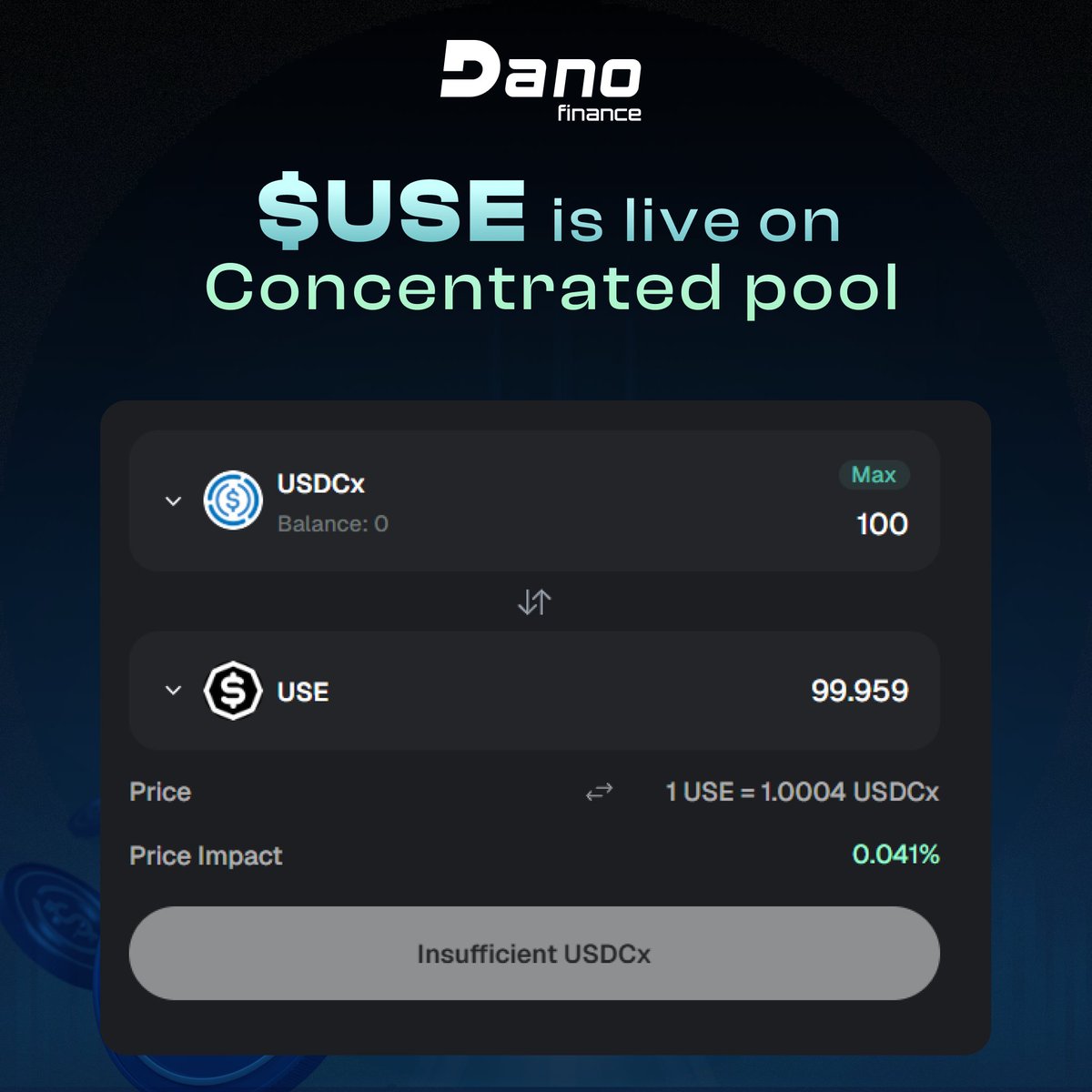
🔥 $USE is now live on Concentrated Pool on @DanoFinance
DanoFinance is the first DEX to support swaps for the USDCx - USE pair
Swap with lower slippage and better execution, powered by concentrated liquidity.
Trade smarter. Swap smoother.
More pairs coming soon.
Ever wished your liquidity positions could earn fees like a real asset?
Tradable position like a revenue bond?
PlasmaDEX is working to make it happen on Ergo.
AVL-based tracking + NFT ownership = a new revenue primitive.
Public testing is live in the Lithos V4 Client.👇
Update @LithosProtocol
Node synced, tested launch script for LP and emissions contract, fixed some bugs in emissions contract, and modified the sync process for the LP so that it is only synced on demand
Syncing is needed for changes in liquidity and for claiming fees, not for swaps.
Hoping to wrap things up and post the update to testnet on Sunday morning.
Would have preferred a bit earlier but life happens.
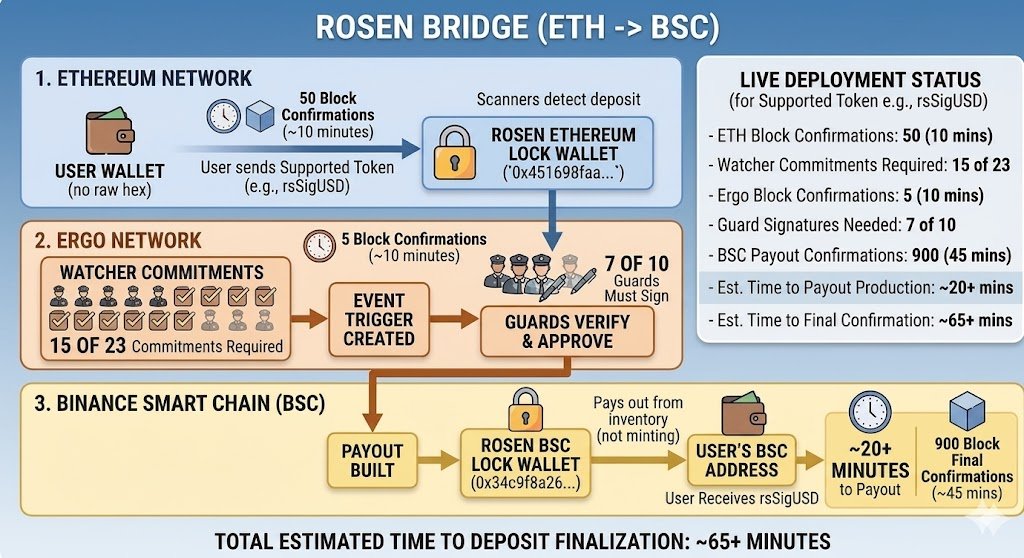
Assumptions are very clear with @RosenBridge_erg
Say we are going from ETH -> BSC
- user sends token to a msig like address on ethereum controlled by a guard set of 7/10
- watchers (decentralized) of 15/23 bring this event on to ergo blockchain where at least 15 watchers need to validate the event actually exists on ethereum and post about it on ergo
- at least 7 guards need to then verify this claim then only releases asset on BSC from another 7/10 msig like address
watchers can join us at ANYTIME and earn rewards while contributing to decentralization and security
Now consider KELP's LayerZero bridge
- user sends token to contract
- contract burns token
- DVN (equivalent to guard-watcher) ran by LayerZero verification and ONLY ONE verification required
- executor delivers message to ethereum where a contract unlocks the token on the ethereum side
To put the exploit in the simplest terms, the 1/1 DVN infrastructure was hacked.
Draw your own conclusions. Know your assumptions.
I added some gemini drawn visualizations of how the bridges work.
Things are looking good for a launch of Lithos Protocol on Mainnet next week.
Crypto has incedibly short term hype cycles markets trying to create and chase narratives.
Lithos took over 3.5+ years to get to this point.
That is a long time in the crypto space. A lot of shiny things, populist narratives came and went in that period.
The goal here was never hype, it was for the purpose.
On chain mining pools that finally push PoW toward the highest Nakamoto coefficient. It's a powerful and unique tool.
Patience is building power slowly.
Mainnet next week. Proud of that grind.
Run it.
6 months ago KuCoin admitted fault for my $300K liquidation. Here's what happened since.
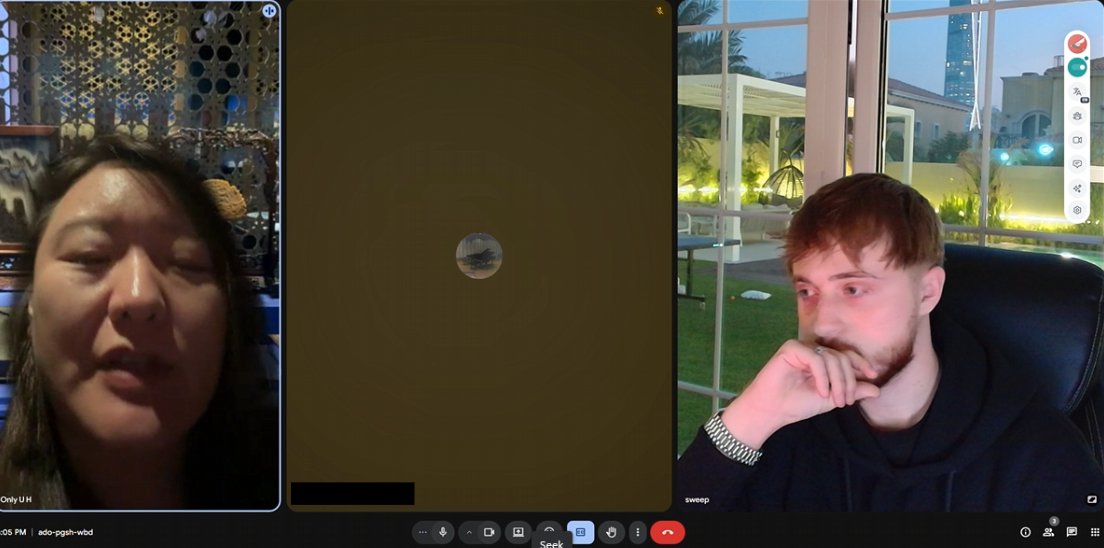
I took a Google Meet with their Head of Futures. I went to an in person meeting at Tribes in Dubai Mall with their Global Business Director. I sent 10+ proposals. I gave them every possible way to make this right.
On the call they took full responsibility. They admitted the liquidation was caused by broken infrastructure. Their platform failed and they said so themselves.
But here's the part that's hard to believe. Their Head of Futures couldn't understand basic futures mechanics. I had to explain how margin, liquidation and order book depth works to the person running the futures division at a top 10 exchange.
The person responsible for resolving my case didn't understand the product that caused it.
Their first offer: bring us $2.5 billion in trading volume and you can "earn it back." I did the math for them live in the chat. $10,000 per 100M volume. That's 0.01% return. To recover $250K I would need to generate the monthly volume of a top 50 institutional desk. For free.
I said no.
Their second offer was worse. $20K upfront, but only if I hit 1,000 active users and $300M in volume first. Then a $30K "cashback" that requires KuCoin's manual approval.
I said no again.
Their third offer was even worse than the second. $10K/month. Halved the numbers from the deal they already couldn't close. After an in person meeting. After a Google Meet. After weeks of negotiations.
Every single offer came with the same condition: delete the tweets, stop talking, and come work for us as a KOL. Promote the exchange that wrongfully liquidated me. Bring them users. Make them money. Then maybe they'd consider giving back what they took.
I told them in the chat: "It's like someone steal from me $250K and then tells me come work for me and you'll make it back (maybe)."
Their response? "Let me think about it."
Then silence. Weeks of silence. I had to chase them for every single reply. Christmas came and went and I gave them a final deadline January 6th. They came back with yet another lowball.
KuCoin had their Head of Futures, their Global Business Director, and multiple senior reps in this group chat. They all saw every message. They all went quiet when it mattered.
Today I'm releasing the full 30 minute Google Meet recording and the complete Telegram history. Every message. Every offer. Every time they went silent. You'll hear them admit fault and then watch them do nothing about it.
They had 6 months to make this right. They chose silence.
Video drops today.
@Armeanio’s essay perfectly diagnoses the pathology of modern crypto: much of what the industry celebrates as "protocol revenue" is simply digital corporatism, a technocratic rebranding of traditional Payment for Order Flow (PFOF). Lithos is the exact structural antidote required to democratize the PoW base layer.
But if we follow this logic to its natural conclusion, we must confront the next frontier of rent extraction: Layer 2 rollups.
The broader industry has accepted centralized L2 sequencers as a "necessary evil" for scaling. But this centralization isn't a temporary cultural failing; it is a matter of architectural determinism.
The EVM Account Model relies on a global, synchronous state. When thousands of users interact with a smart contract, they are fighting to overwrite the exact same shared ledger. To prevent a chaotic collision of concurrent transactions, the architecture strictly requires a centralized arbiter to act as a traffic cop and organize the queue.
By design, that arbiter becomes the ultimate Order Flow King. They are granted total visibility over the mempool and an exclusive monopoly on MEV extraction.
This is where Ergo’s architecture moves from a technical nuance to a structural necessity.
The eUTXO model fundamentally alters the physics of execution. Because state is local, perfectly partitioned into isolated, independent boxes rather than a shared global whiteboard, transactions are inherently asynchronous. They do not naturally collide. Consequently, an L2 built on Ergo doesn’t strictly need a monopolistic sequencer to dictate order.
If an intermediary ever attempts to extract rent, censor a user, or sandwich a trade, the eUTXO architecture natively allows that user to generate their own local state transition, bypass the middleman entirely, and settle permissionlessly on L1. You cannot be a King of Order Flow if your users can mathematically walk around your tollbooth.
But here is the critical synthesis that most modular theorists miss: an L2 "escape hatch" is purely theatrical if the underlying Layer 1 is controlled by a builder cartel. A malicious L2 sequencer will simply bribe the L1 cartel to censor your exit.
This is why these pieces must exist together. Lithos immunizes the L1 base layer against capture. eUTXO immunizes the L2 execution layer against monopoly.
You cannot build a non-extractive L2 on a shared-state EVM, and you cannot enforce a fair L2 on a captured L1. Ergo is quietly assembling the only complete, mathematically rigorous immune system left in the space.