@arvindpawan1 At the undergrad level, I would have loved the ability/independence to take a bunch (> 5 or 6) of technical electives from other engineering & science departments, rather than be tied to strictly departmental offerings.
Humbled to think of all my dad has done to develop Li-ion batteries despite life challenges- his dad passed away when he was just 2 mo. old and he initially decided to not go to college to instead support his family. Read his story here in @Bloomberg! https://t.co/5MPrPh0WlW
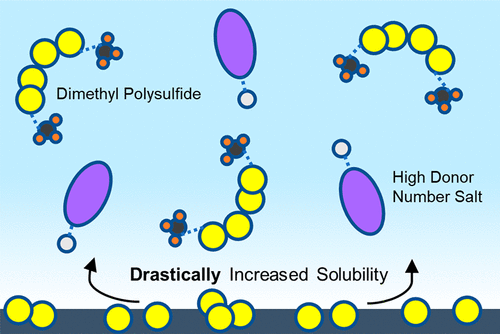
New paper out in ACS Energy Letters! In this work, we develop an understanding of the joint effects of high donor number compounds and organopolysulfide conversion on the discharge behavior of lithium-sulfur batteries. Lots of fun insights into solution-coordination behavior!
@AhmedElabd44 Thanks for the great questions! Really awesome to hear your thoughts :). Yeah we did, DMA and MeIm are so reactive that it’s honestly hard to get more than a few cycles
@AhmedElabd44 SEI alone wouldn’t necessarily be the dominant contributor, as dimethyl polysulfides have been shown to reduce on Li-metal into better SEI-forming species than lithium polysulfides. However, definitely a great point, the SEI certainly plays a large role.
@AhmedElabd44 Great question! In Li-S batteries, increased CE (>100%) is associated with heightened polysulfide shuttling (back & forth reduction/oxidation of polysulfides during delithiation). High donicity amplifies this solution-mediated behavior, both for better (capacity) and worse (CE).
Evoking High-Donor-Number-Assisted and Organosulfur-Mediated Conversion in Lithium–Sulfur #Batteries, a Letter by Abhay Gupta, Amruth Bhargav, and Arumugam Manthiram @UTAustin https://t.co/ui4tnEijdd
@BrianTHeligman@ArtirKel Both the sulfate-free process as well as the NaCl ion exchange with clays (?) definitely seemed to come out of left field. Not entirely sure what they’re signaling at. Would definitely like/need to hear more details from Tesla!
@alexjadecove Learned a lot from your presentation! Curious to know what the major bottlenecks are with DLE technologies, including electrochemical ones.
@BrianTHeligman In terms of an optimization problem, negative emissions techh would probably have positive affects on a lot of systems i.e ocean acidification and corals. Direct air capture at scale maybe?
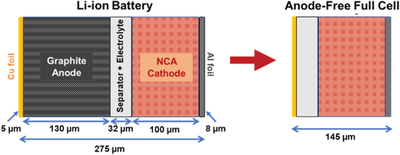
Had a lot of fun working on this review! There's been some great work done in recent years on developing anode-free cells, and it will be exciting to see how this cell format further develops moving forward. #battchat