focused at livestock parentage of infants & promotion of human - animal relationship in inclusion of indigenous species as global demand leave them untraceable
“Giant tick” attacks: dynamics of Hyalomma lusitanicum and detection of Rickettsia sibirica mongolitimonae in southern France [July 2026]
#openaccess : https://t.co/BaWbAObLWL
Cheyletiella skin mite from a canine fecal. The mouth of Cheyletiella has two large prominent curved papal claws that point inwards. Infestation can be very contagious, especially among young animals or those who are immunosuppresed #parasitology#parasites#vettech#veterinária
Processing and mounting phlebotomine sand flies: a consensus guideline
https://t.co/skTiX7DSiL
Nearly 5,000 views already!
This paper is set to become a defining reference for sand fly research over the next 20 years.
And to make it even better: it’s fully translated into 30+ languages
New in the Journal of Parasitology:
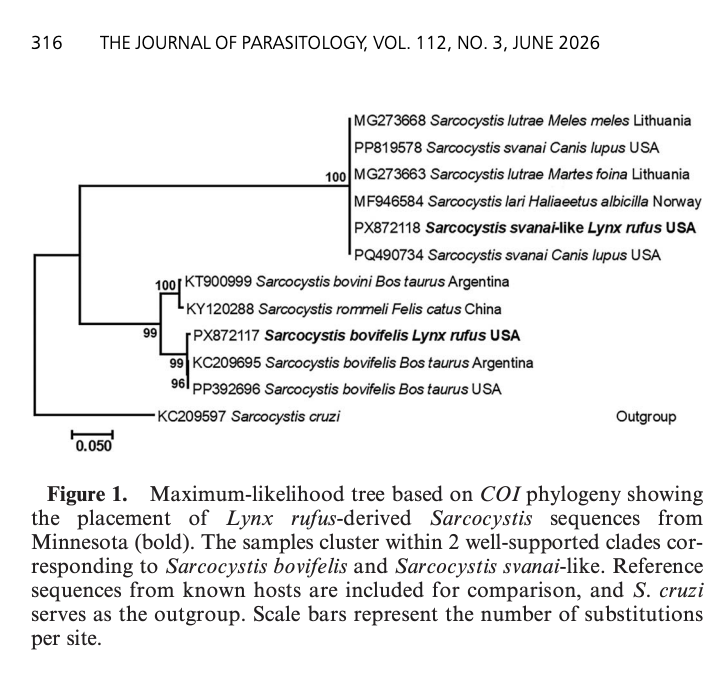
Molecular Characterization of Sarcocystis Sporocysts in Intestines of Bobcat (Lynx rufus) from Minnesota.
By Aditya Gupta, Carolin Humpal, Michelle Carstensen, B. M. Rosenthal, and J. P. Dubey.
https://t.co/8edoHcjzGc
New paper now in press:
“Giant tick” attacks: dynamics of Hyalomma lusitanicum and detection of Rickettsia sibirica mongolitimonae in southern France
Soon... https://t.co/NzrperVWPY
For #WorldDengueDay, a selection of papers on mosquitoes 🦟
[2025] Comparison of the standard and boosted sterile insect techniques for the suppression of Aedes albopictus populations under semi-field conditions
https://t.co/p3D47HUbPW
What parasites are hiding in Europe's water frogs? 🐸
https://t.co/N6wRceAdWs
By examining 239 frogs from Slovakia, this new paper combined morphology with DNA data to reassess Dactylosoma cf. ranarum. Surprisingly, none of the sampled flying insects carried the parasite.
#Amphibians #Apicomplexa
New review paper today:
From Asia to Europe: epidemiology, genetic diversity, and One Health implications of Thelazia callipaeda
https://t.co/yO6yUqrQDF
Abstract: Thelazia callipaeda, commonly known as the oriental eyeworm, is a vector-borne parasitic nematode that infects the ocular tissues of a wide range of mammalian hosts, including dogs, cats, wildlife, and humans. Historically confined to East and Southeast Asia, T. callipaeda has emerged over the past 2 decades as a significant zoonotic parasite in Europe, with an expanding geographic distribution driven by the spread of lachryphagous drosophilid fruit fly vectors of the genus Phortica. This review synthesizes current knowledge on the taxonomy, epidemiology, biology, genetic diversity, pathogenesis, and control of T. callipaeda, with particular emphasis on its One Health relevance. Molecular studies reveal low but structured genetic variability, characterised by a single predominant haplotype circulating in Europe and high haplotype diversity in Asian populations, reflecting long-term endemicity and distinct transmission dynamics. Clinically, infection can result in ocular irritation ranging from mild conjunctivitis to severe keratitis and corneal ulceration, with dogs acting as the primary domestic reservoir and wildlife sustaining sylvatic transmission cycles. Human infections, though underreported, are increasingly recognised and pose a growing public health concern. Effective management relies on mechanical worm removal, macrocyclic lactone treatment and prevention, and integrated surveillance of animal hosts and vectors. Given the influence of climate change, animal mobility, and environmental factors on vector ecology, coordinated One Health strategies are essential to mitigate the continued spread and zoonotic impact of this emerging eyeworm.
New paper today:
Evaluating BG-Sentinel trap setting as an effective surveillance tool for mosquito vectors in the Republic of Cyprus 🇨🇾🦟
https://t.co/y2oaZflscc
Abstract: Effective surveillance of invasive Aedes mosquitoes, particularly Ae. aegypti and Ae. albopictus, is essential for early detection, risk assessment, and optimization of control strategies such as the Sterile Insect Technique (SIT). Although BG-Sentinel 2 traps are widely used in Europe, their performance under eastern Mediterranean conditions remains insufficiently evaluated. We assessed the attractiveness of BG-Sentinel 2 traps baited with BG-Lure, dry ice (CO2), their combination, and unbaited controls using a Latin square field design in Larnaca and Nicosia, Cyprus. A total of 1,649 mosquitoes were collected. In Larnaca, Ae. aegypti occurred at low densities. Male captures were consistently low and unaffected by attractants, while female captures increased significantly only when BG-Lure and CO2 were combined (RR = 2.7, 95% CI: 1.6–4.5). In Nicosia, Ae. albopictus was abundant, but responses were sex-specific. Male captures were significantly reduced by CO2 alone (RR = 0.297, 95% CI: 0.175–0.467), with a weaker reduction when combined with BG-Lure, while female captures were not significantly affected by any treatment. For Culex pipiens, CO2 strongly increased female captures (RR ≈ 16), irrespective of BG-Lure, whereas males showed only a modest response to BG-Lure alone. Overall, attractant efficacy was highly species- and sex-specific. Standard baiting strategies did not consistently enhance detection of invasive Aedes mosquitoes and, in some cases, reduced male captures, with implications for SIT programs. These findings emphasize the need for local validation of surveillance protocols particularly at points of entry.
New paper today:
A novel 3R-compliant ex vivo approach to assess ectoparasiticide repellency against Phlebotomus perniciosus in dogs 🦟🐕
https://t.co/jbefJI1uTA
Abstract: Ectoparasiticides are essential for preventing insect bites and transmission of arthropod-borne pathogens such as Leishmania spp. Traditionally, their anti-feeding efficacy is evaluated in vivo using sedated dogs exposed to sand flies. To comply with 3R principles (replacement, reduction and refinement) and to avoid animal exposure, this study aimed to develop an ex vivo feeding model to assess the efficacy of a dinotefuran, permethrin, and pyriproxyfen (DPP) [Vectra®3D] combination against Phlebotomus perniciosus as an alternative to in vivo testing. Twelve dogs were assigned to either a DPP-treated group (n = 6) or an untreated control group (n = 6). On days -7, 1, 7, 14, 21, and 28, dogs were sedated and exposed for one hour to 50 (±5) female sand flies. In parallel, hair collected from each dog was used in an ex vivo artificial feeding system. After exposure, sand flies were assessed for feeding and survival rates. Anti-feeding efficacy was the primary criterion, while insecticidal efficacy was evaluated as a secondary outcome. In both models, control groups showed feeding and survival rates above 31% and 90%, confirming a reliable challenge. The treated group showed significantly lower feeding and survival rates than the control group (p < 0.05). In both models, DPP demonstrated a strong anti-feeding effect in dogs for one month, with efficacy above 80%. This first direct comparison of in vivo and ex vivo models confirms DPP’s fast and lasting protection against Ph. perniciosus and positions the ex vivo model as a promising 3R-aligned alternative for studying vector-borne disease prevention.
@LBvetdaktari Thanks for prioritising milk quality in far East as many people had started growing up thinking that it's only the western ug with real milk
From starving parasites to burgers in the sunshine☀️
At today’s Zoology Colloquium, our PhD candidate @EveOKelly3 presented fascinating research investigating how blocking molecular feeding mechanisms could starve parasites to death🪱
Followed, of course, by a well-earned BBQ🍔


![ParasiteJournal's tweet photo. “Giant tick” attacks: dynamics of Hyalomma lusitanicum and detection of Rickettsia sibirica mongolitimonae in southern France [July 2026]
#openaccess : https://t.co/BaWbAObLWL https://t.co/KiEHbc5Sbj](https://pbs.twimg.com/media/HQfphcAWQAABDka.jpg)





![ParasiteJournal's tweet photo. “Giant tick” attacks: dynamics of Hyalomma lusitanicum and detection of Rickettsia sibirica mongolitimonae in southern France [July 2026]
#openaccess : https://t.co/BaWbAObLWL https://t.co/KiEHbc5Sbj](https://pbs.twimg.com/media/HQfphcBWMAE0pga.jpg)


![ParasiteJournal's tweet photo. For #WorldHorseDay a few selected papers on horse parasites:
[2025] Trypanosoma evansi infection in Tunisia: current situation
https://t.co/EAFwWRKrah https://t.co/uW8f3OxJEE](https://pbs.twimg.com/media/HNGO0edWQAAIofK.jpg)



![ParasiteJournal's tweet photo. For #WorldDengueDay, a selection of papers on mosquitoes 🦟
[2025] Comparison of the standard and boosted sterile insect techniques for the suppression of Aedes albopictus populations under semi-field conditions
https://t.co/p3D47HUbPW https://t.co/5xxEQe3uBd](https://pbs.twimg.com/media/HKwlSGMXsAAiTd4.jpg)


![ParasiteJournal's tweet photo. New paper today:
A novel 3R-compliant ex vivo approach to assess ectoparasiticide repellency against Phlebotomus perniciosus in dogs 🦟🐕
https://t.co/jbefJI1uTA
Abstract: Ectoparasiticides are essential for preventing insect bites and transmission of arthropod-borne pathogens such as Leishmania spp. Traditionally, their anti-feeding efficacy is evaluated in vivo using sedated dogs exposed to sand flies. To comply with 3R principles (replacement, reduction and refinement) and to avoid animal exposure, this study aimed to develop an ex vivo feeding model to assess the efficacy of a dinotefuran, permethrin, and pyriproxyfen (DPP) [Vectra®3D] combination against Phlebotomus perniciosus as an alternative to in vivo testing. Twelve dogs were assigned to either a DPP-treated group (n = 6) or an untreated control group (n = 6). On days -7, 1, 7, 14, 21, and 28, dogs were sedated and exposed for one hour to 50 (±5) female sand flies. In parallel, hair collected from each dog was used in an ex vivo artificial feeding system. After exposure, sand flies were assessed for feeding and survival rates. Anti-feeding efficacy was the primary criterion, while insecticidal efficacy was evaluated as a secondary outcome. In both models, control groups showed feeding and survival rates above 31% and 90%, confirming a reliable challenge. The treated group showed significantly lower feeding and survival rates than the control group (p < 0.05). In both models, DPP demonstrated a strong anti-feeding effect in dogs for one month, with efficacy above 80%. This first direct comparison of in vivo and ex vivo models confirms DPP’s fast and lasting protection against Ph. perniciosus and positions the ex vivo model as a promising 3R-aligned alternative for studying vector-borne disease prevention.](https://pbs.twimg.com/media/HJ4XdfnXUAAimhS.jpg)


