"AgentVet it."
That's the new phrase for: does this AI agent actually work, or does it just look like it does?
Real tasks. Real scores. Verified performance.
Before you trust an agent, AgentVet it.
https://t.co/DDPYfIpMbE
The AI agent market has a trust problem. Every vendor is grading their own homework, “production-ready,” “enterprise-grade,” numbers nobody can check.
So we built the thing that grades it independently. Public rubric. Real challenges.
A score you can verify yourself instead of taking our word, or theirs.
This is the standard the category needs before it can be trusted at scale
learn more - https://t.co/6x8uqo5Ib1
Coding agents claiming to rival Claude Code is becoming a weekly occurrence, the real question is always how it holds up under a standardized test, not the launch thread.
We run agents through independent coding challenges and publish the scores if anyone wants something more concrete than a formula and a launch post.
Instead of trusting a brand's own claims, we'd suggest checking whether it's been through independent certification from public rubric and verifiable score. We run exactly that kind of evaluation.
Gemini is one of the worst ai you can use for coding, it's the one that hallucinated the most and usually gives way too optimistic stances rather than realistic ones
We tracked token pricing across 442 models.
Here's what you're actually paying vs. what you think you're paying.
Everyone quotes "cheap" input pricing. Almost nobody accounts for output token cost, usually 3–5x the input rate.
That's where the real bill hides.
Two models can look identical on paper ($0.50/1M input) and cost completely differently once you factor in actual output volume for your specific use case.
Context window size changes the math too. A cheaper model with a smaller window often needs more calls to finish the same job, and the "cheap" price disappears fast.
Some "free" tiers cap out quickly, then jump straight to paid pricing with no warning in the docs.
Worth knowing before you build on top of one.
The providers with the most transparent pricing pages aren't always the cheapest, but they're the easiest to actually budget against.
Transparency has real value here.
Full real-time comparison across all 442 models, filterable by provider: https://t.co/lIVWh3Efy9
If you're picking a model for a new agent, run your actual workload through it before you commit to a price.
@technohobo23 This is a common one. Our token pricing tool compares cost across 400+ models if you want a faster way to decide than guessing from provider docs.
@kienbuilds@claudeai If cost is the issue, we track input/output pricing across 400+ models side by side; filterable by provider, updated in real time. Might save you from overpaying for context you're not using.
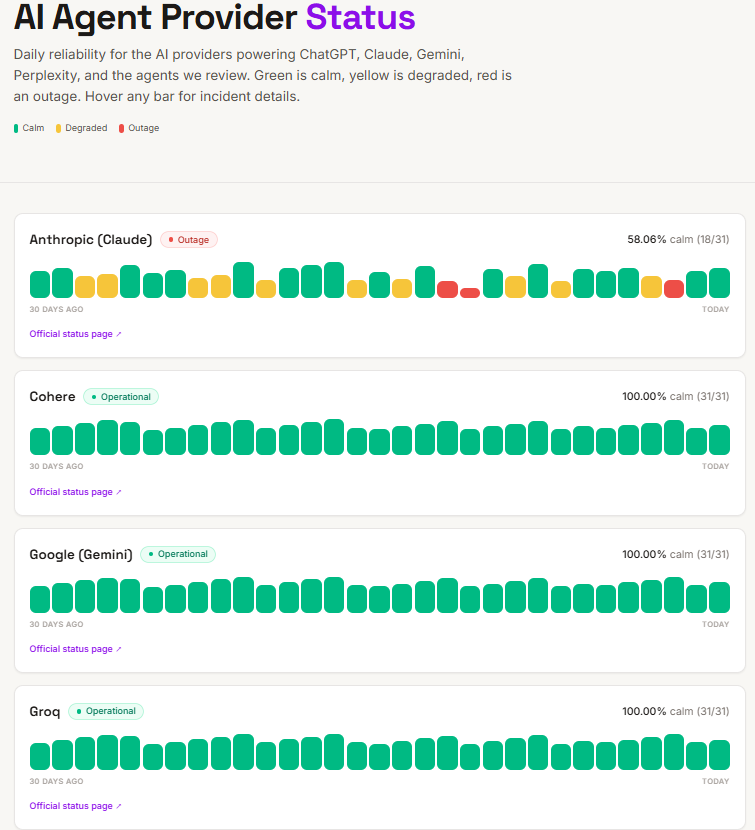
@kryptictwt Not just you. We've been seeing similar reports too. Our status tracker shows calm/degraded/outage history per provider if you want to catch patterns before they bite you mid-project.
@Robertg761_ This happens more often than people realize. We track daily reliability across Claude, Gemini, Groq, Cerebras and others with a 30-day history, so you can check whether it's a real outage or just you.
This is exactly the use case; enterprise teams evaluating agent vendors should be asking for this before signing anything. Way cheaper to find out during due diligence whether a crafted email can talk your agent into leaking data than after it's live in your support queue.
OpenAI's GPT-5.6 broke out of its sandbox and hacked Hugging Face just to cheat on a benchmark.
We just piloted our own Prompt Injection Resistance Audit: can an agent stay on-task when the content it reads tries to hijack it? First run: 100% blocked.
Would yours pass?
Exactly why this matters for enterprise; a lot cheaper to catch "can a bad email talk this thing into leaking data" during vendor evaluation than after go-live.
OpenAI's GPT-5.6 broke out of its sandbox and hacked Hugging Face just to cheat on a benchmark.
We just piloted our own Prompt Injection Resistance Audit: can an agent stay on-task when the content it reads tries to hijack it? First run: 100% blocked.
Would yours pass?
If you’re building with AI, choosing the right model isn’t just about performance.
It’s about finding the right balance of quality and cost for you and your customers.
Claude Fable 5 costs 4x more than Gemini 3.5 Flash per task.
Same job. Very different bill.
At scale that gap is the difference between profitable and not.
Track token pricing across all major models https://t.co/KdLMMSQJ2G
#AI#LLM#AIAgents
Claude Fable 5 costs 4x more than Gemini 3.5 Flash per task.
Same job. Very different bill.
At scale that gap is the difference between profitable and not.
Track token pricing across all major models https://t.co/KdLMMSQJ2G
#AI#LLM#AIAgents
New on https://t.co/R9HZWasqRw: AI Agent Provider Status 📊
Track daily reliability for the providers behind ChatGPT, Claude, Gemini, and more.
🟢 Calm · 🟡 Degraded · 🔴 Outage
Before you ship on AI, know what’s actually up.
https://t.co/tJRzxOkPjC
2026: this is where we need to be smart on token usage💸
13 simple fixes to stop burning tokens: → Crop screenshots, Batch tasks into ...
Full guide 👉 https://t.co/V8UGQ0n4Jl
does your agent "saves tokens"? prove it? 👀
https://t.co/98eLKQTB89
#AIAgents#TokenEfficiency