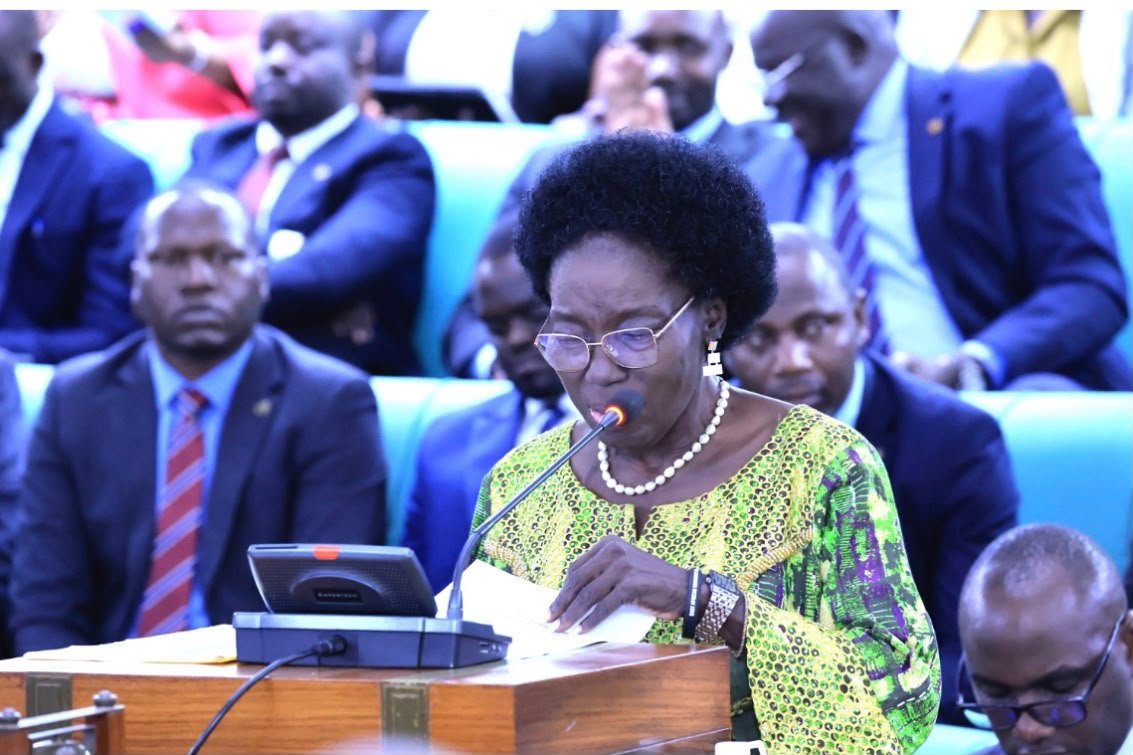
Thank you, Rt. Hon. @RebeccaKadagaUG, First Deputy Prime Minister and Minister for East African Community Affairs, @meaca_ug, for bringing this important development in East African integration to our attention.
It is encouraging to see the @jumuiya taking practical steps towards establishing a regional payment system that will make it easier for our countries to trade and conduct business using regional currencies.
However, as we work towards economic integration, we must also think about how our people communicate, interact and connect.
1. The Place of Kiswahili in Integration
Kiswahili plays a significant role in this journey. It can bring traders closer, ease communication across borders and help ordinary East Africans identify with one regional community.
Our currencies can make trade easier, but our shared language can bring our people closer.
Let us therefore pursue financial integration alongside linguistic and cultural integration.
As Watetezi wa Kiswahili Uganda, we are ready to offer technical support to @GovUganda and @Parliament_Ug in advancing this important agenda.
2. A Call for Institutional Commitment
Rt. Hon. @ObothOboth and Rt. Hon. @Thomas_Tayebwa, as a spokesperson for Kiswahili stakeholders and promoters, I would love to see Parliament embrace Kiswahili lessons, just as the Cabinet has taken steps towards promoting the language.
We would also like to see qualified but unemployed Kiswahili professionals given opportunities in public service. Uganda has a pool of trained Kiswahili teachers, translators, interpreters, authors and other language professionals whose expertise remains underutilised.
Engaging this human resource would significantly accelerate our East African integration agenda. I believe we could make substantial progress towards achieving our integration goals.
3. A Personal Commitment and Appeal to the President
Your Excellency, President @KagutaMuseveni, your commitment to East African integration, alongside the late Presidents Daniel arap Moi and Benjamin Mkapa, was instrumental in reviving the EAC. Your vision and dedication to regional unity remain an important foundation for a united, peaceful and prosperous East Africa. This legacy deserves to be strengthened.
I appeal to you to empower Kiswahili stakeholders and promoters to contribute meaningfully towards turning this long-standing vision into reality.
My advocacy has never been about political positions or personal gain. Whenever I see an opportunity to advance East African integration through Kiswahili, I will stand firm and continue working tirelessly, whether compensated or not, as I have always done.
We want an East Africa whose people communicate, work together and relate as brothers and sisters while developing our economies and celebrating our diverse cultures.
4. Kiswahili in Government and Public Service
Your Excellency, Uganda has talented Kiswahili translators, interpreters and authors. We propose a deliberate government policy to progressively translate official government documents, public information materials and other relevant institutional publications into Kiswahili.
This would be a practical demonstration of our commitment to regional integration.
We would also love to see Kiswahili training institutionalised across government ministries, Parliament, the diplomatic service, Uganda Airlines, state agencies and other public institutions.
Our officials, diplomats and public servants should be equipped with the language skills necessary to engage effectively with our East African partners.
It is concerning that some of our diplomats engage with regional partners without even the basic Kiswahili greeting “Habari?” We cannot continue to overlook our own regional language while giving unquestioned prominence to colonial languages. The time to change is now.
This is an opportunity to utilise local expertise while creating employment for qualified Kiswahili professionals.
5. Addressing Challenges in Education
Your Excellency, although Kiswahili has been introduced into the lower secondary curriculum, particularly at S1 and S2, some schools have notyet implemented the initiative effectively.
We are concerned about the level of monitoring and enforcement by @Educ_SportsUg and @NCDCgov
Kiswahili should not be treated as an optional subject where it is part of the approved curriculum. Schools must be supported and guided to implement the policy.
One of the explanations frequently given by some schools is the lack of qualified teachers. Yet, many trained Kiswahili teachers remain unemployed, with some having been forced to pursue opportunities outside their profession. We told them to advertise and see.
We need deliberate coordination between the Ministry of Education, teacher associations and other stakeholders to bridge this gap.
6. Protecting Our Languages While Promoting Unity
Unfortunately, some people continue to regard Kiswahili as unimportant even senior officers, while others fear that promoting it will undermine indigenous languages.
In my view, this is a misunderstanding of the purpose of a shared regional language.
Kiswahili is not intended to replace Lugisu, Runyankore, Acholi, Ateso, Luganda or any other indigenous language. Our mother tongues remain important elements of our identities and cultural heritage.
However, we also need a common language that enables us to communicate beyond our ethnic and national boundaries.
Language should be a bridge, not a barrier. It should unite us rather than become an instrument of exclusion or discrimination.
7. An Appeal to National Leaders and Civil Society
I also respectfully call upon Gen. @mkainerugaba to support this initiative and recognise the importance of Kiswahili in strengthening regional cooperation, patriotism and our shared East African identity.
I urge civil society organisations, cultural institutions, universities, private sector players and all Kiswahili stakeholders to join this cause.
This is not about partisan politics. It is about our country, our region and the future we want to build together.
I am not a politician, but I have Uganda and Africa at heart. I believe we can build a more united East Africa and, eventually, a more integrated Africa through deliberate investment in a shared language.
Let us turn our commitments into action.
Johnpaul Arigumaho - Kiswahili advocate
Umoja wa lugha, uchumi na maendeleo ya Afrika Mashariki! 🌍
#kiswahilileokiswahilikesho
@jumuiya@_AfricanUnion@NRMOnline
#Kiswahili #EastAfricanIntegration #AfricanUnity
@_AfricanUnion
HAPPY WORLD TEACHERS’ DAY! 🌍📚🇺🇬 Heri ya Siku ya mwalimu Duniani
Today, we celebrate teachers, the foundation of every educated, skilled and productive society. You shape character, nurture talent, preserve culture and build the human capital that drives nations forward.
In Uganda, special appreciation to our Kiswahili teachers, who strengthen @jumuiya integration, @_AfricanUnion unity, communication and opportunity.
I call upon H.E. the President @KagutaMuseveni , the @moes_ug and sister MDAs to give World Teachers’ Day the national recognition it deserves just as we celebrate other national milestones.
Let us honour teachers not only with words, but with sustained investment in their welfare, professional growth and quality education.
When we invest in teachers, we invest in Uganda’s future. 🇺🇬
@KagutaMuseveni@JanetMuseveni@Educ_SportsUg@NCDCgov@UNEB_UG Dr @MuyingoDr33246
Kiswahili Leo. Kiswahili Kesho. Pamoja Tutafika. 🌍🇺🇬
#WorldTeachersDay #Uganda #kiswahilileokiswahilikesho
A NEW CBC GENERATION IS COMING TO UNIVERSITY IN 2027. ARE OUR UNIVERSITIES READY?
Uganda’s first major CBC cohort is approaching university. This is not simply about admitting new students but it is about whether our universities are ready for learners shaped by competence-based teaching, continuous assessment, digital learning, practical skills and a different learning culture.
The transition must begin NOW: curriculum alignment, lecturer preparedness, assessment systems, ICT infrastructure, student support, AI literacy and stronger links between university learning and the world of work.
I have raised these questions in a new article:
��� https://t.co/2uZ0fEuXTJ
This conversation concerns all of us.
@Educ_SportsUg @JanetMuseveni @MuyingoDr33246 @NCDCgov @UNEB_UG @nche_uganda @Makerere @kyambogou @kiuvarsity @VUKampala @ReachDrMuganga @DeKaMug
2027 is approaching. University preparation cannot wait until the CBC graduates arrive at the university gate.
#CBC #UgandaEducation #HigherEducation #EducationUganda #CBC2027