I love this! Santander has open-sourced its open-source AI initiatives.
The bank pushed 11 repos, live this week under Apache-2.0 on the code, but the data synthetic or anonymised only.
Quite a moment for a bank this size, putting its AI control layer on the open internet for anyone to fork. This is the bit every bank has to get right.
So what is it?
→ autoguardrails: a scaffold for stress-testing LLM guardrails, jailbreaks included (can we use this LLM?)
→ "mechanical governance" for high-stakes LLM decisions, with hard gates and governance metrics (can we trust an LLM with this decision?)
→ mutatis-mutandis: discrimination testing with counterfactual comparators, straight out of a published paper (very important if you're lending!)
→ stressed-datasets: public benchmarks republished in "stressed" form to probe model robustness in that scenario
→ gen-fraud-graph: a synthetic fraud-graph generator to benchmark fraud detection (really, really cool, need to dig into this one)
→ llm_bridge: a vendor-neutral client for OpenAI, Bedrock and Gemini, so you skip the lock-in (again, how many companies are struggling with this?)
→ ralph: their own spin on the Ralph loop, the run-an-agent-in-a-loop trick from the indie AI crowd
I think I need to write a whole Rant on each of these pieces.
The most important thing for a big regulated actor is "Can you show a decision was safe, fair, auditable, and the same tomorrow as it was today." Santander published its working answer and handed it to everyone, competitors included.
Why give it away?
1. Attract talent - this is a huge signal they've got their AI act together
2. Signal internally - We have these tools, use them
3. Give regulators confidence - Here's how we work, you can audit it
(The board that signs off on releases includes Legal and the CISO. That tells you how seriously they treat it.)
I've watched banks spend years trying to govern AI behind closed doors and ship nothing. Doing it in the open, with a contributor agreement and a proper open-source office, is a faster route to getting it right.
The banks that pull ahead from here will be the ones who can prove their AI works.
@bancosantander just open-sourced a head start.
Repo is here. 👇
https://t.co/IilShwzvl2
@AngelicaLozanoC Sra. Ud es sub-normal o mononeuronal?. Es muy difícil hacerle entender a una persona con cemento en la cabeza. Q comentario tan salido de todo.
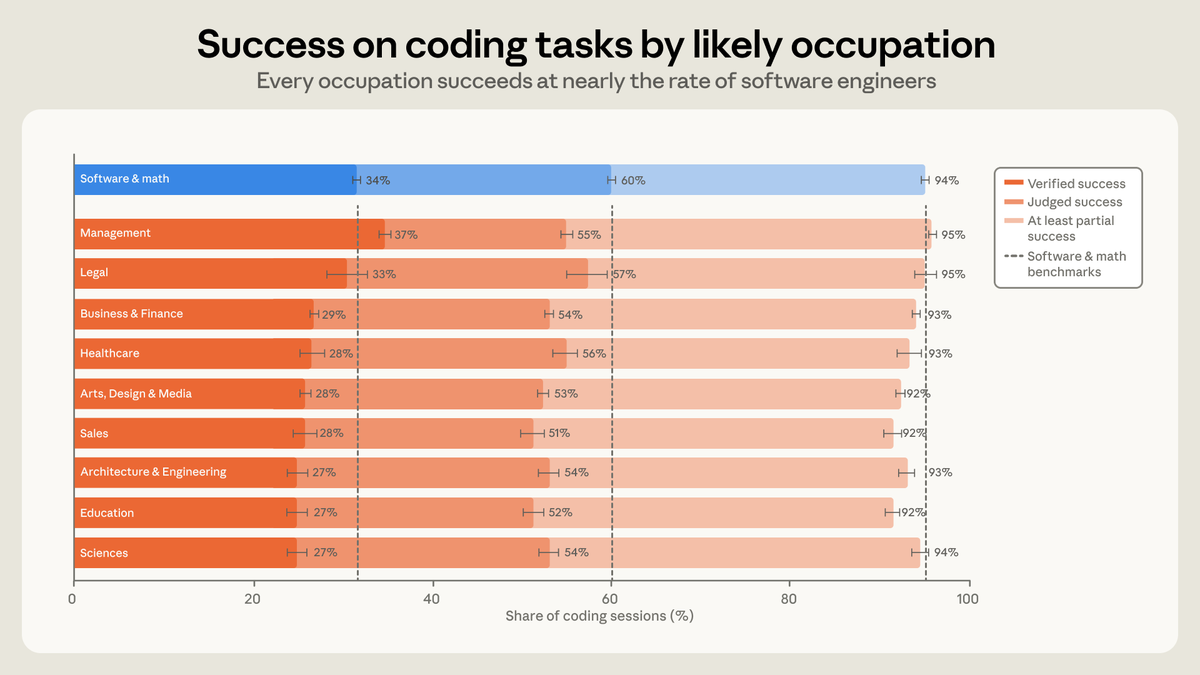
We compared Claude Code success rates between occupations.
On our toughest measure of success—requiring verifiable evidence that a goal was completed, like committed code—every field was within 7 percentage points of software engineering.
We’re rolling out changes to make Fable 5’s safeguards for frontier LLM development visible.
Starting this week, flagged requests will visibly fall back to Opus 4.8—the same as our safeguards for cyber and bio. You will see this every time it happens. On the API, any flagged requests will return a reason for their refusal (coming to server-side fallback in the next few days).
We wanted to deploy Fable 5 to our users quickly and safely. Visible safeguards can be probed, so they have to be robust, which takes time to get right. Invisible safeguards can be targeted more narrowly, allowing us to ship quickly with very few false positives. We went with invisible safeguards for this reason—and that was the wrong tradeoff. You should have visibility into the safeguards we have in place, and why. We’re sorry for not getting the balance right.
Making the safeguards visible makes them easier to work around, so keeping them robust to jailbreaks will unfortunately mean more false positives while we improve the classifiers. We're also tuning our bio and cyber classifiers to trigger less often on harmless requests. We know this is frustrating and we’ll do our best to keep this period as short as possible.
If you think a request has been mistakenly flagged: run /feedback in Claude Code, click thumbs-down on the fallback in https://t.co/LtktniD5HY or Cowork, or file the safeguard appeal form for API requests. Your reports help us tune these classifiers and we appreciate your feedback.
https://t.co/TDAAYRGqDt
Introducing Claude Fable 5: a Mythos-class model that we’ve made safe for general use.
Its capabilities exceed those of any model we’ve ever made generally available.