Most "GPU exposure" has nothing underneath it you could point to.
Ours starts with a serial number.
Every Device on AION is split into exactly 40 Fractions. One Fraction is one Compute Unit, recorded against that specific machine: manufacturer, model, serial.
Forty is a hard cap in the purchase agreement. A Device never gets a 41st.
We like this constraint more than we expected to. It forces every conversation back to one physical box and the hours it actually ran, instead of a blended number from a pool no one can see.
When you hear "compute," what do you picture first: a model, a cloud bill, or a machine in a rack?
The quiet risk in GPU rental: concentration.
One big GPU cloud's top 3 customers reportedly make up 80%+ of its revenue.
Great until one of them builds their own.
A thousand small renters is harder to win. Also harder to lose all at once.
The AI shortage isn't chips anymore. It's power.
You can order GPUs now. Finding somewhere with the power and cooling to switch them on is the hard part.
A GPU on a roadmap isn't capacity. A racked, powered one is
A first data center in Osaka, costed at up to $6.3B, is the hall as a plan.
One of the larger sites in Japan, on paper. Construction cost is not a connected watt. The spare hour does not exist until something is seated and running.
AION would not book the yen until the date is real. SKU, hours, time. A campus can be announced. The invoice is the hour.
Does a build like this clear because the power is there, or because the lab needed a photograph in a new region?
Best of the three: the Hock Tan post. Biggest room, and it is the credit loop in one line. Send that first. Zuckerberg second. NTT after lunch. No war, no token, no product.
An H100 worth more than last year is the hour refusing to age on schedule.
The board was supposed to depreciate. The spare hour got scarcer instead. Owning the hall lets you keep the card after the accountant has written it down. Renting it means you pay the new price.
AION reads that as useful life, not a slogan. SKU, hours, time, on a Device that is still running. A model can mark it down. The log is what it still clears.
If older cards are worth more, not less, what do you think the buyer is paying for? Is it the generation on the box, or the hour it still delivers?
Hock Tan calling it a casino, while Broadcom is arranging the money for OpenAI to buy Broadcom chips, is the hall financing its own customer.
$50B of revenue and still spending it on training. The spare hour is the cost. The credit is the structure. Default risk at a high is the lender noticing the loop.
AION would separate the two invoices. A chip order funded by the seller is not an hour that ran. SKU, hours, time. The commitment can be circular. The log cannot.
If the customer is also the credit, what do you think is actually scarce ? is it the board, or a buyer who is not the lender?
Even Microsoft rents GPUs.
It was reportedly ~62% of one specialist GPU cloud's 2025 revenue.
When demand outruns what you can build, you rent from whoever already built it.
That's the AI compute market in one line.
Building an AI product today, would you buy GPUs or rent them?
Most teams say rent. Speed, flexibility, focus.
But there's a point where owning wins. Where's your line?
Who actually rents a GPU?
Not just the big labs. Meta, OpenAI, even Microsoft rent. Below them: every AI product answering users. Then the long tail: startups, university labs, render studios.
We mapped the whole renter list 👇 [https://t.co/wfAvZH63lK ]
Inference overtook training as the bigger slice of AI infra spend in 2025 (58.6%, Futurum). The 1-yr H100 contract rates rose ~38% Oct→Mar (SemiAnalysis).
Power, not chips, is the bottleneck.
This week we're on the demand side: who rents GPUs?
Most people only ever see the price of a GPU hour.
Here's what actually happens inside one:
Request → a team needs compute
Match → to one specific Device
Run → the job runs
Log → hours recorded against the serial number
Attribute → per Device, net of fees
Next week we take it apart, step by step. Which step do you think most platforms skip?
An idle GPU depreciates exactly as fast as a busy one.
The clock runs either way. Only one of them is working.
The real question isn't how new the chip is. It's whether it's placed, matched and maintained.
How many useful years does a data-centre GPU really have: 3, 5 or 6?
Weekend homework.
Next time anyone tells you that you own part of "real hardware", ask five questions:
1. Which machine?
2. Which part of it?
3. Who keeps the record?
4. What happens when it breaks?
5. How do you get out?
Most pitches go quiet at question 2. Which question would you ask first?
The A100 launched in 2020.
It's still being rented today.
Chips age out of headlines long before they age out of work.
Headlines follow launches. Work follows hours.
Friday close.
Board: memory stayed expensive and sold forward.
Hour: got a futures ticker, still printed a dozen prices.
Hall: the biggest US grid paused, Europe stalled, Google tried orbit.
We didn't add a fourth number this week. We named which tape moved.
Which one do you carry into Monday?
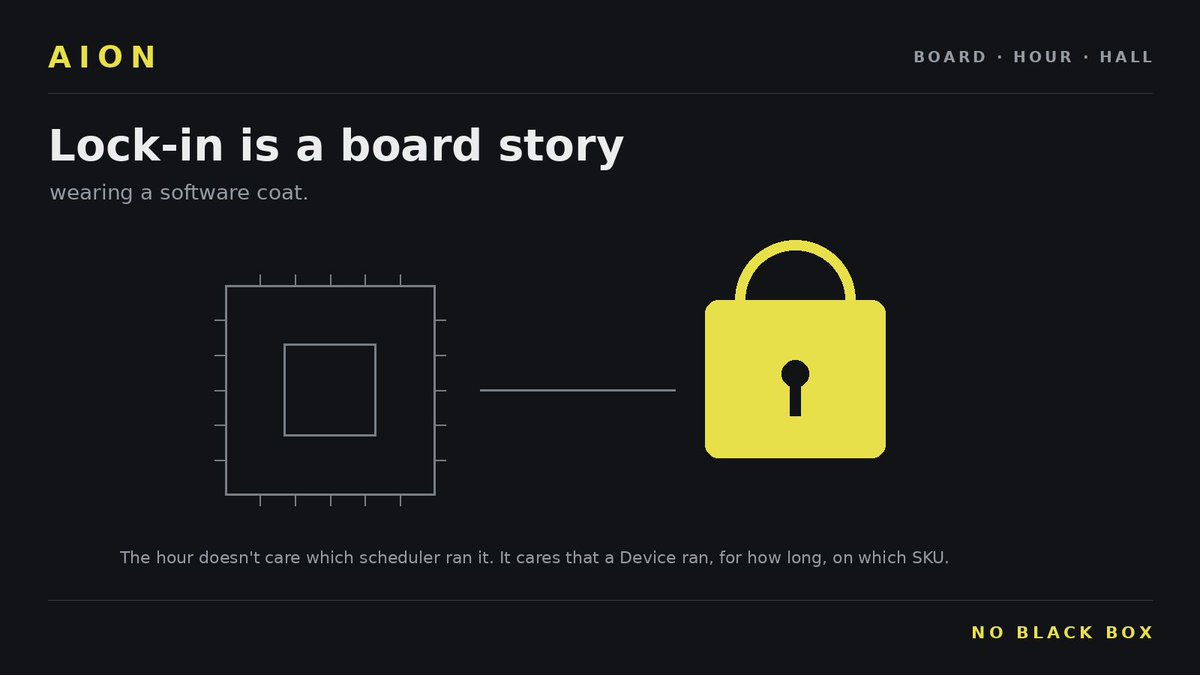
Every chip vendor wants its own software stack. Fine.
The hour doesn't care which scheduler ran it.
It cares that a Device ran, for how long, on which SKU.
Lock-in is a board story wearing a software coat.
If the stack picks a winner, what is the buyer really locked into: the chip, or the hour?
Trucking gas to a site so the delay does not slip again is the hall admitting the date is the scarce line.
The pipeline was the plan. Compressed gas on a truck is the workaround. The spare hour still does not exist until a Device is seated and running.
AION reads that as the same lesson as Wisconsin. A gigawatt on a slide is a photograph. Power that arrives is the invoice.
Does a truck count as the watt connecting, or just as the delay being managed?
$100B from the Gulf to extend an AI bet is the hall raising money before the hour exists.
Not a spare hour. Not a board already seated. A check looking for a watt, a site, and a date.
AION would put the log next to the raise. SKU, hours, time. Capital can be committed. It cannot print an hour that ran.
If that money lands, what do you think it buys first? chips, or a connection date?
Four TPUs in orbit.
Google's first Suncatcher satellite went up Oct 1: four Trillium chips on about 1kW of solar, testing whether AI silicon survives launch, radiation and vacuum.
It's a photograph of compute. Not yet an hour.
The board left the building.
The hall is a vacuum.
The open line is still how long the watts stay on.
Does orbit change the invoice, or just move the same constraint off the grid?
Skip if you already replied yesterday.
A site that drops for days is a hall problem wearing a cloud logo.
Power outages. Link flaps. Storage failures. The card can be seated and the hour can still be zero.
AION reads that as the log, not the brochure. Uptime is the invoice. A megawatt on a map is not.
If the complaint is the power and the network, what was the buyer renting — the GPU, or the hour it stayed up?
Chip-debt vehicles stacking up is the hall borrowing against silicon that is not seated yet.
Broadcom. Oracle. SpaceX. Same structure. A promise the board exists, and that someone still wants the hour when it does.
AION would not call a special-purpose fund an invoice. SKU, hours, time. Debt can fund the order. It cannot print the log.
If the crowding-out is the funding, not the watt, which line do you think breaks first — the chip order, or the hour?







![AI0Ncloud's tweet photo. Who actually rents a GPU?
Not just the big labs. Meta, OpenAI, even Microsoft rent. Below them: every AI product answering users. Then the long tail: startups, university labs, render studios.
We mapped the whole renter list 👇 [https://t.co/wfAvZH63lK ] https://t.co/pv9uPxV6MS](https://pbs.twimg.com/media/HUbwX5_WEAAhcwS.jpg)