H100s are 3 years old, supposed to be depreciating to zero, and their rents are UP 35–45% this year. New data centers pay themselves back in ~1 year at spot prices. NVDA trades at 13.7x forward. This is the most hated “bubble” I’ve ever seen. It’s 1997, not 1999.
Long $NVDA $AVGO $IREN $NBIS $CRWV $MU
Below is my argument for being long compute:
Let’s first start with what we know about compute ROIC currently.
First, I want to talk about rentals. SpaceX pointed out on its Q3 call that pricing is now tracking slightly above the $30–50mm/MW range they provided last quarter. Using what the market knows, it costs about $40–50mm/MW to build a data center right now (Jensen has put a 1GW AI factory at $50–60B). At short-term rentals above $50mm/MW, subtracting out opex like energy and site ops/maintenance/insurance (~$3–4mm/MW/yr) and depreciation (~$6mm/MW/yr), the EBIT is around $40mm/MW, providing a ROIC of ~90% pre-tax (~70% after-tax) and a payback period of ~1 year (SpaceX says under a year at current pricing). Even at LT contracts, which have been at about a third of short-term rentals (the large gap between ST and LT rentals shows the severe compute scarcity we are in now), the ROIC is ~16% pre-tax (~12–13% after-tax), with a ~3.5-year payback. These projects will without a doubt continue to be funded at these levels, as that level of ROIC is well above the current cost of capital. People point to CRWV’s 15% unsecured notes (really the 9.75% notes trading at a ~15–16% yield), but that is only one tranche of their debt, with the DDTLs still pricing in the 8–9% range (SOFR+450–550bps on the latest facilities, and the investment-grade DDTL 4.0 at ~5.9% fixed). NBIS just raised $3.5B from Citi at SOFR+275bps as well.
Knowing these projects are going to continue to get funded, as the ROIC is phenomenal and compute is still scarce, one can feel confident in projections like NVDA’s and AVGO’s, as they are calling for 70% revenue growth (FY28) and 100% AI revenue growth (~$58B to ~$115B in FY27) respectively, in line with the ~50GW SemiAnalysis expects to be added in 2027, roughly as much as the entire industry built through 2024. NVDA currently sits at 13.7x FactSet consensus FY28 EPS (Jan ‘28, so really CY27), which is roughly in line with the ~70% revenue growth guide. But Jensen has said chip unit volumes will double next year, Kress said customer forecasts point to revenue doubling, and the street only has FY29 growing 33%. If FY28 lands anywhere near what customers are forecasting and FY29 grows even 50%, NVDA is trading at ~7–8x FY29 earnings. AVGO sits at ~19x, and as rentals continue to rise (which I will explain later), the sentiment around these names should rerate. Put NVDA at 15–25x on FY29 numbers, as we have seen in the past, and that’s a 2–3x over two years, with AVGO at 25–30x.
Now onto rental prices. Over the last few months, we have seen rental prices for GPUs surge among Blackwells (B200 +120% YTD, including +79% in just the three months to late September), with Hopper GPUs increasing as well (H100 +35% YTD and ~45% since December, H200 +160% YTD). And this is happening on GPUs that are supposed to be worthless. In accounting, GPUs get depreciated to zero over ~5–6 years, and a B200 delivers ~2.5x the compute of an H100. Yet three years after launch, H100 rentals are UP YoY, and H100s are getting renewed at the same rates they were signed at 2–3 years ago (CoreWeave even renewed A100s out to 2029). The books say these chips are depreciating. The economic reality is that they are appreciating. That is what a compute shortage looks like.
So why do I think rentals have a lot further to run? Look at what the buyers of compute make on it. Backing into Anthropic’s S-1, gross margins on serving customers were ~85% in 1H26, and ~87% in Q2 by my estimate. DeepSeek disclosed $38 of revenue per GPU-hour on V4.1-Flash, which works out to ~80% gross margin even renting B200s at today’s ~$8/hr spot, and 90%+ on owned hardware. When a critical input is in shortage, its price isn’t set by what it costs to build. It’s set by what the buyer can afford to pay, and it keeps rising until it eats into the buyer’s margin. At 85–90% margins, the labs have a lot of room. Anthropic’s serving compute could double and its gross margin would still be ~74%. DeepSeek could pay $19/hr per GPU, more than 2x today’s B200 spot, and still clear a 50% margin. The capacity labs are fighting over right now is serving capacity, where every new GPU turns into revenue at ~85% margins. Right now the profit sits with the labs. In a shortage, it moves toward whoever owns the compute.
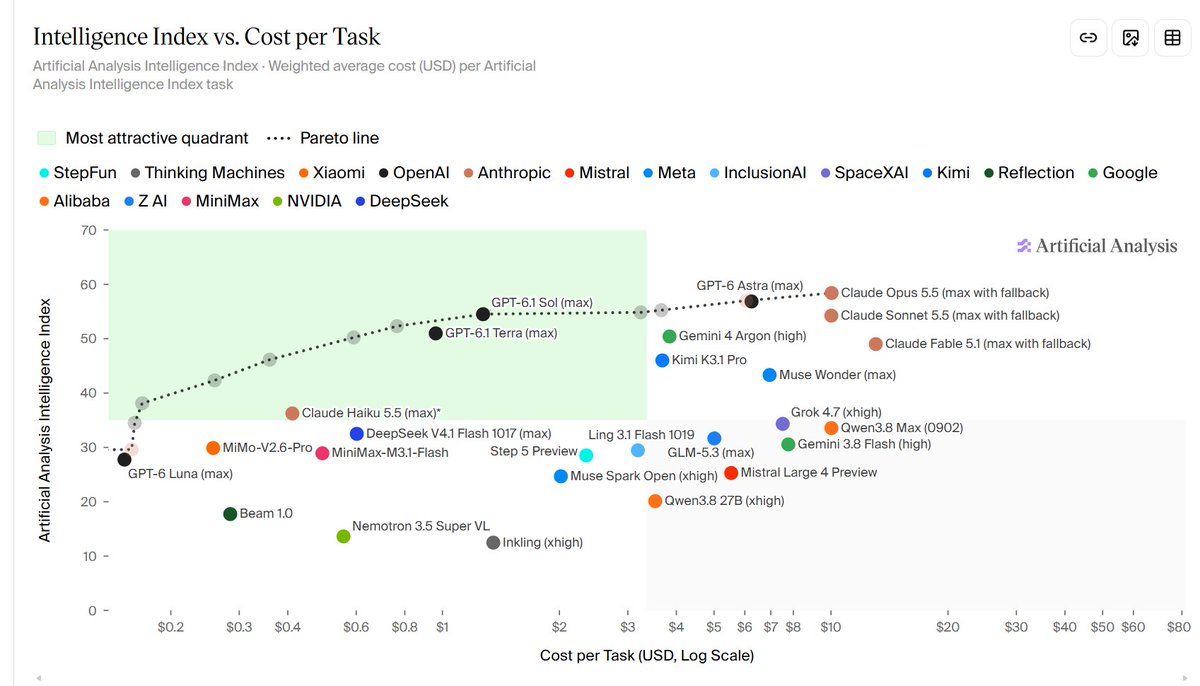
One argument the street commonly makes is that models are getting commoditized (as we have seen Ant and OpenAI cut effective token prices by roughly 35–45% with the newest model releases) and that the next wave of compute will not be able to be funded. This argument misses what’s actually going on. One month ago, Anthropic released Opus 5.5, followed by Sonnet 5.5. They cut Opus list prices 20% (cache reads 60%), which Anthropic says works out to ~40% cheaper per task, which led to a temporary slowdown in ARR growth. However, if you have used Opus 5.5 or models at these levels of intelligence, it is highly obvious what comes next. This is the inflection point where these models can be used for real work: biological discoveries, PhD-level math, advanced financial modeling. In my field, for example, models have gone from taking 3 hours to build shitty public company 3-statement models to 30 minutes with full debt schedules and accurate KPI forecasting. This is something that would previously take a human 5+ hours. Additionally, these models use MORE tokens as they do longer-horizon agentic tasks. I have found myself burning through my usage much faster than ever before despite cheaper token pricing. OpenRouter data shows that since Opus 5.5 was released, Ant’s token volume has gone up ~3.6x (7-day average). Coupled with prices cut ~40%, one could expect almost a 100% ARR surge. Although OpenRouter is just one subset of data, I suspect Anthropic’s ARR has surged since the release of these models, which we will see in the updated S-1, as they have left a blank space for run-rate revenue as of October 31st. The S-1 showed positive cash flow ($3.9B operating cash flow in 1H26), ~$132B in cash and short-term investments, and Q2 revenue of $11.6B against $5.6B of compute costs, even with frontier training running out of the same compute pool. Assuming they raise $100B in the IPO, they should have $230B in cash and exit the year at over $100B run-rate revenue (in line with the $100–120B the FT reports investors expect; it was ~$65B in late July). The ~$640B in compute commitments over the following several years looks very manageable even if Anthropic kept revenue FLAT (despite them growing revenue ~14x YoY in 1H26). So that debunks the theory that model commoditization will prevent the compute buildout. Also, the Chinese “near free” model argument does not hold up. As you can see in the attached chart, Anthropic and OpenAI own the entire pareto frontier, meaning no model is as intelligent for a cheaper cost or more intelligent for the same cost. There is no economical reason for a company to use the Chinese models at this point, and I expect as the gap between Ant/OpenAI and Chinese models widens as it has been, even more token spend will shift towards these models. DeepSeek, the poster child for “near free,” raised API prices 2.3–4.5x this year and demand held, and it spent ~23x its revenue on infrastructure through July. The cheapest lab in the world is a compute buyer too.
Moving onto GPU rentals, I want to take you through some back-of-the-napkin math. Token volume likely grew between 20–40x YoY. OpenRouter weekly tokens went from 4.6T to 113T between Sep ‘25 and Aug ‘26 (~25x), and honestly OpenRouter is some of the worst data to use here, as it’s mostly developers who were tokenmaxxing to start and are now using harnesses to cut tokens. Even that sample grew ~25x. The next leg is broader adoption outside of software dev: paid AI adoption in healthcare and construction went from ~33% to ~42–43% of businesses in just eight months (Ramp), and finance (already ~74% adoption) is moving from chat to agents. Month-over-month annualized growth is still ~20x. We currently have ~90GW of total data center capacity online ex-China (~50GW built through 2024, ~16GW in 2025, ~25GW in 2026), of which I estimate ~45GW is AI, and SemiAnalysis points to another ~51GW getting built in 2027. With NVDA’s Vera Rubin release, we know that each GPU is up to ~10x more token efficient than the Blackwell line, which people will point to as bearish. However, breaking down the composition of the old data center GPUs and the new buildout (~10GW of Hopper-era capacity and ~35GW of Blackwell/ASIC today; next year’s ~50GW roughly half Rubin), we can infer that the token supply addition YoY is about 4–5x effective token supply. Compare this to 20–30x YoY demand growth (which I believe will hold strong, as smarter models = longer-horizon agentic tasks burning even more tokens). And before anyone says efficiency: assume algorithms make every GPU ~3x more token-efficient per year (Epoch’s estimate). That takes effective supply to ~12–15x. Against 20–30x demand, that’s still a 1.3–2.5x deficit. Even if you’re super bearish and assume 5x efficiency, supply only catches up if demand slows to 20x. This will lead to rising GPU rentals, as we have seen, and will exacerbate the compute scarcity nearly EVERY tech CEO has been talking about. As CRWV, IREN, NBIS, SPCX, and AMZN bring new compute online, they will sign at even higher GPU rentals than the market believes now (Bernstein models SpaceX’s blended 2027 price at $26/W vs. >$50/W spot today), and many of those revenues will blow out street expectations (I can provide evidence via models in later posts).
Onto memory, I don’t even know what I really need to say to make the bears bullish. MU and SKHY are trading at ~3-5x forward PE with demand visibility into the 2030s. Yesterday, SKHY and Samsung were reported to be in negotiations with Alibaba and other Chinese clouds (Tencent, ByteDance) for LTAs extending into 2035. But I thought China was supposed to ramp up DRAM and flood the market in 2028, leading to a massive stock decline? Why would Chinese cloud providers lock in TEN-YEAR LTAs if this were true? Because it is not true. The memory scarcity will last through ‘27, ‘28, and likely beyond that. At 3–4x earnings and ~72–73% FCF conversion, these names are sitting on ~18–24% FCF yields. Even returning most of that, I believe MU and SKHY will be able to buy back ~20% of their market caps per year (if they stay at current share price levels) across 2027, 2028, and 2029, retiring ~50% of their shares. Even if a price crash happens in 2030, the share retirement will hedge most of that. Also, even at market cycle price troughs and midpoints for DRAM, MU and SKHY will continue to sell at least 3-5x more bits than before as the data center, autonomous vehicle, and humanoid buildouts continue.
I recommend a long of NVDA, AVGO, IREN/NBIS/CRWV, SPCX (to hedge neocloud buildout/financing risk), MU, and virtually anything else in the AI stack (not financial advice). This is the most hated “bubble” I have ever seen, and consensus among pods has turned fairly bearish on these names. This is 1997, not 1999. One more leg up to the moon.
What I’m watching for that would kill the trade:
1. Multiple months of GPU rental price declines
2. LT contract pricing stalls in the $10-12mm/MW range vs $15-20
3. Lab revenue growth falters for multiple quarters in a row
4. Neocloud financing spreads completely blow out (if credit markets refuse to fund this, the buildout slows no matter what ROIC looks like)
5. Hyperscalers cut capex guidance
6. DRAM contract prices go negative QoQ
@zerohedge Backlog with existing contracts could pay off the unsecured in a little over a year. Management will continue to invest capital in more compute as contracts are delivering IRRs well above the company’s current cost of capital. Project IRR > Yield on debt, invest in project.
Backward looking. I know you’ve been short for probably about 18 months now across the AI stack given your posts so I’m sure you’re still down huge. Dance around and fear monger while you’re up. You should know price is not always fundamentally accurate. You’ve been preaching that AI stocks were wildly overvalued for a year! Is there a chance that the unsecured bonds should be closer to par?
Yes I know what DIP financing is and I understand your sarcastic tone, however most of your posts over the last few months have been straight fear mongering over AI credit with little to no quantitative reasoning or modeling to back up your claims. But yes everything is going to 0!
@ColeNichol99434 Bears have been screaming abt a compute glut for 6 months, but customers are paying 90% of capex upfront. I'm sure there are hundreds of thousands of GPUs lying around! That's why rentals are ripping and customers are funding 90% of capex for the neoclouds! Literal IQ test.
@ColeNichol99434 Peep all the headlines. Saw two unbelievable headlines:: "Coreweave meets wallstreet expectations" and "quality of backlog being tested". Bears making up new arguments after $9B in GPU prepayments puts the financing fears to sleep
Fable 5.2 is just the teaser. We know from independent researchers that they have 2-3 better internal models. Obviously, OpenAI will drop a better model than Fable 5.2 day before or day of the IPO to try and mog Fable 5.2, which will inevitably lead to Anthropic releasing a nuclear warhead of a model that will mog openAI into oblivion. The models released over the next 1.5 weeks will mark the starting point of the detonation of white collar work as we know it 🫡. Oh, and send compute to the moon while you’re at it 🚀🟢🚀
$CRWV $NBIS $IREN
@ColeNichol99434 Duration wins always. Gotta stay unleveraged for me. The fundamentals are strong but I can't force the market to rerate the multiple on the neoclouds.
@ChartandStocks Of course it does but most of Wall Street runs off of pure emotion… buy when there’s blood in the water. Any delays to material compute being brought on by hyperscalers will cause an even scarcer compute environment sending GPU rental prices soaring for the neoclouds
$CRWV to $65 next week on the backs of a cooler CPI and new 5 year contracts signed in the $20mm/MW range above its current computes blended average of ~$12mm/MW
Higher rentals on new contracts around the $22mm/mw range that IREN signed could send the stock higher for sure. Shorter term 3 year contracts above $25mm/mw as well. Prepayments at 90% of GPU capex stop the potential equity dilution that bears continue pointing to. Hard to be bearish from here.
@CreditCapi Message me. Want to talk through the SBUX short and whether I hold the short through earnings tn. Wondering mainly when you expect SSS to lap the inflated growth from store closures. Afraid there will still be artifical SSS inflation and stock will bounce.