In a personal capacity, and not on behalf of Google or Google DeepMind: very glad I could speak with FAZ and SZ about Google's reported classified AI deal with the Pentagon.
Autonomous weapons, mass surveillance, and autonomous policing all concern public health and safety. They are matters of enormous public interest, not just internal policy debates.
Companies that should know better are using safety-washed PR that undermines the honest public conversation we need about AI in classified settings.
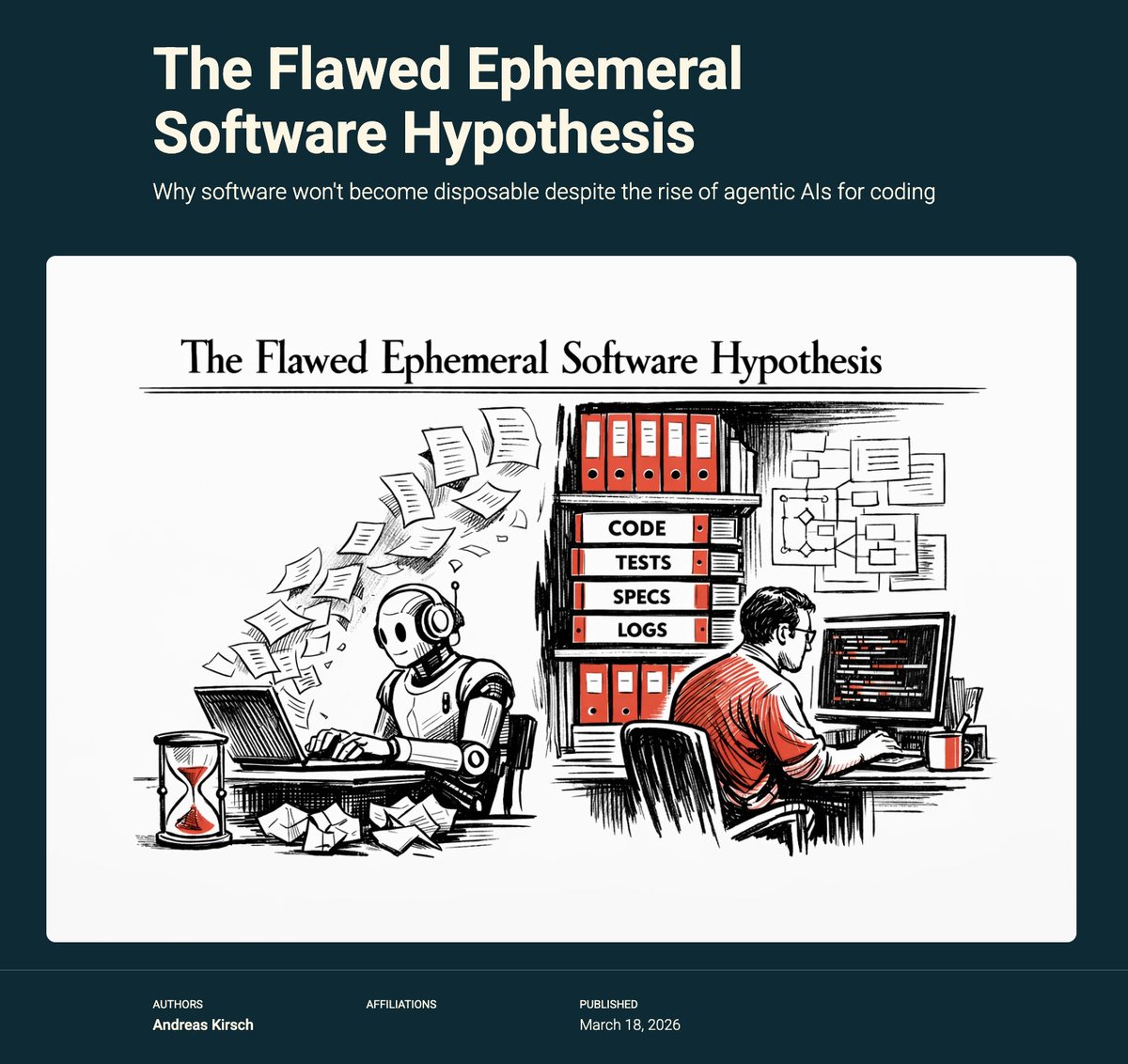
A while back, Andrej Karpathy said the app store will be replaced by generated, disposable software," and Amjad Masad predicted that the value of all application software will go to zero
I think this "ephemeral software hypothesis" is wrong, though, and I want to explain why:
I resigned from OpenAI. I care deeply about the Robotics team and the work we built together. This wasn’t an easy call. AI has an important role in national security. But surveillance of Americans without judicial oversight and lethal autonomy without human authorization are lines that deserved more deliberation than they got. This was about principle, not people. I have deep respect for Sam and the team, and I’m proud of what we built together.
Did OpenAI just sell out to the "Department of War" (DoD), peddling a watered-down deal as some heroic stand for "AI safety" and throwing a competitor under the bus under the guise of standing with them?
Sam Altman might just be spinning this as a win for both AI safety and America, even though the contract likely contains the same legal loopholes which Anthropic refused to sign on.
Sam Altman's announcement highlights "safety principles" such as prohibitions on domestic mass surveillance and ensuring human responsibility for autonomous weapons. But as watchdog group The Midas Project points out in a sharp analysis, this language raises key questions about its real impact:
- Does “human responsibility for the use of autonomous weapons” truly prohibit them, or just require a human to sign off on deployment or report mishaps?
- Why the plural “prohibitions on domestic surveillance”? Is this a broad ban or something narrower, only covering extreme cases?
- Does incorporating these principles mean the DoD is bound by them, or merely that the agreement references OpenAI's views while limiting to "all lawful use"?
These ambiguities suggest the deal may not constrain military applications as strictly as portrayed.
Meanwhile, Anthropic is getting blackballed for actually having a spine.
The Midas Project also asks: If OpenAI believes all companies should receive the same terms without government coercion, why not condition acceptance on lifting the "supply chain risk" label from competitors like Anthropic?
This highlights potential inconsistencies in OpenAI's "support" for rivals, which Sam Altman professed at a company town hall the day before.
It could be more about optics than solidarity.
DoD spokesperson Jeremy Lewin clarified that the contract is based on "all lawful use," with references to existing laws and mutual safety measures, but it's the same compromise Anthropic rejected as containing legal loopholes.
Lewin argues this approach vests decisions in democratic processes rather than private CEOs, framing OpenAI's acceptance as "patriotic."
Yet it raises concerns about whether the ethical boundaries that OpenAI employees and the public have been told about are truly enforceable or can fall victim to legal backdoors.
Journalist Erin Woo notes this means the concerns Anthropic raised around potential misuse for surveillance or weapons could still apply to OpenAI's deal.
Despite internal OpenAI employee support for Anthropic (over 90 signatures on a solidarity pledge), the company proceeded, potentially prioritizing contracts over unified industry standards.
Anthropic's CEO Dario Amodei stated they "cannot in good conscience accede" to unrestricted military access, particularly on domestic surveillance and autonomous weapons.
In response, the DoD escalated with threats to designate them a "supply chain risk," a label typically for foreign threats that could force vendors to sever ties.
This contrast underscores differing approaches: OpenAI, xAI, and Google accepting terms, while Anthropic holds to stricter red lines.
Ultimately, this agreement could set a precedent for looser oversight in AI-military collaborations, potentially eroding broader safety norms under the guise of patriotism.
If AI safety is the goal, these loopholes deserve scrutiny.
I hope the contracts will became available and scrutinized soon.
Come and listen to my talk at LSE next Tuesday about how automation and autonomous weapons are gonna ~~fuck up~~ change everything 🤯
https://t.co/0oviwSOK6v
We are more committed than ever at @DeepMindAI to expanding opportunities in computer science to everyone. These @UniofOxford scholarships aimed at under-represented groups are one part of that process.
https://t.co/bvi5dMMVyh
We saw this coming, and here it is. Endless trapdoors ahead: data inaccuracies, intentional gaming, constant intimate surveillance 24/7, data breaches that will be infinitely worse, &c...
Thrilled to contribute towards @UCL's world-leading AI research with the Professorship of Machine Learning and Artificial Intelligence and their team @UCLAlumni
Learn:
1. linear algebra well (e.g. matrix math)
2. calculus to an ok level (not advanced stuff)
3. prob. theory and stats to a good level
4. theoretical computer science basics
5. to code well in Python and ok in C++
Then read and implement ML papers and *play* with stuff! :-)
Nice talk by Hector Geffner, based on the themes of his paper "Model-free, Model-based, and General Intelligence" (https://t.co/DyWjvwoJnH). https://t.co/k1l1KLPOQ4
Those who forget AI's past are doomed to learn worse versions of it using gradient descent.
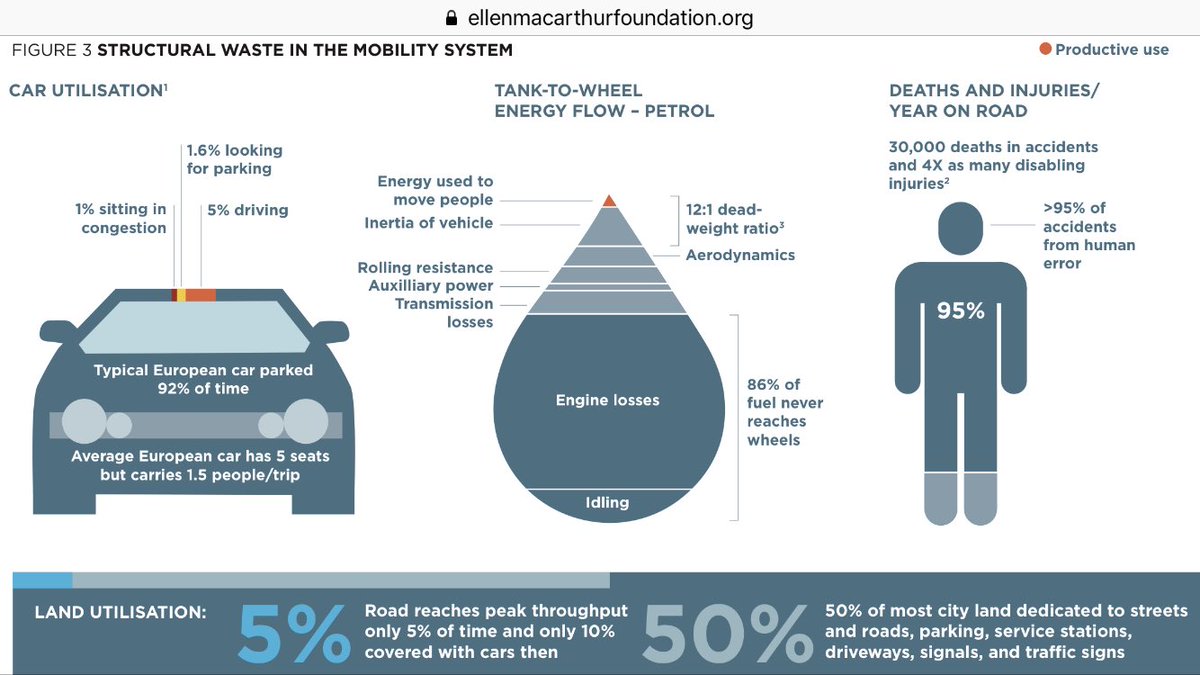
Fascinating graphic from Europe.
• average car is parked 92% of the time.
• roads reach their peak use only 5% of the time.
• 50% of city land area is dedicated to vehicle infrastructure.
• 86% of a car’s fuel never reaches the wheels.
• average car carries 1.5 people/trip
Summer read: reviewing MIT @techreview list of 10 Breakthrough Technologies 2018.
Which ones do you think could be best leveraged to tackle the most critical global issues?https://t.co/O2HTNGs8ls
Super excited to share that Facebook and Google today announced their support for the creation of a new master’s degree program the African Masters in Machine Intelligence at the African Institute for... https://t.co/z3EFC0HFyD
A real robot hand, trained with same learning algorithm and code as OpenAI Five, has learned human-like motions to rotate objects: https://t.co/PCScd0wAo6