If you are also learning AI recently, you can see Andrew Ng's sharing at Stanford University.
Andrew Ng is the founder of https://t.co/s5haJU577b, an adjunct professor of computer science at Stanford University, and brought Google Brain in his early years. In this wave of AI changes, he has been standing in the front.
In recent years, everyone has been making up AI classes, learning models, learning Prompt, and learning workflow. After learning, you will actually encounter a very real problem. When AI tools gradually become something that everyone will use, why is the company willing to give some people a higher price?
first
Andrew Ng mentioned a word in this sharing, AI Native.
"Talents with original AI thinking or proficient AI skills are really in short supply at present. 」
The words AI native can often be seen now, but what is AI native is actually not that simple. It is an ability to calculate with AI and write Prompt, of course, but in what Andrew Ng will talk about later, the real gap has reached a person's working style.
Software engineering is an area where this happened earlier.
Now AI is very strong in coding, and many jobs that used to be done by engineers themselves can be directly handed over to AI. According to past experience, a core skill has become so easy to obtain that related positions will be affected to some extent. But what Andrew Ng sees is that the recruitment demand for software engineers still exists, and it is still difficult to find enough high-quality AI engineers in the industry.
He even said it directly. "If someone is still writing code in the way before ChatGPT appeared in 2022, companies will not hire them. 」
The changes behind this are not complicated. The same job, many steps have to be done from the beginning to the end, and now some of them can be handed over to AI. Some people still do it little by little according to the original process. Some people have been able to put AI into their work, take the time saved to try a few more schemes, or complete things that were too expensive to care about before.
After a long time, although two people still do the same post, the workload they can handle is not the same thing.
second
I think this is the most real layer of AI.
It is not a difficulty whether it can use AI or not. When you really get to the company, you have to understand your work before you know where AI should be placed.
Andrew Ng shared their experience after entering financial institutions. They will look at the internal business process with the bank and study which links can be fully or partially automated through AI workflow or AI Agent.
Take loan approval as an example, there are a series of processes such as due diligence and KYC. Whether a link can be handed over to AI depends not only on whether the model can generate results, but also on reliability, testing, deployment, compliance, security and privacy.
I think this place is especially suitable for comparison with my work.
Many times, people who are really familiar with business will see AI, and not only how to use this tool will pop up in their minds. They will know which step is the most time-consuming, which step has fixed rules, which step looks simple but is particularly prone to mistakes, and also know what results must be taken care of in the end.
Whether AI is used well or not is related to how well you know your work.
third
Andrew Ng also talked about a very important difference later.
AI is now particularly good at verifiable tasks. Like writing code and answering factual questions, as long as there are relatively clear standards, you can constantly check whether the results are correct. But in reality, there is still a lot of work without standard answers. Whether a scheme is good or not, whether a direction should be done or not, the final test is experience, context and grasp of the quality of the results.
This is why skilled use of AI is not enough.
The model can give you a highly completed answer, but it doesn't know what pits the company has stepped on before, and it may not know why customers are particularly sensitive to something. A lot of information that really affects the results is hidden in the projects that a person has done, the people he has met and the long-term accumulated experience.
People who will work with AI need to know when they can trust it, when they should take a closer look, and when the result can't be used directly.
There is a set of data behind the sharing, which I think is particularly illustrative of this matter.
After a job is broken down into specific tasks, 30% to 40% of it may be automated by AI. At present, there are still about 60% that are not completely handed over to AI in a reasonable way.
Andrew Ng mentioned, "When 40% of the tasks become extremely cheap, the remaining 60% will become more valuable as its complement, that is, the work that still needs human beings to complete. 」
This actually gives a very practical direction for people who are learning AI now.
Don't just stare at yourself and learn several functions. Pick a job that you do every day, and take the whole process apart to see which steps can be handed over, where you need your own experience, and whether the time saved can be used to do things that you couldn't do before.
This kind of ability is hard to get suddenly by brushing a few tutorials, and it is more like grinding it out in daily work.
Tools will change and models will be upgraded. If a person is used to using AI to expand his output, and at the same time understands the business and can control the results, such a person will naturally be more sought after in the company.
如果你最近也在学 AI,可以看看吴恩达这次在斯坦福大学的分享。
吴恩达是 https://t.co/s5haJU4zhD 创始人,也是斯坦福大学计算机系兼职教授,早年还带过 Google Brain。AI 这波变化里,他一直站得很靠前。
这几年大家都在补 AI 课,学模型、学 Prompt、学工作流。学到后面其实会碰到一个很现实的问题,等 AI 工具慢慢变成大家都会用的东西,公司为什么还愿意给某些人更高的价格?
第一
吴恩达在这场分享里提到了一个词,AI 原生。
「具备 AI 原生思维或者熟练掌握 AI 技能的人才,目前实在是供不应求。」
AI 原生这几个字现在经常能看到,但什么才算 AI 原生,其实没那么简单,会用 AI 算,会写 Prompt 当然也算一种能力,可吴恩达往后讲的内容里,真正拉开差距的地方,已经到了一个人的工作方式。
软件工程是这件事发生得比较早的领域。
现在 AI 写代码已经很强了,很多过去需要工程师自己完成的工作,可以直接交给 AI。按过去的经验看,一项核心技能变得这么容易获得,相关岗位多少都会受到影响。可吴恩达看到的情况是,软件工程师的招聘需求依然存在,行业里还很难找到足够多的高素质 AI 工程师。
他甚至说得很直接。「如果有人还在用 2022 年,也就是 ChatGPT 出现之前的方式写代码,企业是不会雇佣他们的。」
这背后发生的变化并不复杂。同样一份工作,以前很多步骤都要自己从头做到尾,现在其中一部分已经可以交给 AI。有人还是按照原来的流程一点点做,有人已经能把 AI 放进工作里,把省下来的时间拿去多试几个方案,或者完成以前成本太高、根本顾不上的事情。
时间一长,两个人做的虽然还是同一个岗位,能处理的工作量已经不是一回事了。
第二
我觉得这才是 AI 原生最实在的一层。
它和会不会用 AI 不是一个难度。真正到了公司里,你得先懂自己的工作,才知道 AI 应该放在哪。
吴恩达分享了他们进入金融机构后的做法。他们会和银行一起看内部业务流程,研究哪些环节能够通过 AI 工作流或者 AI Agent 完成全部或部分自动化。
拿贷款审批来说,前面还有尽职调查、KYC 等一系列流程。一个环节能不能交给 AI,也不能只看模型能不能生成结果,后面还有可靠性、测试、部署、合规、安全和隐私这些问题。
这个地方我觉得特别适合拿来对照自己的工作。
很多时候,真正熟悉业务的人看到 AI,脑子里冒出来的不会只有这个工具怎么用,他会知道哪一步最耗时间,哪一步有固定规则,哪一步看起来简单但特别容易出错,也知道什么结果最后必须有人负责。
AI 用得好不好,和你对自己的工作懂得深不深,本来就是连在一起的。
第三
吴恩达后面还讲了一个很重要的区别。
AI 现在特别擅长可验证任务。像写代码、回答事实问题,只要有相对清楚的标准,就可以不断检查结果对不对。可现实里还有很多工作没有标准答案,一个方案到底好不好,一个方向该不该做,最后考验的还是经验、上下文和对结果质量的把握。
这也是为什么,熟练使用 AI 还不够。
模型可以给你一个完成度很高的答案,但它不知道公司以前踩过什么坑,也未必知道客户为什么对某件事特别敏感。很多真正影响结果的信息,藏在一个人做过的项目、见过的人和长期积累的经验里。
会和 AI 一起工作的人,得知道什么时候可以信它,什么时候要多看一眼,什么时候这个结果根本不能直接拿去用。
分享后面还有一组数据,我觉得特别能说明这件事。
把一份工作拆成具体任务后,其中可能有 30% 到 40% 可以由 AI 自动化,目前仍有大约 60% 没有合理路径完全交给 AI。
吴恩达提到,「当那 40% 的任务变得极其廉价时,剩下的 60%作为它的互补品,也就是仍然需要人类来完成的工作,就会变得更加有价值。」
这对现在学 AI 的人来说,其实给了一个很实用的方向。
不用只盯着自己又学会了几个功能。挑一件每天都会做的工作,把整个过程拆开看看,哪些步骤已经可以交出去,哪些地方还需要自己的经验,省下来的时间能不能拿去做以前做不了的事情。
这种能力很难靠刷几个教程突然获得,它更像是在每天的工作里一点点磨出来的。
工具会换,模型也会升级。一个人如果已经习惯借 AI 扩大自己的产出,同时又懂业务、能把住结果,这种人放到公司里,自然会更抢手。
96% of stocks are just along for the ride From 1926—2016, among nearly 26,000 U.S. stocks: · About 58% underperformed Treasury bills · Only 4.3% of companies contributed to all net wealth growth Stock picking isn't about choosing the good ones from a pile of apples; it's about finding a needle in a haystack. The index approach is: Don't judge which one is the needle; buy the entire haystack. #PassiveInvesting #FIRE
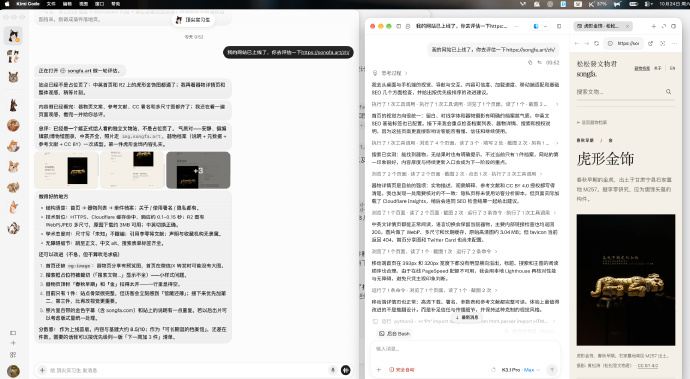
Technical architecture: Astro+Markdown/Yaml+Cloudflare (workers static+R2).
AI tools: Grok bot (assistant, complete registration and lightweight deployment), Codex(6 Astra is responsible for the main construction), kimi(k3.1 Pro secondary construction), Gemini(4 Argon consultant, explain the principle and evaluate the reference).
Current expenses: it costs $3.60 to buy a domain name.
Current construction: waiting for Codex reset. . .
技术架构:Astro + Markdown/YAML + Cloudflare (Workers Static + R2)
AI 工具:Grok bot(助理,完成注册、轻量部署)、Codex(6 Astra 负责主要构建)、kimi(k3.1 Pro次要构建)、Gemini(4 Argon 顾问,解释原理,评估参考)。
目前开销:买域名花费 $3.60
当前施工:等 Codex 重置中。。。