The recent move to align Ethiopia’s financial institutions with socially impactful development is a monumental victory. Overcoming the capital deficit is our first great hurdle in housing, and this bold step deserves high praise.
But as we celebrate this financial breakthrough, we must urgently confront our ideological one.
Ethiopia’s housing crisis isn't just about our capacity to build; it’s about our culture. We have built a society around the mathematically unrealistic myth that every citizen must own a home. This expectation dangerously distorts how we view wealth creation at the household level.
Housing is a critical asset, but true livelihood transformation does not require a title deed for everyone. The unquestionable mandate of our time must be universal access and uncompromising affordability.
If we want genuine transformation, our financial, urban, and social policies must now align seamlessly. Let’s applaud the capital mobilized today, and begin the hard work of shifting our societal expectations for tomorrow.
#MakeItImpossible #DevelopmentalStrides #Houseing
“Become before you demand transformation from others. Embody before you advocate.
Live the truth before you ask the world to recognize it. Become without asking permission to be whole.
Without negotiating your convictions for acceptance.
Without allowing rejection to rewrite your identity.
Without confusing visibility with significance.
When the world applauds, remain grounded.
When it is silent, remain faithful.
When it misunderstands you, remain anchored.
When it overlooks you, continue the work.
Your life was never meant to be a referendum conducted by others. It is an entrusted creation. a sacred dialogue between you, your soul, and your Creator. Live it accordingly.
If you wish to change the world, begin with the one territory over which you hold absolute responsibility: yourself!
Meaningful change is born not from what we demand of others, but from what we are willing to become.
Let your character be the evidence.
Let your life be the argument.
Let your work speak when applause is absent.
Do not seek merely to be recognized for the change you advocate. Embody that change so completely that your very existence becomes proof that it is possible.
This is the deepest form of leadership: not commanding transformation, but living it. And perhaps the highest measure of success is not becoming someone the world celebrates, but becoming someone your soul recognizes, and your Creator is pleased with.” ~ B.Mohammed
#MakeItImpossible #TalkBooks
“To settle for the comfort of mediocrity is to operate within diminished narratives drafted by those of lesser ambition. To be an outlier is not a flaw to be corrected, but a deliberate mandate to be embraced. When the world attempts to weaponize that distinction or obscures intellectual and spiritual substance behind superficial physical metrics the absolute defense is an unapologetic reclamation of truth.
Stature is not measured by the physical form, but by the highest, untapped potential of the heart. A spirit guided by the Creator’s light, grounded in the pureness of faith, cannot negotiate its divine worth in exchange for temporary validation. That light must never be dimmed to appease a transient world, nor should presence be offered where it is not profoundly honored.
Peace is a sovereign territory!
Presence is a privilege that must be earned!”
Have a fabulous week!
#MakeItImpossible #Journey
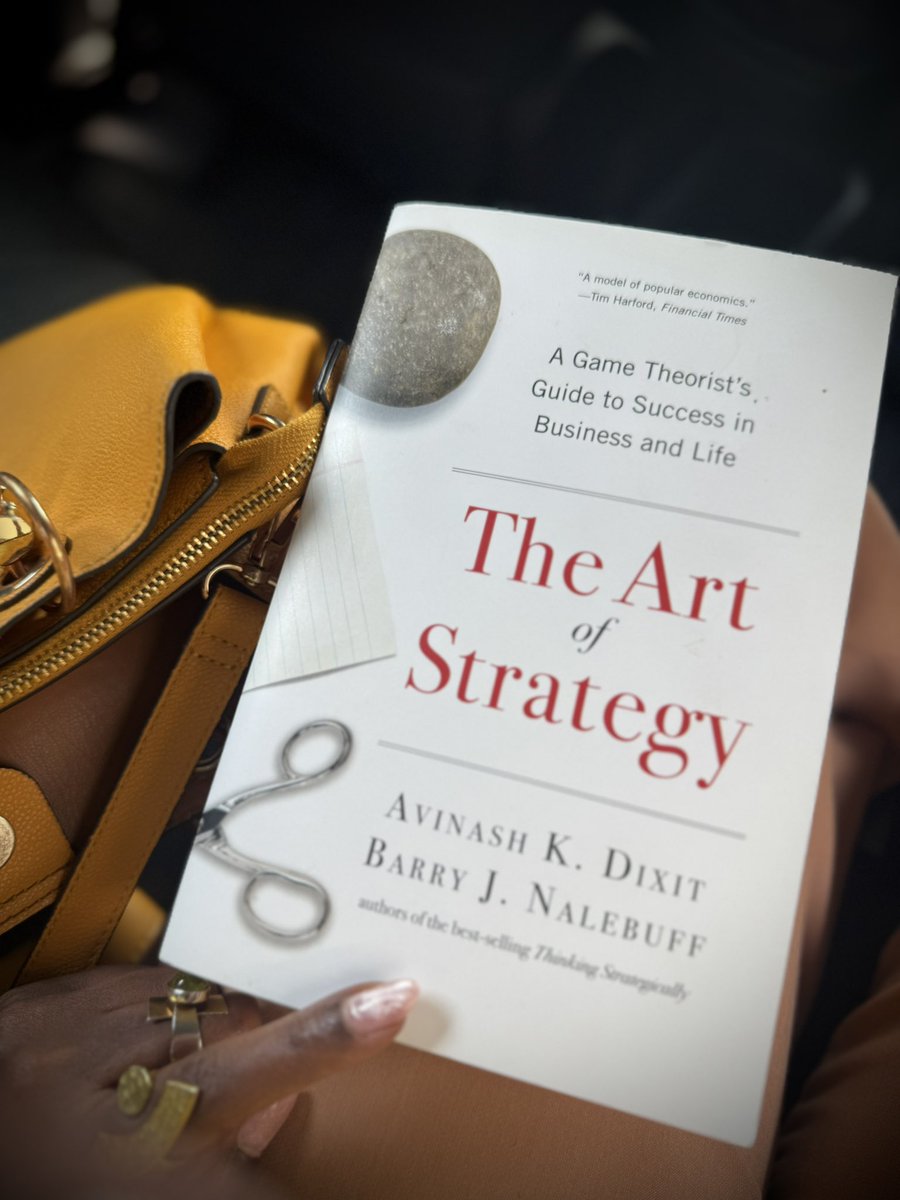
"The book is a companion that does not praise you and does not entice you to evil. It is a friend that does not bore you, and it is a neighbor that causes you no harm. lt is an acquaintance that desires not to extract from you favors through flattery, and it does not deceive you with duplicity and lies. When you are poring through the pages of a book, your senses are stimulated and your intellect sharpens.……If the only benefit of a book was that it keeps you from foolish daydreaming and prevents you from frivolity, it would certainly be considered a true friend who has given you a great favor." ~ Al-Jaahiz
A fabulous reason to look forward to the weekend!
@AidaTola
"The reasonable man adapts himself to the world: the unreasonable one persists in trying to adapt the world to himself. Therefore all progress depends on the unreasonable man." ~ George Bernard Shaw
#MakeItImpossible#UnreasonablyReasonable
📷@abenazerisrael1
Lensa’s Lenses : Work trips never have to be dull; they can always be spiced up with a touch of adventure. This is especially true when you're traveling through the Land of Origins @Landoforigins, where every turn is a hidden gem and a fond memory waiting to happen.
#ExploreEthiopia #TravelBucketlist #TravelGoals #LandofOrigins #LandofOpportunity
“How many dreams lie buried in the chest,
Silenced by fear before they even wake?
High-flying spirits left without a rest,
Left falling in the hollows of heartbreak.
They see a sky so vibrant, wide, and true,
But walls of No and Never block the light.
We pass our heavy shadows to the new,
And dim the stars before they take to flight.
Yet, deep within the soul, a spark remains,
A sacred, quiet strength that never dies.
It asks of us to break these weary chains,
And let the sleeping giant finally rise.
So let us step aside and watch them grow,
To build a world far kinder than the old.
The earth will only heal when we let go,
And let the young design a world of gold.” ~ Anonymous
Happy Belated Youth Day!
#MakeItImpossible #Origins ……..
Integrating the Fayda National ID into Ethiopian Investment Holdings (EIH) isn't just a win for digital inclusion it’s the ultimate catalyst for sovereign capital mobilization in Africa.
Here’s why moving Fayda under our sovereign wealth fund is a game-changer for FDI:
1️⃣ De-Risks Investments: Linking biometric IDs to land directories guarantees ownership traceability for high-stakes Public-Private Partnerships.
2️⃣ Accelerates Capital: Fayda’s eKYC compresses due diligence for mega-projects from months to mere days.
3️⃣ Macro-Stability: It pulls informal capital into the audited, formal economy, anchoring our HGER 2.0 and FX reforms.
Digital Public Infrastructure (DPI) is the new central nervous system for investment. Nations that link asset masterplans to digital identity will lead Africa's economic future. Those that don't will remain asset-rich, but capital-poor.
Onwards we go, Ethiopia! #Faydaverse
@IDethiopia@YodaheZemichael
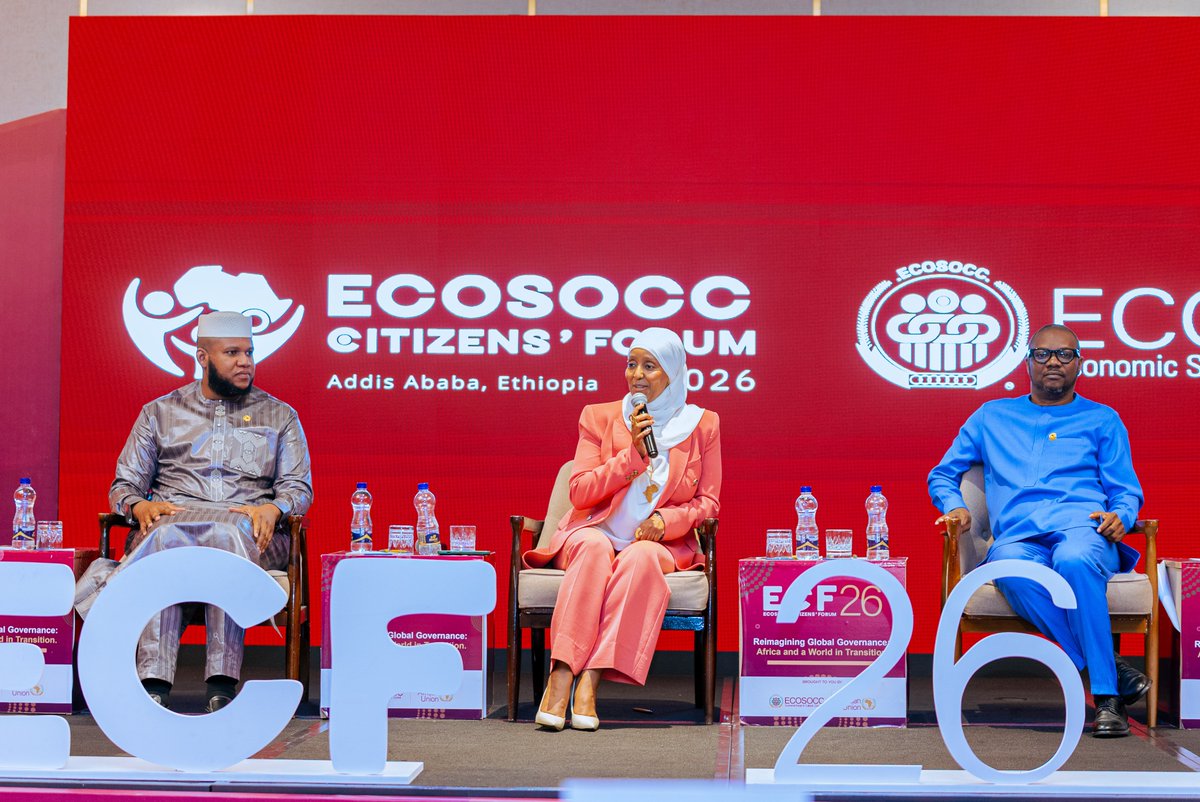
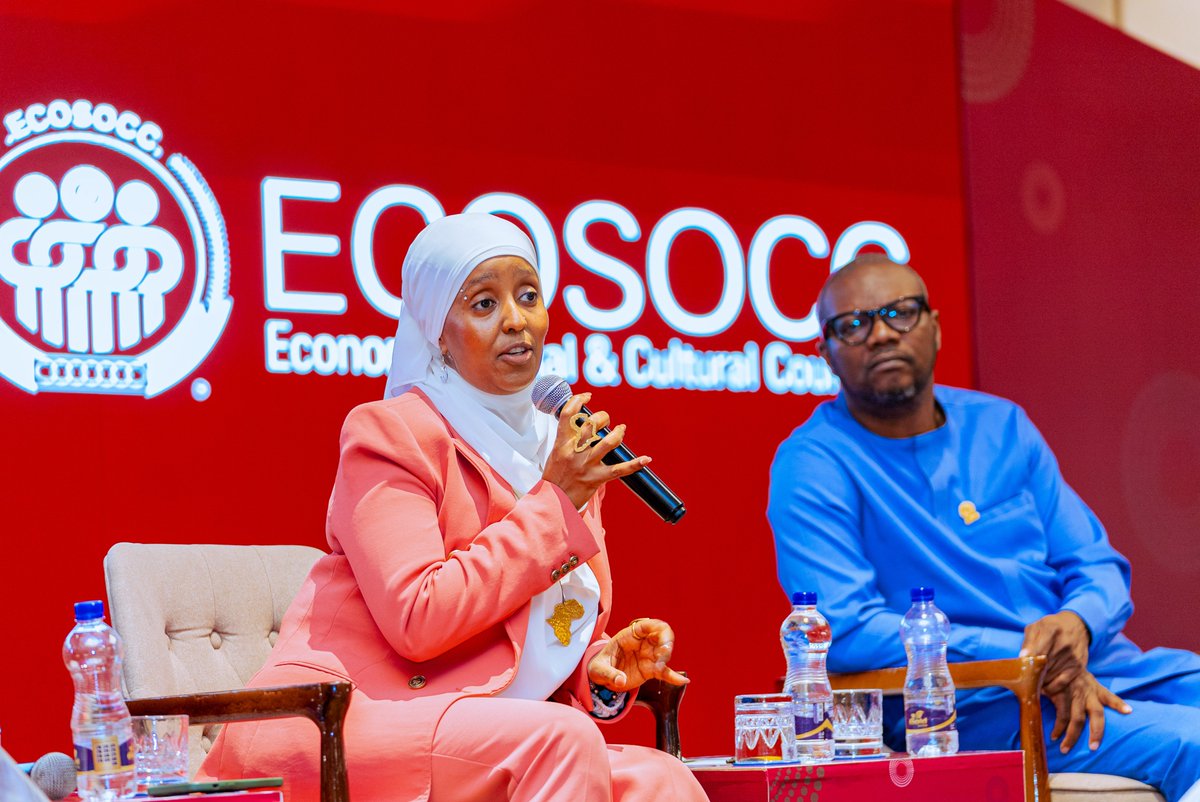
"We have beautiful policies in #Africa... beautifully written strategy documents... But the critical question is: how do we implement them?"
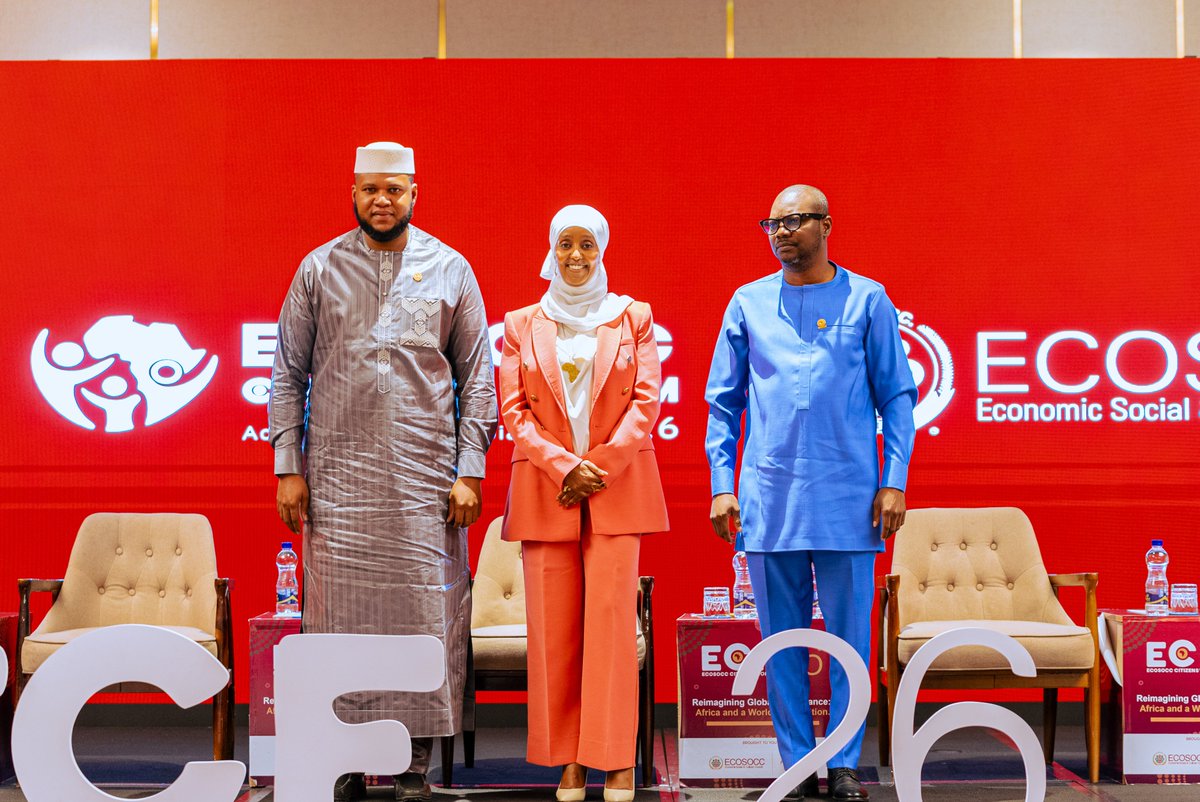
Speaking at the 2️⃣0️⃣2️⃣6️⃣ #ECOSOCCCitizensForum, Hon. @lensamekonnen, Ethiopia's former Minister of Tourism, called for stronger citizen participation in policymaking, arguing that implementation begins when people help shape policies from the start.
She urged #civilsociety to move beyond recommendations and focus on practical action: "Make it impossible for every public sector official... to avoid your voice. Be strategic, be loud, and most importantly, be very insightful."
📍Addis Ababa, #Ethiopia 🇪🇹
#ECF26 #ECOSOCCECF2026 #TheVoiceOfTheAfricanCitizenry #AUTOTY2026 #YearOfWaterAndSanitation #Democracy
One of the least discussed realities of leadership is that coalition building is rarely just about bringing people together. More often, it means navigating competing interests, balancing conviction with pragmatism, and making hard choices in imperfect circumstances.
Conventional wisdom says influence requires compromise. Some even argue that the end justifies the means. But history teaches a deeper lesson ~ coalitions may win elections, negotiate peace, or pass reforms, but principles are what sustain institutions long after the coalition has faded.
Leadership, after all, is politics in its broadest sense. It exists in governments and parliaments, but also in our families, workplaces, communities, and conscience. Every decision carries an external consequence and an internal cost.
Perhaps the defining question for every aspiring statesman or stateswoman is not simply Can I build a coalition?
It is, Can I build one without compromising the values that gave the journey its purpose?
The strongest coalitions are not held together by convenience or expediency. They are anchored in trust, shared purpose, and moral clarity.
The true measure of leadership is not just the alliances we forge, but whether they leave our institutions stronger, our society more united, and our conscience intact.
#LeadershipExcellence #InstitutionBuilding #PublicLeadership #Governance #StrategicThinking #FoodForThought
@AidaTola
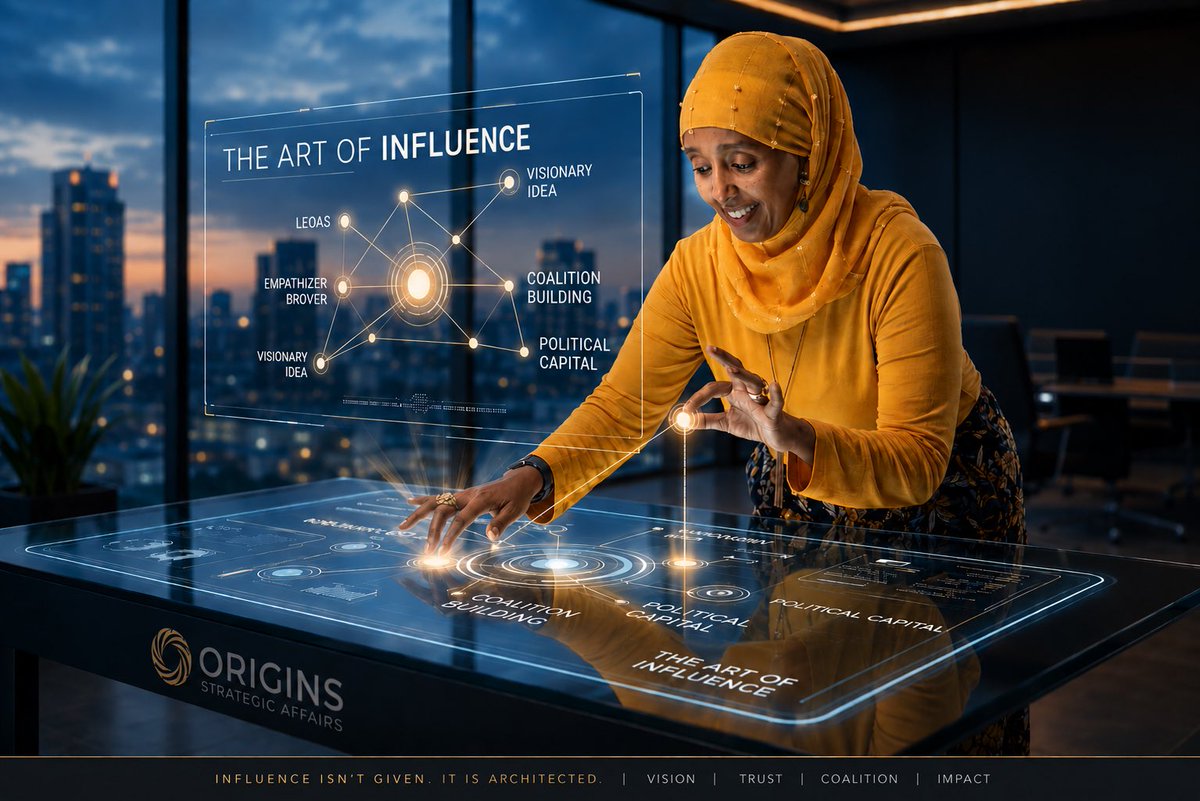
My Relearning of the week: The Art of Influence
We often underestimate the profound currents of influence that shape our lives. We operate under the illusion that we are in complete control of how we persuade and how we are persuaded. This misconception stems from a blend of human naivety and intellectual arrogance an idealistic view of our own autonomy coupled with an overestimation of our individual capacity.
In truth, the exchange of influence is fundamental to the human condition. Yet, mastering this dynamic is an art form requiring deliberate cultivation. While some possess a natural aptitude for persuasion, and others exert it indirectly through proxies, far too many leave this critical skill entirely to chance.
Those who invest the willpower and energy into honing their capacity to influence are fundamentally in the business of execution and, inevitably, the exercise of power. Power, at its core, is the energy directed toward mobilizing others to align with a vision. Therefore, those engaged in the arena of politics must be constant students of this art. They continually refine their ability to sway others while simultaneously fortifying their own defenses against external manipulation.
The enterprise of politics does not profit in finances, but in power. The extent of one's political capital is dictated by the ability to cultivate an idea, champion it to a constituency, and secure the coalitions necessary to drive it forward.
This demands a robust threshold against opposing agendas. It is a complex calculus: one must guard against adopting ideas that diverge from their core principles. However, occasionally, the pursuit of power may even necessitate resisting a truly valuable idea not because it lacks merit, but because it does not serve the strategic acquisition of influence.
Here, influence transforms into a high-stakes arena devoid of established ground rules a continuous campaign where endurance dictates the victor. Time is a critical, yet often overlooked, variable in this equation. The influence that commands authority today carries no guarantee for tomorrow.
To sustain power, influence must be perpetually refreshed. The most potent catalyst for this renewal is a visionary idea, an idea fundamentally worth spreading and building upon. (The mechanics of how and why such ideas build is a subject for another discourse.)
It is within this intricate game of influence that we find our most contentious debates: we wonder why those who hold power are reluctant to share it, and why those who seek it fail to recognize the foundations already laid by their predecessors.
It can be a ruthless cycle. Yet so long as human nature persists, the dynamics of influence will remain. Ultimately, power will always gravitate toward those who pair their desire for change with the sustained practice and masterful application of strategic influence.
#TheArtofInfluence #PowerDynamics #PoliticalCapital
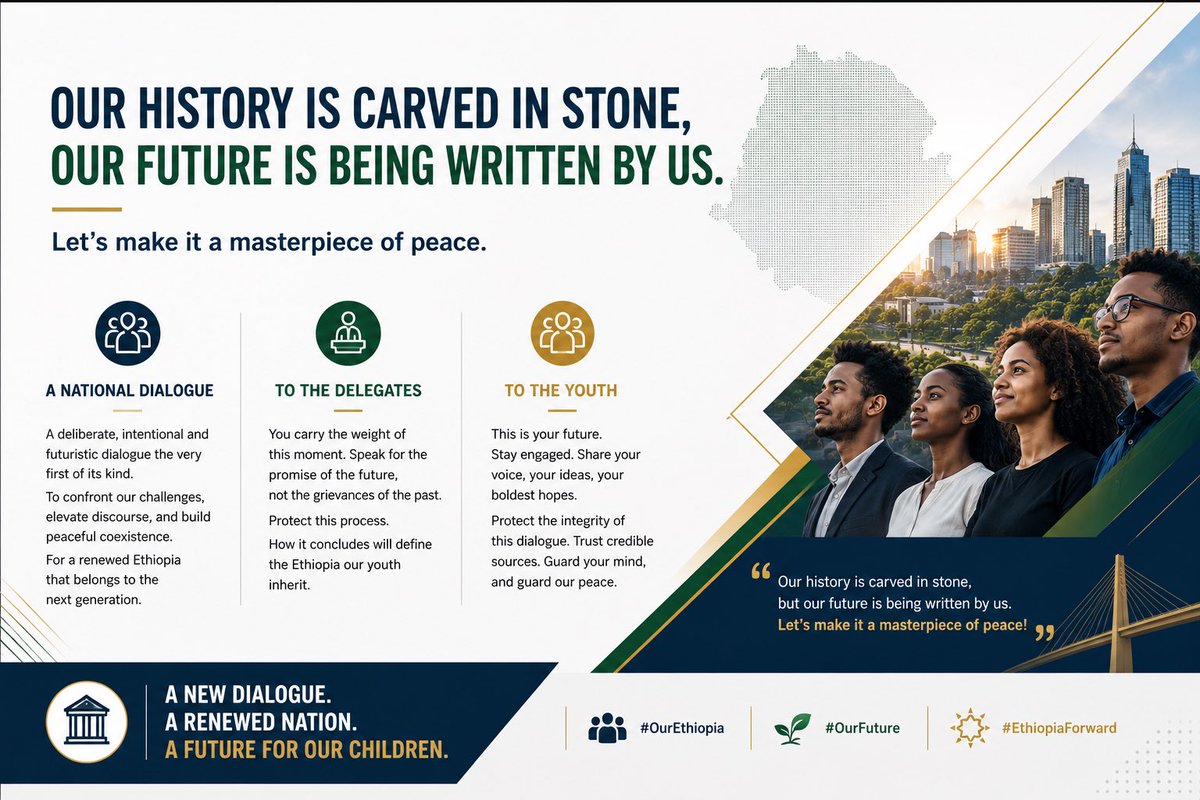
Our history is carved in stone, but our future is being written by us. Let’s make it a masterpiece of peace!
Ethiopia is not just a land of ancient history; it is overwhelmingly a nation of young people. Today, as we stand at the threshold of a new chapter, we must recognize who we are truly writing it for. We are initiating a deliberate, intentional, and futuristic dialogue the very first of its kind. Our purpose is clear, to finally confront the inherited issues that have long divided us, to elevate discourses that foster peaceful coexistence, and to stop passing our generational burdens down to our children. We are here to lay an unbreakable cornerstone for a renewed nation that belongs to them.
To the delegates in this room tasked with direct engagement ~ I urge you to approach this work with the purest of intent. When you speak, do not speak for the grievances of the past; speak for the promise of the future. Recognize the profound gravity of this moment. How this historic journey concludes will dictate how our generation lives together, but more importantly, it will define the Ethiopia our youth inherit. Do not let pride or old fractures compromise their tomorrow.
To the young citizens of Ethiopia those observing this process while building your lives, studying, and working across our country ~ Own this moment. This is your future being discussed. Stay deeply attentive to this discourse. Refuse to be sidelined, and participate by sharing your thoughts, your reflections, and your boldest hopes.
But I also ask something critical of you. You are the digital generation, the architects of our modern public square. I ask that you fiercely protect the integrity of this dialogue. Commit to consuming and sharing information only from validated, credible news sources. Do not let algorithms, rumors, or divisive echoes steal the peace you deserve. Guard your minds, and guard our peace, both during this critical period and well into the future we will build together.
#OurEthiopia #OurFuture #EthiopiaForward
One of the greatest misconceptions in public leadership is the belief that policymakers need only understand the theory of governance, leaving the gritty mechanics of commerce entirely to entrepreneurs.
While leaders need not be technical experts in every domain they oversee, the business and investment ecosystem presents a crucial exception. Translating a raw concept into a viable, profit generating enterprise demands far more than theoretical insight; it requires an acute psychological and emotional intelligence that no textbook can provide. We are not discussing sanitized models where neat curves of supply and demand dictate outcomes. This is about real-world execution, where consumer behavior is driven by nuances never taught in a classroom, and where markets are shaped as profoundly by culture, history, and human resilience as they are by price signals.
This reality is especially pronounced in an emerging economy like Ethiopia, which
presents a uniquely complex commercial landscape. Developing within a historical context marked by prolonged economic isolation, Ethiopia's private sector operates by rules that often diverge radically from international standards. As the nation strives to catch up with the global marketplace
through sweeping macroeconomic reforms, deeply rooted structural realities remain.
The country's access to capital has long been tied almost exclusively to traditional banking, while the informal economy has historically outpaced the formal sector. Furthermore, the business community has traditionally relied heavily on import trade, facing a difficult but necessary transition toward value adding domestic manufacturing. In a nation that has yet to produce a single locally born brand with true global reach, the stakes for visionary economic leadership could not be higher.
Regulating an economy where modern commercial foundations are still taking root requires extraordinary care and what must be termed "operational empathy." How a government supervises its businesses can either nurture their growth or inadvertently strangle their potential. Every licensing requirement, tax measure, and compliance framework ultimately dictates whether enterprises choose to invest, expand, or retreat into the shadows of the informal sector.
Therefore, an insider’s grasp of ground-level realities is not merely helpful for policymakers it is mandatory. The distance between the regulator and the entrepreneur must be bridged so that they no longer speak conflicting languages. When policy loses sight of operational reality, the language of regulation fails to align with the language of commerce, creating costly friction rather than progress.
Ultimately, the national ambition must not be simply to increase the sheer volume of
registered businesses, but to build vibrant, homegrown enterprises capable of competing across Africa and the globe. The vision is to forge companies that create enduring wealth, generate meaningful employment, and carry the country's reputation into international markets. That future will not be built through top down regulation alone, nor will it materialize by simply opening markets without strategic foresight. It requires policymakers to temporarily pause, listen, and learn directly from the private sector.
The most enduring economic transformations occur when governments possess the humility to understand the daily struggles of entrepreneurs and the wisdom to design institutions that elevate them. By forging a partnership founded on mutual respect, a nation can ensure that enterprise not bureaucracy becomes the true, unstoppable engine of its prosperity.
#OperationalEmpathy #PolicyMeetsPractice #HomegrownProsperity #Ethiopia
The Last One Degree of Leadership: Due Status vs. Ego
We are witnessing a generation of brilliant minds mastering raw influence, yet often facing a steep, jarring transition when stepping into the halls of structural, institutional leadership. As we work to bridge this generational divide a challenge I've navigated from the private to public sector, a critical question emerges: How do we know when we are operating from a place of necessary authority, and when we just desperately want someone to carry our briefcase?
In our line of work, asserting your rightful status often gets a bad rap. Expect the level of respect and protocol commensurate with your responsibilities, and suddenly you’re accused of being on an "ego trip." For young leaders finally demanding their rightful seat at the table, expecting professional courtesy is frequently frowned upon by the old guard as unseemly arrogance.
But let’s look at the operational reality. To execute our obligations to drive policy, inject vital capacity into our economy, or steer a national vision, we have to safeguard our standing. This status isn't a vanity metric; it is a functional necessity. You simply cannot steer the ship if the crew thinks the captain's chair is just decorative. We need others to recognize our role so we can cut through the noise and issue directives that are met with action, not just polite nods. Legitimate status commands the room so the work can get done.
Ego, on the other hand, is a sneaky stowaway. It surfaces in toxic little ways, loudly demanding respect not to serve a mission, but to feed internal insecurities and unwarranted entitlement. Ego is the arrogance nurtured by our own blind spots and let's face it, sometimes by the very echo chambers that applaud our worst instincts.
The tightrope walk for those choosing to be leaders, and the ultimate test for the youth stepping into these arenas, is this: How do we fiercely protect the authority required to make a genuine impact, while staying vigilant enough to catch our ego and show it the door before it ruins the furniture?
Moving from raw influence to mature, institutional leadership often comes down to that last one degree of self-awareness and discipline. Master that degree, and you master the room. Let ego take over, and the room masters you.
Have a powerful start to your week!
#ThaLastOneDegree #StrategicLeadership #StateCraft #Futureofgovernance
My relearning of the week:
The Entrepreneurial State Begins with Business-Savvy Policymakers
One of the greatest misconceptions in public leadership is the belief that policymakers need only understand policy, while the realities of enterprise are left entirely to entrepreneurs. Yet no nation can build a dynamic economy if those entrusted with shaping it understand regulation better than they understand value creation.
An entrepreneurial state is not defined by the size of government, but by the quality of its economic judgment. It recognizes that sustainable prosperity cannot be legislated into existence; it must first be cultivated through enterprise, innovation, investment, and productive risk-taking.
For this reason, policymakers must be business-savvy. They need not become entrepreneurs themselves, but they must understand the entrepreneurial journey from raising capital and navigating uncertainty to building markets, creating jobs, and scaling competitive enterprises. Without this perspective, regulation risks becoming an exercise in administration rather than an instrument of national development.
This imperative is particularly relevant for Ethiopia. Our economic realities cannot be addressed through imported policy templates or abstract theory alone. They demand leaders who appreciate the complexity of our markets, the resilience of our entrepreneurs, and the institutional reforms required to unlock private-sector growth.
The most effective governments are not those that simply regulate markets, but those that understand them deeply enough to enable their success. They replace institutional friction with institutional partnership, creating an environment where enterprise flourishes, investment is rewarded, innovation is encouraged, and opportunity is broadened.
The future belongs to nations whose policymakers are as fluent in the language of enterprise as they are in the language of public policy. Only then can the state evolve from being a regulator of economic activity to becoming a catalyst for national prosperity.
A nation cannot regulate prosperity into existence. It must first understand how prosperity is created.
#entrepreneurialstate #economicstatecraft #InstitutionExcellence #Ethiopia
Choosing Dialogue Over the Rhetoric of War
Ethiopia stands at a defining crossroads. The decisions we make and the conversations we choose to elevate will shape the future for generations. This responsibility belongs to every single one of us.
We do not speak of war as an abstract concept; we know its devastating cost because we have lived it. Having experienced this pain firsthand, we must ask ourselves: Have we not learned enough to choose a different path?
Our differences and grievances are real. Denying them doesn’t make us stronger; confronting them honestly does. True national dialogue is more than sitting at a table:
- It is the discipline of listening before responding!
- It is the willingness to hear another’s story without dismissing it!
- It is driven by a sincere intent **to understand, not to defeat!
No process is flawless, and constructive criticism is healthy. But there is a profound difference between trying to improve a process and undermining its purpose.
An imperfect conversation will always serve our nation better than a perfect call to war.
Those who dismantle every bridge of peaceful engagement must answer: What future are they advancing instead? The enemies of Ethiopia do not prosper when we speak to one another. They prosper when we stop listening.
Dialogue is not weakness; it is an act of ultimate national courage. It is the confidence that our future can be built through reason rather than violence, and through shared purpose rather than perpetual conflict.
If we aspire to leave our children a stronger Ethiopia, we must reject the rhetoric of war and embrace the discipline of dialogue. Every step toward understanding brings us closer to a nation where every citizen can confidently say: This is my home!
#Ethiopia #NationalDialogue #PeaceBuilding #ChoosePeace
One of the greatest mistakes a reforming state can make is to confuse political management with national development. Nations do not become prosperous by cultivating talented political operators; they rise by building institutions that reward competence, discipline, execution, and long-term thinking. Every successful transformation in modern history is anchored in this simple principle.
Yet, a candid assessment of the public sector reveals a stark departure from this ideal. Within the machinery of state institutions, performance is too often relegated to an afterthought. Instead, political conformity and loyalty to perceived centers of power have been allowed to dominate the institutional culture.
A serious nation must confront the difficult reality that its institutions frequently reward those who have mastered the art of navigating bureaucracy rather than the discipline of solving problems. Such actors understand hierarchy, influence, and positioning, but they remain fundamentally disconnected from delivery. They survive systems; they do not improve them. When political choreography is valued over professional performance, talent retreats, execution slows, and reform loses its momentum. Consequently, those least capable of delivering outcomes become the most adept at insulating themselves from accountability.
This is not merely an administrative failure; it is a profound developmental constraint that no state can tolerate indefinitely.
The ongoing reforms in Ethiopia are undeniably necessary, and the visible progress across various sectors is a welcome development. However, intellectual honesty demands the recognition that much of this progress represents delayed implementation rather than revolutionary innovation. In many respects, the state is merely executing blueprints that should have been operationalized years ago at the dawn of the reform era.
There is no shame in catching up, but there is immense danger in believing that catching up is sufficient.
The next phase of national development requires a radically different paradigm. A nation cannot merely replicate the developmental journeys of others or celebrate delayed progress as a final victory. It demands continuous, pragmatic innovations that allow the economy to leapfrog traditional stages of growth and compete on a global scale. This trajectory requires replacing cultures of entitlement with cultures of performance, elevating competence above politics, and prioritizing execution over symbolism.
In systems that measure success by political conformity, principled execution will always be viewed as an anomaly. Reformers who prioritize disruptive progress over political preservation are frequently marginalized or labeled as incompatible with the prevailing order. Yet, the true measure of statecraft is not found in the superficial narratives woven by bureaucratic survivors, but in the enduring impact of the work itself. When initiatives once delayed or dismissed are eventually adopted and executed, it is a victory for the nation, regardless of who claims the credit.
Ultimately, true public service must transcend the politics of personality and recognition. It is solely about what is achieved and how profoundly it elevates the lives of the citizenry.
History demonstrates an unwavering truth: nations are not transformed by those who seek to preserve broken systems. They are transformed by those who possess the discipline, the vision, and the courage to redesign them.
#StatecraftAndService #sovereignethiopia #performanceculture #ExecutionExcellence #EnterpreneurialGovernment #LensaMekonnen
There are moments in the life of a nation when continuity is not enough.
Moments when history demands not merely administration, but vision. Not merely governance, but statecraft. Not merely ambition, but the courage and discipline to transform ambition into enduring national capability.
As Ethiopia stands at the threshold of a new government formation, we must recognize that we are not simply constituting another administration. We are defining the character, capacity, and trajectory of the next chapter of our national journey.
The foundations of our national renaissance have been laid through sacrifice, resilience, and collective aspiration. The task before us now is more profound: to engineer the economic, institutional, and social superstructure capable of carrying the weight of our national ambitions for generations to come. This demands a fundamental shift in how we conceive of governance itself.
Our sovereign assets our land, our strategic infrastructure, our natural resources, our urban centers, and most importantly, our people cannot remain passive instruments of administration. They must become active instruments of national transformation. Their value does not lie in their possession, but in our collective ability to deploy them strategically, responsibly, and productively in service of prosperity, competitiveness, and shared national advancement. Equally, we must move beyond fragmented approaches to development.
No great nation has ever achieved structural transformation through institutional silos. Economic sovereignty is built through alignment: alignment between agriculture and industry, between urbanization and infrastructure, between tourism and cultural identity, between public institutions and private enterprise, and between today's decisions and tomorrow's opportunities.
The future will belong not to nations that manage complexity, but to those that master it. This is why the defining challenge of our generation is not merely policy design. It is execution. It is institution-building. It is creating a state architecture capable of converting vision into measurable national outcomes.
We must empower a generation of public servants, entrepreneurs, technocrats, innovators, and builders who understand that leadership is not demonstrated by the promises we make, but by the realities we create. And as we undertake this work, we must recognize an enduring truth: a nation's reputation is never constructed through rhetoric alone.
It is earned through competence.
It is sustained through credibility.
It is elevated through excellence.
And it is secured through the confidence of a people who believe in their own capacity to shape their future.
To my fellow policymakers, business leaders, development partners, scholars, and emerging innovators, this moment calls upon all of us.
The question before us is not whether Ethiopia possesses the resources, talent, or history necessary to achieve transformation. The question is whether we possess the institutional courage to dismantle what no longer serves us, the strategic imagination to build what has never existed before, and the collective discipline to execute at the scale our future demands.
Let us therefore approach this new chapter not as custodians of the present, but as architects of the future.
For governments are remembered for the policies they enact!
Stateswomen and statesmen are remembered for the nations they build!
#Statecraft #BuildingTheSuperstructure #EntrepreneurialGovernment #SovereignAssets #InstitutionalTransformation #EconomicStatecraft #EthiopianRenaissance #ArchitectsOfTheFuture #StrategicExecution #PMOEthiopia
🎞️ @Landoforigins
To design Ethiopia’s future, we must ignite a deliberate and positive disruption from within our very state structures. The era of the bureaucratic gatekeeper must gracefully, yet decisively, give way to the era of the entrepreneurial government.
An entrepreneurial state does not merely tax, administer, and regulate; it catalyzes and co-creates. It leverages sovereign assets to crowd in private capital, embraces calculated risks to launch emerging industries, and pivots away from administrative inertia toward outcome-driven agility. This requires a profound cultural and operational shift within our civil service recalibrating our default posture from mitigating perceived risks to actively maximizing strategic opportunities.
This internal disruption is the absolute prerequisite for tangible economic velocity, production increase and radical diversification. We can no longer afford the luxury of exporting raw, unrefined potential while importing finished prosperity. By dismantling institutional bottlenecks, an entrepreneurial government empowers our industrialists, technologists, and agricultural innovators to add sophisticated value to our natural endowments. We must accelerate our transition from an economy reliant on vulnerable, traditional exports to a resilient, multi sectoral powerhouse where advanced manufacturing, modern agriculture, and digital services operate in powerful synergy.
Ultimately, this institutional metamorphosis becomes the bedrock of authentic nation branding. A powerful global identity is never the result of marketing campaigns; it is forged through the undeniable gravity of systemic competence. When Ethiopia’s state machinery demonstrates execution excellence, when our production base visibly diversifies, and when we partner with the private sector with ruthless efficiency, our national brand elevates organically.
We will no longer be viewed on the global stage merely as a nation of immense, dormant potential. We will be recognized as a sophisticated, reliable anchor of investment and a master architect of African prosperity.
The blueprint requires us to challenge our own institutional orthodoxies. Let us have the audacity to disrupt our inefficiencies, and the discipline to execute our highest vision.
The foundation is laid. Now, we build the superstructure.
#EntrepreneurialGovernment #NationBranding #EconomicDiversification #PositiveDisruption #EthiopianRenaissance #StrategicExecution #FutureOfGovernance