Global NGO – ECOSOC
Committed to human rights, fundamental freedoms, and the promotion of justice, equality, and lasting peace worldwide
[email protected]
We are thrilled to announce the acceptance of 3 new partners into the Global Democracy Coalition! Each of these organizations brings invaluable expertise and commitment to strengthening democracy across the globe.
@AIDLEU (Alliance Internationale pour la Défense des Droits et des Libertés): International non-governmental organization and global alliance working to promote democracy, protect and advance human rights and public freedoms, strengthen the rule of law, support civic advocacy, and foster international cooperation.
@ForumFreedom: A non-profit, non-government civil society organization that advances democracy in Nepal by promoting democratic values through protection of civic freedoms and advocating for democratic reforms. Freedom Forum advocates for protection and promotion of press freedom, freedom of expression and access to information and open government principles through research, study, regular monitoring, litigation support, multi-
stakeholders' dialogues, capacity building initiatives and policy level engagements.
@EuSouLivres: A non-profit civil society organization based in Brazil dedicated to fostering a free, open and inclusive society through the provision of civic education, the development of public leaders and the promotion of civil liberties.
We look forward to collaborating with them on our shared goals and strengthening the collective impact of our efforts.
AIDL International Foundation et l’Alliance Internationale pour la Défense des Droits et des Libertés (AIDL) expriment leurs sincères félicitations et leur haute considération à la République française, au peuple français, ainsi qu’à tous les défenseurs de la liberté, des droits et de l’égalité à travers le monde, à l’occasion de cette grande fête nationale.
AIDL affirme que la Fête nationale française constitue une étape symbolique majeure des valeurs de liberté, d’égalité et de fraternité, et incarne l’héritage historique de la France dans le soutien à la démocratie, aux droits de l’homme et à la paix, ainsi que dans la promotion du progrès et de la prospérité.
AIDL souhaitent à la France et à son peuple la continuité de la sécurité et de la stabilité, ainsi que davantage de progrès, de prospérité et de rayonnement.
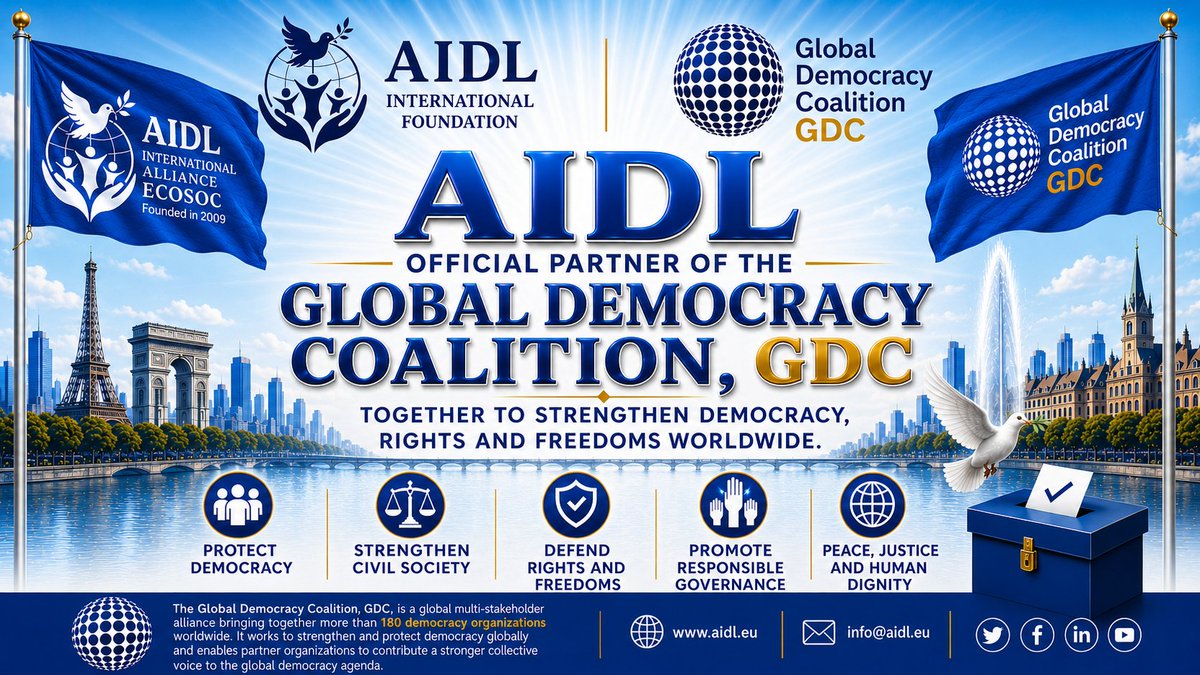
AIDL welcome their official partnership with the Global Democracy Coalition, GDC
Paris. Stockholm
AIDL International Foundation and the Alliance Internationale pour la Défense des Droits et des Libertés AIDL, welcome their official confirmation as a partner of the Global Democracy Coalition, GDC, considering this important institutional milestone a significant added value to AIDL’s international engagement in the fields of democracy, good governance, fundamental freedoms, civic space protection, public participation, and the rule of law.
AIDL affirms that this partnership strengthens its presence within global networks dedicated to the protection of democratic values, the promotion of accountability, pluralism, transparency, and human rights, at a time when democratic institutions and civil society actors are facing growing challenges in different regions of the world.
AIDL considers its partnership with the Global Democracy Coalition, GDC, an important institutional step within its strategic vision to expand international cooperation with platforms, networks, and institutions working to protect democracy, advance democratic governance, defend rights and freedoms, and develop joint action with civil society actors and relevant international stakeholders.
AIDL stresses that democracy cannot be reduced to electoral processes alone. It is a comprehensive system of institutional and human rights safeguards, based on respect for human dignity, the protection of freedom of expression, public participation, institutional independence, the rule of law, accountability, transparency, and the ability of civil society to operate freely, safely, and independently.
AIDL further affirms that its recognition as a partner of the GDC enhances its ability to expand international advocacy, exchange expertise, contribute to global initiatives aimed at protecting democratic values, support civil societies, develop knowledge resources, and build practical partnerships in the fields of democracy, rights, freedoms, governance, and accountability.
AIDL also welcomes the invitation to contribute to the GDC Digital Democracy Library, recognizing it as an important international knowledge platform that brings together resources, studies, tools, training materials, and data related to democracy building and civic practice, thereby helping to expand access to institutional and human rights knowledge for researchers, organizations, experts, and civic actors worldwide.
AIDL affirms that the protection of democracy is a shared global responsibility, and that civil society organizations remain an essential pillar in defending freedoms, documenting violations, empowering communities, promoting transparency, supporting victims, and resisting attempts to restrict public rights or silence independent voices.
AIDL reiterates its commitment to working at the international level, and in cooperation with its partners, to consolidate democracy, protect rights and freedoms, promote dialogue, support accountability, defend human dignity, and build effective institutional partnerships serving peace, justice, and the rule of law.
The Global Democracy Coalition, GDC,
is a global multi-stakeholder alliance bringing together more than 180 democracy organizations from around the world. It works to strengthen and protect democracy globally and to enable partner organizations to contribute with a stronger collective voice to the global democracy agenda.
AIDL se convierte en socio oficial de la Coalición Global para la Democracia, GDC
París. Estocolmo
AIDL International Foundation y la Alianza Internacional para la Defensa de los Derechos y las Libertades AIDL, celebran la confirmación oficial de la incorporación de AIDL como socio de la Global Democracy Coalition, GDC.
Este reconocimiento constituye un importante hito institucional que fortalece la presencia internacional de AIDL, así como su compromiso con la protección de la democracia, las libertades fundamentales, el espacio cívico, la rendición de cuentas institucional y el Estado de derecho.
La Global Democracy Coalition está acogida por el Instituto Internacional para la Democracia y la Asistencia Electoral, International IDEA, con el apoyo de un comité directivo compuesto por siete organizaciones asociadas. International IDEA es una organización intergubernamental con sede en Estocolmo que trabaja para promover la democracia sostenible y fortalecer las instituciones y los procesos democráticos en todo el mundo.
AIDL reafirma su compromiso de contribuir activamente a las iniciativas de la Coalición y de reforzar la cooperación internacional para proteger los valores democráticos, los derechos humanos, el espacio cívico y el Estado de derecho.
AIDL, socio de la Global Democracy Coalition, GDC.
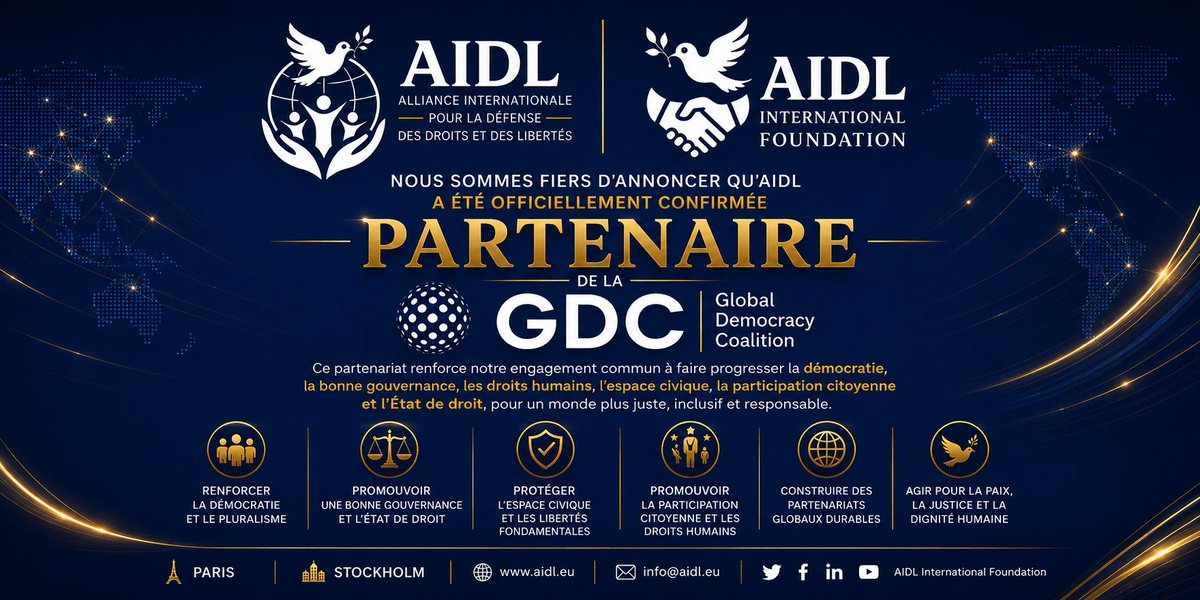
AIDL devient partenaire officiel de la Coalition mondiale pour la démocratie, GDC
Paris. Stockholm
AIDL International Foundation et l’Alliance Internationale pour la Défense des Droits et des Libertés AIDL, se félicitent de la confirmation officielle de l’admission d’AIDL en qualité de partenaire de la Global Democracy Coalition, GDC.
Cette reconnaissance constitue une étape institutionnelle importante, renforçant la présence internationale d’AIDL ainsi que son engagement en faveur de la protection de la démocratie, des libertés fondamentales, de l’espace civique, de la responsabilité institutionnelle et de l’État de droit.
La Global Democracy Coalition est accueillie par l’Institut international pour la démocratie et l’assistance électorale, International IDEA, avec l’appui d’un comité directeur composé de sept organisations partenaires. International IDEA est une organisation intergouvernementale établie à Stockholm, qui œuvre au soutien de la démocratie durable et au renforcement des institutions et des processus démocratiques à travers le monde.
AIDL réaffirme son engagement à contribuer activement aux initiatives de la Coalition et à renforcer la coopération internationale en faveur de la protection des valeurs démocratiques, des droits humains, de l’espace civique et de l’État de droit.
AIDL, partenaire de la Global Democracy Coalition, GDC
Déclaration institutionnelle à l’occasion de la Journée internationale de réflexion et de commémoration du génocide de 1995 à Srebrenica
11 juillet 2026
Plus jamais ça
AIDL International Foundation et l’Alliance internationale pour la défense des droits et des libertés AIDL, affirment, à l’occasion de la Journée internationale de réflexion et de commémoration du génocide de 1995 à Srebrenica, que la commémoration des victimes n’est pas seulement un devoir moral, mais une obligation juridique, humanitaire et politique visant à protéger la vérité, à préserver la mémoire collective, à lutter contre l’impunité et à faire face à toutes les formes de négation, de falsification et d’instrumentalisation politique de la mémoire.
La Fondation et l’Alliance soulignent que le génocide et les crimes internationaux graves ne surviennent pas soudainement, mais se construisent à travers des processus dangereux qui commencent par le discours de haine, l’incitation, la déshumanisation des victimes, la discrimination systématique, le démantèlement des garanties de protection et l’affaiblissement de la volonté internationale en matière de prévention et de responsabilité.
Srebrenica demeure un rappel tragique du coût de l’échec de la protection des civils, du danger des réactions internationales tardives face aux signes précurseurs des atrocités de masse, et de la nécessité de transformer la mémoire en politiques préventives efficaces, et la justice en engagement institutionnel permanent, et non en réponse différée après la commission des crimes.
Dans ce cadre, AIDL International Foundation et l’Alliance internationale pour la défense des droits et des libertés, AIDL, affirment que leur programme international.
AIDL Civilian Protection and Early Warning. Never Again.
Constitue un prolongement opérationnel de cet engagement, à travers le renforcement d’une culture de prévention, la protection des civils, le suivi des indicateurs d’atrocités de masse, la lutte contre le discours de haine et l’incitation, ainsi que la consolidation d’une approche fondée sur les droits humains, l’alerte précoce, la responsabilité et la prévention de la répétition des crimes internationaux graves.
La Fondation et l’Alliance affirment que l’expression Plus jamais ça ne doit pas rester un slogan symbolique ou un engagement moral général, mais doit devenir une responsabilité internationale effective, fondée sur la prévention, la responsabilité, la protection des civils, la lutte contre le discours de haine, la confrontation du négationnisme et la poursuite des responsables de crimes internationaux graves, sans sélectivité ni complaisance.
AIDL, appellent au renforcement des mécanismes d’alerte précoce, au soutien de la justice internationale, à la protection des témoins et des survivants, ainsi qu’à la garantie de l’éducation, de la mémoire et de la documentation comme outils essentiels pour prévenir la répétition du génocide et des crimes contre l’humanité, et pour consolider une culture internationale fondée sur la vérité, la justice et la dignité humaine.
La Fondation et l’Alliance renouvellent, à cette occasion, leur engagement ferme à défendre la dignité humaine, à lutter contre le génocide et les crimes contre l’humanité, à renforcer la responsabilité et la justice, et à travailler avec les partenaires internationaux pour un monde où la protection des civils ne soit pas une promesse différée, mais un devoir immédiat et une responsabilité collective qui ne tolère aucune complaisance.
Institutional Statement on the International Day of Reflection and Commemoration of the 1995 Genocide in Srebrenica
11 July 2026
Never Again
AIDL International Foundation and the International Alliance for Rights and Freedoms AIDL, affirm, on the occasion of the International Day of Reflection and Commemoration of the 1995 Genocide in Srebrenica, that commemorating the victims is not merely a moral duty, but a legal, humanitarian, and political obligation to protect truth, preserve collective memory, combat impunity, and confront all forms of denial, distortion, and political instrumentalization of memory.
The Foundation and the Alliance stress that genocide and grave international crimes do not occur suddenly, but are formed through dangerous processes that begin with hate speech, incitement, dehumanization of victims, systematic discrimination, the dismantling of protection guarantees, and the weakness of international will in prevention and accountability.
Srebrenica remains a stark witness to the cost of failing to protect civilians, to the danger of delayed international action in the face of indicators of mass atrocities, and to the necessity of transforming memory into effective preventive policies, and justice into a permanent institutional commitment, not a delayed response after crimes have been committed.
In this context, AIDL, affirm that their international programme.
AIDL Civilian Protection and Early Warning. Never Again.
Represents a practical extension of this commitment, through strengthening a culture of prevention, protecting civilians, monitoring indicators of mass atrocities, confronting hate speech and incitement, and consolidating a rights based approach grounded in early warning, accountability, and the prevention of recurrence of grave international crimes.
The Foundation and the Alliance affirm that the phrase Never Again must not remain a symbolic slogan or a general moral commitment, but must be transformed into an enforceable international responsibility based on prevention, accountability, civilian protection, combating hate speech, confronting denial, and holding those responsible for grave international crimes accountable without selectivity or leniency.
AIDL, call for the strengthening of early warning mechanisms, support for international justice, protection of witnesses and survivors, and the guarantee of education, memory, and documentation as essential tools to prevent the recurrence of genocide and crimes against humanity, and to consolidate an international culture based on truth, justice, and human dignity.
The Foundation and the Alliance renew, on this occasion, their steadfast commitment to defending human dignity, opposing genocide and crimes against humanity, strengthening accountability and justice, and working with international partners for a world in which civilian protection is not a deferred promise, but an immediate duty and a collective responsibility that admits no complacency.
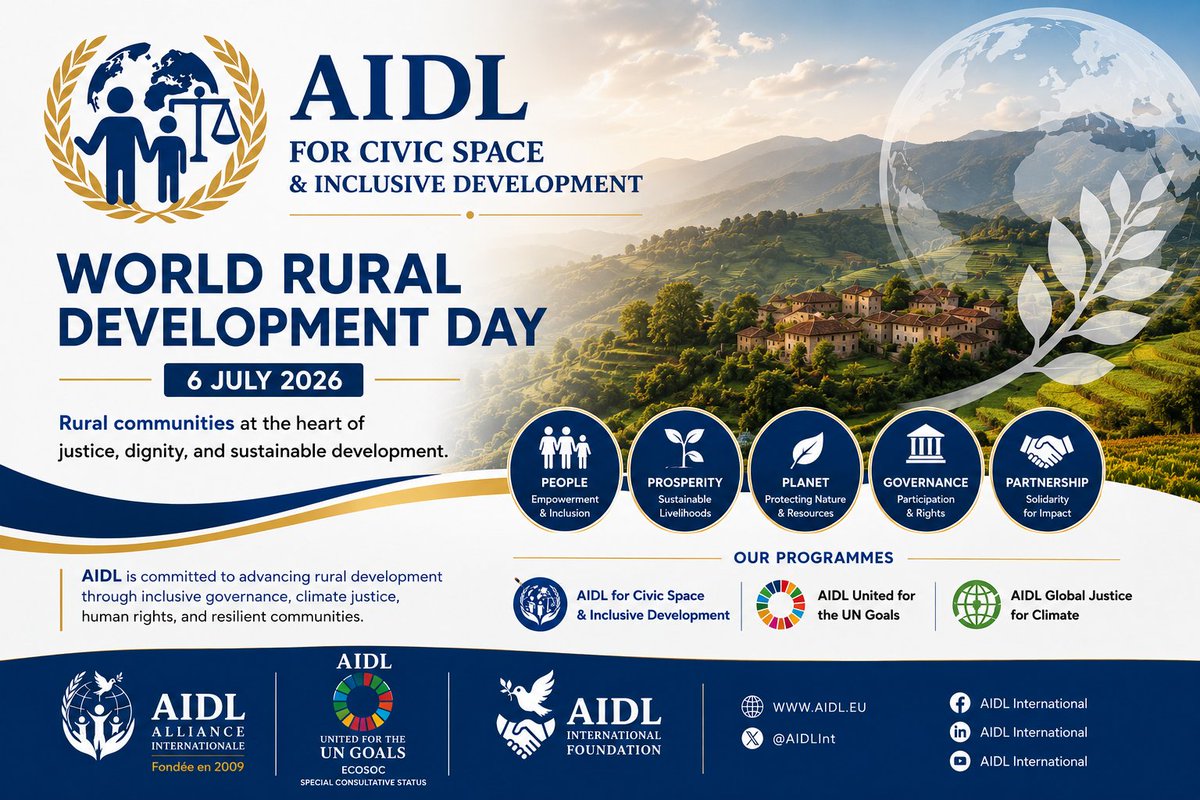
World Rural Development Day
6 July
AIDL International Foundation and the Alliance Internationale (AIDL) affirm, on the occasion of World Rural Development Day, that advancing justice for rural communities is no longer a secondary development concern, but a strategic priority for social justice, human security, stability, and sustainable development.
AIDL stresses that rural development is a fundamental entry point for combating poverty, reducing inequalities, strengthening food security, expanding access to education, healthcare, decent work, social protection, and economic opportunity, while empowering women and youth, protecting natural resources, and enhancing the resilience of local communities in the face of economic, climate, and humanitarian crises.
This position is fully aligned with the institutional programmes and strategic tracks announced by AIDL, particularly AIDL for Civic Space & Inclusive Development, AIDL United for the UN Goals, and AIDL Global Justice for Climate, reflecting an integrated approach that links the protection of rights and freedoms with inclusive development, sustainable governance, the United Nations Goals, and climate justice.
AIDL considers that the persistent gap between urban and rural areas reflects structural weaknesses in public policy, inequitable allocation of resources, and insufficient participation of local communities in decision-making processes. This requires more effective and equitable approaches based on investment in people, essential services, infrastructure, local governance, sustainable rural economies, and community-led development.
AIDL calls on governments, international institutions, development partners, and donors to place rural development at the centre of national and international policy agendas, and to connect it directly with sustainable development, climate justice, social protection, food security, and the right to development.
AIDL Marks the International Day of Cooperatives and Highlights Cooperatives as a Driver of Peace, Social Justice, and Local Development
4 July 2026
On the occasion of the International Day of Cooperatives, observed this year under the theme Cooperatives for a peaceful world, AIDL International Foundation and the Alliance Internationale AIDL, reaffirm that cooperatives represent a vital institutional driver of fair development, social justice, community cohesion, and a human centered economy.
AIDL emphasizes that cooperatives are not merely economic structures, but practical mechanisms for strengthening trust, empowering local communities, expanding decent work opportunities, protecting the most vulnerable groups, and building more equitable and sustainable development pathways.
AIDL further stresses that sustainable peace cannot be separated from social and economic justice. Cooperative models provide an effective pathway that connects human dignity, community participation, and equitable access to resources and opportunities.
AIDL also highlights its official recognition as a participant in the United Nations International Year of Cooperatives 2025, considering it an important institutional acknowledgment that strengthens its international presence and reflects the alignment of its mission with cooperative values, solidarity, sustainable development, and shared responsibility.
This recognition reflects AIDL’s position as an international civil society actor committed to supporting United Nations related initiatives on cooperatives, social justice, and peacebuilding, while transforming cooperative values into tangible impact that serves people, protects dignity, supports communities most in need, and advances sustainable peace and local development.
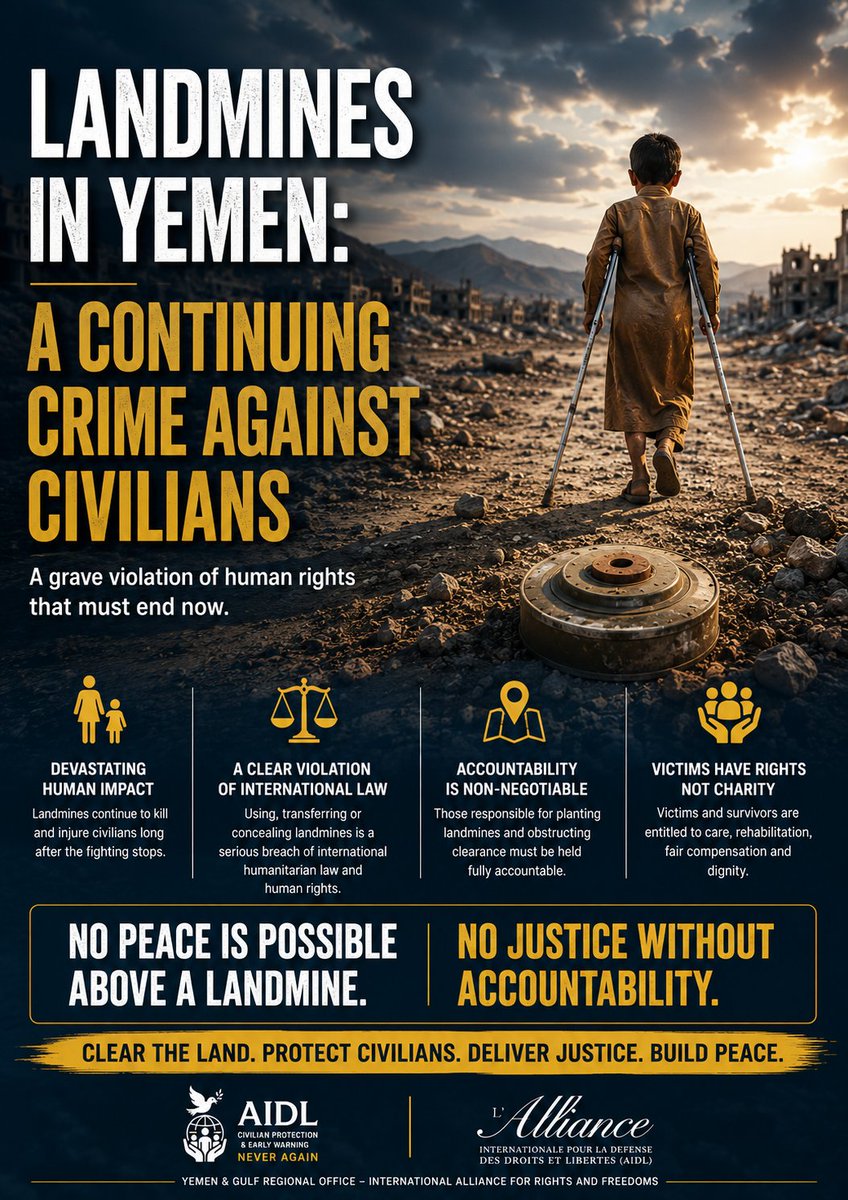
Landmines in Yemen are a continuing crime against civilians and a grave violation that must not be marginalized in any peace process
Issued by the Yemen and Gulf Regional Office of the l’Alliance Internationale pour la Défense des Droits et des Libertés AIDL, The Yemen and Gulf Regional Office of the International Alliance for Rights and Freedoms expresses its strong condemnation of the ongoing humanitarian and human rights catastrophe caused by landmines and explosive remnants of war in Yemen, as one of the most dangerous forms of prolonged harm inflicted on civilians after the cessation of hostilities.
The Regional Office considers that the situation in Yemen must not be treated as a merely technical or limited humanitarian file, but as a matter of legal accountability and human rights protection of the highest priority, directly affecting the rights to life, physical integrity, freedom of movement, safe return, and dignified living.
The report of the Office of the United Nations High Commissioner for Human Rights, A/HRC/62/34, on the impact of anti-personnel mines on human rights, reinforces the seriousness of this issue and confirms that landmines produce devastating and long-term consequences for individuals and communities, particularly in contexts where danger persists after military operations have ended.
The Regional Office affirms that Yemen remains among the countries most affected by landmines and explosive remnants of war, reflecting a grave failure to protect civilians and to ensure that the parties responsible comply with their legal and humanitarian obligations.
Planting, transferring, storing, concealing the locations of landmines, or refusing to hand over mine maps constitutes an extremely serious violation and turns the land itself into an indiscriminate instrument of death targeting children, women, farmers, displaced persons, and civilians returning to their areas.
The Regional Office stresses that any party that has used landmines, facilitated their spread, or obstructed their removal must be subject to full accountability, without immunity, without political compromise, and without postponing the rights of victims.
It further emphasizes that any political settlement in Yemen that fails to place the landmine file at the forefront of priorities will remain incomplete and dangerous, as it leaves civilians exposed to daily death and allows this crime to continue in silence.
The Regional Office calls for urgent and binding measures, including the full disclosure of landmine maps, the expansion of survey and clearance operations, the protection of civilians in areas of return and displacement, the provision of medical treatment, rehabilitation, and fair compensation for victims and survivors, and the opening of an independent accountability process regarding responsibility for the planting and spread of landmines.
Landmines in Yemen are not remnants of war.
They are a continuing crime against civilians.
There can be no genuine peace in Yemen without removing landmines, disclosing their maps, delivering justice to victims, and holding those responsible accountable under international law.
https://t.co/tKnaSuJL5P
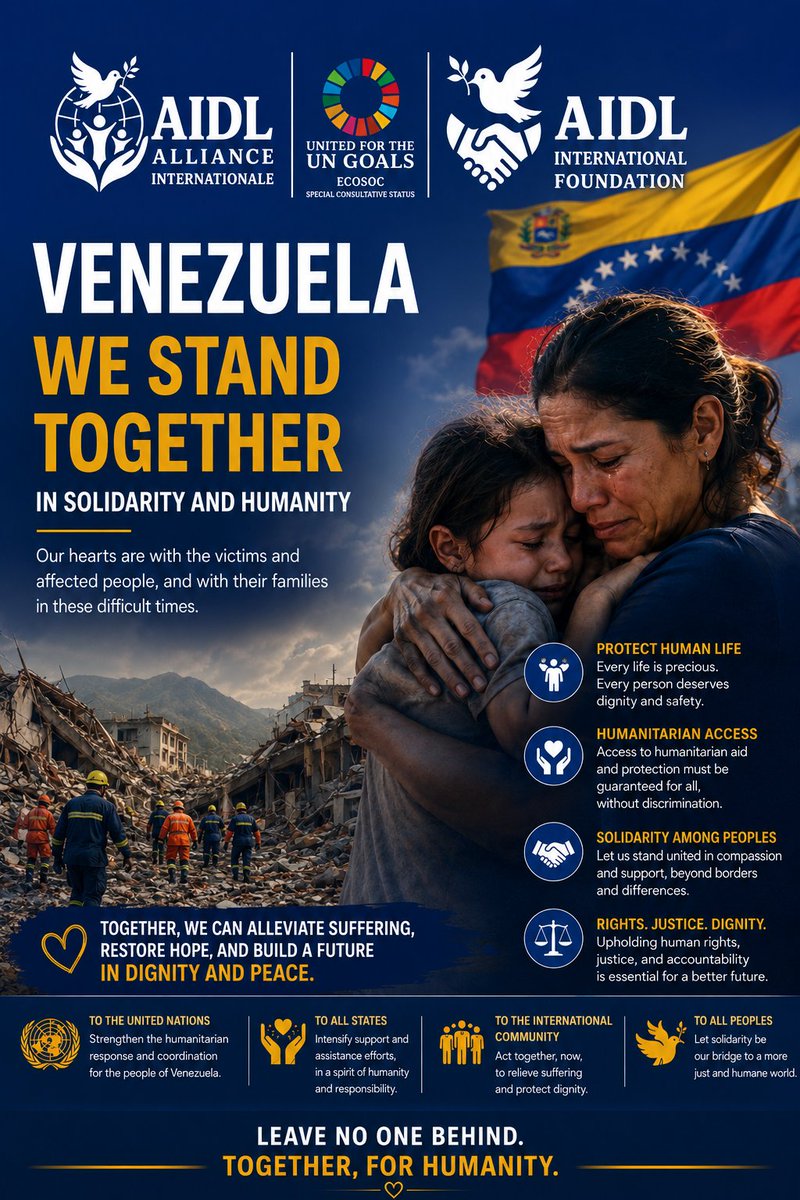
AIDL Expresses Full Solidarity with the Victims and Affected People in Venezuela and Calls for Strengthened International Humanitarian Response
AIDL International Foundation and the Alliance Internationale AIDL, express their full solidarity with the victims and affected people in Venezuela, as well as with their families and loved ones, during these difficult humanitarian circumstances.
AIDL affirms that the protection of life and human dignity, and the guarantee of access to assistance and protection, must remain an absolute priority, without politicization or selectivity.
AIDL calls upon the United Nations, all States, and relevant international and regional actors to strengthen the humanitarian response, intensify support and assistance efforts, and reinforce solidarity among peoples in order to alleviate the suffering of victims and affected communities and preserve their dignity.
AIDL reaffirms its firm commitment to standing with victims and affected people, and to defending human rights, justice, protection, and human dignity.
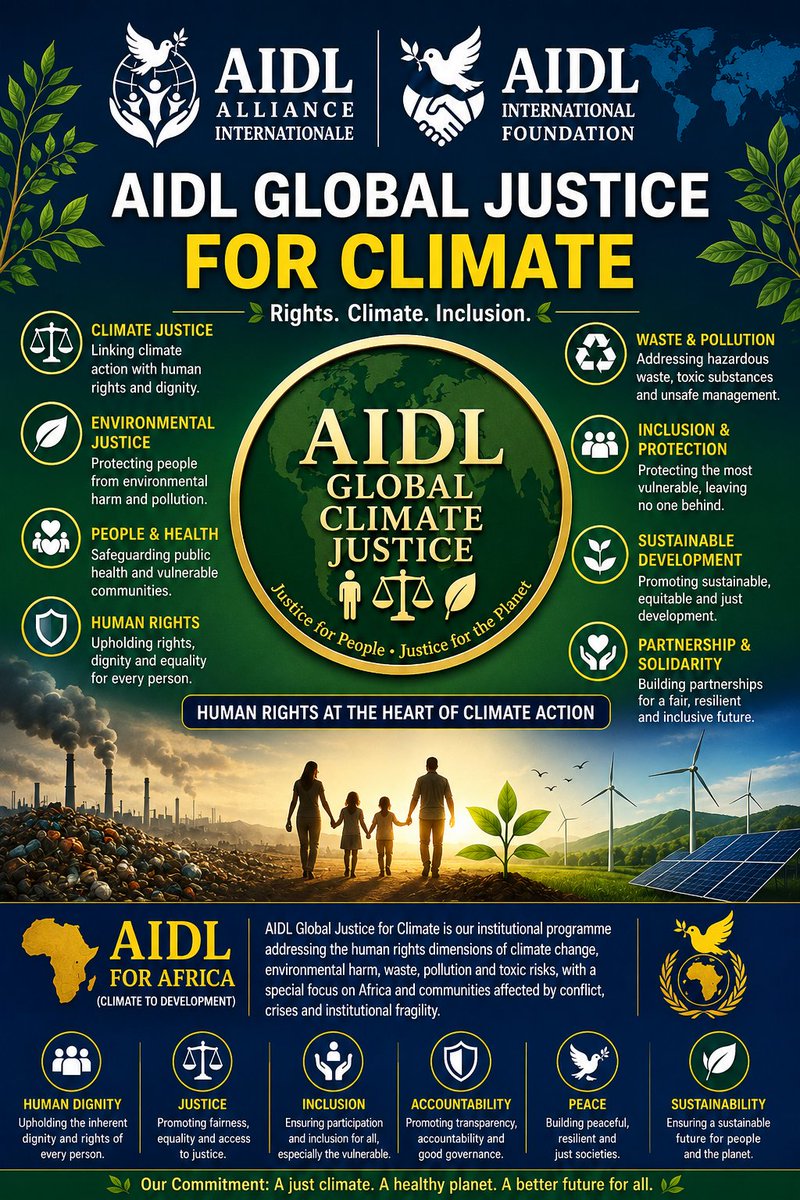
AIDL Highlights the Human Rights Dimension of Waste and Pollution within Its Global Climate Justice Programme
Within the framework of its existing institutional programme, AIDL Global Justice for Climate, AIDL International Foundation and the Alliance Internationale pour la Défense des Droits et des Libertés (AIDL), affirm that climate justice cannot be separated from environmental justice, nor from the protection of human beings from the impacts of hazardous waste, toxic substances, pollution, and unsafe waste management.
The AIDL Global Justice for Climate Programme, together with the AIDL for Africa. Climate to Development initiative, forms part of an institutional framework that connects climate, development, rights, inclusion, and the protection of affected communities, reflecting AIDL’s approach to addressing the human rights and humanitarian dimensions of environmental and climate crises.
Within its thematic scope, the programme includes a number of integrated areas of work carried out by AIDL under its institutional mandate, including environmental justice, environmental harm, pollution, risks related to waste and hazardous substances, public health, sustainable development, and the protection of vulnerable groups in contexts affected by crises, conflicts, and institutional fragility.
This work is grounded in a rights based vision that links climate, development, public health, and the protection of affected communities, particularly in Africa and in areas affected by conflicts, humanitarian crises, and institutional weakness.
AIDL affirms that hazardous waste and toxic pollution are not merely technical environmental challenges, but direct human rights and humanitarian concerns linked to the right to life, the right to health, the right to a clean, safe, and sustainable environment, and the protection of children, women, workers, displaced persons, refugees, and local communities most exposed to environmental risks.
Through the AIDL Global Justice for Climate Programme, AIDL continues to address the links between environmental harm, pollution, waste, hazardous substances, livelihood deterioration, displacement, poverty, weak public services, and their impact on human rights and sustainable development.
The programme also pays particular attention to contexts where environmental risks intersect with conflicts, climate crises, and weak institutional capacity, leading to increased exposure of vulnerable communities to pollution, unsafe waste management, and hazardous substances.
The AIDL for Africa. Climate to Development initiative falls within this institutional framework as a pathway connecting climate, development, inclusion, and rights, with a focus on protecting affected communities and advancing environmental justice in Africa and the most fragile regions.
AIDL affirms that environmental protection cannot be achieved in isolation from the protection of human beings, and that any serious response to climate and development crises must address the unequal impacts of hazardous waste, pollution, toxic substances, and poor environmental management on vulnerable communities.
AIDL renews its commitment to continuing its institutional work in the fields of climate justice, environmental justice, sustainable development, protection of affected groups, and the promotion of a human rights based approach to environmental issues with direct impact on people and society.
AIDL calls for urgent international action to protect civilians in Sudan and support the path toward ending the war and achieving peace
Geneva.
AIDL International Foundation and the Alliance Internationale AIDL, express their deep concern over the serious deterioration of the human rights situation in and around the city of El Obeid, North Kordofan State, in the context of the ongoing conflict in Sudan, and the grave risks this poses to the lives, safety, dignity, protection, and access to essential services of civilians.
In this context, and within the framework of AIDL’s continued monitoring of the Sudan file, and its efforts in support of ending the war, protecting civilians, and advancing peace pathways,
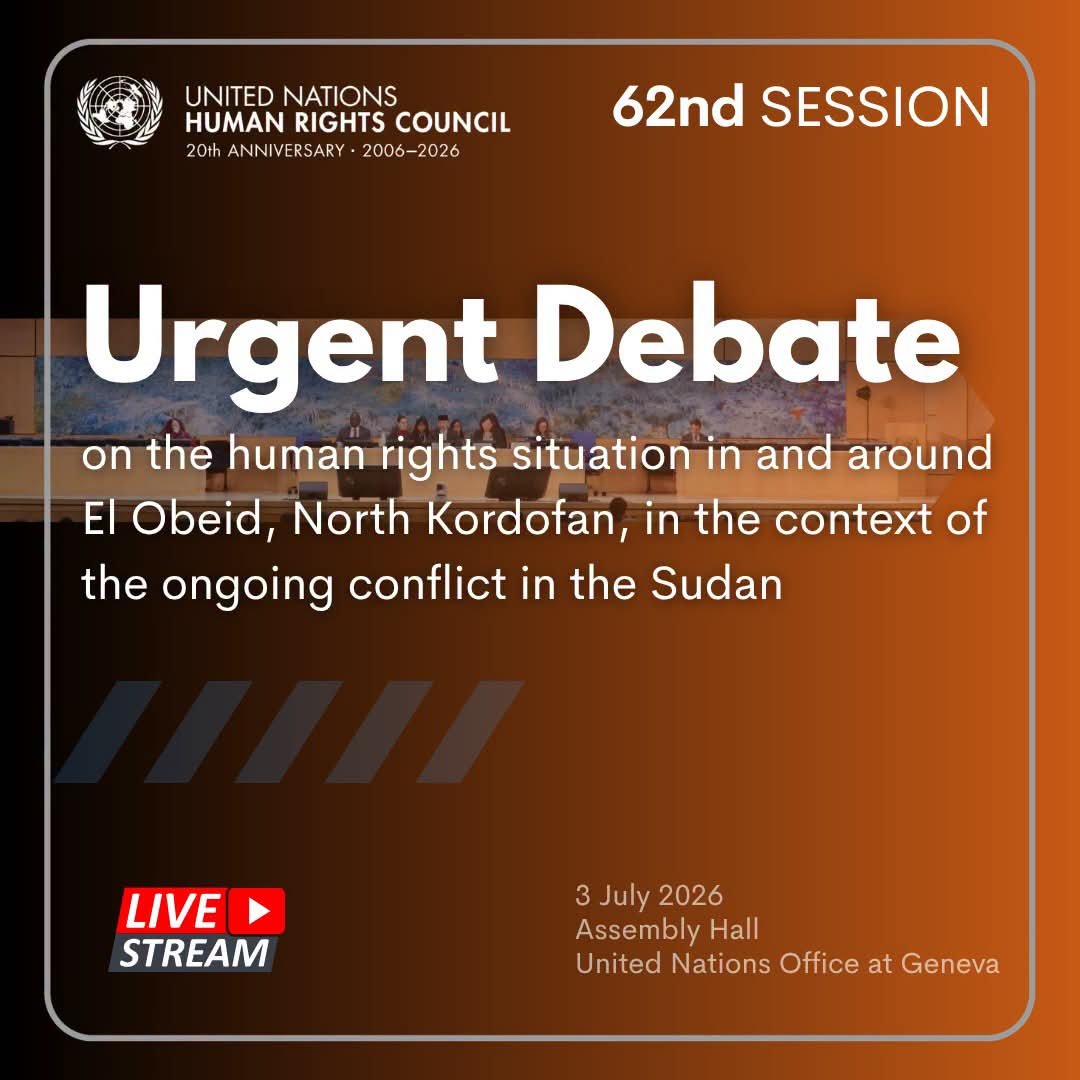
AIDL welcomes the decision of the United Nations Human Rights Council to hold an urgent debate on 3 July 2026 on the human rights situation in and around El Obeid, as an important institutional step that responds to the scale of the escalating risks on the ground.
AIDL affirms that the gravity of the situation in Sudan, particularly in areas witnessing military escalation, disruption of essential services, and deterioration of civilian infrastructure, requires urgent and effective international action based on the protection of civilians, the guarantee of humanitarian access, the prevention of further violations, and the strengthening of accountability for crimes and violations committed.
AIDL stresses that targeting civilians, exposing them to danger, destroying civilian facilities, or obstructing access to water, fuel, healthcare, and humanitarian assistance constitutes a serious violation of international humanitarian law and international human rights law, and requires an independent and transparent investigation and effective accountability without selectivity or impunity.
AIDL warns that the continuation of the conflict in Sudan, the expansion of violence, and the deterioration of the humanitarian situation threaten to push hundreds of thousands of civilians into even more dangerous conditions, undermine prospects for stability and peace, and further aggravate the suffering of women, children, older persons, persons with disabilities, displaced persons, and all groups most exposed to risk.
AIDL calls on the Human Rights Council to adopt a clear and strong position that places the protection of civilians at the forefront of priorities, supports independent investigative mechanisms, and ensures that accountability and justice are included in any international approach to addressing the Sudanese crisis.
AIDL also calls on all parties to the conflict in Sudan to immediately cease attacks against civilians, fully comply with the rules of international humanitarian law, respect the principles of distinction, proportionality, and military necessity, facilitate safe and unconditional humanitarian access, and engage seriously in a process that leads to ending the war and achieving a just and sustainable peace.
AIDL affirms that addressing the Sudanese crisis cannot be limited to political statements or formal measures. It requires genuine international will, practical measures to protect civilians, stop violations, hold those responsible to account, and support a peaceful solution that preserves Sudan’s unity, sovereignty, and the dignity of its people.
AIDL, renew their full solidarity with civilians in Sudan, as well as with the victims and survivors, and reaffirm their continued commitment to standing with the Sudanese people until sustainable peace is achieved.
🔴 BREAKING!
The United Nations Human Rights Council is holding an urgent debate to “address the human rights situation in and around El Obeid, North Kordofan, in the context of the ongoing conflict in the #Sudan.”
📅Friday, 3 July 2026
⏰10:00 am (GMT+2)
🏦 UN Geneva
INFO ➡️ https://t.co/AG0QWFXBuR
INTERNATIONAL DAY OF PARLIAMENTARISM
30 JUNE
The AIDL International Foundation and the Alliance Internationale pour la Défense des Droits et des Libertés (AIDL) commend the vital role of free, independent, and effective parliaments in safeguarding human rights, upholding the rule of law, strengthening democratic governance, and ensuring transparency and accountability as fundamental pillars of democratic societies.
The Foundation and the Alliance stress that the legitimacy of any parliament is not measured by its mere existence or the convening of its sessions, but by its genuine independence, its ability to legislate effectively, exercise meaningful oversight over the executive, represent the will of the people, and protect rights and freedoms without interference, domination, or political manipulation.
At the same time, the Foundation and the Alliance strongly criticize the continued existence of parliaments in many countries that serve only a symbolic function.
When legislative institutions become merely a façade used to confer artificial legitimacy on policies that undermine human rights, weaken the rule of law, suppress accountability, and entrench impunity, they cease to fulfill their constitutional purpose of protecting citizens and defending the public interest.
The (AIDL) reaffirm that democracy cannot be measured simply by the existence of a parliament. It must be measured by a parliament's ability to exercise its constitutional powers independently, effectively, and transparently.
A legislature stripped of its authority or subordinated to the executive branch can no longer serve as a genuine guarantor of human rights, fundamental freedoms, and the rule of law.
On the International Day of Parliamentarism, the Foundation and the Alliance renew their call for strengthening parliamentary independence, safeguarding democratic institutions, and empowering legislatures to fully exercise their legislative, oversight, and accountability functions in order to protect human dignity, uphold human rights, and reinforce the rule of law worldwide.
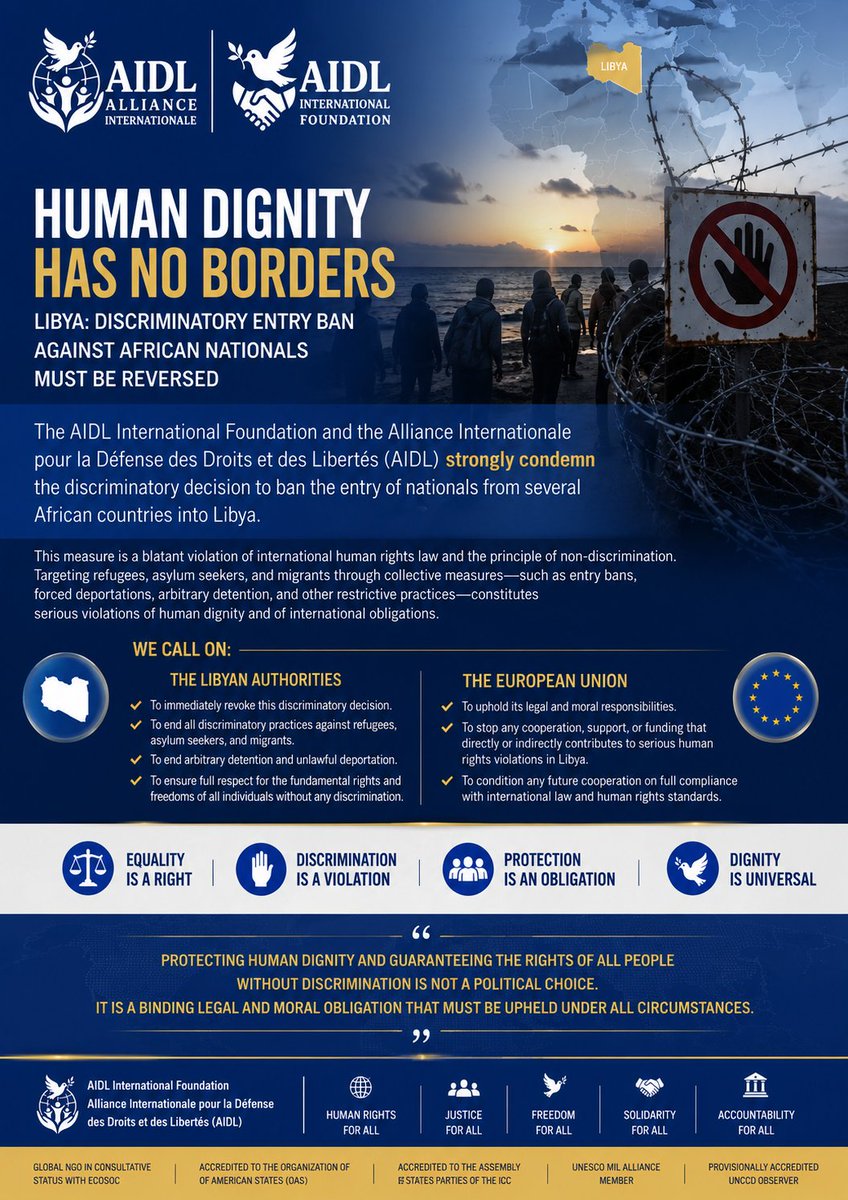
The AIDL International Foundation and the Alliance Internationale pour la Défense des Droits et des Libertés (AIDL) strongly condemn the discriminatory decision to ban the entry of nationals from several African countries into Libya. We firmly denounce this measure as a clear violation of international human rights law and the fundamental principles of equality and non discrimination.
Such a decision reflects policies based on discrimination on the grounds of nationality, national origin, or race.
The targeting of refugees, asylum seekers, and migrants through collective measures, including entry bans, forced deportations, arbitrary detention, and other restrictive practices, constitutes a serious violation of human dignity and of obligations arising under international human rights law and international refugee law. It also undermines the fundamental right to seek and enjoy asylum.
The (AIDL) call on the Libyan authorities to immediately revoke this decision, end all discriminatory practices against refugees, asylum seekers, and migrants, abolish policies of arbitrary detention and unlawful deportation or refoulement, and ensure full respect for the fundamental rights and freedoms of every individual without discrimination.
We further call on the European Union to uphold its legal and moral responsibilities by ending any cooperation, support, or funding that directly or indirectly contributes to serious human rights violations against refugees, asylum seekers, and migrants in Libya. Any future cooperation with the Libyan authorities should be strictly conditioned on full compliance with international law, international human rights law, and international refugee law.
Protecting human dignity and guaranteeing the rights of all persons without discrimination is not a political choice. It is a binding legal and moral obligation that must be upheld under all circumstances.
Electric shocks.
Beatings.
Rape.
Humiliation.
Burning.
Sleep deprivation.
Waterboarding.
These are not merely words.
They are acts of torture, absolutely prohibited under international law, without exception or justification, whether committed in times of peace or armed conflict.
Yet torture continues to be practiced by repressive, authoritarian, and dictatorial regimes, as well as by states that disregard their international legal obligations. Detention centres, secret prisons, and security agencies continue to be used as instruments of repression, intimidation, and the silencing of human rights defenders, journalists, activists, political opponents, and civilians.
Any state that authorizes, tolerates, conceals, or fails to investigate and prosecute torture bears international legal responsibility for these crimes. Sovereignty can never serve as a shield for impunity or as a justification for violating human dignity.
Torture is not a tool of justice. It is a crime that destroys the rule of law, spreads fear and terror, undermines public trust in institutions, and constitutes one of the gravest assaults on human dignity and the universal principles upon which the international human rights system is founded.
Alliance Internationale AIDL reaffirms that, in accordance with its international human rights mandate and responsibilities, it will continue to document acts of torture, preserve evidence, identify perpetrators, expose those responsible, and pursue accountability through every available national, regional, and international legal mechanism. Every individual who orders, commits, facilitates, enables, finances, conceals, or tolerates torture must be identified, investigated, prosecuted, and held fully accountable. There must be no safe haven, no immunity, and no impunity for perpetrators of torture.
Alliance Internationale AIDL further calls upon the international community to end the culture of impunity and to adopt firm and effective measures against all states and entities that practice, tolerate, facilitate, or fail to prevent torture, ensuring justice for victims, protecting human dignity, strengthening the rule of law, and upholding the full implementation of international human rights law and international humanitarian law.
#InternationalDayInSupportOfVictimsOfTorture
Alliance Internationale AIDL
International Day in Support of Victims of Torture.
26 June.
On the International Day in Support of Victims of Torture, Alliance Internationale AIDL reaffirms that torture remains one of the gravest violations of international law and fundamental human rights. It is an international crime that can never be justified, tolerated, or excused under any circumstances, including armed conflict, states of emergency, or the pretext of national security.
Despite the development of international human rights law, torture and other forms of cruel, inhuman, or degrading treatment continue to be practiced in a number of countries, particularly where authoritarian governance, weak judicial independence, and the absence of effective accountability prevail. In such environments, places of detention too often become spaces where serious human rights violations occur beyond public scrutiny and effective oversight.
Alliance Internationale AIDL remains deeply concerned by the continued use of torture to silence political opponents, intimidate human rights defenders, journalists, lawyers, and civil society activists, extract forced confessions, suppress peaceful dissent, and instill fear within society. Reports of deaths in custody, enforced disappearances, arbitrary detention, and systematic ill treatment continue to expose a persistent pattern of impunity in several parts of the world.
The Alliance emphasizes that the prohibition of torture is an absolute and non derogable rule of international law. No political objective, security consideration, or exceptional circumstance can justify practices that violate the inherent dignity and physical and psychological integrity of every human being.
On this occasion, Alliance Internationale AIDL calls upon the international community, the United Nations, the Human Rights Council, and all States to.
Ensure prompt, impartial, independent, and effective investigations into all allegations of torture.
Hold all perpetrators, those who ordered, authorized, or tolerated torture, fully accountable before the law.
Guarantee victims' rights to justice, truth, full reparation, rehabilitation, and effective remedies.
Strengthen independent monitoring of all places of detention and ensure unrestricted access for oversight mechanisms.
End impunity by reinforcing judicial independence and aligning national legislation with international human rights obligations.
Human dignity is not granted by governments. It is an inherent and inalienable right belonging to every individual. No society can claim to uphold justice, democracy, or the rule of law while torture continues to be practiced or concealed.
Today, Alliance Internationale AIDL stands in solidarity with victims and survivors of torture worldwide and renews its commitment to advancing accountability, protecting fundamental rights, and ensuring that torture is never tolerated, ignored, or forgotten.
Torture is an international crime.
No justification. No impunity. No exceptions.
Justice begins with accountability, and human dignity must always prevail.
Alliance Internationale AIDL.
#Sudan: Grave human rights violations & abuses by all parties are compounding what is already the world’s largest humanitarian crisis.
@UNHumanRights Deputy Chief @Dabokunda calls on #HRC62 to act urgently to protect the Sudanese people & to avert an even wider crisis.
https://t.co/sol2n4hC7r
AIDL appelle le Conseil des droits de l’homme, lors de sa soixante-deuxième session, à adopter une position plus ferme et plus efficace face aux violations graves des droits humains
Genève, le 14 juin 2026
La Fondation internationale AIDL, en partenariat institutionnel avec l’Alliance internationale pour la défense des droits et des libertés AIDL, participera, le lundi 15 juin 2026, aux travaux de la soixante-deuxième session ordinaire du Conseil des droits de l’homme des Nations Unies, qui se tiendra à Genève du 15 juin au 7 juillet 2026.
Cette participation s’inscrit dans la continuité de l’engagement institutionnel et juridique constant d’AIDL auprès des mécanismes des Nations Unies, depuis l’obtention par l’Alliance internationale pour la défense des droits et des libertés AIDL, du statut consultatif spécial auprès du Conseil économique et social des Nations Unies en 2017, et dans le prolongement de son parcours international depuis sa déclaration officielle en France en 2014.
La délégation d’AIDL suivra les travaux de la session et contribuera, dans le cadre des procédures applicables, par la présentation de rapports relatifs aux droits humains, d’interventions orales et de contributions institutionnelles pertinentes, ainsi que par sa participation aux discussions et aux événements parallèles organisés en marge de la session.
AIDL affirme que la protection des droits humains ne peut plus se limiter à des expressions de préoccupation ou à des positions générales, alors que les violations graves s’intensifient, que les conflits armés se multiplient, que les crises humanitaires s’aggravent et que les risques pesant sur les civils et les groupes les plus vulnérables ne cessent de croître.
AIDL souligne que le contexte actuel exige du Conseil des droits de l’homme des positions plus fermes, des mécanismes de suivi plus efficaces et des mesures concrètes, capables de garantir la protection des victimes, de renforcer la responsabilité et de prévenir l’impunité, conformément au droit international des droits humains et au droit international humanitaire.
AIDL appelle le Conseil des droits de l’homme à accorder une priorité claire à la protection des civils, des femmes, des enfants, des réfugiés, des personnes déplacées, des personnes en situation de handicap, des défenseurs des droits humains et de toutes les catégories affectées par les conflits armés, les crises humanitaires et les violations systématiques.
AIDL appelle également au renforcement des mécanismes de surveillance, de documentation et de responsabilité, au soutien du travail des procédures spéciales, ainsi qu’à la garantie d’une participation indépendante et effective des organisations de la société civile, en tant que partenaires essentiels pour révéler les violations, porter la voix des victimes et renforcer l’engagement international en faveur de la protection des droits et libertés fondamentaux.
AIDL rappelle que la protection de l’espace civique, la préservation de l’indépendance des organisations de la société civile et la garantie de leur participation sans restriction ni intimidation constituent des éléments indispensables de tout système international sérieux de protection des droits humains, de l’État de droit, de la justice et de la responsabilité.
AIDL réaffirme son engagement à travailler de manière sérieuse et responsable avec les mécanismes des Nations Unies, et à poursuivre ses efforts en faveur de la justice, de la responsabilité, de la dignité humaine, de la protection des victimes, de la défense des groupes les plus affectés et du renforcement d’un système international plus juste et plus efficace face aux violations graves des droits humains.