AI Evaluation & Quality Reviewer
Building AI-assisted technical projects and documentation.
AI Engineering Student
🇲🇽 English & Spanish | Open to remote work
Looking for full-time remote work in AI Evaluation, QA, Data Review, Annotation or AI Operations.
Native Spanish + written English.
High availability. Strong with detailed instructions and consistent work.
Studying AI Engineering. Ready to start immediately.
Prefer async roles.
6/6
I’m currently polishing the VS Code experience and the CLI direction so HITO can eventually feel more like:
git status
hito status
hito next
hito why
Still a work in progress, but the north star is clear:
Make complex projects much harder to lose control of.
1/6
I’ve been building something called HITO.
The idea is simple:
Software projects don’t usually fail because nobody can write code.
They fail because people lose track of what the project is, what changed, what’s actually proven, and what should happen next.
5/6
Underneath that simple view is a deeper engineering layer: evidence, currentness, project history, protected areas, architecture, runtime ownership, and why a next action is or isn’t justified.
The goal is not another flashy AI dashboard.
It’s project memory with evidence.
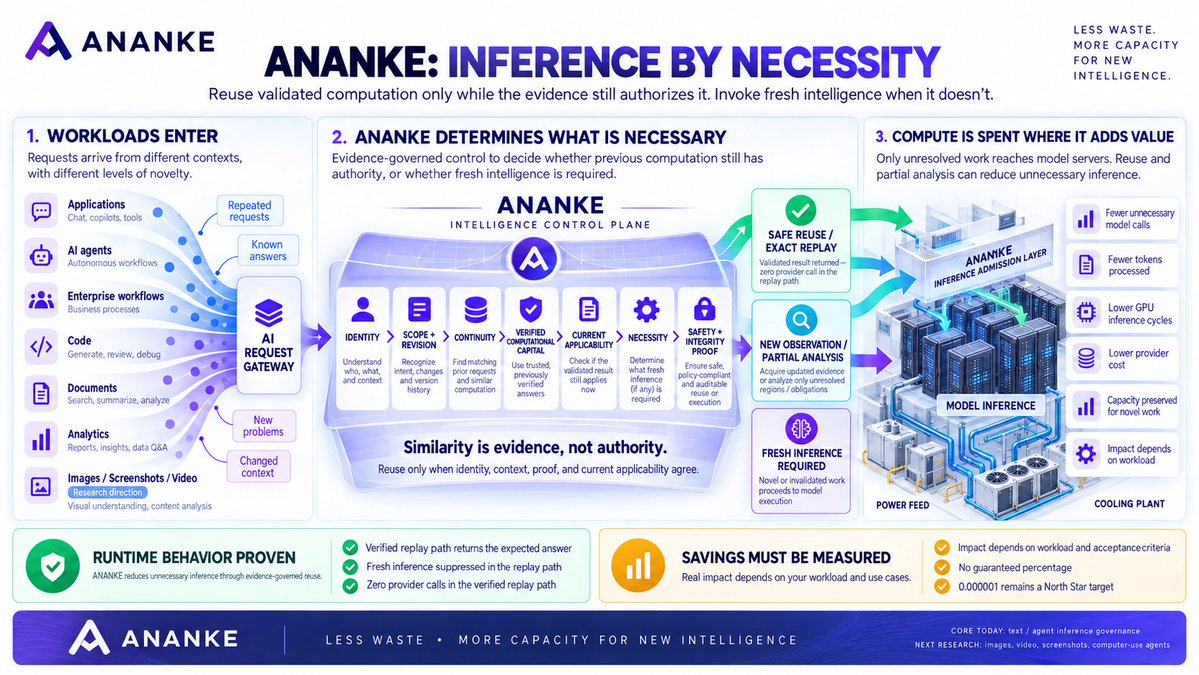
Current canonical ANANKE detected an external state change programmatically, propagated the affected dependency closure, resolved those nodes to governed Computational Capital, selectively invalidated only the affected Capital, and preserved unrelated Capital without false reuse.
Your AI system keeps paying to solve work it has already solved. I’m building a system that tries to stop that but only when it can prove reuse is still safe
Don’t merely find reusable computation. Establish whether that computation currently has authority to replace fresh inference, fail closed when it doesn’t, and record why the model was or wasn’t invoked.
Companies increasingly pay models to recompute things they have already computed, while being understandably afraid to reuse old results because stale or incorrect reuse can be worse than the cost of another inference.
AION cuts, routes, remembers, verifies, and reuses AI work so companies spend fewer tokens and repeat less computation.
What AION actually does
-cuts unnecessary context
-routes each task to the right model
-retrieves only the evidence needed
-reuses previous verified work
-checks claims before sending them
-records what worked
-improves future calls
-measures tokens, cost, latency, and quality
Your existing stack spent $180,000 last month. AION identified $52,000 of repeated or oversized AI work. We removed $38,000 without reducing your accepted-answer rate.
Keep your current providers and applications. Put AION in front of them. AION coordinates the optimizations your stack currently performs separately or does not perform at all.