New: neuro-symbolic AI hits 95% task accuracy (vs 34% standard) using just 1% of training energy. The AI efficiency revolution is coming.
Lock flexible terms into your infrastructure contracts before the cost gap becomes a competitive gap. (ScienceDaily/Tufts, April 5)
#AIInfrastructure #FutureOfWork #AILeaderEdge
OpenAI: $25B revenue, $852B valuation — and projected to lose $14B in 2026. Its CEO wants a Q4 IPO. Its CFO says not yet.
If your AI strategy depends on vendor stability, build pricing risk into your budget now. (The Information, April 6)
#EnterpriseAI#AIStrategy #AILeaderEdge
OpenAI + Anthropic + Google are now sharing breach intelligence to stop Chinese AI model theft.
US officials estimate it costs Silicon Valley "billions annually." CISOs:
When did you last audit your AI vendor's model-level IP protections? (Bloomberg, April 6)
#AILeadership #AILeaderEdge
Check out the latest article in my newsletter: #6 How to Design a Company That Runs for You (And Why You're Still Using AI Like It's Google) https://t.co/JXZKkyxdgW via @LinkedIn
The three signals breaking in AI this week — and what they mean for your organization:
① AWS + OpenAI just signed a $100 billion compute deal (March 2, 2026 — Reuters, TechCrunch, AWS official blog)
AWS is now the exclusive third-party cloud provider for OpenAI's "Frontier" platform — the infrastructure layer for managing AI agents at scale. OpenAI's total funding round closed at $110 billion, backed by Amazon ($50B), Nvidia ($30B) and SoftBank ($30B).
What this means for you:
The enterprise AI infrastructure market is consolidating into two lanes — AWS-OpenAI and Microsoft-Azure. If your organization is still evaluating cloud strategy for AI, that window is closing. Your CTO's vendor decision this quarter is no longer a technical choice. It's a strategic one.
② The FDA granted its first breakthrough designation to a generative AI chatbot (March 3, 2026 — STAT News, BusinessWire)
RecovryAI's post-surgery recovery assistant — an LLM prescribed by physicians to patients for 30 days after joint replacement surgery — received FDA Breakthrough Device Designation today. It checks in twice daily, monitors recovery trajectories, and escalates deviations to the clinical team.
What this means for you:
Generative AI just crossed into regulated medical device territory. Healthcare and life sciences executives now have a visible compliance runway ahead. The governance frameworks being written around RecovryAI will set the standard for every patient-facing AI that follows. This is the moment to get ahead of it, not react to it.
③ ServiceNow launched a "control tower" for managing thousands of AI agents simultaneously (February–March 2026 — CIO, ServiceNow)
ServiceNow's new AI Platform gives enterprises a centralized system to deploy, monitor and govern AI agents across workflows at scale. 57% of companies already have AI agents in production (G2, 2025). The problem is most can't control them yet.
What this means for you:
The agent adoption curve is ahead of the governance curve — which is exactly where risk lives. If your organization is building with AI agents, the question your COO should be asking right now is: who owns accountability when an agent makes a decision nobody authorized?
The pattern across all three:
Infrastructure is consolidating. Regulation is arriving. Governance is lagging. The organizations that will lead in 2026 are not the ones moving fastest — they're the ones who built oversight before they scaled.
What's the biggest gap in your organization right now — infrastructure, compliance, or control?
🧭 Dr. Z | AI Leader Edge | From classrooms to boardrooms
McKinsey just redefined what "headcount" means.
They've got 60,000 in their workforce. 40,000 humans. 20,000 AI agents.
Let that land for a second.
Eighteen months ago? They had 3,000 agents.
3,000 to 20,000. In 18 months.
This isn't a pilot program. This isn't innovation theater. This is their operating model now.
And here's what to listen for:
They're not calling these agents "tools" anymore. They're calling them headcount. Because that's what they are. They're doing work. Making decisions. Moving the business forward.
While most companies are still stuck in committee meetings debating whether AI is "ready"... McKinsey already has a 1:2 ratio.
For every two humans, one AI agent. Actually working.
So here's my question for you:
What happens when your competitors figure this out before you do?
Because the transformation isn't coming. It's already here. The companies winning right now aren't the ones with better strategy decks. They're the ones with AI agents in production. At scale.
You don't have to match McKinsey's numbers tomorrow. But you do need to start building your answer to this question today:
What does "workforce" mean at your company in 2027?
Because if the answer is still "just humans"... you're already behind.
We at AI Leader Edge bring you these around-the-corner insights.
Watch our latest Podcast Episode on this subject:
https://t.co/QHmFET9svz
McKinsey just redefined what "headcount" means.
They've got 60,000 in their workforce. 40,000 humans. 20,000 AI agents.
Let that land for a second.
Eighteen months ago? They had 3,000 agents.
3,000 to 20,000. In 18 months.
This isn't a pilot program. This isn't innovation theater. This is their operating model now.
And here's what to listen for:
They're not calling these agents "tools" anymore. They're calling them headcount. Because that's what they are. They're doing work. Making decisions. Moving the business forward.
While most companies are still stuck in committee meetings debating whether AI is "ready"... McKinsey already has a 1:2 ratio.
For every two humans, one AI agent. Actually working.
So here's my question for you:
What happens when your competitors figure this out before you do?
Because the transformation isn't coming. It's already here. The companies winning right now aren't the ones with better strategy decks. They're the ones with AI agents in production. At scale.
You don't have to match McKinsey's numbers tomorrow. But you do need to start building your answer to this question today:
What does "workforce" mean at your company in 2027?
Because if the answer is still "just humans"... you're already behind.
We at AI Leader Edge bring you these around-the-corner insights.
Watch our latest Podcast Episode on this subject:
https://t.co/QHmFET9svz
McKinsey just redefined what "headcount" means.
They've got 60,000 in their workforce. 40,000 humans. 20,000 AI agents.
Let that land for a second.
Eighteen months ago? They had 3,000 agents.
3,000 to 20,000. In 18 months.
This isn't a pilot program. This isn't innovation theater. This is their operating model now.
And here's what to listen for:
They're not calling these agents "tools" anymore. They're calling them headcount. Because that's what they are. They're doing work. Making decisions. Moving the business forward.
While most companies are still stuck in committee meetings debating whether AI is "ready"... McKinsey already has a 1:2 ratio.
For every two humans, one AI agent. Actually working.
So here's my question for you:
What happens when your competitors figure this out before you do?
Because the transformation isn't coming. It's already here. The companies winning right now aren't the ones with better strategy decks. They're the ones with AI agents in production. At scale.
You don't have to match McKinsey's numbers tomorrow. But you do need to start building your answer to this question today:
What does "workforce" mean at your company in 2027?
Because if the answer is still "just humans"... you're already behind.
We at AI Leader Edge bring you these around-the-corner insights.
Watch our latest Podcast Episode on this subject:
https://t.co/QHmFET9svz
Somewhere, right now, someone is building the "impossible."
$9.95/month for brain-cloud connectivity. Ray Kurzweil says 2032. Most people laugh.
But think about this: 20 years ago, carrying the world's knowledge in your pocket sounded absurd. Today, you're reading this on that device.
The pattern? What seems ridiculous today becomes unremarkable tomorrow.
Brain expansion subscriptions. Cognitive upgrades. Memory backups. Yes, there'll be billing issues (imagine getting locked out of your own thoughts for non-payment 😂).
But that's not the point.
The point:
While we debate what's possible, someone's already prototyping it. The future doesn't wait for permission.
So here's my question:
What "impossible" thing are YOU building?
Because I guarantee you—in 2032, someone will look back and say, "Of course that happened. How did we not see it coming?"
Be the person they're talking about.
@robfrasca and I at AI Leader Edge are here to bring you the unthinkable AI insights that your business needs to start getting ready for.
#AILeaderEdge #Innovation #RayKurzweil #BrainCloudConnectivity #FutureIsNow #BuildTheFuture
McKinsey just redefined what "headcount" means.
They've got 60,000 in their workforce. 40,000 humans. 20,000 AI agents.
Let that land for a second.
Eighteen months ago? They had 3,000 agents.
3,000 to 20,000. In 18 months.
This isn't a pilot program. This isn't innovation theater. This is their operating model now.
And here's what to listen for:
They're not calling these agents "tools" anymore. They're calling them headcount. Because that's what they are. They're doing work. Making decisions. Moving the business forward.
While most companies are still stuck in committee meetings debating whether AI is "ready"... McKinsey already has a 1:2 ratio.
For every two humans, one AI agent. Actually working.
So here's my question for you:
What happens when your competitors figure this out before you do?
Because the transformation isn't coming. It's already here. The companies winning right now aren't the ones with better strategy decks. They're the ones with AI agents in production. At scale.
You don't have to match McKinsey's numbers tomorrow. But you do need to start building your answer to this question today:
What does "workforce" mean at your company in 2027?
Because if the answer is still "just humans"... you're already behind.
@robfrasca and I at AI Leader Edge bring you these around-the-corner insights.
Watch our latest Podcast Episode on this subject:
https://t.co/QHmFETa0l7
One-Person Billion-Dollar Company 🔔
Anthropic's CEO just said something that should keep every executive awake tonight.
"When will there be the first billion-dollar company with one human employee?"
His answer: "2026."
That's not a futurist's fantasy. That's Dario Amodei — CEO of the company behind Claude AI — giving it a 70-80% probability.
He then turned to Instagram co-founder Mike Krieger and asked:
"Could you have built Instagram alone with Claude 4?"
Krieger's answer: He'd still need co-founder Kevin Systrom — but the two of them could manage with AI handling everything else.
Think about that. Instagram. $1 billion acquisition. 13 employees. And now even THAT seems bloated.
Here's what Amodei identified as the 3 most likely business types:
→ Proprietary trading (AI trades your own capital faster than any human)
→ Developer tools (AI writes the code, handles support, billing, and marketing)
→ Fully automated customer service businesses (zero human touchpoints to scale)
And it's not theoretical. It's already happening:
Midjourney: $200M ARR — 10 people
Cursor: $100M ARR in 21 months — 20 people
Cal AI: $12M ARR — 4 people
BuiltWith: $14M/year — ONE person
The Lean AI Native Leaderboard now tracks companies averaging $3.7M revenue per employee.
That's 10x the traditional SaaS standard.
And 74% of them are already profitable.
After studying this data for weeks, I found the pattern. Every solo billion-dollar business needs exactly 3 things:
SELL SYSTEMS, NOT TOOLS
AI models are becoming commodities. What's scarce is turning them into reliable outcomes for a specific customer.
Don't sell the software. Sell the transformation.
MINIMAL HUMAN DEPENDENCY
AI agents handle marketing, support, compliance, and delivery. You become the Chief Visionary Officer — orchestrating AI agents, not doing the work.
A DEFENSIBLE MOAT
If someone can replicate your business in a weekend, it's not a billion-dollar business. Your moat is proprietary data, domain expertise, or a compounding network effect.
Here's what most people are missing:
The one-person unicorn won't come from someone building the BEST AI tool.
It will come from someone who understands a SPECIFIC industry so deeply that they can turn AI into an outcome machine for that vertical.
The founder won't be a programmer. They'll be a domain expert who knows what problems are worth $1B to solve.
The question isn't whether this will happen. The question is whether you'll build it — or watch someone else do it.
♻️ Repost if this shifted your thinking.
🔔 Follow Zdenka Cumano for a daily AI strategy that cuts through the noise.
#AI #AIAgents #Entrepreneurship #OnePersonBillionDollarCompany #FutureOfWork #AIStrategy #Solopreneur #StartupFounder #AILeaderEdge
70-80% chance a SINGLE PERSON builds a $1 BILLION company by 2026. Not 2045. Not 2030. THIS YEAR OR NEXT. Dario Amodei (Anthropic CEO) just said it at their developer conference. And the data proves it's already happening: • Midjourney: $200M ARR, ~10 people • Cursor: $10...
The "SaaSpocalypse" isn't about AI replacing software.
It's about AI revealing which software was delivering value—and which was just filling seats.
The same filter is coming for leadership.
Not "do you use AI?" but "do you know how to deploy it with judgment?"
@AILeaderEdge https://t.co/mP58Kn4p4Q
Stop asking: "What can AI do for us today?"
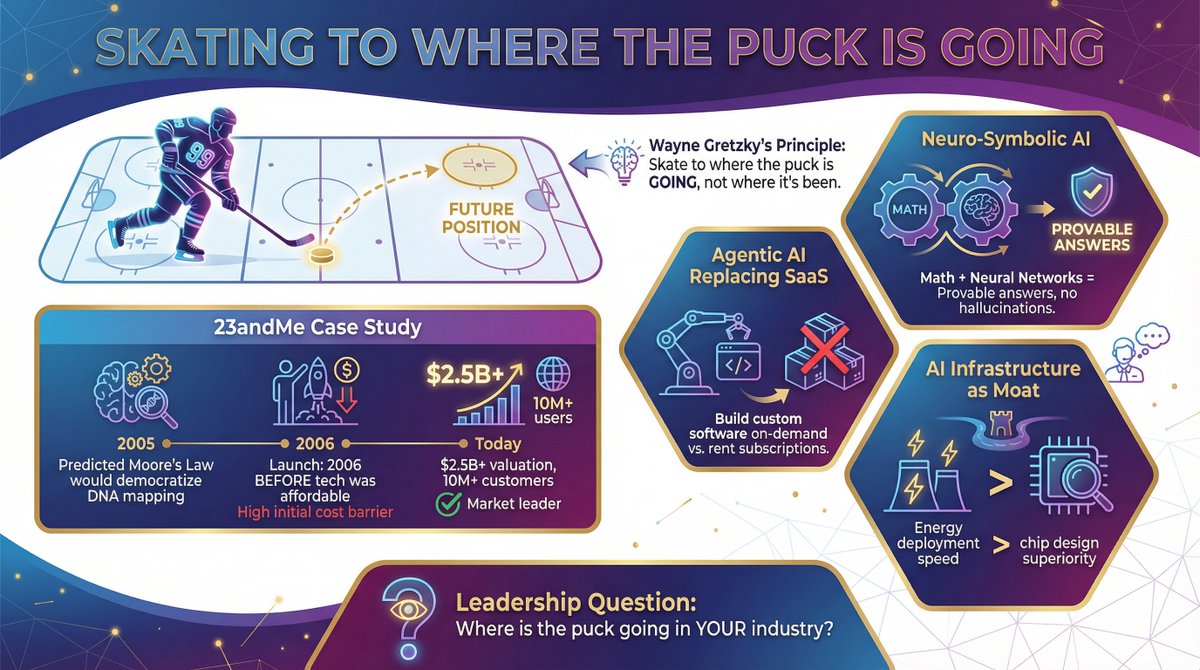
Start asking: "Where is the puck going in OUR industry?"
In 2026, anticipation isn't competitive advantage.
It's the baseline requirement for survival.
Where are you skating? 🏒
🏒 Wayne Gretzky's secret: "I skate to where the puck is going, not where it's been."
In 2005, Anne Wojcicki applied this to genomics.
Result: $2.5B+ company before the tech was even affordable.
Here's how to see where YOUR industry's puck is going 🧵
Pattern #3: AI Infrastructure as Moat
The new battlefield isn't chip design.
It's ENERGY DEPLOYMENT speed.
China builds data center power faster than US — not better tech, but systemic velocity.