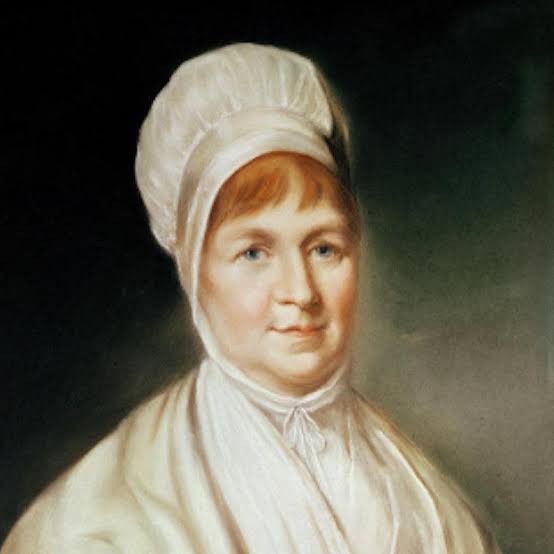
Woman of the Day prison reformer and philanthropist Elizabeth Fry, born OTD in 1780 in Norwich, the first woman to give evidence to a Select Committee. It was instrumental in the passing of the Gaols Act 1823, which separated the sexes.
Caring responsibilities came early to her. Her mother died when she was 12 — she had twelve siblings — and as a Quaker, she took an interest in the impoverished, the sick and prisoners. A “plain Friend”, she dressed plainly, did not dance or sing, and took philanthropy very seriously.
In 1813 and at the suggestion of another Friend, Elizabeth visited Newgate Prison and found women and children in small overcrowded cells where they had to manage washing, cooking, toilet functions, and sleep on straw. Some hadn’t even been tried at court. She was horrified.
“All I tell thee is a faint picture of reality; the filth, the closeness of the rooms, the furious manner and expressions of the women towards each other, and the abandoned wickedness, which everything bespoke are really indescribable".
She returned the following day with food and clothing, but family finances prevented her from doing more until 1816. At first, she concentrated on the children by funding a school inside the prison for them, but she found it impossible to ignore the plight of the women. They were at the mercy of male inmates who raped and sexually exploited them. On release, the few occupations available to women were beyond their reach. Life was without hope.
Elizabeth founded the Association for the Reformation of the Female Prisoners in Newgate and encouraged other affluent women to set up classes for women prisoners, providing them with materials so they could learn to sew and knit. It calmed them — “Already, from being like wild beasts, they appear harmless and kind" — and meant they had employable skills on release.
When she gave evidence to a Select Committee on 27 February 1818, she pulled no punches. She told them in graphic terms of the rapes and sexual exploitation suffered by the women. Her powerful evidence helped to secure the Gaols Act 1823 which required prisons to separate the sexes.
Other provisions of the Act included paying gaolers (to combat corruption), requiring doctors and chaplains to visit prisoners (still an important statutory requirement today), and greater emphasis on reform and rehabilitation.
The Gaols Act was far-seeing and genuinely progressive, but other than separation of the sexes, toothless. Town gaols and debtors prisons were excluded and there was no means of checking that its provisions were being met.
Elizabeth returned once more to give evidence to a Select Committee of the House of Lords in 1835, pointing out that "in many instances their condition is melancholy...they may truly be called schools for crime", that some still had "no instruction, no employment, no classification [of inmates]...and they get into a most low and deplorable state of morals...I would not say that all are in that condition, but I fear many are".
In those days, many prisoners faced transportation to New South Wales even for the most minor of crimes (for more serious offences, hanging was the go-to sanction). They faced eight months in vermin-infested cramped holds, often flooded with bilge-water, and strictly rationed fresh water. The women transported by the First Fleet had only the clothing they were standing up in and when this became infected with lice and had to be burnt, they were given rice sacks to wear. Elizabeth campaigned for better care and provision for them too.
In 1825, she published "Observations of the Siting, Superintendence and Government of Female Prisoners", an influential book that laid out in clear detail how penal regimes should be run.
Somewhere along the way, Elizabeth established a "nightly shelter" for the homeless in London after seeing the body of a boy who had frozen in winter and set up a system of volunteers to visit the poor and homeless and provide help and comfort to them. She campaigned against the slave trade, and in 1840, opened a training school for nurses. Florence Nightingale took a team of Fry nurses to the Crimea.
Her abiding principles of kindness and fairness sprang from her Quaker faith and she was the first woman — other than the late Queen, of course — to be depicted on a British banknote.
Elizabeth Fry died in 1845 at the age of 65. I cannot tell you how much I admire this woman.
Less than a century later, Westminster and Holyrood subsequently ditched Elizabeth’s truly progressive approach to prison as a place for rehabilitation, not punishment, and decided that it would be even more “kind and inclusive” to hold men in women’s prisons, as long as they claimed to be women too.
In wartime and in war zones, that would be regarded as a war crime under the Geneva Convention, and those officials who allowed it would be classed as war criminals.
It’s peacetime, allegedly, but I’d still call it a human rights violation, and I have a few choice words for all of those politicians and civil servants who nodded along with it. I hope their complicity haunts them.
Woman of the Day philosopher, historian and author Mary Wollstonecraft, born OTD in 1759 in Spitalfields, London, widely regarded as Britain’s first feminist. Her reputation was unjustly shredded for a century after her early death but her influence was far-reaching and can still be seen today.
Born to an affluent family, Mary was treated very differently to her brother: an expensive education for him, a couple of years at day school for her. It rankled. Her profligate, abusive and drunken father made her hand over money held in trust for her till she reached adulthood, and she had to endure his violent rages. The teenage Mary tried to protect her mother by lying outside her mother’s bedroom door. Those early years left a mark.
Friendships with independently minded women also made their mark and by the age of 25, Mary had opened a small girls’ school in North London with her two sisters and her friend Fanny Blood. Money was short and when Fanny died in childbirth, Mary reluctantly worked as a governess for an aristocratic couple in Cork. It was a fractious working relationship. She found the lady of the house ‘frivolous’ with ‘neither sense nor feeling’ and was sacked.
Back to London she went, penniless and depressed, but it was a turning point.
In 1787, Mary found a radical publisher willing to publish her first book, Thoughts on the Education of Daughters, based on her experiences. She built a literary career, meeting and sharing ideas with other radical thinkers including William Godwin. He didn’t impress her when they first met in 1791. They argued all evening and he left, irritated.
Five years later, Mary defied social convention and got in touch again with William. By this time, she had lived in Paris during the Reign of Terror, had two affairs, given birth to a daughter out of wedlock, attempted suicide - she threw herself off Putney Bridge and was saved only by the intervention of passing watermen - and published her groundbreaking work, A Vindication of the Rights of Woman in 1792.
Her Vindication was prompted by Talleyrand’s 1791 report to the French National Assembly which loftily concluded that women were only fit to have domestic education: taught to run a home. It went against everything Mary believed in and she argued that women were not inferior to men, and if they appeared to be, it was because they were denied education. She posited that men and women alike should be treated as rational beings and treated equally.
“Taught from infancy that beauty is woman’s sceptre, the mind shapes itself to the body, and roaming round its gilt cage, only seeks to adorn its prison.”
“My own sex, I hope, will excuse me, if I treat them like rational creatures, instead of flattering their fascinating graces, and viewing them as if they were in a state of perpetual childhood, unable to stand alone.”
In 1797, Mary and Godwin married but their domestic set-up was regarded as controversial. She was pregnant when they wed, he spent his days twenty doors away so they could maintain some independence, and they communicated via letters.
On 30 August 1797, after eighteen hours of labour, Mary gave birth to her second daughter, Mary Shelley, author of Frankenstein. The attending surgeon (she’d actually wanted a midwife) was out of his depth and she suffered acute haemorrhaging followed by infection. Eleven days later, she died, aged just 38.
In 1798, William published a well-intentioned but poorly judged account of Mary’s life. The affairs, the child born out of wedlock, the unorthodox religious opinions: they were the sticks by which Mary’s reputation was comprehensively trashed, and the mud stuck for a century.
A man would never have been judged by the same standards. Look at Mary Shelley’s contemporary, Lord Byron.
Mary’s Vindication of the Rights of Women was influenced by Olympe de Gouges’ Declaration of The Rights of Woman, published the year previously in 1791.
In turn, Mary influenced the views of Millicent Garrett Fawcett and Elizabeth Barrett Browning. We know how Millicent devoted her life to securing votes for women but Elizabeth, a vocal supporter of Mary, reflected those views in her verse-novel, Aurora Leigh, which influenced Susan B. Anthony’s thinking about the traditional roles of women, especially in relation to marriage versus independence.
Susan’s fight led in time to the Nineteenth Amendment which finally granted American women the vote.
Mary said, “Strengthen the female mind by enlarging it, and there will be an end to blind obedience.”
When a professor - a man, of course - defended regulated prostitution as necessary for men's health, Woman of the Day Aletta Jacobs swiftly retorted, “If that is really your opinion, you are morally obliged to make your daughters available for this purpose.”
Who knew that we would still be having this argument in 2026? Certainly not Aletta, born OTD in 1854 in The Netherlands, the first woman officially to attend a Dutch university and the first woman in her country to receive a doctorate in medicine.
She was born into a liberal Jewish family and wanted to become a doctor, like her father, but women were denied secondary education in many areas, and entirely excluded from universities. After primary school, she rejected the limited "finishing school" option for girls - it was “idiotic”, she said - and she had to lobby the authorities persistently just to become one of the first Dutch women to attend high school.
Persistent lobbying became the underlying theme of her life. None of the opportunities so readily available to men ever opened to Aletta unless she fought for them. She even had to petition the Dutch Prime Minister directly to be admitted to the University of Goningen in 1871 for provisional admission for one year, and thereafter to allow her to sit exams and graduate. In 1878, she earned her medical degree, and the following year, her doctorate, the first woman in the Netherlands to do so.
Aletta spent some time observing women doctors in London and met Dr Elizabeth Garrett Anderson, the first female doctor in England, and her sister, Millicent Garrett Fawcett. They shared similar views on women’s suffrage and the education of women.
Fully-qualified Dr Jacobs could not treat male patients - it was improper, indecent or unchaste for a woman to be in close proximity to male patients - and when she tried to take part in hospital clinical rounds, they would often refuse treatment or examination if she was present.
At this point, I would have expected NHS Fife’s collective head to be exploding, but then I remembered. They too are only concerned about the comfort and feelings of men.
Inevitably, Aletta established a practice in Amsterdam providing free care to poor women and children, and came up against a host of social problems that affected them most: widespread poverty, unhealthy working conditions such as long shifts without breaks for shop girls, repeated pregnancies harming the health of women, high infant mortality, sexually transmitted diseases among patients and especially among prostituted women.
"During this time I saw with my own eyes the catastrophic results that frequent pregnancies can have for a woman."
In 1882, she opened the world’s first birth control clinic and introduced the pessary (diaphragm) to the condemnation of her male medical colleagues, religious leaders, and others who called it disgusting and immoral because they thought it would lead to rampant adultery and invite divine punishment.
"If contraceptives were available – could a childless world be the result? Would they promote adultery?…I found comfort only by realising that a baby is most women’s greatest wish, which they would give up only for very serious reasons."
By 1883, Aletta was actively challenging the denial of the vote to women. She tried to register to vote. After all, existing electoral law did not explicitly exclude women: it granted voting rights to "citizens" who paid a certain amount of taxes, and she was an independent, taxpaying woman who ticked all the boxes.
After a bit of head-scratching, the mayor and city council of Amsterdam admitted that even though, strictly speaking, the law didn’t actually *exclude* women, mumble mumble, something something…she should ask the Amsterdam District Court. The District Court decreed that she was not a citizen, even though she met the criteria, so she appealed to the Supreme Court.
Shades of Canada’s Famous Five “persons” case here.
Of course you are not a citizen, said the Supreme Court, and anyway, taxes for married women are paid by their husbands, blithely overlooking the fact that Aletta was a single woman. The government obligingly amended the constitution in 1887 to explicitly limit voting rights to "male" citizens, thus closing the loophole.
Aletta responded by starting her lifelong campaign for women's suffrage, heading the Dutch Association for Women's Suffrage from 1894, and co-founding the International Woman Suffrage Alliance. She had ties with the USA’s Carrie Chapman Catt and devoted herself to women’s rights and pacifism on a full-time basis from her retirement from practice in 1903 until her death in 1929.
Dutch women were granted the vote in 1919.
"I feel happy that I have seen the three great objects of my life come to fulfillment during my life…They were: the opening for women of all opportunities to study and to bring it into practice; to make Motherhood a question of desire, no more a duty; and the political equality for women."
"Fighting for what is right makes life worth living."
Please sign this petition. If you have signed it, please keep sharing. 10k will give a standard government response. This is just fluff. Nothing will change. We need to make politicians talk about it in a debate to push for an inquiry. Sexual assault and rape of women and children in our healthcare has to end.https://t.co/QoKOs6LeOz
One off rape doesn't ensure this Dr loses his licence. He's still able to work in healthcare, ensuring not only patients are at risk but staff as well. This is a safeguarding failure.
https://t.co/dl0URJE8jg
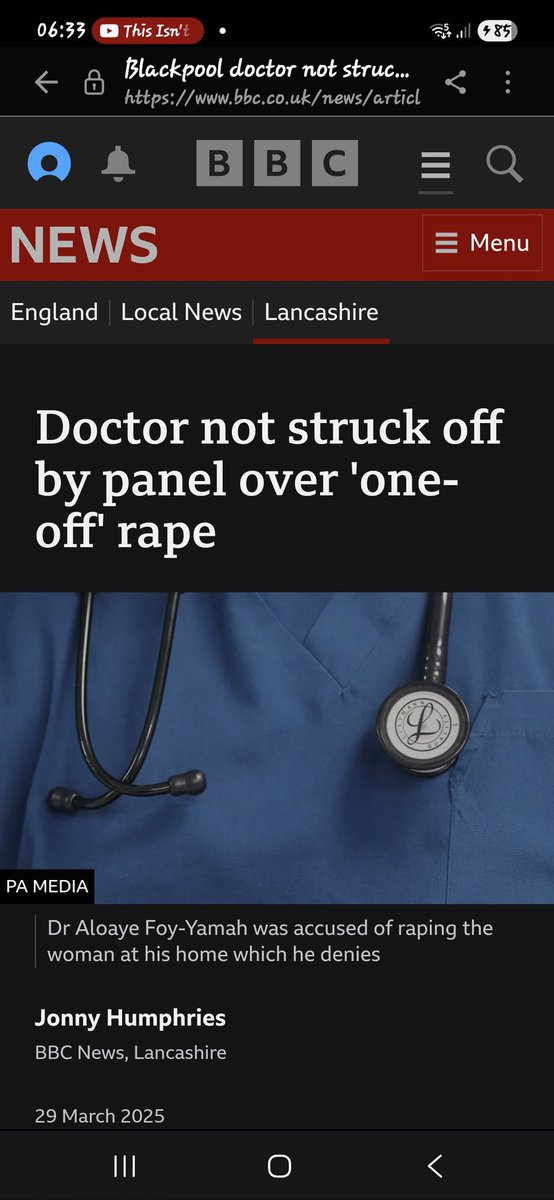
29 March 2025
A doctor found by a tribunal to have raped a young woman at his home avoided being struck off over what the panel described as a "one-off" attack.
Dr Aloaye Foy-Yamah, then a consultant at Blackpool Victoria Hospital, instead had his medical licence suspended for 12 months for attacking the woman.
Police investigated but did not charge Dr Foy-Yamah, but the Medical Tribunal Practitioners Service (MPTS) concluded on the balance of probabilities that he had raped the woman - which he denies.
The panel, which emphasised the incident had not taken place at work, has been accused of "victim-blaming" and failing to properly assess Dr Foy-Yamah's risk given that it found he had raped someone.
Campaign group Surviving in Scrubs, founded by two doctors who aim to highlight sexism, sexual harassment and sexual violence in the healthcare workforce, told the BBC it was "appalled" by the ruling.
"This belittles the traumatic experiences of survivors of sexual assault and undermines public trust in the profession," co-founder Dr Becky Cox said.
"It sets a standard that perpetrators of sexual violence face minimal consequences for their actions."
This is an extraordinary bit of reporting by @HJoyceGender.
Apparently, the police have been logging actual CRIMES against people without their knowledge, at the behest of trans activists.
How I was secretly logged as a criminal by police https://t.co/LeU1ByMXjJ
Gender criticals and some feminists are up in arms fighting each other. Very inspiring. So I wrote about intersectionality, cowardice and courage.
Link ⬇️
🚨 BREAKING: Luke Healy was groomed online, affirmed by doctors, & nearly lost to transition—until his mother, a nurse of over 3 decades, said no. Now, they’re exposing the medical betrayal.
WATCH @ThomasHealy's story in the #IdentityCrisis series:
What Sandie Peggie’s tribunal makes clear,if people are willing to really look, is that this is, at its core, about an employer treating an employee badly. That’s the crux of it. A woman raised legitimate concerns and was punished for it. Everything else is a distraction. The problem is, as soon as trans ideology enters the picture, the focus shifts entirely. The employer’s conduct is no longer central. Instead, the woman herself is scrutinised, second-guessed, and turned into a problem to be managed.
The impact this has on women is profound. It affects their livelihoods, their mental health, their place in the world. Many are left isolated not because they did anything wrong, but because the people around them become afraid of being associated with them. Sandie’s case is forcing that dynamic into the open, and being able to watch it unfold on the livestream matters, because it’s the first time many people will see how this actually plays out - who’s protected, who’s exposed, and what that tells us.
There are many differences between us, George, but some are particularly relevant to this debate.
1. You're a man and I'm a woman.
2. You've been wealthy and famous since your early 20s. I didn't become well known until I was well over 30.
3. I've never been given 15 months for handcuffing a man to a wall and beating him with a chain.
4. I believe in freedom of speech and belief.
For more than half my life I was a regular anonymous person. Some of those years were spent in poverty. That's why I understand the importance of single-sex spaces for women who're reliant on state-funded services. That's why I understand why mixed public changing rooms are a problem for women. That's why I have a problem with men 'identifying' into women's rape crisis centres, domestic abuse and homeless shelters that are supposed to be single-sex. I don't stand against gender identity ideology because I personally still need those services, but because my life has taught me exactly how vulnerable women are when they don't have the money/influence I have now.
You yourself have been convicted of violent assault. The overwhelming number of people who commit crimes of violence are male, just like you. That's why I don't want to see men identifying into women's prison cells or any of the spaces mentioned above. Not all men are violent or predatory, but enough are to make safeguarding necessary.
Lastly, I'm a writer who believes in freedom of speech and belief. As we both know, the safe, fashionable thing in the arts world right now is to do exactly what you're doing: parrot TWAW and sneer at the unenlightened plebs who think sex is important and matters. For a man who was once all about non-conformity, George, you couldn't have become more predictably or more tediously conformist.
“No one at the time imagined that the country would go quite that fucking insane in such a relatively short period of time.”
Mea culpa: my part in the rise of the trans cult https://t.co/uUZPYRiKeA
Two hundred men in women's fencing?
One is too many but this is so distressing. If this isn't misogyny what is?
This woman deserves a public apology and her proper place as a female fencer restored.
Superb interview with @sharrond62 on #bbcPM “I’m just really pleased that women & girls are getting their sport back at last. But this has been an incredibly excruciating journey which has taken nearly ten years” 💜