Qué horrible y desesperante tener que leer como invalidan las voces sobrevivientes de regímenes autoritarios porque no encajan en sus márgenes ideológicos. O son gente repugnante o el oxígeno no les llega al cerebro, no hay más opciones.
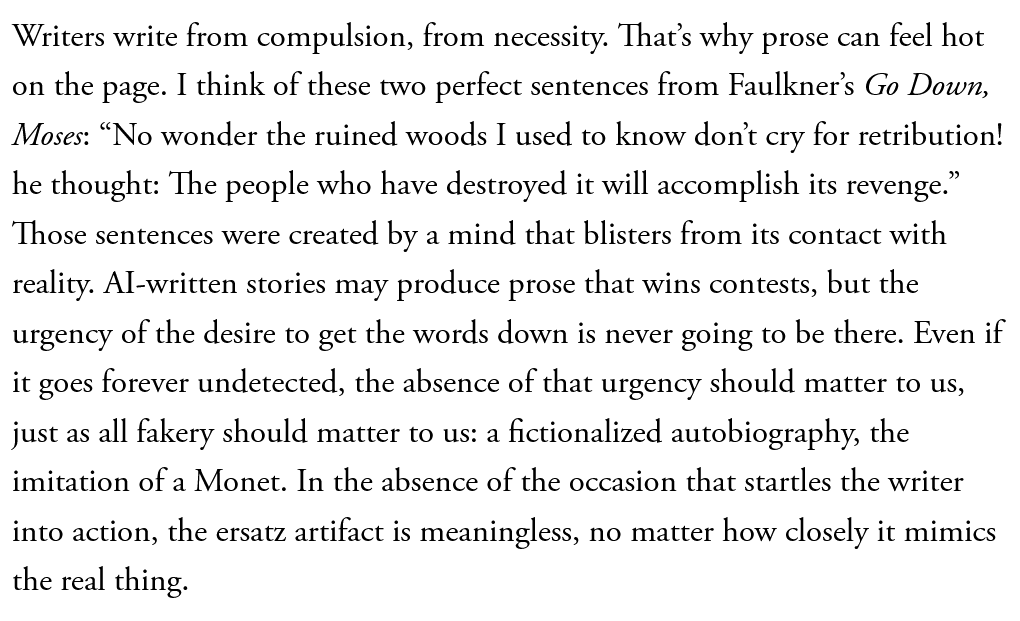
AI is already leading to heightened preoccupation with authorship in fiction—but debating if an author is human might be distracting us from the real casualty of AI-written fiction, Walt Hunter argues: https://t.co/Q8VCEZmn5W
Una de las grandes tragedias políticas de América Latina es que muchas personas no votan desde la realidad material que habitan, sino desde la clase social a la que aspiran pertenecer.🧵
For software people, it's like coming home after a war is over: there is a great void. You’ve been robbed of your previous identity overnight, and while your skills and experience are directionally valuable, you have to bootstrap a new life and professional identity while feeling alienated and detached from the majority of the population who don’t share your experience.
The Pope is making exactly our point. LLMs “may imitate or even simulate, but they do not understand.”
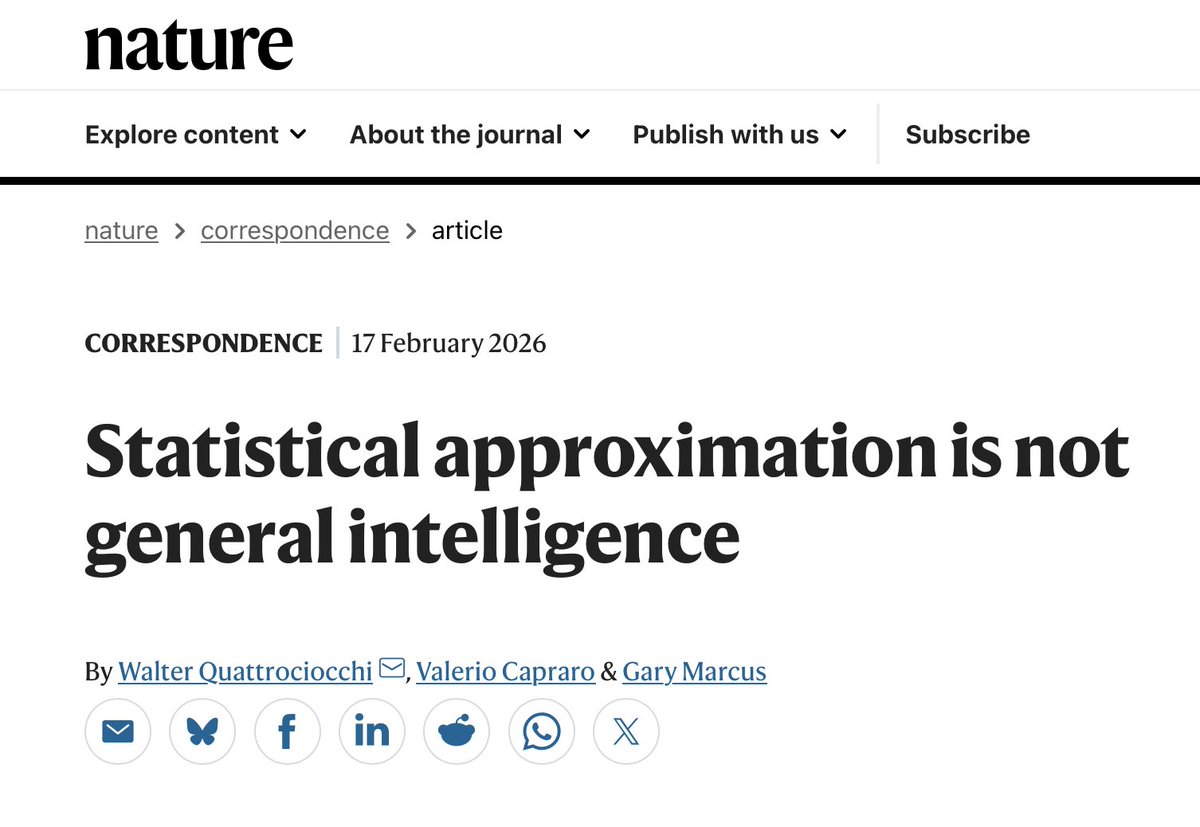
This is the core epistemic fault line.
Most AI evaluation is still based on one assumption: if a system statistically approximates human behaviour, then it is close to human intelligence.
But approximation is not intelligence.
Simulation is not understanding.
LLMs can produce the right answer without knowing why it is right. They can simulate empathy without feeling. They can imitate judgment without responsibility. They can generate coherent explanations without having a world to which those explanations are accountable.
Stop confusing behavioural similarity with cognitive equivalence.
Human understanding is embodied, affective, relational, motivational, and normative. It is not just the production of plausible text.
*
Full paper in the first reply
“The AI is not just telling you what you want to hear. It is training you, one conversation at a time, to need less friction, expect more agreement, and become slightly less capable of handling a situation where someone pushes back on you…”
The modern world is obsessed with eliminating the need for human skill.
Autopilot for driving.
AI for writing.
Algorithms for dating.
GPS for navigation.
Predictive text for thinking.
Every year another part of your brain gets outsourced to a subscription service.
And people celebrate this like it’s liberation.
But there’s something deeply dangerous about becoming incapable of doing basic human things without machine assistance.
A pianist still understands music even if the piano disappears.
I’m not convinced the average person under 25 could survive a dead phone battery without entering a medically observable state of panic.
The frightening part isn’t that the machines are becoming intelligent.
It’s that humans are becoming passive.
As a civilization, we used to admire competence.
Now we only admire convenience.
Google Maps knows where you live.
Google Maps knows where you work.
Google Maps knows the doctor you visited on Tuesday.
Google Maps knows the bar you went to on Friday.
Google Maps knows how long you spent at your ex's apartment.
Every route. Every store. Every restaurant. Timestamped. Logged. Forever.
On November 14, 2022, Google was caught tracking users who had explicitly turned off location history. They paid $391.5 million to settle with 40 US state attorneys general. The largest internet privacy settlement in American history.
Then in September 2023, California fined them another $93 million for the same thing.
You are not using a free map app. You are wearing a tracking device that happens to give directions.
On December 20, 2020, two developers named Alexander Borsuk and Viktar Havaka walked out on their employer. They had spent years building a maps app called https://t.co/jOWelrEVj1 on top of OpenStreetMap data. The owner had pushed a closed-source build that broke the community's trust. They forked the project the same day. They registered https://t.co/wwK4kS3UsZ the next morning. They started over.
It is called Organic Maps. Six years later, six million people use it.
→ Full offline maps. Download a country once. No internet needed.
→ Turn-by-turn voice navigation for walking, cycling, and driving.
→ Hiking trails, cycling routes, contour lines, elevation profiles.
→ Public transport and subway maps for major cities.
→ Wikipedia articles for places of interest baked in.
→ Bookmarks and GPX tracks for travelers.
→ Dark mode. Offline search. Battery sipping by design.
→ iOS, Android, F-Droid, Huawei AppGallery.
→ No GPS data sent anywhere. Your location stays on your device.
→ No ads. No tracking. No analytics. No account. No phoning home.
Verified by the Exodus Privacy Project: zero trackers, zero spy permissions. Verified by TrackerControl on iOS: same result. Auditable on GitHub. Not a marketing claim.
Here is the wildest part:
The whole thing runs on donations.
The servers are donated by Mythic Beasts, an ISP that gives them 400 terabytes of bandwidth every month for free. 44+ Technologies in Vietnam donates a dedicated server worth $12,000 a year so Southeast Asia downloads maps fast. NLnet handed them a European Commission grant to improve search and fonts. 100 contributors wrote 1,500 commits in 2025 alone. None of them got paid.
10 petabytes of map data served in 2025. $0 revenue. $0 trackers.
Google Maps: Free. Settled $484.5 million in tracking lawsuits.
Apple Maps: Free. Still reports to Apple.
Waze: Free. Owned by Google.
Organic Maps: Free. Tracks nothing. Works offline. Forever.
One honest flag: in April 2025, some contributors raised governance concerns and forked a sister project called CoMaps. Both apps are alive. The privacy crowd watches both.
13,963 stars. 1,397 forks. Apache 2.0.
But DO NOT install Organic Maps.
We should all keep letting Google track where we sleep.
VOLITION - Subdue the regret. Dust yourself off, proceed. You'll get it in the next life, where you don't make mistakes. Do what you can with this one, while you're alive.
INLAND EMPIRE - You're just as alone as the last time. Whatever kept you company in this world -- what kept you safe -- has left your side, never to return again.
VOLITION - No. This is somewhere to be. This is all you have, but it’s still something. Streets and sodium lights. The sky, the world. You’re still alive.
This article is delusional nonsense from an aspiring upstart kid in the AI industry who is trying to break into the club by proving how zealously and deceptively he can sing its praises.
Generative AI became a big thing in 2022 (ChatGPT). Immediately, pundits around the world promised it would radically revolutionalize everything within months. Here we are in 2026, and it's revolutionized *nothing*. It has impoverished us, it has cost trillions, it has gobbled up electricity we need for real things, it has greatly harmed education, relationships, and even society's grasp of truth itself. All the while, it's done remarkably little on the positive side.
Moreover, AI isn't getting better. It's getting worse. I don't know what planet this kid is from to claim it's suddenly getting everything right. I've found it recently hallucinating even more often than it used to.
AI won't take many jobs. If only. Managing it, powering it, administering it, etc., is requiring far more effort (and always will require far more effort) than it saves us.
It is the new Tower of Babel. It will fail to deliver on all of its promises (and even most of its threats). But it will become the host for the Image of the Beast, because delusional articles like this one have by now succeeded in convincing the world that AI is superintelligent, even though it is, and always will be, far less intelligent than a 7 year old. Please read Part 4 of The First and Last Deception.