most of you are using claude wrong in a way that's costing you real money. i'm gonna show you exactly what's broken and how to fix it tonight.
the 6 specific mistakes that make claude tweets sound like AI and tank your reach:
MISTAKE 1: fresh chat every session
opening a new chat each time means claude has zero memory of your niche, voice, or what works in your space. it pulls from the statistical average of every tweet ever written. corporate slop, every time.
fix: use a project, not a chat. project keeps your context permanent.
MISTAKE 2: no viral reference material in the project
without proven viral tweets in your niche pinned as a reference, claude has nothing to compare your tweet against. it defaults to internet-average structure.
fix: drop a viral tweet package (170+ real tweets in your niche with view counts) into the project files. claude pulls structure from winners instead of averages.
MISTAKE 3: no humanizer pdf
banned AI vocab leaks into every output. delve. pivotal. crucial. enduring. transformative. em dashes everywhere. rule of three groupings. readers feel the AI before they can name it. engagement collapses.
fix: drop a humanizer pdf in the project. 25 modules of banned vocab and structures. claude strips them on every output.
MISTAKE 4: no voice calibration
claude is guessing what your voice sounds like every time. some days it nails it, most days it sounds like someone else.
fix: a 14 question worksheet you fill out once. tone, hooks, banned phrases, opinions you actually hold. claude reads it on every future chat. voice locked permanently.
MISTAKE 5: same prompt structure every time
"write me a tweet about X" gets the same robotic output every time. you need 75+ prompts across 16 categories (authority, mechanism, callout, encounter, breakdown, story, math, info, cta, reply, thread). rotate through them. variety in input creates variety in output.
MISTAKE 6: no constraint block at the end of prompts
claude follows constraints when you state them. it defaults to AI patterns when you don't. every prompt should end with: "no em dashes, no rule of three, no banned vocab, no round AI numbers, lowercase open, one anchoring detail, killer landing not preachy guru, on-niche only, comply with the X 2026 algorithm rules and humanizer banned list."
fix all 6 and your tweets shift from corporate slop to actual viral structures within 9 days.
i bundled the full setup into one product. tweet printer. the 14 module course, the 75+ prompt vault, the swipe vault of 60+ hooks and ctas, the voice calibration worksheet, the daily SOP, the troubleshooting card for when claude drifts, the 170+ page viral tweet package, the 25 module humanizer pdf, the build-your-own-prompts guide.
$100. one payment, lifetime access plus every update i ever push.
at this price the math is dumb. one tweet that hits pays for it 30 times over.
RT + comment "PRINTER" and i'll dm you the link (must be following)
I tested every major AI tool over 3 months.
Honest ranking for a professional in their mid-50s
who is not a tech person and does not want to become one.
1st: Claude
Best for anything requiring nuance, context, or judgment.
Drafting, analysis, meeting prep, client communication.
Holds complex context across a long conversation.
When you give it your actual perspective — not just a question —
the output reflects that perspective back in a useful way.
It also pushes back when you are wrong. That is rare.
This is the one tool I would keep if I could only keep one.
2nd: ChatGPT
Good for quick brainstorming and first-pass research.
Gets noticeably generic when you go into real specifics.
3rd: Perplexity
Best for research with sources attached.
Saves me from 45 minutes in a search engine rabbit hole.
Citations matter when you are sharing with clients.
Worth mentioning: https://t.co/JETGPTdGN5
For call transcripts. I resisted for 4 months.
Now I use it on every significant call.
Briefing AI afterward with the actual transcript changes
how I follow up.
Did not make the list: anything requiring more than an hour
of setup before it did anything useful.
My time has value. Act like it.
You need 2 or 3 of these working well, not twelve.
Tomorrow: the exact workflow I built around these tools
and what it actually replaced.
I tested every major AI tool over 3 months.
Honest ranking for a professional in their mid-50s
who is not a tech person and does not want to become one.
1st: Claude
Best for anything requiring nuance, context, or judgment.
Drafting, analysis, meeting prep, client communication.
Holds complex context across a long conversation.
When you give it your actual perspective — not just a question —
the output reflects that perspective back in a useful way.
It also pushes back when you are wrong. That is rare.
This is the one tool I would keep if I could only keep one.
2nd: ChatGPT
Good for quick brainstorming and first-pass research.
Gets noticeably generic when you go into real specifics.
3rd: Perplexity
Best for research with sources attached.
Saves me from 45 minutes in a search engine rabbit hole.
Citations matter when you are sharing with clients.
Worth mentioning: https://t.co/JETGPTdGN5
For call transcripts. I resisted for 4 months.
Now I use it on every significant call.
Briefing AI afterward with the actual transcript changes
how I follow up.
Did not make the list: anything requiring more than an hour
of setup before it did anything useful.
My time has value. Act like it.
You need 2 or 3 of these working well, not twelve.
Tomorrow: the exact workflow I built around these tools
and what it actually replaced.
I know someone who had not updated his core process in over a decade.
Sharp instincts. Respected in his field.
His operations: habits formed years ago, a follow-up system that
depended entirely on him personally remembering things,
and a growing backlog he kept meaning to fix.
He had known it was a problem for 3 years.
He just never had the bandwidth to fix it.
When I showed him how I had rebuilt parts of my own workflow,
he said something I did not expect:
"I always assumed the setup would be the hard part."
It was not. The hard part was admitting how much time he had been losing.
Attempt 1: we built a system together.
He looked at it and said "I will never actually use this."
He was right. I had over-engineered it. We scrapped it.
Attempt 2: we started with just one bottleneck.
The single task costing him the most time each week.
What we found: 11 hours a week spent on work that existed
only to support the work he should have been doing himself.
The AI-assisted version took one afternoon to build.
Result:
9 hours recovered per week
2 significant client relationships reconnected in month one
First new business from those relationships within 6 weeks
The process was not his bottleneck.
The process was hiding the work he was actually built for.
At what point did you realize a system you built
was quietly working against you?
@PawsitiveVybe@maxintechnology@phosphenq You seem a bit more "perceptive" than my dawgs...LOL! Can you build me an agent to keep the chubby one from stealing the skinny one's food...LOL (Long-Haired Chihuahuas if it helps)
I know someone who had not updated his core process in over a decade.
Sharp instincts. Respected in his field.
His operations: habits formed years ago, a follow-up system that
depended entirely on him personally remembering things,
and a growing backlog he kept meaning to fix.
He had known it was a problem for 3 years.
He just never had the bandwidth to fix it.
When I showed him how I had rebuilt parts of my own workflow,
he said something I did not expect:
"I always assumed the setup would be the hard part."
It was not. The hard part was admitting how much time he had been losing.
Attempt 1: we built a system together.
He looked at it and said "I will never actually use this."
He was right. I had over-engineered it. We scrapped it.
Attempt 2: we started with just one bottleneck.
The single task costing him the most time each week.
What we found: 11 hours a week spent on work that existed
only to support the work he should have been doing himself.
The AI-assisted version took one afternoon to build.
Result:
9 hours recovered per week
2 significant client relationships reconnected in month one
First new business from those relationships within 6 weeks
The process was not his bottleneck.
The process was hiding the work he was actually built for.
At what point did you realize a system you built
was quietly working against you?
Everyone says AI is a young person's game.
I am in my mid-50s. I think they have it exactly backwards.
What a 25-year-old with AI tools has:
· Speed
· Energy
· Comfort with the interface
· Ability to produce high volume output quickly
That is real. I am not dismissing it.
What I have with the same tools:
· 35+ years of context that tells me which outputs are correct
· Pattern recognition for which clients will push back and why
· The ability to spot the dangerous assumption in a clean analysis
· Relationships that took decades and cannot be replicated by a tool
The 25-year-old can generate 50 options in an hour.
I can tell you in 10 minutes which 3 are worth pursuing
and why the other 47 fail in practice.
Speed is now cheap. Judgment is not.
MIT research found that experienced professionals using AI
outperformed both AI alone and junior professionals using AI
on complex judgment tasks.
The combination is not additive. It is multiplicative.
I spent most of last year assuming the world was moving past me.
I was wrong. I was just behind on one tool.
If you are a professional in your 50s wondering if it is too late:
it is not. You have more to work with than you think.
Comment "AI" for the guide I built for professionals in our position.
Everyone says AI is a young person's game.
I am in my mid-50s. I think they have it exactly backwards.
What a 25-year-old with AI tools has:
· Speed
· Energy
· Comfort with the interface
· Ability to produce high volume output quickly
That is real. I am not dismissing it.
What I have with the same tools:
· 35+ years of context that tells me which outputs are correct
· Pattern recognition for which clients will push back and why
· The ability to spot the dangerous assumption in a clean analysis
· Relationships that took decades and cannot be replicated by a tool
The 25-year-old can generate 50 options in an hour.
I can tell you in 10 minutes which 3 are worth pursuing
and why the other 47 fail in practice.
Speed is now cheap. Judgment is not.
MIT research found that experienced professionals using AI
outperformed both AI alone and junior professionals using AI
on complex judgment tasks.
The combination is not additive. It is multiplicative.
I spent most of last year assuming the world was moving past me.
I was wrong. I was just behind on one tool.
If you are a professional in your 50s wondering if it is too late:
it is not. You have more to work with than you think.
Comment "AI" for the guide I built for professionals in our position.
3 things AI cannot do for you.
And why each one becomes more valuable as AI gets better at everything else.
1. The conversation in the room.
Reading the energy. Knowing when to stop talking.
Catching the moment someone's expression contradicts what they're saying.
No model does this. It requires someone who has been in enough
rooms to recognize the signals without being told what to look for.
2. The relationship built over years.
A client who has trusted you through two market cycles
and a major personal decision is not going to replace you with a chatbot.
The relationship is the product.
That took years of showing up, being right when it mattered,
and being honest when it was hard.
That cannot be compressed.
3. The judgment that comes from living through consequences.
AI has processed millions of documents about failure.
You have personally survived it.
That gap is real. It grows more valuable as AI gets better
at everything that can be written down.
The experienced professional who picks up AI tools
is not being outcompeted. They are building a moat.
Tomorrow: why that moat is still at risk for most people,
and the specific mistake that leaves it undefended.
3 things AI cannot do for you.
And why each one becomes more valuable as AI gets better at everything else.
1. The conversation in the room.
Reading the energy. Knowing when to stop talking.
Catching the moment someone's expression contradicts what they're saying.
No model does this. It requires someone who has been in enough
rooms to recognize the signals without being told what to look for.
2. The relationship built over years.
A client who has trusted you through two market cycles
and a major personal decision is not going to replace you with a chatbot.
The relationship is the product.
That took years of showing up, being right when it mattered,
and being honest when it was hard.
That cannot be compressed.
3. The judgment that comes from living through consequences.
AI has processed millions of documents about failure.
You have personally survived it.
That gap is real. It grows more valuable as AI gets better
at everything that can be written down.
The experienced professional who picks up AI tools
is not being outcompeted. They are building a moat.
Tomorrow: why that moat is still at risk for most people,
and the specific mistake that leaves it undefended.
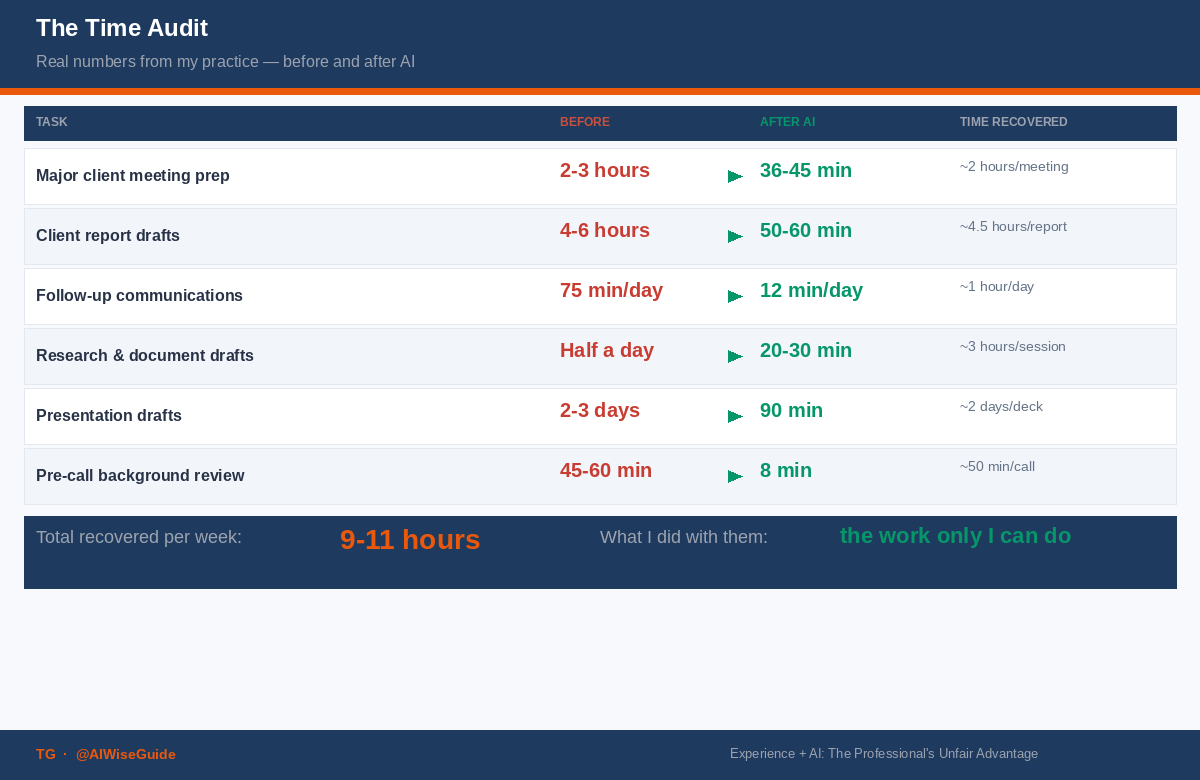
A friend of mine spent 6 hours on a client report last month.
Same report. Same complexity. Same client profile.
The following month: 52 minutes.
Here is exactly what changed — and why it almost did not happen.
Two months before the 52-minute report, he tried AI.
Spent 45 minutes with it.
The output was generic. He closed the tab.
"Useless," he told me. Went back to doing it manually.
I asked him what prompt he had used.
"Write a client summary."
That is it. No context. No history. No specifics.
No sense of what the output was for or who would read it.
So AI wrote a client summary.
A perfectly bland one that could have been for anyone.
What changed the second time:
Client background: 3 sentences
The three things that mattered most to this specific person: 2 sentences
The concerns from the last conversation: 1 paragraph
His own recommendation and why he believed it: 1 paragraph
Output: specific, useful, ready to send with minor edits.
Time: 52 minutes including his own revisions.
Client response: "The clearest analysis you've sent in years."
The difference between a useless AI output and a genuinely
useful one is almost always the same thing:
the person using it gave it nothing to work with.
AI is only as good as what you bring to it.
That is great news if you have something worth bringing.
If you tried AI once and it underwhelmed you,
did you try again with more context, or did you write it off?
Yesterday I promised the breakdown. Here it is.
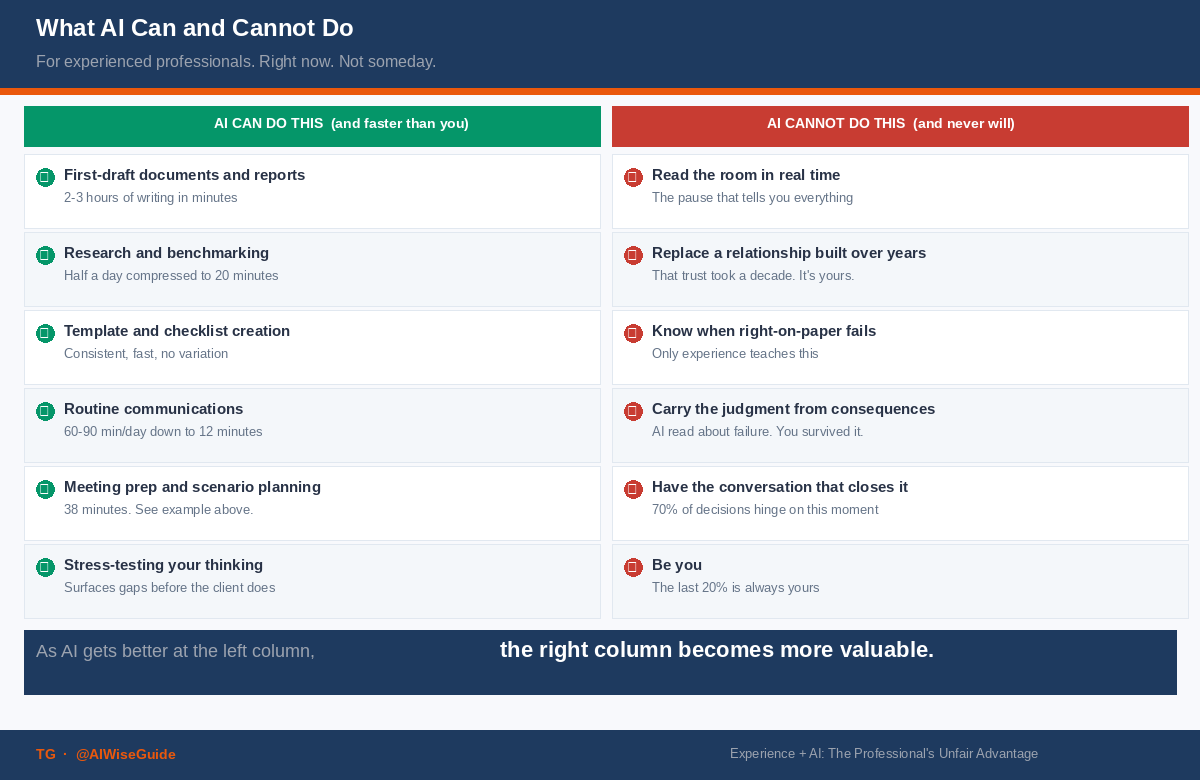
What AI can do right now, with a decent prompt and 10 minutes:
· First-draft documents and reports
(2-3 hours of writing down to minutes)
· Research and benchmarking
(half a day down to 20 minutes)
· Template and checklist creation
(hours down to minutes, consistent every time)
· Routine communications
(60-90 min of daily writing down to 15 minutes)
My colleague was spending 14 hours a week on those tasks.
That is 35% of her working hours. That was the uncomfortable part.
What AI cannot do, regardless of how good the prompt is:
· Reading a room in a difficult conversation
· The trust built with a specific client over 8 years
· Knowing when right-on-paper fails in practice
· The judgment that comes from living through consequences
Those last four are her entire value proposition.
They are also why her rates are what they are.
The 14 hours AI can handle was hiding the 26 hours that matter.
She was not being replaced. She was being buried.
Which part of your work is burying the part that actually matters?
Comment "AI" and I will send you the guide to run this audit yourself.