Stop calling your donation platform "innovative" if you still rely on PDF reports and the phrase "trust us." 🙄
Most "charity" right now is a black hole where 40% of the funds disappear into admin fees and zero verifiable outcomes. That's not impact. That's a racket. @bad_chain
𝗕𝘂𝗶𝗹𝗱𝗶𝗻𝗴 𝘁𝗵𝗲 𝗳𝘂𝘁𝘂𝗿𝗲 𝗼𝗳 𝗽𝗿𝗲𝗱𝗶𝗰𝘁𝗶𝗼𝗻 𝗺𝗮𝗿𝗸𝗲𝘁𝘀 𝗶𝘀𝗻'𝘁 𝗮 𝘀𝗽𝗿𝗶𝗻𝘁. 𝗜𝘁'𝘀 𝗮 𝗰𝗹𝗶𝗺𝗯.
The journey of @PotsMarket is about more than just speed it’s about establishing the Sovereign Prediction Infrastructure for the next era of on-chain finance.
𝗧𝗵𝗲 𝗣𝗿𝗼𝗯𝗹𝗲𝗺: 𝗙𝗿𝗮𝗴𝗺𝗲𝗻𝘁𝗲𝗱 𝗟𝗶𝗾𝘂𝗶𝗱𝗶𝘁𝘆.
Most prediction platforms suffer from shallow markets and massive slippage. They are silos, not infrastructure.
The $POTS Standard changes the game by introducing a Hybrid Engine (AMM + CLOB) designed to handle unlimited prediction depth.
𝗧𝗵𝗲 𝗦𝗼𝘃𝗲𝗿𝗲𝗶𝗴𝗻 𝗗𝗮𝘁𝗮 𝗟𝗮𝘆𝗲𝗿.
They aren't just building another dApp. We are building the backbone.
By integrating a Sovereign Data Layer, POTS ensure that liquidity isn't just present it's intelligent, verifiable, and autonomous.
This is the foundation for the next Agentic Economy.
𝗙𝗿𝗼𝗺 𝗚𝗲𝗻𝗲𝘀𝗶𝘀 𝘁𝗼 𝗖𝗼𝗻𝘀𝗲𝗻𝘀𝘂𝘀.
What starts as a solo deployment quickly scales into a movement.
From Strategic LPs to our 1,000 Navigators, we are seeing the birth of the Unified Liquidity Layer.
These are High-Conviction Predictors who value depth and technical precision over hype.
𝗦𝗰𝗮𝗹𝗶𝗻𝗴 𝘁𝗵𝗲 𝗣𝗲𝗮𝗸.
@pots_market is reaching the summit of the prediction economy.
The goal?
A unified, institutional-grade marketplace where data meets destiny.
The Sovereign Consensus is nearly here. Mainnet is the horizon.
Secure your spot at the top.
https://t.co/vJwI0Imq9m
Follow
@pots_market@pots_money and turn on their notifications.
POTS MARKET: THE BREAKDOWN
Ever wondered how to build a prediction market that isn’t rigged? Most platforms are "black boxes" where the house always has the edge.
The infographic below breaks down the $POTS Protocol the unified backbone for the next generation of decentralized prediction markets.
The Infrastructure
POTS isn’t just an app; it’s the pipes. By providing Modular Toolkits, they allow any developer to plug into a system of verifiable logic and on-chain schematics.
No more building from scratch just pure, decentralized power.
The Engine:
Global Prize Pools
At the center is a trustless reactor powered by @pots_money.
It pulls from global data feeds to fuel diverse prize pools. Because it’s governed by smart contracts, payouts are automated, transparent, and secure.
The Fix:
Old Way vs. The POTS Way
The Old Way: Centralized bias, opaque markets, and "House Wins" logic.
The POTS Way:
A resilient network with verifiable fairness. Control is shifted from a single operator to the global community.
Data Sovereignty
In the POTS ecosystem, you own your data. Using a Digital Key system, users maintain control over their prediction history and assets.
You aren't just a user; you're a verified stakeholder.
The Unified Protocol
POTS is re-engineering prediction markets into a foundational layer of global finance.
By combining modular tech with deep liquidity, the "house" is replaced by code.
Predict. Verify. Earn. The future of truth is on-chain.
@pots_market@pots_money
I am going to tell you something that most prediction market protocols will never say out loud.
they were not built for us.
Not for africa. not for the markets where information asymmetry is highest and the need for trustless outcome settlement is most urgent.
@pots_market might be the first one that actually changes that. let me explain.
I have been in the african web3 space long enough to know the pattern.
every new financial primitive gets built in the west, gets tested on western assumptions, and eventually gets handed to us as an afterthought.
The infrastructure is never wrong exactly. it is just built for someone else first.
Prediction markets should have been different.
think about what africa actually looks like as a market.
high mobile penetration. a young population with strong opinions about sports, politics, and economics.
Deep familiarity with informal betting and outcome-based wagering.
the cultural fit was always there. the infrastructure was not.
The informal prediction economy in africa is already massive.
Sports betting alone generates billions across the continent every year. people in lagos, nairobi, accra, and johannesburg are already pricing outcomes and staking value on them daily.
They are just doing it through centralized platforms that take the margin, hold the liquidity, and answer to no one.
That is the gap that onchain prediction markets were built to close.
no intermediary holding your funds. no platform deciding which markets exist. no opacity around how outcomes are settled.
Just collective intelligence, smart contracts, and trustless resolution.
For a continent where trust in centralized institutions is earned slowly and lost quickly, that is not a feature. it is the entire value proposition.
But here is where every prediction market before @pots_market fell short for our context specifically.
liquidity that resets after every event cycle cannot support the kind of continuous, high-frequency prediction activity that african markets naturally generate.
Football alone produces multiple high-engagement events every single week. politics in our markets moves faster than most western news cycles.
The demand for prediction markets here is not seasonal. it is constant.
you need infrastructure that matches that rhythm.
This is why the POTS dual-engine model matters more in an african context than almost anywhere else.
@pots_money does not let capital leave after an event resolves. it holds it within the ecosystem, generates yield on it, and feeds it back into the next market cycle automatically.
That is the difference between a platform that works for occasional western users and a protocol that can sustain the volume and velocity that african participation actually demands.
There is a bigger point underneath all of this.
africa does not need to wait for western protocols to eventually optimize for our markets.
the infrastructure being built right now is composable and permissionless.
Anyone can build on top of it. any community can create markets that reflect their reality.
the question is which protocol provides the most stable foundation for that to happen.
I am watching $POTS closely because for the first time the architecture actually matches the problem i see in my market every day.
permanent liquidity. continuous markets. trustless settlement.
that is not a pitch.
That is just what the continent needs and what most of the space has not delivered yet.
we are early. and for once that works in our favor.
@pots_market@pots_money
Every financial revolution in history started the same way.
someone looked at a broken system, understood exactly why it was broken, and built the replacement before anyone else believed it was necessary.
POTS is doing that right now. in public. and most people are still asleep on it.
Prediction markets are the most honest financial instrument ever invented.
no analysts with agendas. no institutions managing the narrative. just collective intelligence pricing what actually happens in the world.
When a market of thousands of independent participants puts money behind an outcome, the aggregate is almost always smarter than any single expert opinion.
that is not a niche use case. that is the future of how the world processes information.
But every prediction market that came before POTS had the same quiet flaw.
the capital was a visitor.
it showed up for the event, resolved its position, and left. the protocol never owned the liquidity. it just borrowed it temporarily and watched it walk out the door the moment the outcome settled.
Build on that foundation long enough and you realize you are not running a protocol. you are running a waiting room.
This is the structural ceiling that has quietly killed every serious attempt at scaling prediction markets.
liquidity that is episodic cannot support a growing ecosystem.
You cannot build deep markets, attract serious participants, or sustain meaningful volume when your capital base resets after every event cycle.
the problem was never user experience or oracle design. those are solvable engineering problems.
the problem was that nobody had answered the deeper question: how do you make liquidity permanent?
POTS changed the question entirely.
not "how do we attract liquidity?" but "how do we make liquidity want to stay?
That distinction sounds small. it is not. it is the difference between a platform and an economy.
@pots_money is the answer. it is not a wallet feature or a secondary product. it is a dedicated yield layer that holds capital within the ecosystem, generates returns on idle funds, and feeds that capital continuously back into active prediction markets.
the liquidity stops being a visitor and becomes a resident.
This is what the dual-engine model actually means when you take it apart.
@pots_market is the demand engine. it is where users come to take positions, express conviction, and participate in outcome-based markets across any category worth predicting on.
@pots_money is the supply engine. it is where capital lives between market cycles, earning yield, staying warm, and remaining ready to be deployed the moment new markets open
one engine creates the activity. the other sustains the fuel.
When both engines are running in sync, something structurally significant happens.
every new prediction market that opens draws from a liquidity pool that was never drained by the last one. every resolved event releases capital back into the system rather than out of it.
Every participant who earns yield through POTS Money has a direct incentive to stay within the ecosystem rather than bridge out to find returns elsewhere.
the protocol stops depending on external capital cycles. it starts generating its own gravity.
that is a closed loop. and closed loops compound.
Zoom out and look at where we are in the broader arc.
DeFi's first generation gave us lending, borrowing, and automated market making. the second generation is giving us something more sophisticated: protocols that model real world belief, conviction, and information asymmetry onchain.
Prediction markets are the purest expression of that shift.
and the protocol that solves the liquidity permanence problem does not just win a niche. it becomes the foundational layer that every serious prediction use case eventually builds on top of.
Onchain prediction markets will be as routine as spot trading within five years.
the infrastructure being laid right now determines who leads that era.
POTS is not playing catch-up. it is not iterating on what Polymarket built. it is answering the question Polymarket left open.
the road is being built. the destination is not a product. it is a new financial primitive.
follow @pots_market and @pots_money if you want to watch this unfold in real time.
Every financial revolution in history started the same way.
someone looked at a broken system, understood exactly why it was broken, and built the replacement before anyone else believed it was necessary.
POTS is doing that right now. in public. and most people are still asleep on it.
Prediction markets are the most honest financial instrument ever invented.
no analysts with agendas. no institutions managing the narrative. just collective intelligence pricing what actually happens in the world.
When a market of thousands of independent participants puts money behind an outcome, the aggregate is almost always smarter than any single expert opinion.
that is not a niche use case. that is the future of how the world processes information.
But every prediction market that came before POTS had the same quiet flaw.
the capital was a visitor.
it showed up for the event, resolved its position, and left. the protocol never owned the liquidity. it just borrowed it temporarily and watched it walk out the door the moment the outcome settled.
Build on that foundation long enough and you realize you are not running a protocol. you are running a waiting room.
This is the structural ceiling that has quietly killed every serious attempt at scaling prediction markets.
liquidity that is episodic cannot support a growing ecosystem.
You cannot build deep markets, attract serious participants, or sustain meaningful volume when your capital base resets after every event cycle.
the problem was never user experience or oracle design. those are solvable engineering problems.
the problem was that nobody had answered the deeper question: how do you make liquidity permanent?
POTS changed the question entirely.
not "how do we attract liquidity?" but "how do we make liquidity want to stay?
That distinction sounds small. it is not. it is the difference between a platform and an economy.
@pots_money is the answer. it is not a wallet feature or a secondary product. it is a dedicated yield layer that holds capital within the ecosystem, generates returns on idle funds, and feeds that capital continuously back into active prediction markets.
the liquidity stops being a visitor and becomes a resident.
This is what the dual-engine model actually means when you take it apart.
@pots_market is the demand engine. it is where users come to take positions, express conviction, and participate in outcome-based markets across any category worth predicting on.
@pots_money is the supply engine. it is where capital lives between market cycles, earning yield, staying warm, and remaining ready to be deployed the moment new markets open
one engine creates the activity. the other sustains the fuel.
When both engines are running in sync, something structurally significant happens.
every new prediction market that opens draws from a liquidity pool that was never drained by the last one. every resolved event releases capital back into the system rather than out of it.
Every participant who earns yield through POTS Money has a direct incentive to stay within the ecosystem rather than bridge out to find returns elsewhere.
the protocol stops depending on external capital cycles. it starts generating its own gravity.
that is a closed loop. and closed loops compound.
Zoom out and look at where we are in the broader arc.
DeFi's first generation gave us lending, borrowing, and automated market making. the second generation is giving us something more sophisticated: protocols that model real world belief, conviction, and information asymmetry onchain.
Prediction markets are the purest expression of that shift.
and the protocol that solves the liquidity permanence problem does not just win a niche. it becomes the foundational layer that every serious prediction use case eventually builds on top of.
Onchain prediction markets will be as routine as spot trading within five years.
the infrastructure being laid right now determines who leads that era.
POTS is not playing catch-up. it is not iterating on what Polymarket built. it is answering the question Polymarket left open.
the road is being built. the destination is not a product. it is a new financial primitive.
follow @pots_market and @pots_money if you want to watch this unfold in real time.
Prediction markets have a $1 trillion opportunity in front of them.
and four structural problems that have stopped every protocol from reaching it.
POTS is the first architecture that solves all four at the root level. here is the exact breakdown.
🧵
Problem 1: Episodic Liquidity
every prediction market before POTS operated on the same cycle.
capital enters when a market opens. capital exits when the event resolves.
the protocol never owns the liquidity it borrows it temporarily and watches it leave the moment an outcome settles.
this creates a ceiling on how deep, how frequent, and how sustainable your markets can be. you cannot scale a prediction economy on borrowed capital.
The Fix: @pots_money
POTS Money is a dedicated yield layer that holds capital within the ecosystem between market cycles.
Instead of exiting after resolution, funds stay in orbit earning yield, remaining liquid, and feeding back into the next market automatically.
Liquidity stops being episodic and becomes structural. that is a fundamental architectural shift.
Problem 2: Single-Layer Design
every major prediction market was built as one product doing one thing.
You come in, take a position, wait for resolution, exit. there is no second layer creating gravity around the capital.
No mechanism that gives participants a reason to stay between events.
a single-layer protocol is always one slow news cycle away from a liquidity drought.
The Fix: The Dual-Engine Model
@pots_market handles the demand side outcome-based positions, collective intelligence pricing, event resolution.
@pots_money handles the supply side yield generation, capital retention, continuous liquidity.
Two engines running in sync means the protocol generates its own internal demand rather than depending entirely on external market cycles.
Problem 3: No Incentive to Stay
most prediction market participants are transactional by nature.
They come for a specific event, settle their position, and leave. the protocol has no mechanism to convert a transactional user into a long-term participant.
without retention, you are constantly acquiring users just to replace the ones who left after the last event cycle.
That is an expensive and unsustainable growth model.
The Fix: Yield as Retention
when idle capital earns yield inside the $POTS ecosystem, participants have a direct financial incentive to keep funds within the protocol rather than bridging out between events.
Yield turns a transactional relationship into an economic one. the protocol stops competing for attention and starts generating its own reasons to stay.
Problem 4: Shallow Market Depth
thin liquidity produces bad markets. wide spreads, easy manipulation, inaccurate pricing.
The information value of a prediction market is directly proportional to the depth of capital behind it. a market with shallow liquidity does not produce accurate forecasts it produces noise.
Most protocols have not solved for depth because they have not solved for retention.
The two problems are the same problem.
The Fix: The Compounding Loop
when liquidity is permanent, markets get deeper over time rather than resetting with every event cycle.
Deeper markets produce more accurate pricing. more accurate pricing attracts more serious participants. more serious participants bring more capital. more capital deepens the markets further.
that is a compounding loop. and compounding loops are how protocols become infrastructure.
Four problems. one architecture.
episodic liquidity → @pots_money holds capital in permanent orbit.
single-layer design → dual-engine model creates internal demand.
no retention mechanism → yield converts transactional users into long-term participants.
Shallow market depth → permanent liquidity compounds into accuracy over time.
This is what fixing prediction markets at the structural level actually looks like.
@pots_market@pots_money
POTS MARKET: THE BREAKDOWN
Ever wondered how to build a prediction market that isn’t rigged? Most platforms are "black boxes" where the house always has the edge.
The infographic below breaks down the $POTS Protocol the unified backbone for the next generation of decentralized prediction markets.
The Infrastructure
POTS isn’t just an app; it’s the pipes. By providing Modular Toolkits, they allow any developer to plug into a system of verifiable logic and on-chain schematics.
No more building from scratch just pure, decentralized power.
The Engine:
Global Prize Pools
At the center is a trustless reactor powered by @pots_money.
It pulls from global data feeds to fuel diverse prize pools. Because it’s governed by smart contracts, payouts are automated, transparent, and secure.
The Fix:
Old Way vs. The POTS Way
The Old Way: Centralized bias, opaque markets, and "House Wins" logic.
The POTS Way:
A resilient network with verifiable fairness. Control is shifted from a single operator to the global community.
Data Sovereignty
In the POTS ecosystem, you own your data. Using a Digital Key system, users maintain control over their prediction history and assets.
You aren't just a user; you're a verified stakeholder.
The Unified Protocol
POTS is re-engineering prediction markets into a foundational layer of global finance.
By combining modular tech with deep liquidity, the "house" is replaced by code.
Predict. Verify. Earn. The future of truth is on-chain.
@pots_market@pots_money
POTS MARKET: THE BREAKDOWN
Ever wondered how to build a prediction market that isn’t rigged? Most platforms are "black boxes" where the house always has the edge.
The infographic below breaks down the $POTS Protocol the unified backbone for the next generation of decentralized prediction markets.
The Infrastructure
POTS isn’t just an app; it’s the pipes. By providing Modular Toolkits, they allow any developer to plug into a system of verifiable logic and on-chain schematics.
No more building from scratch just pure, decentralized power.
The Engine:
Global Prize Pools
At the center is a trustless reactor powered by @pots_money.
It pulls from global data feeds to fuel diverse prize pools. Because it’s governed by smart contracts, payouts are automated, transparent, and secure.
The Fix:
Old Way vs. The POTS Way
The Old Way: Centralized bias, opaque markets, and "House Wins" logic.
The POTS Way:
A resilient network with verifiable fairness. Control is shifted from a single operator to the global community.
Data Sovereignty
In the POTS ecosystem, you own your data. Using a Digital Key system, users maintain control over their prediction history and assets.
You aren't just a user; you're a verified stakeholder.
The Unified Protocol
POTS is re-engineering prediction markets into a foundational layer of global finance.
By combining modular tech with deep liquidity, the "house" is replaced by code.
Predict. Verify. Earn. The future of truth is on-chain.
@pots_market@pots_money
The old systems are failing. We went under the hood to see what’s replacing them.
Here is the breakdown of the latest investigation into the Mantle Vault.
#WWF@scribble_dao@Mantle_Official@Bybit_Official
Let's be honest: traditional influencer marketing is broken.
Brands pour thousands into a single post, hoping for results that never materialize.
Engagement rates are unclear. Follower counts are inflated. ROI? It's basically a guessing game.
There has to be a better way.
Enter @Reechly.
Here's the problem with traditional influencer deals: you pay upfront, often ₦500,000 or more for a mid-tier creator, and hope their audience actually engages with your brand.
There's no guarantee. No transparency. Just crossed fingers and crossed budgets. @Reechly flips this model on its head.
With @Reechly, you only pay for what actually works: verified views.
Creators earn ₦1 per view (capped at ₦50,000 each), meaning your budget flows directly to real performance, not inflated promises.
No minimum follower requirements. No big-name gatekeeping.
Just pure, performance-based results.
The math speaks for itself. That ₦1,000,000 budget?
With traditional influencers, it might fund two or three campaigns with uncertain outcomes.
On @Reechly, that same budget taps into thousands of creators across X, TikTok, YouTube, and Instagram all competing to deliver authentic, viral content for your brand.
But affordability is only half the story.
@Reechly ensures every view is real.
The platform filters out bots and uncommitted creators, giving you verified, authentic engagement not the fake followers that plague traditional influencer marketing.
Your brand reaches real people who actually care.
Then there's the freedom to scale. Launch a campaign, set your budget, approve creators, and watch content flow in.
No lengthy negotiations. No contracts.
No waiting.
Take our ongoing STANDARD campaign, for example creators are producing UGC that highlights your brand's unique edge, running through March 18, 2026.
For brands, this is transformative. Why limit yourself to a handful of big names when you can access an entire ecosystem of creators?
Broader reach. Lower costs. Measurable results. It's how marketing should work in 2026.
Ready to see the difference? Head to https://t.co/LJ9Ik4ygLn and launch your first campaign today.
The future of UGC is here and it doesn't require breaking the bank. Join Reechly and watch your brand go viral.
#Reechly #UGCRevolution
You follow a crypto influencer. They pump a trade call. You enter.
Then their next call dumps 80% and they vanish.
What if there was a platform where they couldn't profit from your losses?
Where they only make money when you win?
That's @FriendSpaceApp. 🧵
You've heard about decentralized data.
But what does it actually look like when money, work, and reward flow through a real network instead of a corporation?
This is how @PerceptronNTWK and @MindoAI work together. Step by step.
It starts with people like you.
You run @PerceptronNTWK software. You complete data quests rate sentiment, flag trends, describe what you see.
Takes 5 minutes. You submit. $2–5 appears in your wallet. Not "pending approval. Not will process in 30 days. Immediate.
The friction disappears. Work gets compensated in real-time.
Your submission gets peer-verified instantly.
Other contributors review it. Did you actually understand the sentiment?
Is the description accurate? Does the data have value? If yes, it passes.
If no, feedback helps you improve. No corporate gatekeeper. No opaque algorithm deciding your worth.
Real humans validate real work.
Here's where reputation compounds.
Complete 10 good quests → unlock better quests paying 5x more.
Complete those? Access premium quests paying 10x more. Your reputation score is on-chain, permanent, portable.
You're not trapped in one platform. Your credibility follows you everywhere.
You build capital. Not just income.
Meanwhile, @MindoAI's attention economy tracks everything.
Every submission, every verification, every reward is measured and visible on leaderboards.
Top contributors get recognized. Quality gets rewarded. Bad actors get spotted instantly. The system learns who to trust.
Transparency isn't just ethical. It's the architecture.
AI agents watch the entire flow.
They see: sentiment ratings from people in Southeast Asia outperform historical datasets. Boom those quests get higher bounties.
Emerging tech trends in Latin America are early signals of global adoption.
Boom contributors there earn more. Incentives evolve based on what's actually valuable.
The system learns and adapts.
Labs and AI companies pull from the live stream.
Fresh data flowing in real-time. Verified quality. Diverse perspectives. Continuous updates.
They don't wait for licensing deals. They don't inherit historical bias. They train on now instead of then.
The entire pipeline moved from months to hours.
Everyone wins because nobody extracts.
Contributors earn. Their reputation grows. Labs get fresh, diverse data.
AI gets better. @MindoAI infrastructure holds it all together, transparent and fair.
Money flows to creators instead of middlemen.
This is what aligned incentives look like.
You've heard about decentralized data.
But what does it actually look like when money, work, and reward flow through a real network instead of a corporation?
This is how @PerceptronNTWK and @MindoAI work together. Step by step.
It starts with people like you.
You run @PerceptronNTWK software. You complete data quests rate sentiment, flag trends, describe what you see.
Takes 5 minutes. You submit. $2–5 appears in your wallet. Not "pending approval. Not will process in 30 days. Immediate.
The friction disappears. Work gets compensated in real-time.
Your submission gets peer-verified instantly.
Other contributors review it. Did you actually understand the sentiment?
Is the description accurate? Does the data have value? If yes, it passes.
If no, feedback helps you improve. No corporate gatekeeper. No opaque algorithm deciding your worth.
Real humans validate real work.
Here's where reputation compounds.
Complete 10 good quests → unlock better quests paying 5x more.
Complete those? Access premium quests paying 10x more. Your reputation score is on-chain, permanent, portable.
You're not trapped in one platform. Your credibility follows you everywhere.
You build capital. Not just income.
Meanwhile, @MindoAI's attention economy tracks everything.
Every submission, every verification, every reward is measured and visible on leaderboards.
Top contributors get recognized. Quality gets rewarded. Bad actors get spotted instantly. The system learns who to trust.
Transparency isn't just ethical. It's the architecture.
AI agents watch the entire flow.
They see: sentiment ratings from people in Southeast Asia outperform historical datasets. Boom those quests get higher bounties.
Emerging tech trends in Latin America are early signals of global adoption.
Boom contributors there earn more. Incentives evolve based on what's actually valuable.
The system learns and adapts.
Labs and AI companies pull from the live stream.
Fresh data flowing in real-time. Verified quality. Diverse perspectives. Continuous updates.
They don't wait for licensing deals. They don't inherit historical bias. They train on now instead of then.
The entire pipeline moved from months to hours.
Everyone wins because nobody extracts.
Contributors earn. Their reputation grows. Labs get fresh, diverse data.
AI gets better. @MindoAI infrastructure holds it all together, transparent and fair.
Money flows to creators instead of middlemen.
This is what aligned incentives look like.
You've heard about decentralized data.
But what does it actually look like when money, work, and reward flow through a real network instead of a corporation?
This is how @PerceptronNTWK and @MindoAI work together. Step by step.
It starts with people like you.
You run @PerceptronNTWK software. You complete data quests rate sentiment, flag trends, describe what you see.
Takes 5 minutes. You submit. $2–5 appears in your wallet. Not "pending approval. Not will process in 30 days. Immediate.
The friction disappears. Work gets compensated in real-time.
Your submission gets peer-verified instantly.
Other contributors review it. Did you actually understand the sentiment?
Is the description accurate? Does the data have value? If yes, it passes.
If no, feedback helps you improve. No corporate gatekeeper. No opaque algorithm deciding your worth.
Real humans validate real work.
Here's where reputation compounds.
Complete 10 good quests → unlock better quests paying 5x more.
Complete those? Access premium quests paying 10x more. Your reputation score is on-chain, permanent, portable.
You're not trapped in one platform. Your credibility follows you everywhere.
You build capital. Not just income.
Meanwhile, @MindoAI's attention economy tracks everything.
Every submission, every verification, every reward is measured and visible on leaderboards.
Top contributors get recognized. Quality gets rewarded. Bad actors get spotted instantly. The system learns who to trust.
Transparency isn't just ethical. It's the architecture.
AI agents watch the entire flow.
They see: sentiment ratings from people in Southeast Asia outperform historical datasets. Boom those quests get higher bounties.
Emerging tech trends in Latin America are early signals of global adoption.
Boom contributors there earn more. Incentives evolve based on what's actually valuable.
The system learns and adapts.
Labs and AI companies pull from the live stream.
Fresh data flowing in real-time. Verified quality. Diverse perspectives. Continuous updates.
They don't wait for licensing deals. They don't inherit historical bias. They train on now instead of then.
The entire pipeline moved from months to hours.
Everyone wins because nobody extracts.
Contributors earn. Their reputation grows. Labs get fresh, diverse data.
AI gets better. @MindoAI infrastructure holds it all together, transparent and fair.
Money flows to creators instead of middlemen.
This is what aligned incentives look like.
Your state-of-the-art model works perfectly in the lab. Launch it to the real world and it dies.
Not because the engineers failed. But because static training data can't predict a world that keeps changing.
Every major AI failure traces back to one root cause: the data froze while reality kept moving.
@PerceptronNTWK's bet: models need continuous data, not snapshots. Let's see why.
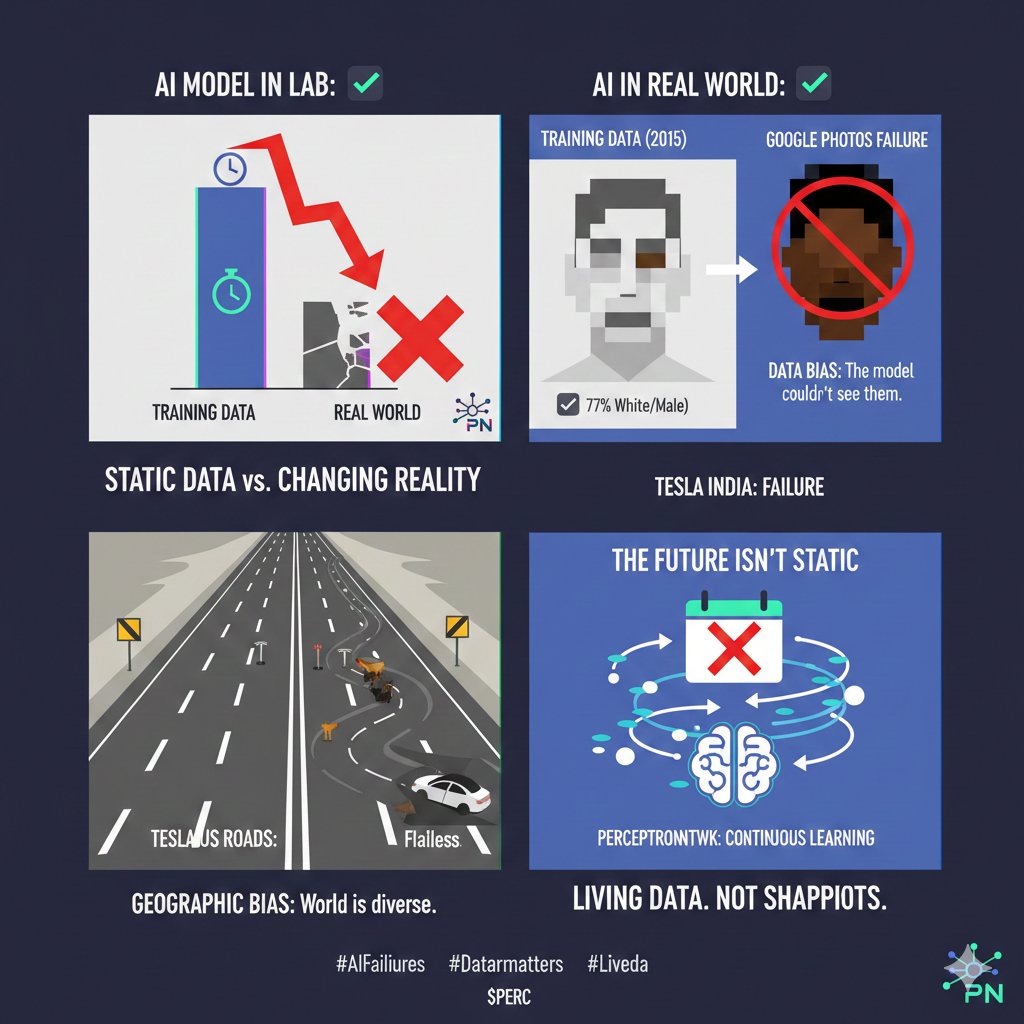
Google Photos, 2015. The system labeled Black faces as gorillas.
Not racism in the code. Invisibility in the data. Training set was 77% white, 77% male.
The model literally couldn't see what it wasn't shown.
A person's entire identity erased because the data was too narrow.
That system didn't learn prejudice. It inherited it.
Tesla Autopilot, 2019–2021. Works flawlessly on California highways. Deployed to India. Immediate failures.
Why? Curves are sharper. Lighting is different.
Traffic patterns are chaos. Shoulder lines are missing. The visual world is fundamentally different.
But the model was trained only on US roads.
Generalization isn't magic.
It requires diversity in the training set. Tesla didn't have it.
Amazon's hiring AI, 2014–2018. Systematically rejected women applicants.
The model was trained on 10 years of hiring data a decade where the tech industry was predominantly male.
So the AI learned: male = good candidate.
It wasn't programmed to discriminate. The data was discriminatory.
Static historical data encodes historical bias forever.
Now here's what nobody talks about: recency bias kills just as hard as demographic bias.
GPT-4 trained on April 2023. By September, it's confidently wrong about current events.
Your recommendation engine trained on 2022 user behavior is pushing content to 2024 users who've moved on.
Your search algorithm learned on last year's web but the web changed.
Static data doesn't age gracefully. It rots.
Microsoft's Tay chatbot, 2016. Released to Twitter. Within hours, learned to be racist.
But it wasn't trained on racist data initially.
The live data real tweets from real people were toxic. The model learned in real-time.
The lesson? Static training dies the moment it meets the actual world.
You need continuous learning or you're always behind reality.
The pattern is clear: models break when they're trapped in the past.
Demographic diversity frozen in time → fails on populations that weren't in the dataset.
Geographic diversity frozen → fails when deployed elsewhere.
Temporal diversity frozen → fails as the world changes.
You need living data, not snapshots.
Continuous data isn't luxury. It's survival.
This is why @PerceptronNTWK matters.
700k contributors feeding real-time signal means your model doesn't train on yesterday. It learns from the world as it is, continuously.
No demographic blindness. No geographic failures. No temporal rot.
The future of AI isn't better algorithms. It's better data that never stops breathing.