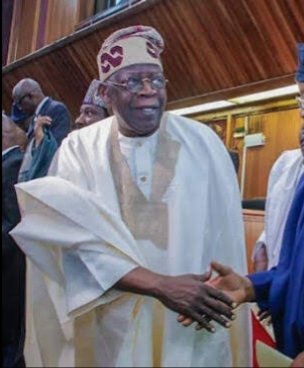
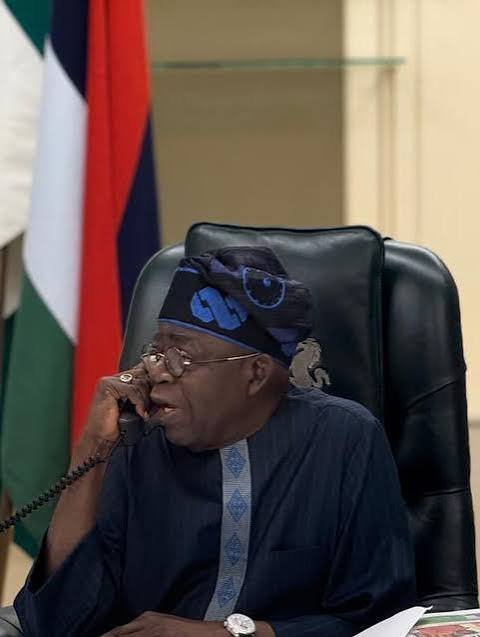
You went to meet the president to tell him that Nigeria is bleeding. The president said he doesn't agree with the term used. He agreed with you that Nigeria has security challenges. He said some of the structural and geographical challenges are being addressed, and that these are issues that should have been addressed decades ago. He asked for the job and inherited the assets and liabilities.
He talked about the creation of State Police to improve security at the local level with constitutional guard rails to prevent abuse; he even said locals should be aware of strange fellows that the crisis in the Sahel is worsening our situation. He talked about the creation of new Army Divisions to improve response time geographically across all regions, and the increase in security budget, and the procurement of arms for Forest Guards to properly man the forests. He said the Government refused to yield to the demands of the terrorists to release their leaders instead, the security forces went after the families of the terrorists.
On INEC, he said the politicians crying wolf are afraid of the companies they keep. The members of the parties are the ones taking themselves to court. He said INEC has been neutral and they should not expect him to roll the red carpet for the opposition or give them a rope they will use to tie him. He is ready to wrestle with them, and all is fair in politics.
On their Catholic Schools, he doesn't have control over the States. Constitutionally, the powers to return schools to the missions belong to the states; he did it as Governor and continued to fund the schools. He cannot make any law as president to return the schools.
On the economy, the President said we are coming out of the woods. He said he has taken bold decisions to reposition the economy for future growth. The opposition hasn't mentioned one thing they would do differently or any of his policies they would reverse. He didn't say Nigeria is eldorado.
How many times have the Catholic diocese in the states engaged their governors who are collecting 3x FAAC allocations?
If the Bishops think the economy is not rebounding, that's fine. What other suggestions or economic policies do they want the president to implement? They can put it in writing.
What were they expecting Asiwaju to say as President? We are too funny in this country. Anyways, go and prepare for the next election and come out to support your Catholic candidate boldly.
My assertion is not flawed and N80trillion is a fair estimate if you understand Nigeria's finances.
1. 2023 minimum wage bill was N4.99trn. With doubled minimum wage and pension liabilities we are looking at additional N6trn yearly. 2023 - 2026 ( N 18trn - 20trn ).
States would also need cash to be injected as bailout to pay salaries via ways and means. Look at the FAAC increase and compare it to 2023.
2. Look at our revenue from oil taxes and customs, if we evaluate at N460 instead of the market rate, calculate the suppressed revenue deficit - that's another N20trn deficit.
3. Look at fuel subsidy levels in 2023. We were inching close to N7trn annually. With Iran war, and crude at $100 per barrel, subsidy would be at least N15trn per annum.
4. Interest on debt, previous ways and means and new debt. Estimate that as well.
At 97% debt service-to-revenue ratio, tell me how the budget would be funded. The entire 2025 budget of N54trn would have been funded from ways and means.
At this point the CBN would be forced to introduce N1,000,000 notes and N50,000 note to buy bread. Economics don't answer to emotions.
Your statistics on world bank poverty estimates is another discussion. It's 2022 data extrapolation and less than 30,000 homes were surveyed. Read the methodology again.
I like Tinubu.
He is gracious.
He will welcome you.
He will listen attentively to you.
He will encourage you to say your mind
He will let you make any type of request
And he will STILL tell you no. ☺️
And then he will do what he wants to do...
And NOTHING will happen.
On 22nd December 2022 at the "Business Forward" luncheon with members of the Nigerian business community in Lagos did he not stand Infront all of us and say...
"No matter how long you protest, we are going to remove subsidy!"
LOL.
Na that kain pesin una wan play with?
Men of God una, Bishops ko, Bishops ni.
PFN oh, Catholic oh all of them compromised.
A church in Los Angeles, The First Congregational Church of Los Angeles, beautifully performed the Celestial Church of Christ Hymn (694, Stanza 3) in Yoruba language.
The language + the message = heavenly. 🔥
When some of us say Nigeria isn't as financially rich as many assume, people get offended.
The 2026 budget carries a deficit of about ₦31.46 trillion. That's money the government doesn't currently have and must raise through borrowing or alternative financing.
This is the dilemma behind infrastructure delivery. Government can't fund every major project simultaneously from its own revenues, so it increasingly turns to tax-credit financing.
And companies funding projects through tax credits will naturally prioritize roads and infrastructure that directly benefit their operations.
That's why you sometimes see new strategic roads being built while older federal roads remain in terrible condition. It's not always about neglect.
Nigeria is not just extracting resources; we are building the infrastructure that will power future generations.
From gas processing plants to strategic pipeline networks, these investments are laying the foundation for industrial growth and economic prosperity.
The world may see our challenges, but we should never overlook the scale of what is being built. Nigeria's gas revolution is a national asset, and its full impact is still ahead of us. 🇳🇬 🙏
When they say “Tinubu didn’t win the 2023 election” just show them this video and move on.
This video of Peter Obi saying, “the person WE voted is Bola Ahmed Tinubu” will be very important as we go into the campaign proper.
Save this tweet and share to others.
You said the tax bill will increase taxes.
Those that got tax relief testified.
You said the coastal road is not real.
Those that ply it and can confirm the progress of work, testified.
You said FX policy failed.
Those that now have better access to FX testified.
You said Governors are not receiving more money.
Governors have testified they are receiving more.
You said Trump will remove Asiwaju.
Trump testified he is proud working with Asiwaju.
You said NELFUND is fake.
Students benefiting from NELFUND are on Tiktok testifying.
When you are working, you don't tell people " Go and verify".
They by themselves TESTIFY.
Before Naira Marley, before Obesere, there was Chief IK Dairo.
Watch his entertaining live performance in Brooklyn, New York (1992).
Lyrics🔞
Chief IK Dairo was the first African musician to be honored by Queen Elizabeth II as a member of the Order of the British Empire (MBE)
100% of Zero is Zero: What NLNG Teaches Us About the Bonga South-West Tax Incentive
By Babs Omotowa
Bloomberg recently reported that the Federal Government has agreed to an $11.5-per-barrel tax incentive to enable Shell's $20 billion Bonga South West project to finally proceed.
Some commentators have described the tax incentive as "unusually generous" — reportedly double the standard fiscal terms for deepwater projects in Nigeria. They argue that a previous Executive Order had capped such tax credits at 20% of a licensee’s annual tax liability.
It is a fair question to ask.
But before we answer it, it is worth starting with a simple truth: an untamed river does not irrigate any farm; a locked vault, however full, pays no one's school fees.
That is the essence of "100% of zero is zero."
The Bonga South West field — 150,000 barrels a day, discovered in 1995 — has sat stranded since 2010. This is nearly two decades of idle oil that has paid no dividends, created no jobs, and funded no roads, simply because it has never been allowed to flow.
Nigeria does not have the capital or technical means to develop it alone.
Meanwhile, capital that could have come here has instead gone to Mozambique, Guyana, Brazil, and Angola — countries that made their fiscal terms attractive enough to compete for it.
The Petroleum Industry Act has considerably improved our fiscal and regulatory climate, but amendments are still being considered to further enhance it. But legislative amendment of this nature is a slow tide, and yet the world's shift away from hydrocarbons will not wait for us to finish adjusting the sails.
A Vault That Sat Locked for a Quarter-Century
Nigeria has been here before, and the story is worth telling plainly because it did not end the way skeptics had feared in 1989.
The Nigeria LNG project was first imagined in 1965. For nearly twenty-five years, it went nowhere — one false start after another — until 1989, when NNPC, Shell, Total, and Agip finally signed the NLNG Shareholders' Agreement.
What broke the deadlock was not swagger, persuasion or goodwill; it was the Nigeria LNG Act, which offered concrete, time-bound incentives: a ten-year exemption from company income tax, alongside other evergreen incentives, exemptions and guarantees designed to give investors the confidence that the ground would not shift beneath a multi-decade, multi-billion-dollar commitment.
To be precise, because the honesty of the comparison depends on it: NLNG's incentive consists of both a holiday - a ten-year runway after which full company income taxation resumed, as well as some permanent exemption from tax, fees, and levies.
Whether the Bonga SW arrangement is only a time-bound design, or is structured as a standing per-barrel term for the life of the field, is a detail that would be visible to the public when the agreement is gazetted, and/or passed into law as the NLNG incentives were.
What is no longer in dispute is what the NLNG tax holiday and evergreen incentives brought.
It persuaded international shareholders to commit $7.5 billion to build the first two production trains, with Nigeria contributing $2 billion of its own.
That initial trust has since grown into five additional trains and a further $30 billion in capital investment — a single seed that became an orchard.
Counting the Harvest, Honestly
By NLNG's own published "Facts and Figures," the project has generated nearly $130 billion in sales revenue since 1999. It is worth understanding which of these figures represent money that landed directly in the government's hands, and which represent broader economic activity that the project set in motion — the difference between the fruit you can hold and the shade the tree provides to everyone standing under it.
Direct fiscal revenue to government has included over $22 billion in dividends, roughly $10 billion in Company Income Tax and Education Tax paid after the ten-year holiday expired, about $0.6 billion in PAYE, $2 billion in withholding tax, and $2 billion in VAT and port charges — a genuine fiscal harvest north of $36 billion, against Nigeria's original $2 billion stake.
Broader economic activity - separate from, but no less real than direct fiscal revenue - includes some $21 billion in feedgas purchases paid to the government and $10 billion spent on local goods and services. These represent economic activity that would not have existed at all had the project not moved.
A market that never opens sells nothing to anyone.
Layered on top of both are the harder-to-price, easier-to-feel benefits: LPG supply at a time when domestic refineries had gone quiet since 2008; 1,500 direct and 5,000 indirect Nigerian jobs; twenty-four-hour electricity in Bonny Island, where much of the country still measures light in hours rather than assuming its constancy; and roughly half the cost of the ₦280 billion Bonny-Bodo Road.
In 2015, NLNG's first CIT payment — at $2.1 billion, the largest single Company Income Tax payment in Nigeria's history - arrived at the exact moment that the federal and state governments needed it to pay salary arrears. It became, in effect, an unplanned bailout fund, proof that a well-timed harvest can matter as much as a large one.
It bears saying plainly: these are NLNG's results, achieved over twenty-five years under its own specific terms. They demonstrate what unlocking stranded capital can do.
What Bonga SW delivers over time will depend on its own execution, timeline, and oversight. But the key is to unlock it now rather than to continue to leave it stranded. The country needs it during these challenging times.
Nigeria Is Not Alone in This Calculation
Every major hydrocarbon nation competing for scarce global capital has reached for similar tools, each shaped to its own circumstances:
· Guyana offered ExxonMobil a 2% royalty on its Liza, Payara, and Yellowtail projects, an unusually fast cost-recovery ceiling of up to 75%, exemption from corporate income tax, and a promise that fiscal terms would not change for the life of the contract.
· The United Kingdom ring-fenced its North Sea reliefs so upstream profits from Shell's Victory gas field could not be diluted by unrelated losses elsewhere in the business — a roughly 90% saving that made the field's economics work.
· The United States used federal and state tax credits alongside immediate expensing of drilling costs to make its Gulf Coast carbon-capture and blue hydrogen megaprojects viable for ExxonMobil.
· Norway paired tax credits with accelerated depreciation and refundable exploration credits to bring its Northern Lights offshore electrification and CCUS projects to life.
None of these governments handed away their patrimony. Each simply recognized that a smaller share of a project that is executed is worth more than a full share of one that remains stranded.
What This Should Not Become
Another worry beneath the "unusually generous" critique is about precedent. Nigerians have, through experience, become worried about what a generous deal for one investor becomes once every investor expects the same.
The President had reaffirmed that the incentives are not blanket concessions but will be ring-fenced and focused on new capital, incremental production, and strong local-content delivery. This safeguard is that megaproject terms like this would remain ring-fenced to genuinely exceptional cases — defined by scale, technical difficulty, production, and the years a field has already sat stranded — rather than becoming the new floor for ordinary developments.
If four or five such megaprojects do emerge, each carrying $20 billion in investment, that is not fiscal generosity escalating out of control; it will be $100 billion in foreign direct investment, jobs, and local content flowing into an economy that badly needs all three.
The government's part would not end with signing the incentive. NLNG's history is a reminder that stranded capital is unlocked by more than fiscal terms alone — customs clearance that doesn't stall at the port, regulators who move at the pace of the investment rather than the pace of the bureaucracy, and agencies genuinely aligned behind the strategic value of the project.
An offshore field like Bonga South West is spared the security and community-relations complexity of an onshore development, which makes it a more forgiving test case — but the rest of the machinery must keep pace with the fiscal generosity already on the table.
Building Trust, Not Just a Field
One other lesson that NLNG offers, one that matters more than the dollar figure, is that transparency compounds trust the way an oilfield compounds revenue, slowly, then significantly. NLNG's own public "Facts and Figures" disclosures are precisely what make this comparison possible today.
The same standard — regular, public reporting on Bonga South West's investment milestones, production start-up, and fiscal remittances — would let Nigerians know that this incentive is doing what it was designed to do: create value, and that it is not a giveaway or a revenue loss.
It is what a quarter-century-locked vault finally being opened looks like: a considered, well-precedented bet that a smaller share of something real will always outweigh the whole of nothing at all.
-Omotowa
@BabsOmotowa
is a former Managing Director of Nigeria LNG Limited and Vice President at Shell.
#KemKem
If not this Lady, most of us in history wouldn't have known these facts from Nigeria to South Africa. Have you heard something like this before?
The Internet does not forget history
The guy is really talented. I've followed him from the days when he started out doing song covers.
Check this one also, my favorite.
Lyrics:
Àṣẹ irú ẹmi l'jọ́ba
Òwì nínú orò rẹ̀, mo gbà bẹ́
Àṣẹ ìrètí tún wà Fún Igi tà gẹ́lórí
Ó gbọ́ orò rẹ̀ mú, mo gbà bẹ́
Omi odò tó kan ilẹ̀ padà dún
Gẹ́gẹ́ bí orò rẹ̀, mo gbà bẹ́
Àánú ni
Àánú ni
Ohun tá wọ́n kan gbàwé fún Ló ṣe wèrè
(Ló ṣe wèrè)
Omi tí wọ́n ní kò lè sàn tó wá di ibù
Mo ní bó ṣe ń ṣòlá
(Mo ní bó ṣe ń ṣòlá rẹ̀) Òun l'ó yé
Translation:
It is almost unbelievable that someone like me could become a king or rise to greatness; You spoke it in Your word, and I received it. So there is still hope.
Even for a tree that has been cut down, according to Your word, I received it.
There is still hope For the sour water of a flowing stream to become sweet again; According to Your word, I received it.
It is all by mercy. It is all by mercy. What others had to labour and fast for, You made it easy and effortless for me.
The pond they said could never flow Eventually, it became a mighty body of water. I can only marvel at how You bring glory out of impossibilities. Only You understand the mysteries of how You work.
The U.S. recovered a greater volume of electronic materials from the ISWAP raid in Nigeria than from the operation that killed Osama bin Laden at his compound in Abbottabad, Pakistan.
Items recovered included hundreds of laptops, servers, and heavy communications hardware used for command, control, and coordination.
Mobile phones, hard drives, and communication radios with end to end encryption that contained sensitive data regarding ISIS/ISWAP operational planning, financing, and international links.
Hundreds of specialized satellite internet communication devices that the insurgents were using to evade ground based network disruptions in the Lake Chad Basin and Sambisa Forest.