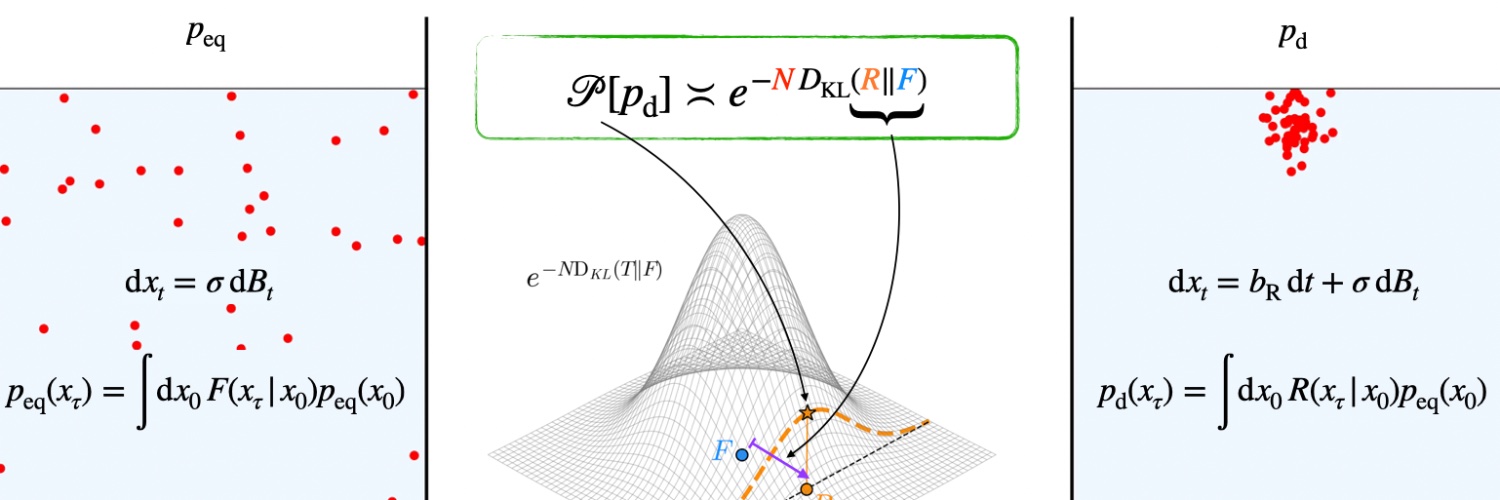
@alec_helbling But that’s precisely what Tweedie’s says: the score function points from the current point to the denoised mean, which is the mean of all points in the target that could have been noised to the current point. When the latter is mostly noise, any target could have produced it.
Whenever I finish a paper I think to myself “that wasn’t too hard, anyone could’ve written that.” Then I start work on my next project and I’m reminded that research is hard.
(2) the diffusion model commits a large fraction of its information budget to recreating the perceptual details of the image. The first point illuminates the effectiveness of classifier-free guidance, and the second explains why latent diffusion models are more efficient.
A talk based on my recent ICML paper 'On the Separability of Information in Diffusion Models' is now available on YouTube: https://t.co/2xTbuzyQsI
(1/n)
That is, a slightly noisy image of a cat still reveals the cat. In my paper I show that, in image diffusion models (1) semantic and perceptual information are largely 'orthogonal' to one another, and
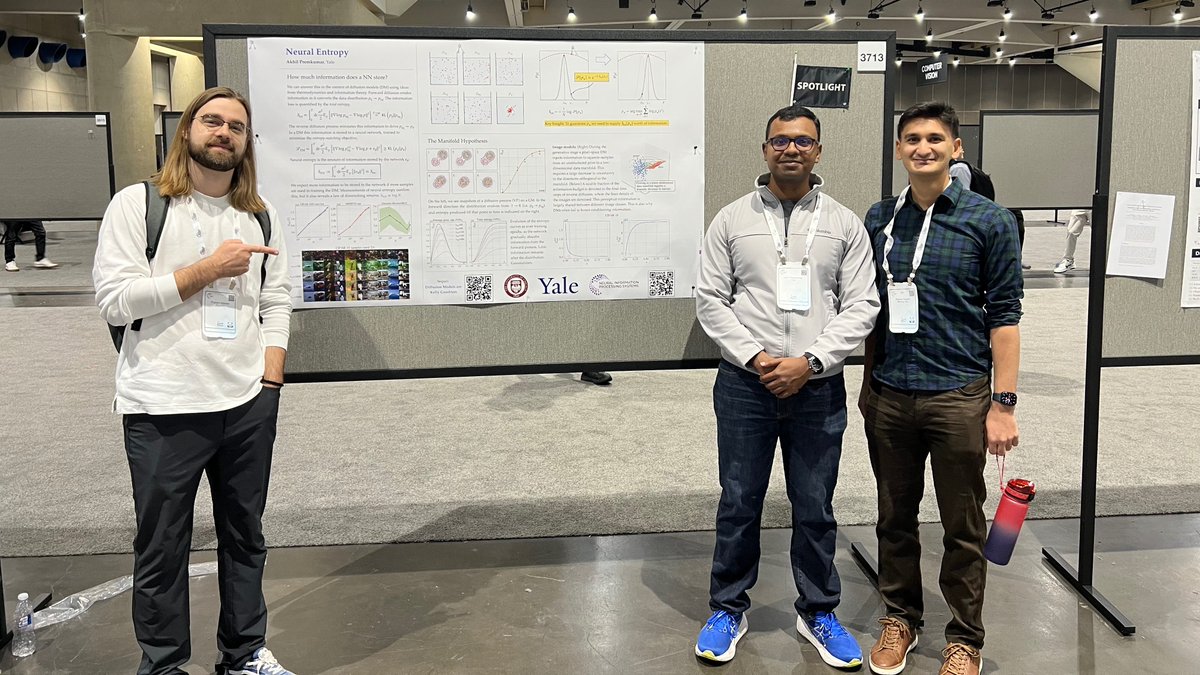
Thanks to everyone who came by my poster at #NeurIPS2025 last week. Talked non-stop for over 3 hours and got wonderful questions, comments, and feedback from many visitors. Most of all, I was pleasantly surprised to learn that people read my papers😄. See https://t.co/uYffklQQAn
How much information is stored in a neural network?
In the context of a diffusion model we can answer this question. Come by my poster at NeurIPS at 11 am today to find out how.
‘Neural Entropy,’ poster #3713
The recording of @AkhilPrem_K presentation on the connections between Information Theory and Diffusion Models is now available on our YouTube channel.
Watch the full talk at https://t.co/TSBCYa5x7s
@LimYenKheng I think classes are limited by their very structure. The universe does not come with a mandate that you have to understand electromagnetism in 10 weeks. But that’s exactly what we attempt in a class.