masih inget agent DLMM di @MeteoraAG gua yang bulan kemaren ngehasilin gua $1.5k, ini adalah tutorial lengkap 32 menit full dari awal banget setup hingga oprek.
kalian yang gabisa apa-apa udah dijelasin semua di sini.
kalo ada yang kurang tolong banget buat komen biar gua bikinin video lanjutan.
semua link untuk setup kebutuhan ada di komen
00:00 Intro
02:47 Persiapan Tools
04:32 Fundamental
09:08 Installing
12:13 ENV dan User Config
18:57 First Start
20:27 Telegram Community
24:12 Basic Troubleshoot
27:02 Screen Session
28:05 Hardcode
30:10 Penutup
Hermes Agent changed how I work
it's the highest leverage agent framework you can set up right now
what makes it different:
> it routes tasks to the right model based on complexity and cost
> learns your voice and preferences over time
> handles context switching without losing thread
> works across your entire stack instead of living in one tool
save this blueprint and build your own
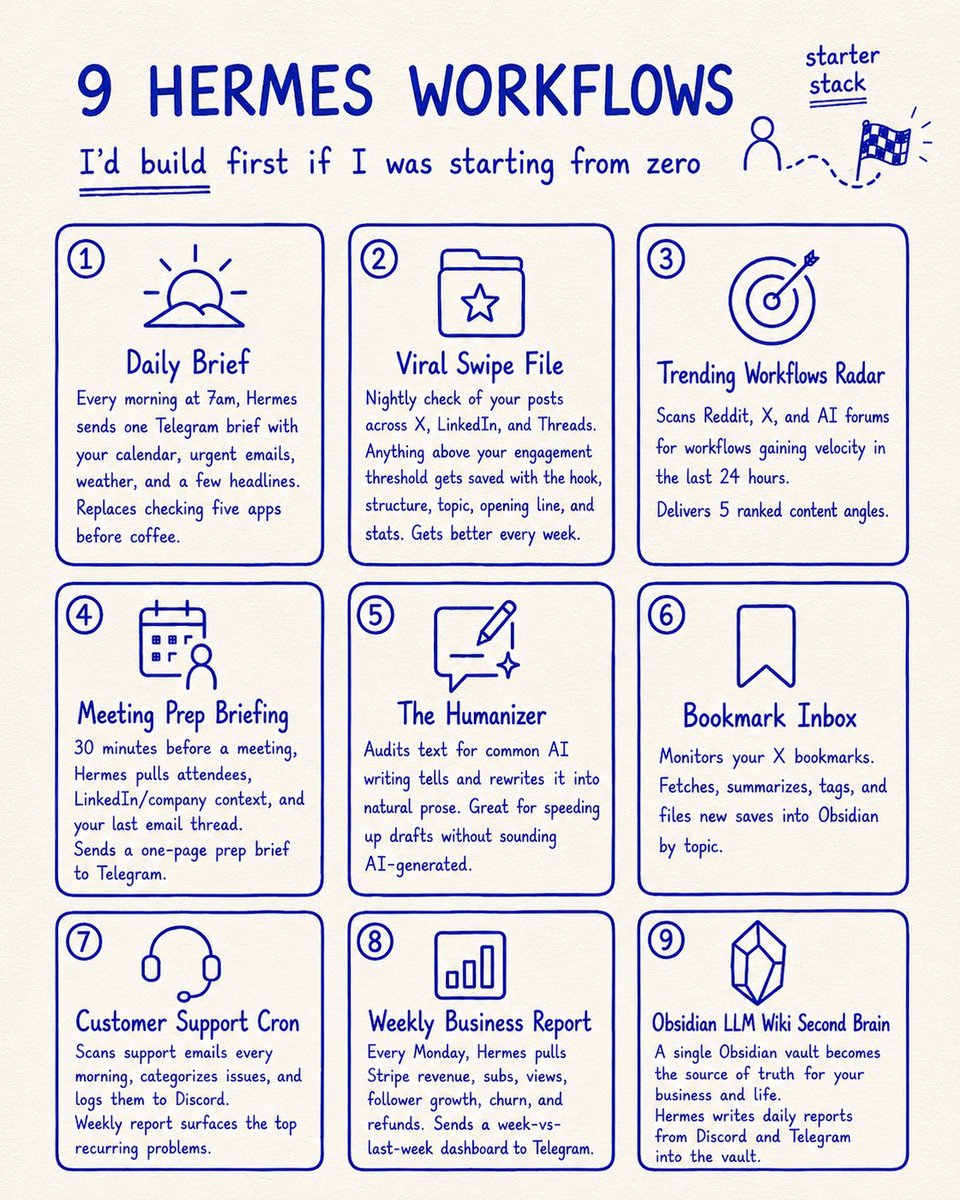
If I was starting Hermes from zero, these are the 9 workflows I'd build first (to make it a real Chief of Staff):
1. Daily Brief
Every morning at 7am, Hermes pulls my calendar, top 3-5 urgent emails, weather, and 3 headlines from my interest feeds, then drops it as one scannable message in Telegram.
Replaces my old shitty ritual of opening 5 apps before coffee.
2. Viral Swipe File (self-improving)
A nightly cron checks every post I've published across X, LinkedIn, and Threads.
Anything that crosses my engagement threshold gets auto-extracted into a structured swipe file with the hook, structure, topic, opening line, and stats.
It gets better every week. Over time the swipe file builds a precise fingerprint of what works for me, calibrated against real data.
3. Trending Workflows Radar
Every morning Hermes scans Reddit, X, and AI forums, identifies what workflows are gaining velocity in the last 24 hours, and delivers a ranked list of 5 content angles.
This helps me stay on top of the hottest workflows people are cooking in AI.
4. Meeting Prep Briefing
30 minutes before every Google Calendar meeting, Hermes pulls the attendee list, fetches their LinkedIn/company context, summarizes my last email thread with them, and sends a one-page brief to Telegram.
I walk into every call sounding prepared without digging through threads.
5. The Humanizer
A skill that audits any text against 30+ known AI writing tells (em-dashes, "delve," "tapestry," tricolon structures) and rewrites them into natural prose.
Lets me accelerate first drafts with AI without sounding like I did (probably my most used workflow in my entire stack)
6. Bookmark Inbox
Hermes monitors my X bookmarks automatically. Anything new gets fetched, summarized in 3 bullets, auto-tagged, and filed into my Obsidian vault by topic.
Saved stuff becomes searchable knowledge instead of digital clutter.
7. Customer Support Cron
Every morning Hermes scans my inbox for support tickets, categorizes them by issue type, and logs everything to my company Discord.
Weekly report surfaces the top 5 recurring issues so I know what to actually fix in the product.
8. Weekly Business Report
Every Monday morning Hermes pulls Stripe revenue, newsletter subs, content views, follower growth, churn, and refunds.
Then drops it as a single dashboard in Telegram with this-week-vs-last-week.
9. Obsidian LLM Wiki Second Brain
A single Obsidian vault that becomes the source of truth for everything in my business / life (Karpathy-maxxing)
I have Hermes writes a daily report on everything that happened across my Discord and Telegram, then add it to the vault.
Over time it becomes a deep knowledge base I can point any model at.
•••
If you want to build these, simply paste this post into your Hermes agent and tell it to build the ones you want.
It'll ask you which integrations to connect (Gmail, Stripe, Telegram, etc), pull your business context, and set them up for you.
What workflows do you love that should I add??
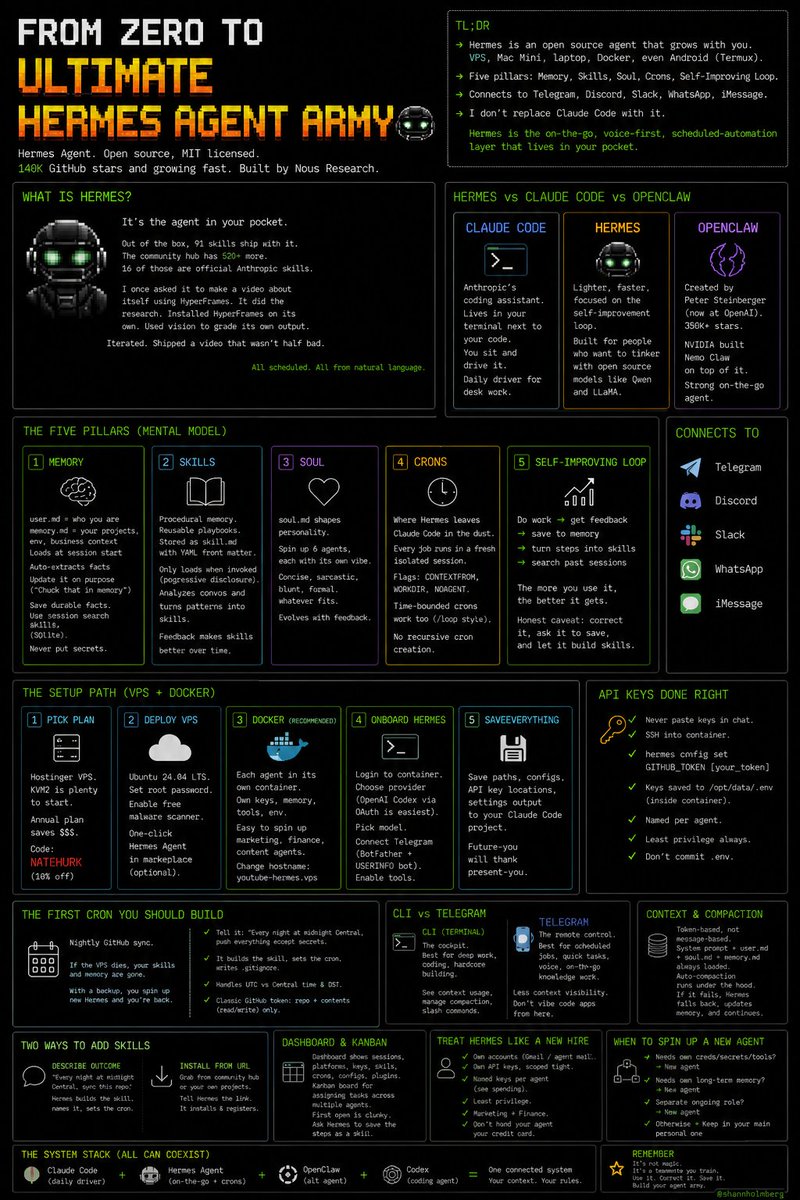
how to set up your Hermes Agent control room
send this image + the repo below to your agent and it will configure itself based on the blueprint
https://t.co/Bb2nEm96i8
this is the same architecture I use to run specialist agents across both my agencies
how to go from prototype → production with Hermes Agents
here's the framework I use every time I spin up a new specialist agent:
> prototype inside my main Hermes Agent (or orchestrator)
> run it 4 to 10 times, guiding it and building the workflow
> correct drift and mistakes each iteration
> let the skills emerge naturally through repetition
> optional: fine-tune in a dedicated claude code or cursor session
> spin up a new docker instance with the refined workflow as a specialized agent
you can't create a solid production agent from scratch. it needs to be crafted through iterations.
example: you want to automate strategy data collection
you spin up a test agent inside your main instance and hand it the brief
first run pulls the wrong data types, formats are off, and the angles you'd pick manually are missing
second run gets closer but still drifts & makes mistakes
third run you're correcting less, the agent gets more right, and the skills are writing themselves in the background
when it finally runs clean, you take those skills and connected scripts and port them into a dedicated specialist agent
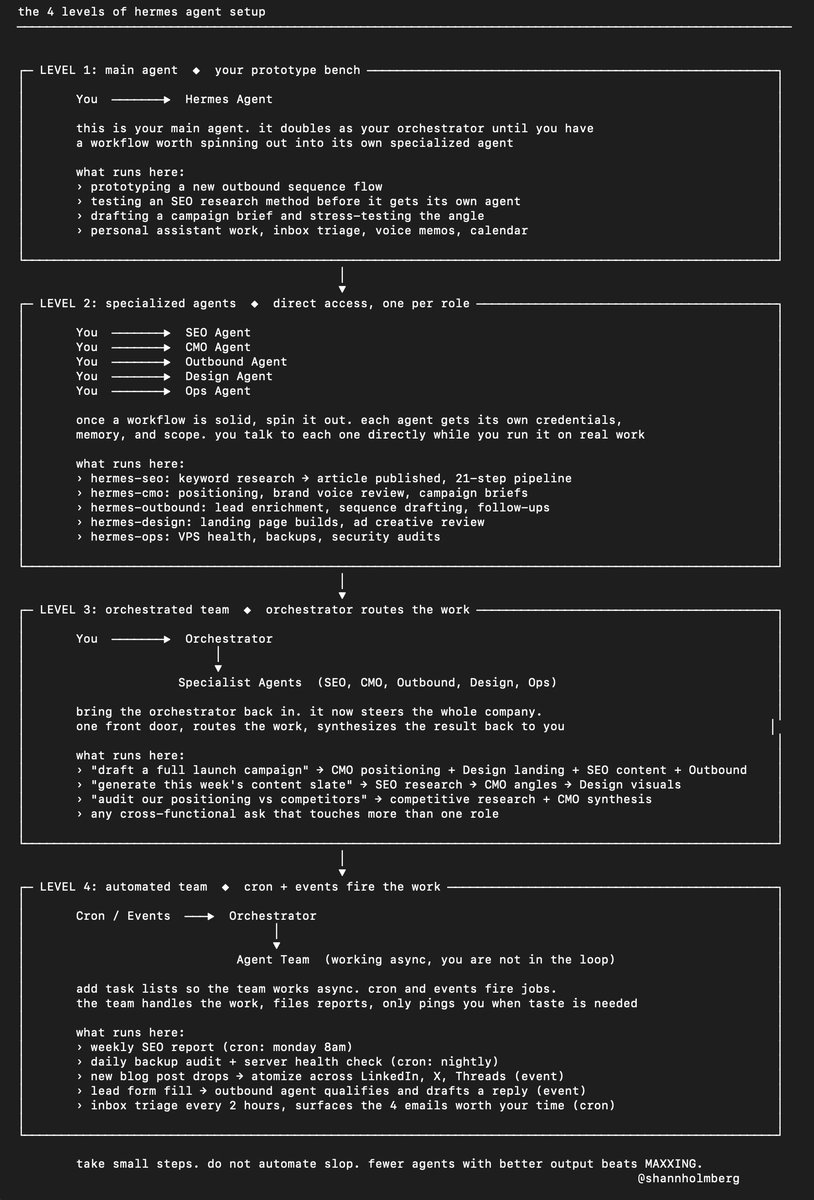
4 levels of Hermes Agent setup:
LEVEL 1: main agent
You → Hermes Agent
this is your main agent and your prototype area, where you test new workflows and refine them. it doubles as your orchestrator until you have something worth breaking out
----
LEVEL 2: specialized agents
You → SEO Agent
You → CMO Agent
You → Ops Agent
once a workflow is solid, break it out into its own agent with its own credentials, memory and scope.
---
LEVEL 3: orchestrated team
You → Orchestrator
↓
Specialist Agents
bring the orchestrator back in. it now steers the company of agents you have built.
----
LEVEL 4: automated team
Cron / Events → Orchestrator
↓
Agent Team
add task lists so the team works async. cron and events fire jobs, the orchestrator routes them through the task bus, the team handles the work without you
----
take small steps, you DO NOT want to automate slop.
if your output at level 1 is mediocre, you are about to scale mediocrity. 20 agents shipping low quality work at speed is worse than 3 shipping great work slowly.
I would rather run fewer agents with better output than MAXXING the agent count and spitting out more of the same.