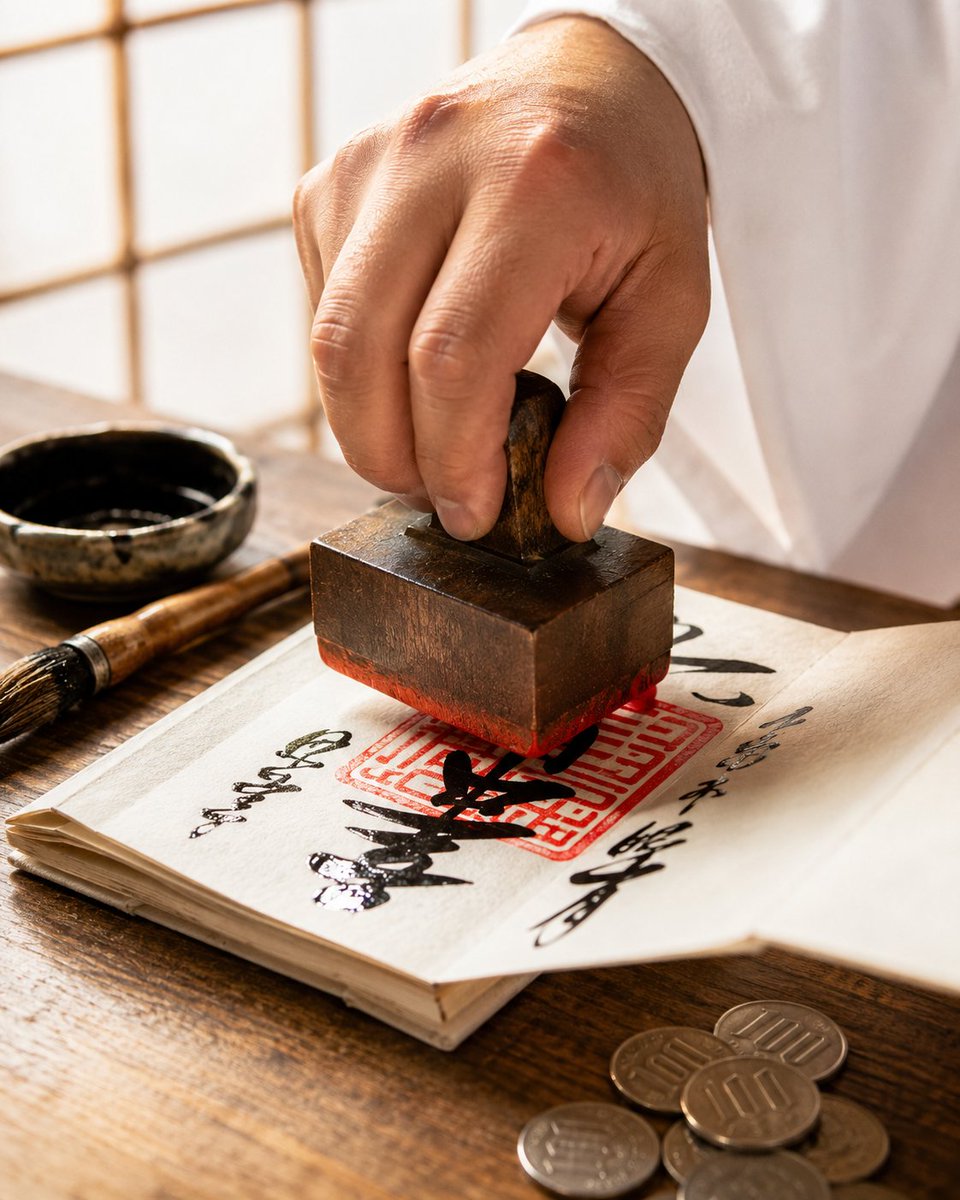
Most people leave Japan with photos.
Some leave with a small folding book
that took twenty monks and priests to fill.
It's called a goshuincho.
At nearly any shrine or temple you can hand it over,
and someone will brush the name of the place,
the date, and a blessing in black ink,
then press a red seal over it.
While you wait. Every one different.
The offering is around $2 to $3.50.
It started as proof.
Centuries ago you had to copy out an entire sutra
by hand and donate it before you got the stamp.
Now the copying is gone, but the seal still means
"this person actually came here."
Some are famous.
At Iwashimizu Hachimangu in Kyoto,
the character for eight is drawn as two doves,
because doves carry messages for that god.
Kinkaku-ji capped one special seal
at 300 a day, one per person.
It runs out.
A few things caught me off guard.
It's cash. Coins, ideally.
A one-person shrine office can't break a big bill.
And you pray first, then hand over the book.
Nobody enforces that. Everyone does it.
I suspect the pages where the brush slipped a little
end up being the ones people love most.
I can't prove that. It's just what people say.
A $3 souvenir, made by hand, in front of you,
by someone whose family may have been doing this
on that exact spot for 500 years.
It isn't a stamp collection.
It's a list of every place you stood still for a minute.