Alexander Solzhenitsyn gave the most controversial speech *against* Western Civilization at Harvard in 1978.
As a survivor of the Russian Gulags, they expected him to praise the West. Instead, he made a jarring accusation:
The West is a dying civilization. If it doesn't change its ways, it is doomed to collapse.
In fact, he said this has been the case for 500 years, when the West made a crucial mistake:
"How did the West decline from its triumphal march to its present debility?
...the mistake must be at the root, at the very foundation of thought in modern times. I refer to the prevailing Western view of the world which was born in the Renaissance…
I refer to humanism — the proclaimed autonomy of man from any higher force above him."
Solzhenitsyn said humanism made man autonomous from God, Truth, and objective morality.
If all morality is subjective, then man has nothing to live nor die for. Naturally, he loses his courage, embraces materialism, and grows effeminate to modern evils.
So, what is the solution?
A return to belief in a transcendental morality under God:
"If, as claimed by humanism, man were born only to be happy, he would not be born to die. Since his body is doomed to death, his task on earth evidently must be more spiritual…
The fulfillment of a permanent, earnest duty so that one’s life journey may become above all an experience of moral growth: to leave life a better human being than one started it."
All cultures live, or die, based on their respect of the True, Good, and Beautiful.
To save the West, Solzhenitsyn says start with beautifying your soul, for that is both how you live well, and begin to make civilization itself beautiful again.
The Iranian women’s national football team refused to sing the anthem of the Islamic Regime. Tonight. At the opening match of the Asian Cup. In front of the entire world.
So, to all liberal Western women:
Watch and learn.
THIS is what real feminism looks like.
@AndreasSteno The "insufficient policy response" assumptions given in the paper is quite the mistake imo, in such a scenario..
US policy responses by a united Fed/Treasury/Trump will be astronomical.. Other countries would just tag along and multiply..
With our new content verification module, you can check whether any url address is registered on the Nexus (NXS) blockchain by a specific user (Sigchain) genesis ID.
Preventing impersonation and fake content to be mixed with real content.
Register your content now!
You spend hours creating. AI can clone your style in seconds. The problem isn’t talent anymore — it’s proof. Proof that YOU made it, and that proof following your work everywhere it goes.
🧵
@AndreasSteno Their clients are anyone using compute, whether for SaaS, freelance, hobby, agents, or else.
If AI replaces SaaS, software will be more abundant with chips supply as limiting factor.
Nvidia still wins.
We've finally released v1.0.0 of the Q-wallet!
https://t.co/MhMEl1oMAB
Follow the installation instructions here to install (Edge preferred): https://t.co/slhxfwyUxP
And check how to connect to your website!
We'll be starting the release on Microsoft Edge Add-ons store asap..
https://t.co/9rOfC4c6aF is really evolving fast with over 10 dApps coming to life, and a verification protocol for people, businesses and agents.
2026 is the year we decentralise everything.
@Jamie1Coutts Another issue is; if Bitcoin do upgrade and hard fork, is it still Bitcoin? Or something new?
We've been through this "hard forking Bitcoin to make it better" before with BCH, BSV and so on, and the maxis were clear: "Only BTC is Bitcoin".
I used to wave away quantum computing (QC) risks to Bitcoin as far-fetched. I don’t anymore.
The usual pushback goes like this: QC isn’t a threat for years, and if it is, then the whole financial system is in trouble anyway. That line of nihilistic thinking may be comforting to some, but it misses the point.
Big banks aren’t sitting idle. They’re already investing in quantum research, building internal teams, partnering with QC developers, and thinking about how to harden their systems over time. They’re not “quantum-safe” today — but they’re not starting from scratch either.
Bitcoin is different. It can upgrade, technically. But doing so requires slow, messy coordination across a decentralised network. There’s no risk committee, no mandate, no one who can just say “we’re switching now.”
So this isn’t about panic or pretending I know the precise timelines. Maybe QC is five years away. Maybe it’s fifteen. The problem is that quantum risk is low-probability but massive-impact — and those are exactly the risks decentralised systems struggle to deal with early.
Add AI into the mix, and it’s at least plausible that timelines compress rather than extend.
What’s interesting is the growing gap between developer confidence and institutional behaviour. Even if developers think there’s a zero percent chance of a quantum threat in the next five years, some institutions are clearly pricing it higher.
The recent decision by CLSA strategist Chris Wood to remove BTC from his widely followed portfolio due to QC risk may look like “paper hands,” but it matters. It signals that quantum risk is entering institutional risk frameworks — even if views differ widely.
And those views do differ. There’s plenty of counter-evidence. Harvard’s reported decision to increase its exposure by roughly 280% shows institutional support for Bitcoin isn’t disappearing. What’s changing isn’t demand, but dispersion — my guess is that institutional alignment on how to price tail risks diverges further as the QC threat rises.
It’s also plausible that Harvard’s decision had nothing to do with quantum risk at all. Falling volatility alone, consistent with their asset-allocation framework, would justify a higher weighting.
There’s nuance and a lot of in-depth technical understanding, which I’m still working through. But asking these questions is reasonable. @caprioleio has been pushing on this for a while, and he’s right to challenge the shrug-it-off attitude.
What is unreasonable is pretending that JPMorgan and Bitcoin face the same problem. One can prepare in advance and mandate change. The other has to convince everyone, in advance, that a future threat is worth acting on.
Which brings me to the incentive problem.
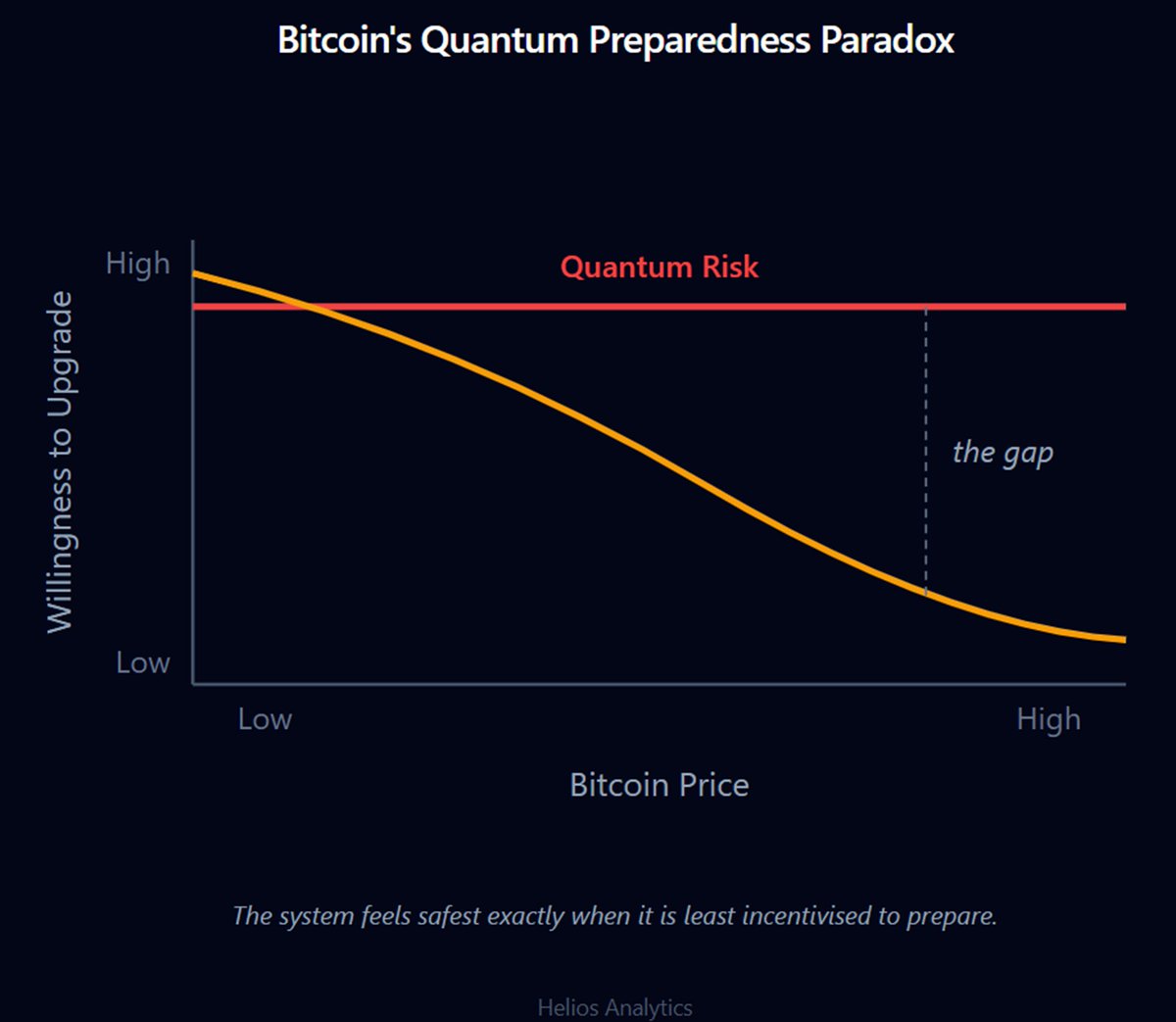
As Bitcoin’s price rises, confidence rises — and the willingness to push through disruptive, precautionary upgrades falls. The system feels safest exactly when it is least incentivised to prepare.
Quantum risk doesn’t move with price, but the gap does.
@RaoulGMI@batsoupyum It takes us back to the hard fork discussions; BTC not good enough as-is, only this time it's a probable requirement.
It's just that other chains have already solved this problem, BTC devs must act fast to not lose its position.
There's no absolute constant in technology.
The first ever post on Nexus using the Distordia standard template:
https://t.co/us722bsxh7)
Verified to be mine based on the fact that this Genesis ID (post's owner) is a Sigchain of mine: a164ce40f9522d2c436b17f9842a408508009780a594e1de3c7fca63ea3266aa
https://t.co/1vYrg4EMKg