Prof Rajeev Varshney FAA FRS (@MurdochUni)—a new Fellow of the Australian Academy of Science— is recognised for his work in genomics and molecular breeding has transformed global food security, enabling smallholder farmers to grow resilient, high-yield crops in harsh regions. Through initiatives like the Tropical Legumes Project, his genomics-assisted breeding has boosted nutrition and lifted millions out of poverty. Congratulations to this true champion for sustainable agriculture! #FellowsAA @rajvarshney
"Congratulations, Dr. Alagarasan, on securing a postdoctoral position in Prof. Rajeev K. Varshney FRS’s lab in Murdoch university. Wishing you all the best as you pursue your passion for science and turn your dreams into reality. Best wishes, dear Alagarasan!"
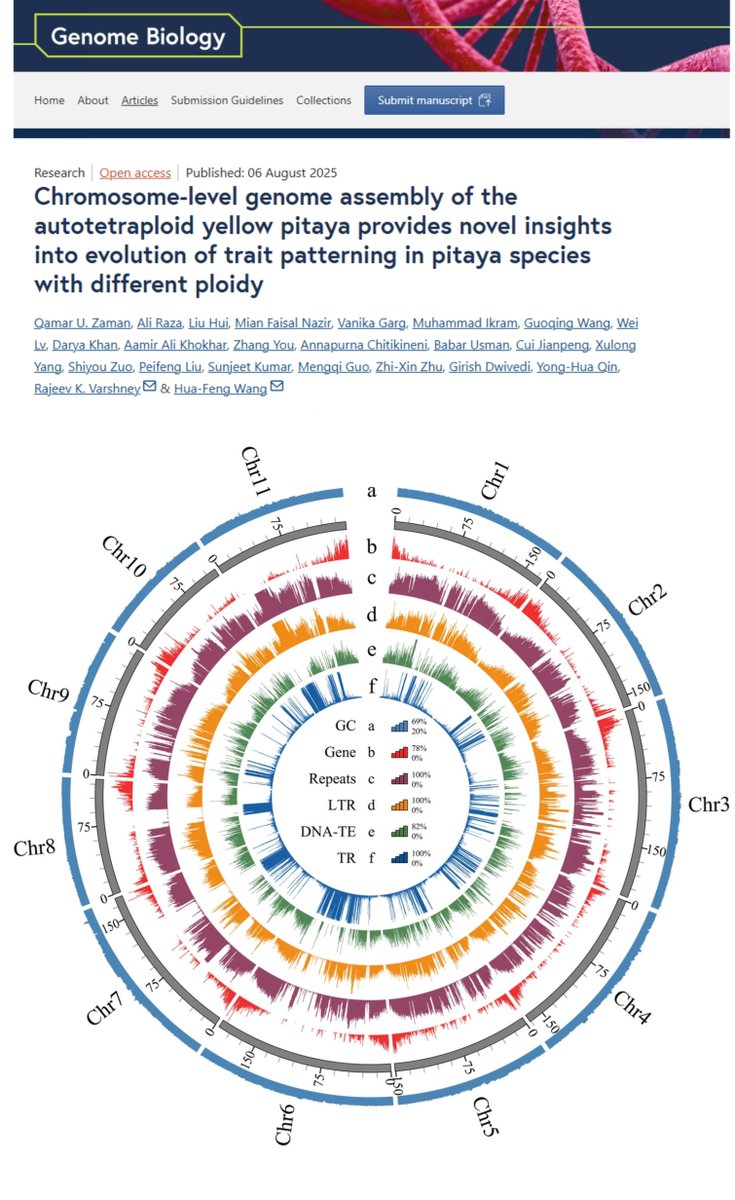
Ever wonder why dragon fruit comes in different colours? @MU_CCFI_Biotech has contributed to the development of a chromosome-level genome assembly for yellow pitaya (dragon fruit) that offers some likely answers!
In a paper published in @GenomeBiology, the international research team, consisting of scientists from Hainan University, Shenzhen University, the Chinese Academy of Sciences, Frasergen Bioinformatics, @uwanews and South China Agriculture University, used advanced sequencing technologies to create a high-quality genome assembly for yellow pitaya.
They found that yellow pitaya likely evolved from red pitaya and confirmed key structural variations between the species that help explain the two species’ phenotypic differences.
Importantly, this new resource will enable faster breeding of an important cash crop that has been severely hindered due to the lack of a reference genome.
Congratulations to all the co-authors, namely @Qamaruzaman1, @Ale_Raza6, Liu Hui, @MianFNazir, @GargVanika, Muhammad Ikram, Guoqing Wang, Wei Lv, Darya Khan, Aamir Ali Khokhar, Zhang You, @Anuchitikineni, Babar Usman, Cui Jianpeng, Xulong Yang, Shiyou Zuo, Peifeng Liu, Sunjeet Kumar, Mengqi Guo, Zhi-Xin Zhu, @cardiacimager, Yong-Hua Qin, @rajvarshney and Prof Hua-Feng Wang.
Read the paper here:
https://t.co/uloEmJrgH1
On Wednesday, we had the pleasure of welcoming members from @theGRDC's leadership team to @MurdochUni, where we discussed ongoing research activities, showcased our research facilities, and spoke about how we can best work together to enhance agricultural productivity in Australia.
Sincere thanks to GRDC Managing Director @nige_hart and Dr Juan Juttner, GRDC General Manager, Genetic Technologies, Biosecurity & Regulation, for making the trip, and for all your support of @MU_CCFI_Biotech over the years.
When research and industry get together and collaborate, Australian farmers win!
#AgResearch #Partnership #AustralianAgriculture #MurdochUniversity #GRDC
More detail on the impact that the @MU_CCFI_Biotech-led chickpea pangenome paper could have on Australia's chickpea industry has been published in a @MurdochUni press release:
“The Australian chickpea pangenome marks a significant step in safeguarding future production, as it enables us to accelerate the development of chickpea varieties tailored to each region. That could mean varieties that are more drought-resilient and acid soil-tolerant in Western Australia and nationally, and more resistant to diseases like Ascochyta Blight," explains CCFI Director @rajvarshney.
@theGRDC Senior Manager for Oilseeds and Pulses, Dr Francis Ogbonnaya, added that:
“This landmark GRDC investment in the development of an Australian chickpea pan-genome represents a major leap forward in our understanding of chickpea genetics that underpins Australia’s unique growing conditions"
@ChickpeaAus breeder @kbhobbo added that
“These findings fill in some much-needed knowledge gaps regarding the genetic makeup of Australian chickpea varieties, which will be essential for further improvement through identifying the genes responsible for yields, stress tolerance and disease resistance.”
Read the full press release here: https://t.co/yq7pRz0Ihb
Preprints from our talented student Alagarasan now on bioRxiv! His hard work and dedication in understanding and conceptualizing these studies are truly commendable. Check out his recent work https://t.co/InXpyzkZs4 https://t.co/vhXLAb7y9w https://t.co/XvtWiHDJ2L
High plasticity increases phenotype-environment mismatch leading to sub-optimal performance in underutilized crop species https://t.co/g2Fju1Nnjt #biorxiv_plants
I express my perspectives on integrating the spirit of philosophical inquiry into PhD training in the journal Nature. @IiserTirupati
https://t.co/PbdPyYS881