Former Buddhist monk, investigative journalist, author, performing artist, & human rights activist committed to freedom and ending totalitarianism, everywhere.
The Wisdom of Many Voices: How Myanmar’s Extraordinary Diversity May Teach Humanity the Democratic Art of Belonging, Listening, and Shared Liberation by Alan Clements https://t.co/WvROX6HG8S
READ on Alan's Substack, and if moved, please subscribe, offered freely as dana: https://t.co/YwGTv4DSLg?
“We may have different religions, different languages, different colored skin, but we all belong to one human race."
- Kofi Annan, 7th Secretary-General of the United Nations — Chair of the Advisory Commission on Rakhine State, Myanmar, established on August 23, 2016.
The Future We Must Dare to Imagine
Myanmar, Human Dignity, and Our Shared Humanity
ALSO PUBLISHED ON MIZZIMA MYANMAR NEWS https://t.co/oqVw3JPntu?
READ on Alan's Substack, and if moved, please subscribe, offered freely as dana: https://t.co/YwGTv4DSLg?
By Alan Clements
In recent months, I have spent time once again along the Thailand–Myanmar border, meeting internally displaced families, former political prisoners, democracy activists, ethnic leaders, humanitarian workers, and young people whose lives have been shaped by a conflict they did not choose. Many have lost homes, livelihoods, communities, and loved ones. Entire futures have been interrupted by war, military rule, and displacement. Yet what remains with me most is not the magnitude of their suffering. It is the remarkable persistence of their humanity.
Again and again, I encountered people who refused to allow fear, violence, or loss to become the defining fact of their lives. Former political prisoners spoke less about what had been done to them than about the country they still hoped to help build. Young activists spoke not only of resistance but of responsibility. Community leaders discussed not merely injustice but the difficult work of reconciliation that must eventually follow conflict. Standing along the border, listening to these stories, I found myself returning to a question that has accompanied me for nearly half a century: What kind of society allows every human being to live with dignity, security, freedom, and a genuine sense of belonging?
My relationship with Myanmar began long before the current crisis. In 1979, I entered Burma as a young Buddhist monk and spiritual seeker. Like many who first encounter the country, I was struck by the extraordinary generosity of its people. I encountered a culture deeply shaped by traditions of compassion, humility, and moral courage. At the same time, I found a society living beneath the shadow of authoritarian rule, where fear often existed alongside kindness and silence frequently accompanied wisdom.
What began as a spiritual journey gradually became something else. Over the decades, Myanmar became one of my greatest teachers. I watched students challenge military power at enormous personal risk. I witnessed monks walk peacefully into danger in defense of conscience and truth. I met journalists willing to endure imprisonment rather than abandon their commitment to honest reporting. I came to know democracy leaders, former political prisoners, ethnic representatives, and countless ordinary citizens whose courage often exceeded anything I had encountered elsewhere in the world.
Those experiences taught me that political freedom cannot be understood merely as the absence of oppression. A nation is not ultimately defined by what it rejects. It is defined by what it aspires to become. The removal of tyranny, however necessary, does not by itself create a democratic society. Democracy requires a deeper foundation. It requires a culture capable of recognizing the equal worth of every human being.
This principle lies at the heart of one of the most important documents of the modern era. The authors of the Universal Declaration of Human Rights, writing in the aftermath of catastrophic violence, affirmed that recognition of the inherent dignity and equal rights of all members of the human family forms the foundation of freedom, justice, and peace. Their insight remains profoundly relevant today. In a century increasingly marked by authoritarian resurgence, political polarization, mass displacement, and competing forms of exclusion, the question of human dignity remains central to the future of democratic life.
Myanmar's modern history illustrates both the urgency and difficulty of this challenge. The country's extraordinary diversity has always been one of its greatest strengths. Yet that same diversity has too often been manipulated, politicized, or weaponized. Ethnic, religious, and political differences have repeatedly become sources of division rather than opportunities for mutual enrichment. The result has been generations of conflict that continue to shape the country's present reality.
This is why I continue to reflect upon an important moment in Myanmar's recent history. On August 23, 2016, Daw Aung San Suu Kyi—the democratically elected State Counsellor of Myanmar, Nobel Peace Laureate, and today one of the world's most prominent imprisoned political leaders—invited former United Nations Secretary-General Kofi Annan to chair the Advisory Commission on Rakhine State. Whatever conclusions one may draw regarding subsequent events, the deeper significance of that initiative deserves careful consideration.
The Commission sought to address one of Myanmar's most difficult and emotionally charged challenges. At its core was an acknowledgment that no stable democratic future can emerge if significant populations remain excluded from the promise of belonging. Lasting peace cannot be sustained through permanent marginalization. Democracy cannot flourish where entire communities feel unseen, unheard, or unwanted.
Kofi Annan expressed this truth with characteristic simplicity when he observed that despite our different religions, languages, and appearances, we belong to one human race. His words speak not only to Myanmar but to a broader human dilemma. Across the world, societies are struggling with the question of whether diversity will be experienced as a threat or embraced as a source of strength. Increasingly, the health of democratic culture depends upon how that question is answered.
For Myanmar, the challenge extends far beyond the removal of military rule. The deeper task is the creation of a political and moral culture in which every citizen can participate fully in national life without fear of exclusion because of ethnicity, religion, language, geography, or political conviction. A democratic society worthy of the name cannot merely tolerate difference. It must create conditions in which difference can coexist within a shared framework of citizenship and mutual respect.
This is one reason why conversations about federal democracy remain so important. Federalism is often discussed primarily as a constitutional arrangement or political structure. Yet at its deepest level, it represents something more profound: a recognition that unity and diversity need not be opposing forces. A healthy federal democracy allows multiple identities to coexist within a larger civic framework. It permits people to remain fully Karen, Kachin, Shan, Chin, Mon, Rakhine, Rohingya, Bamar, Muslim, Buddhist, Christian, Hindu, or secular while also belonging to a common national community.
Such a vision demands more than political negotiation. It requires trust, imagination, patience, and a willingness to move beyond inherited fears. It requires institutions capable of serving all citizens fairly. It requires accountability without vengeance, justice without dehumanization, and memory without perpetual grievance. Most importantly, it requires a collective commitment to the idea that no community's dignity can be secured through the exclusion of another.
My years in Myanmar, first as a monk and later as a writer and advocate for democracy and human rights, have convinced me that political transformation and moral transformation are inseparable. Societies do not achieve lasting peace solely through legislation, elections, or constitutional reform. They achieve peace when citizens begin to see one another differently. The teachings of the Buddha frequently emphasize the dangers of ignorance, fear, and separation. Those insights are not confined to personal spiritual practice. They also offer valuable guidance for societies attempting to heal from division and conflict.
The future of Myanmar will undoubtedly be difficult. The wounds of history are deep. Distrust remains widespread. Millions continue to live with uncertainty, displacement, and trauma. No serious observer should underestimate the scale of the challenges ahead. Yet neither should we underestimate the resilience of the Burmese people.
History is often written through the actions of governments, armies, and political leaders. Yet during my recent travels along the border, I was reminded that history is also shaped by ordinary people who refuse to surrender their humanity under extraordinary circumstances. The individuals I met carried grief, uncertainty, and loss. They also carried determination, humor, generosity, and hope. They continued to educate children, care for neighbors, support families, and imagine futures larger than their present hardships.
As I left the border, I found myself thinking less about military strategies, political negotiations, and constitutional frameworks than about the faces of those I had met. Former prisoners. Displaced families. Young activists who have never known a day of genuine democratic freedom. Their circumstances differed, but they shared a common conviction that Myanmar could become more than the sum of its wounds.
After nearly five decades of walking in and out of Myanmar's story—first as a monk, later as a journalist and author, and now as an aging witness to another generation's struggle—I have come to believe that the country's future will not ultimately be determined by the ambitions of generals or the calculations of politicians. It will be determined by whether the people of Myanmar can build a society in which every citizen feels that they belong.
That remains the unfinished task of democracy. It is also the unfinished task of our common humanity.
Along the border, amid uncertainty and displacement, I met people who still dare to imagine such a future. Their courage may prove to be Myanmar's greatest resource. In a world increasingly divided by fear, exclusion, and distrust, their example offers a reminder that dignity, freedom, and belonging are not merely political aspirations. They are the foundations upon which every humane society must ultimately stand.
About the Author
Alan Clements is an author, former Buddhist monk ordained in Burma, and longtime human-rights advocate whose life's work has centered on conscience, nonviolence, and the struggle against authoritarian rule. He is the author of seventeen books, including Conversation with a Dictator, Unsilenced: Aung San Suu Kyi—Conversations from a Myanmar Prison, and Politics of the Heart: Nonviolence in an Age of Atrocity. For more than three decades he has worked closely with Burmese democracy leaders, former political prisoners, monks, and civil-society voices. His essays and interviews have appeared in international media across Asia, Europe, and the United States.
READ on Alan's Substack, and if moved, please subscribe, offered freely as dana: https://t.co/YwGTv4DSLg?
The Noble Friend and the Noble Leader: Sayadaw U Pandita’s Final Lesson for Myanmar, Aung San Suu Kyi’s 81st Birthday, and the Moral Urgency of Proof of Life
By Alan Clements
Read on Alans Substack: https://t.co/TTWB8VaWlJ
Read on the Mizzima Myanmar News website: https://t.co/YwwQHzz2to?
The Sound of a Silenced Voice: Aung San Suu Kyi still imprisoned at age 81
By Alan Clements
Read on DVB —Democratic Voice of Burma https://t.co/h7H1zfSqa4
Crossing the Myanmar border to visit an IDP Camp of Internally Displaced People 🙏
The River Between Worlds:Along Myanmar's Border, the Voices of the Displaced Ask Whether the World Still Knows How to Listen by Alan Clements
READ on Mizzima Myanmar News website: https://t.co/mh0S3YPRcr
From Fergus, Derek; She used “Rakhine Muslim”, never Bengali. …. Sadly my collection of speeches only goes up to 2015 as the file was lost. These are likely to be in Burmas Voices of Freedom as extracts. It shouldn’t be too hard to track them down, but who knows with the internet being what it is. I definitely did not encounter her use anything other than Rohingya or Rakhine Muslim. But the question of illegal immigration was so taboo it’s excluded from the record and reinterpreted as racism.
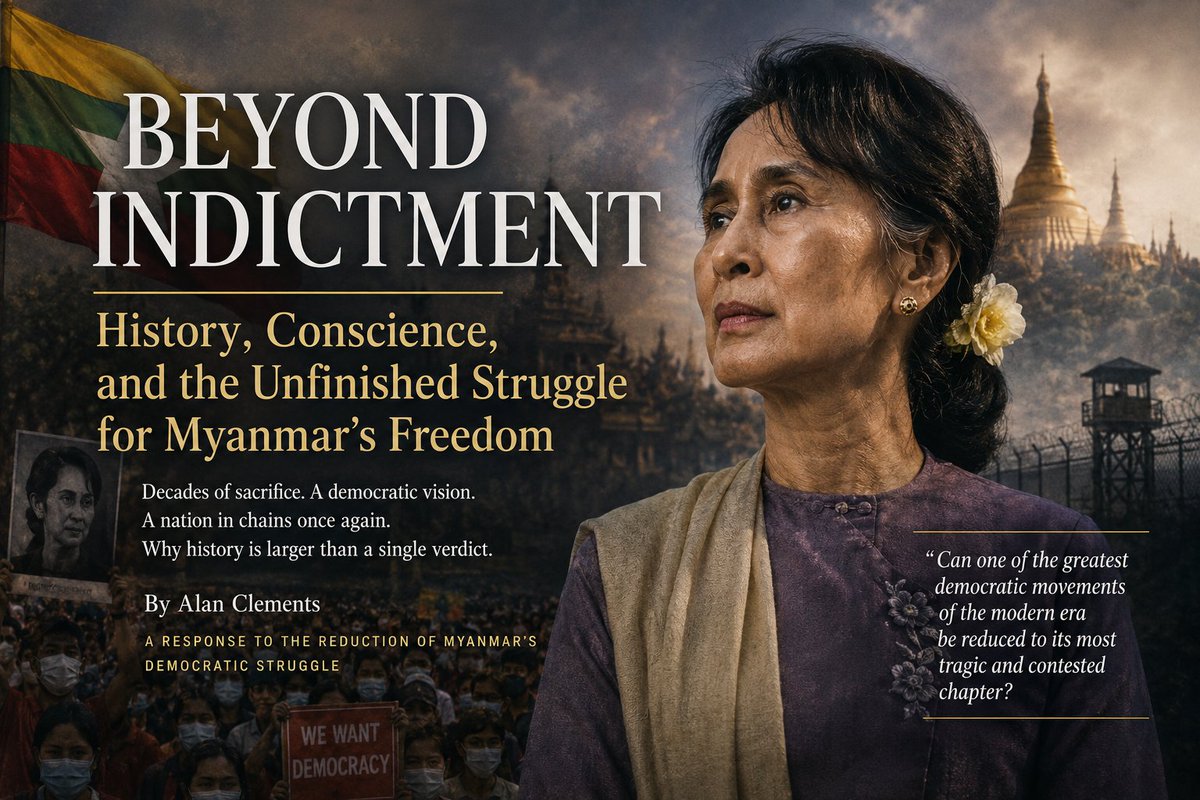
Beyond Indictment: History, Conscience, and the Unfinished Struggle for Myanmar's Freedom
By Alan Clements
READ on Alan Clements Substack https://t.co/BdO4zH3uuE
READ on the DVB—Democratic Voice of Burma website: https://t.co/n21idnqVtn
Or read below:
Beyond Indictment: History, Conscience, and the Unfinished Struggle for Myanmar's Freedom
By Alan Clements
My recent open appeal to United Nations Special Envoy Julie Bishop was animated by a simple humanitarian principle: no prisoner should disappear into the darkness of state secrecy. Whatever political disagreements one may have with Aung San Suu Kyi, whatever criticisms may be leveled against her decisions in office, and whatever conclusions history may ultimately draw about her legacy, there remains a fundamental obligation to demand proof that she is alive, medically cared for, and not being subjected to the enforced disappearance that Myanmar's military regime has inflicted upon countless others. The right to humane treatment does not depend upon political popularity. It does not depend upon ideological conformity. It does not depend upon whether a person is celebrated, controversial, admired, or condemned. It is a principle that either applies to all human beings or it means very little.
What struck me in the response to that appeal was not disagreement over the humanitarian request itself. Rather, it was the familiar insistence that any discussion of Aung San Suu Kyi must first pass through a predetermined moral tribunal. Before one may acknowledge her sacrifices, one must recite her failures. Before one may recognize her historical significance, one must accept a particular interpretation of her role in the Rohingya crisis. Before one may express concern for her imprisonment, one must agree that her place in history has already been settled.
This approach reflects a larger problem in the way Myanmar is increasingly discussed. One of the most remarkable democratic movements of the modern era is being reduced to a single chapter, a single controversy, and ultimately a single verdict. The extraordinary complexity of Myanmar's struggle against military dictatorship—its decades of sacrifice, courage, compromise, tragedy, and aspiration—is increasingly compressed into a prosecutorial narrative centered almost exclusively upon one issue and one individual.
The question is not whether difficult questions should be asked. They should. The question is whether history itself is being served when the entirety of a democratic struggle is interpreted through a framework so narrow that it obscures more than it reveals.
To understand why this matters, one must begin not in 2017, nor in Rakhine State, but decades earlier in a country subjected to one of the world's most enduring systems of military domination. For generations, Myanmar's armed forces governed through fear. Political opponents were imprisoned. Journalists were censored. Students were beaten, arrested, and killed. Ethnic communities endured repeated military campaigns. Torture, surveillance, intimidation, and arbitrary detention became familiar features of daily life. An entire population learned that the simple act of speaking honestly could carry devastating consequences.
Against this machinery of repression emerged a democratic movement whose achievements are too often forgotten amid contemporary debates. Monks marched unarmed into confrontation with soldiers. Students organized despite the certainty of arrest. Writers continued to speak despite censorship. Ordinary citizens repeatedly risked their freedom and, in many cases, their lives in pursuit of a future they might never personally enjoy. The struggle for democracy in Myanmar was never merely a political project. It was a profound moral undertaking sustained by extraordinary courage.
Aung San Suu Kyi became the most recognizable figure within this movement not because she possessed military power or controlled state institutions, but because millions of people came to see in her a rare convergence of personal sacrifice, political discipline, and moral conviction. Her years of house arrest were real. Her decision to remain in Myanmar while her husband was dying abroad was real. Her willingness to surrender personal freedom in service of a democratic vision was real. These experiences transformed her into a symbol not only for Myanmar but for people around the world who believed that nonviolent resistance could confront even the most entrenched forms of authoritarian power.
None of this means that she should be immune from criticism. It does mean, however, that criticism should be proportionate to historical reality. One of the most common errors in the interpretation of public figures is the temptation to allow a single chapter of a life to eclipse everything that came before it. Human beings are more complicated than that. Political movements are more complicated than that. History itself is more complicated than that.
The Rohingya crisis represents one of the most painful and tragic chapters in Myanmar's modern history. The suffering endured by Rohingya communities cannot be honestly denied or minimized. The destruction of villages, the displacement of hundreds of thousands of people, the trauma carried by families forced across borders, and the continuing uncertainty facing an entire population demand recognition, compassion, and serious reflection. Any discussion that fails to acknowledge these realities begins from a position of moral deficiency.
Yet acknowledging suffering does not require abandoning complexity. Indeed, genuine moral seriousness demands the opposite. It requires a willingness to confront difficult facts even when they complicate preferred narratives.
One of the striking features of many contemporary discussions of the Rohingya crisis is the tendency to begin the chronology only after violence had already erupted. Missing from many accounts is meaningful consideration of the role played by the Arakan Rohingya Salvation Army, or ARSA, an armed insurgent organization designated as a terrorist group by Myanmar authorities following coordinated attacks on police and military outposts in northern Rakhine State. In October 2016 and again in August 2017, ARSA launched simultaneous assaults against security installations, resulting in deaths among security personnel and contributing to an atmosphere of escalating instability in an already volatile region.
To acknowledge these attacks is not to justify atrocities. It is not to excuse abuses. It is not to diminish the suffering of civilians. Rather, it is to insist upon a principle essential to any honest historical inquiry: chronology matters. History did not begin with the military response. Nor did it begin when international headlines first appeared. Events unfolded within a context shaped by insurgency, communal tensions, competing nationalisms, decades of mistrust, military domination, and rapidly deteriorating security conditions. Any account that excludes these realities risks replacing history with advocacy.
For many people inside Myanmar, the ARSA attacks were perceived as a serious security crisis. Whether outside observers agreed with that perception is not the point. The perception existed, and it influenced public opinion, political discourse, and the broader environment within which decisions were made. History becomes distorted when chronology is selectively edited to support conclusions already reached in advance.
Equally troubling is the assumption that Myanmar's civilian leadership possessed powers, information, and freedom of action that it did not actually possess. Much contemporary commentary proceeds as though the civilian government and military establishment functioned as willing partners in a coherent political project. Such interpretations bear little resemblance to the realities of Myanmar's constitutional structure or political history.
The military that imprisoned Aung San Suu Kyi following the coup of 2021 was the same military that had imprisoned her for years. It was the same military that had repeatedly targeted democracy activists, suppressed dissent, censored journalists, and sought to weaken the movement she represented. The relationship between Myanmar's democratic forces and the military was not one of harmony or collaboration. It was defined by decades of hostility, mistrust, and structural conflict.
Myanmar's democratic transition was never a transition in the conventional sense. It was a fragile political experiment conducted within a constitutional framework deliberately designed to preserve military influence. The armed forces retained control over key ministries, controlled the security apparatus, maintained extensive economic interests, and remained, in many respects, a state within a state. This reality does not erase questions of accountability, nor does it absolve civilian leaders of responsibility for decisions made during their time in office. It does, however, complicate simplistic narratives that imagine civilian authorities exercising unrestricted power over institutions they did not control.
The same tendency toward simplification appears in discussions of Aung San Suu Kyi's appearance before the International Court of Justice in The Hague. For some observers, this event functions as the definitive moral verdict upon her life. The argument is straightforward: she appeared before the court, defended Myanmar's position, and therefore her historical legacy is permanently settled.
Such certainty may be emotionally satisfying, but history rarely rewards certainty.
Many people within Myanmar understood her appearance at The Hague differently. They saw a national leader attempting to defend her country from complete international isolation while preserving an already fragile democratic opening. They saw a politician navigating tensions between domestic realities and international expectations under circumstances that offered no easy choices. They saw the daughter of Aung San, the founder of modern Myanmar and the architect of the country's military, attempting to hold together a nation whose democratic transition remained deeply precarious.
One may disagree with her judgment. One may conclude that she made serious mistakes. One may believe she should have acted differently. These are legitimate positions within a democratic conversation. What is not legitimate is the assumption that disagreement automatically resolves every historical question. The Hague remains a subject of debate precisely because reasonable people continue to interpret its meaning differently.
Lost amid these arguments is a deeper truth about Aung San Suu Kyi's political vision. Her life's work was never based upon the destruction of the military. It was based upon the belief that Myanmar's future required transformation rather than annihilation, dialogue rather than permanent warfare, and reconciliation rather than vengeance. Whether one believes this vision was realistic is open to debate. What cannot honestly be denied is that it represented the philosophical foundation of her political project from the beginning.
This commitment to reconciliation is often misunderstood by observers who view politics primarily through the lens of power. Yet the democratic movement in Myanmar was never simply a struggle to replace one ruling class with another. At its best, it represented an attempt to create a political culture capable of transcending the cycles of violence that had scarred the nation for generations. That aspiration may have been imperfectly realized. It may even have failed. But failure does not erase the significance of the aspiration itself.
What is particularly striking in contemporary discussions is how little attention is devoted to what followed the collapse of Myanmar's democratic experiment. The military seized power. Thousands were killed. Millions were displaced. Entire communities were devastated. Democracy itself was decapitated. The very institution that democratic reformers spent decades attempting to transform revealed once again its enduring contempt for civilian rule.
Yet even after witnessing this catastrophe, some commentators remain determined to devote their greatest energies not to understanding the destruction of democracy, but to reducing the democratic movement itself to its imperfections.
This raises a larger question. Can one of the most consequential democratic movements of the modern era be understood primarily through its most tragic and contested chapter? Can decades of sacrifice, imprisonment, resistance, and aspiration be compressed into a single moral verdict? Can a life devoted to confronting dictatorship be reduced to one interpretation of one period of governance under extraordinarily constrained circumstances?
These questions matter because they concern more than Aung San Suu Kyi. They concern how history remembers struggles for freedom. They concern whether complexity is permitted to survive ideological polarization. They concern whether future generations will encounter the story of Myanmar's democratic movement in its full human richness or merely as a simplified morality play.
History's most consequential figures are rarely saints. They are rarely villains. More often, they are human beings attempting to navigate circumstances larger than themselves while carrying burdens that later observers can only partially understand. Aung San Suu Kyi belongs to this category. Her story is neither one of perfection nor one of moral collapse. It is the story of a woman who inspired millions to believe in democratic possibility, who confronted one of the world's most entrenched dictatorships, who sought reconciliation in a deeply divided nation, and who became entangled in one of the most painful and contested chapters of her country's history.
To reduce such a life to a single accusation is not an act of moral clarity. It is an act of historical impoverishment. And it is precisely because the suffering of the Rohingya was real, because the brutality of military rule remains real, and because the struggle for Myanmar's freedom remains unfinished, that we owe ourselves something more demanding than simplification. We owe ourselves the discipline of complexity, the humility to acknowledge uncertainty where uncertainty exists, and the wisdom to recognize that history is not served by reducing human lives to indictments. It is served by the far more difficult task of understanding them in full.
About the Author
Alan Clements is an author, former Buddhist monk ordained in Burma, and longtime human-rights advocate whose life’s work has centered on conscience, nonviolence, and the struggle against authoritarian rule. He is the author of seventeen books, including Conversation with a Dictator, Unsilenced: Aung San Suu Kyi—Conversations from a Myanmar Prison, and Politics of the Heart: Nonviolence in an Age of Atrocity. For more than three decades he has worked closely with Burmese democracy leaders, former political prisoners, monks, and civil-society voices. His essays and interviews have appeared in international media across Asia, Europe, and the United States.
A letter to UN Special Envoy Julie Bishop during her visit to Myanmar
READ on Alan Clements Substack https://t.co/xCIwQYrPag...
READ on the DVBL Democratic Voice of Burma website: https://t.co/TQ0cb5tJih
Or read below:
Dear Ms. Bishop,
Warm greetings. You are preparing once again to enter Myanmar—your fourth visit as the United Nations Special Envoy to a country shattered by military terror and yet still illuminated by the extraordinary courage and resilience of its people. Few diplomatic journeys in recent memory carry such moral gravity. Fewer still arrive at a moment when the distinction between legitimacy and criminality has become so psychologically inverted that violence now dresses itself in the language of governance, propaganda impersonates truth, and authoritarian rule presents itself to the world clothed in the ceremonial vocabulary of diplomacy and statecraft.
Allow me, with humility and urgency, to speak to you not as a strategist, analyst, or political commentator, but as someone whose life has been profoundly and irrevocably shaped by Burma’s revolution of conscience.
I first entered Burma in the late 1970s as one of the earliest Westerners—and among the first Americans—to ordain as a Buddhist monk there. Though I remained only several years, those years altered the architecture of my inner life forever. Burma ceased being merely a country to me. It entered my bloodstream. It became a spiritual homeland; a civilization of extraordinary philosophical subtlety, contemplative intelligence, humor, tenderness, ethical discipline, and moral beauty.
Even now, decades later, the cadence of Burmese speech, the silence of monastery corridors before dawn, the sound of chanting moving through darkness, and the dignity of barefoot monks walking silently beneath monsoon skies continue to inhabit my nervous system like memory itself.
Long before the current catastrophe unfolded, I came to know the Burmese people as among the most psychologically resilient and spiritually courageous human beings on earth.
Years later, following Daw Aung San Suu Kyi’s first release from house arrest in 1995, I was blessed to spend months in clandestine conversation with her inside her home on University Avenue under conditions of military surveillance. Those dialogues became The Voice of Hope, a work she and her late husband Michael Aris helped bring into existence. Since then, together with my longtime colleague Fergus Harlow, I have co-authored volumes documenting Burma’s democratic struggle through oral histories of political prisoners, Buddhist monks, ethnic leaders, artists, resistance fighters, exiles, survivors of torture, and ordinary citizens whose moral courage emerged under conditions that would have psychologically destroyed most human beings.
I say this not to establish credentials, but to communicate something simple and essential: Myanmar is not an abstraction to many of us. It is not merely a geopolitical crisis, a policy dilemma, or a regional instability to be analyzed safely from afar. It is family. It is memory. It is love. It is the face of friends who disappeared into prisons. It is the quiet dignity of former political prisoners emerging from interrogation chambers psychologically fractured yet morally unbroken. It is the voice of monks reciting the Metta Sutta beneath military surveillance. It is the grief of mothers identifying the bodies of children killed by aerial bombardment. For many of us, Burma became not merely a place we once visited, but part of the architecture of our conscience itself.
And today that civilization is being held hostage.
The military coup of February 2021 did not merely overthrow an elected government. It attempted to annihilate the moral imagination of an entire people. Democratically elected leaders were disappeared overnight. Some were executed. Others tortured. Thousands remain imprisoned. Entire villages have been burned to ash. Children bombed from the sky. Monasteries shelled. Journalists hunted. Teachers incarcerated. Humanitarian workers criminalized. Doctors punished for healing the wounded. More than twenty thousand political prisoners languish in cells designed not simply for confinement, but for the systematic erosion of human dignity itself.
This is not governance in any meaningful democratic or moral sense of the word. It is organized psychological terror masquerading as statecraft — a machinery of domination designed not merely to control populations, but to deform reality itself until fear becomes normalized, silence becomes survival, and moral exhaustion gradually begins masquerading as peace.
Imagine, for a moment, if the Australian military arrested every elected leader in Canberra following a democratic election, imprisoned them without transparency, bombed civilians resisting the coup, silenced journalists, and demanded international recognition while calling itself a government. No serious democratic society would entertain such theater for a single day. Yet somehow Myanmar’s generals continue seeking legitimacy beneath the ceremonial language of diplomacy while ruling through fear, torture, surveillance, disappearance, and execution.
Perhaps this is among the most dangerous features of modern authoritarianism itself: not merely its violence, but its capacity to force reality into a condition where obvious criminality must endlessly pretend to be debatable.
You are entering that theater now, Ms. Bishop, and because you are entering it, your presence carries immense symbolic consequence.
I do not envy your position. Diplomacy often requires walking through morally contaminated spaces while preserving the possibility of dialogue. Yet there are moments in history when diplomacy must become more than procedural engagement and institutional ritual. There are moments when diplomacy must recover its ethical soul. This, I believe, is such a moment.
At the center of this crisis stands one woman whose disappearance from meaningful public visibility has itself become an indictment of the international order: Daw Aung San Suu Kyi.
I say this not because she is perfect. No serious historical figure is. Nor do I say it because she should exist beyond criticism. No democratic society can survive if individuals become immune from scrutiny or moral examination. History will continue debating aspects of her leadership and political choices for many years to come. Yet something profoundly dangerous occurs when a woman who once stood among the most recognizable political prisoners on earth can effectively vanish into state secrecy while much of the democratic world gradually acclimates itself to the silence surrounding her condition and whereabouts.
That silence is not neutral.
Silence alters moral reality.
The world does not know where she truly is. We do not know her physical condition. We do not know whether she is healthy, isolated, denied medical care, psychologically tortured, or even alive in any meaningful public sense. Carefully managed fragments appear and disappear. Rumors circulate endlessly. Officials reference private encounters that cannot be independently verified. Yet there has been no genuine proof of life sufficient for her family, for the people of Myanmar, or for the democratic conscience of the world.
Her son, Kim Aris, has pleaded publicly and repeatedly for evidence that his mother is alive and well. This is not an unreasonable request. It is the bare minimum owed to humanity.
Ms. Bishop, I implore you to insist upon meeting Daw Aung San Suu Kyi directly—not symbolically, not through intermediaries, and not through carefully curated talking points delivered by officials invested in preserving opacity. Meet her face-to-face. Speak with her privately if possible. Allow the world to witness her humanity, her consciousness, her condition, and her words.
And if the regime refuses, then let that refusal itself become the truth the world finally hears.
If Senior General Min Aung Hlaing denies you access, he will reveal more through that denial than through a thousand orchestrated press briefings. He will expose the terror beneath the performance. He will confirm what millions already suspect: authoritarian power does not ultimately fear armies nearly as much as it fears uncontrollable moral visibility—the moment when the spectacle collapses and the world suddenly sees, without euphemism or mediation, what is actually being done in its name.
There are moments in history when a single principled act by an international envoy can alter the psychic terrain of an entire crisis. This may be one of those moments.
I ask you also to remember the deeper Myanmar beyond the junta’s machinery of violence. Burma is not reducible to generals, propaganda, prisons, or war. It is one of the great civilizational crossroads of Asia—a country of profound Buddhist scholarship and contemplative practice, but also of mosques, churches, temples, synagogues, poetry, music, intellectual refinement, ethnic plurality, and astonishing cultural sophistication. Before colonial rupture and military domination, Burma possessed one of the most vibrant pluralistic societies in the region, home to well over one hundred ethnic identities, languages, and living traditions.
The tragedy unfolding there is therefore not merely political. It is civilizational. A vast and intricate cultural inheritance—contemplative, artistic, philosophical, democratic, and spiritual—is being slowly suffocated beneath militarized fear, extractive greed, propaganda, and engineered psychological exhaustion. And when civilizations collapse, they rarely disappear all at once. More often they die through fragmentation of memory, normalization of fear, and the gradual erosion of a people’s confidence that truth itself still matters.
You, Ms. Bishop, are also entering this crisis as a woman speaking to another woman whose moral endurance altered the democratic imagination of the twentieth century. Whatever one’s political disagreements with Daw Aung San Suu Kyi over the years, no serious observer can deny the magnitude of her sacrifice, discipline, courage, or symbolic importance to millions of Burmese people.
And so I ask you not merely as an envoy, but as one human being entering the suffering of another—to show up fully for your sister in conscience; to show up for the imprisoned, for the disappeared, for the terrified children sleeping tonight beneath the sound of military aircraft, for the political prisoners who have not touched sunlight in years, and for those whose names no longer circulate internationally because atrocity, repeated long enough, risks becoming background noise to the world.
And please, if your conscience permits it, speak with uncompromising clarity to Senior General Min Aung Hlaing and those surrounding him. Tell them what history already knows: legitimacy cannot be manufactured through uniforms exchanged for civilian jackets, staged elections, choreographed diplomacy, or carefully managed performances of political normalcy. Legitimacy belongs to the people of Myanmar alone.
The path toward genuine international recognition is neither complicated nor mysterious. Release the political prisoners. Restore democratic leadership. End the aerial bombardments. Allow humanitarian access. Stop the torture. Stop the disappearances. Return the country to its people.
History is watching your visit closely, Ms. Bishop. More importantly, so are millions of frightened, displaced, imprisoned, and grieving Burmese people who possess little left except the fragile hope that somewhere, somehow, someone still recognizes their humanity.
After the devastation of the Second World War, Eleanor Roosevelt helped midwife the Universal Declaration of Human Rights into existence from the ashes of civilizational catastrophe. At its core stood a proposition both simple and revolutionary: that human dignity is inherent, indivisible, and universal—not conditional, not strategic, and not negotiable.
Human dignity either lives everywhere, or it begins dying everywhere.
And perhaps that is what Myanmar now represents to the modern world: not merely a distant political crisis, but a mirror held before the conscience of humanity itself. A mirror asking whether modern civilization still possesses the moral imagination necessary to recognize suffering before it becomes normalized beyond recognition; whether diplomacy still remembers the difference between engagement and accommodation; whether conscience itself still carries force in an age increasingly organized around spectacle, strategic ambiguity, algorithmic distraction, exhaustion, and fear.
History will not remember this era primarily for the elegance of official statements or the choreography of diplomatic theater. It will remember whether human beings, when confronted with organized cruelty, retained the courage to see clearly and speak truthfully anyway.
From my heart to yours, I ask you to carry that clarity into Myanmar.
The people of Burma deserve to be seen.
And the world deserves proof that conscience has not yet disappeared from history.
Respectfully,
Alan Clements
About the Author
Alan Clements is an author, former Buddhist monk ordained in Burma, and longtime human-rights advocate whose life’s work has centered on conscience, nonviolence, and the struggle against authoritarian rule. He is the author of seventeen books, including Conversation with a Dictator, Unsilenced: Aung San Suu Kyi—Conversations from a Myanmar Prison, and Politics of the Heart: Nonviolence in an Age of Atrocity. For more than three decades he has worked closely with Burmese democracy leaders, former political prisoners, monks, and civil-society voices. His essays and interviews have appeared in international media across Asia, Europe, and the United States.
A Final Word—The Witch Burning of Aung San Suu Kyi: Burma, Empire, Propaganda, and the Collapse of Moral Complexity in the Digital Age
by Alan Clements
Read on Substack
https://t.co/9jqmbRqqYH
WOMEN STAND AGAINST ISLAM!
Croatia has stormed the Eurovision final with a historic anthem that denounces the Ottoman occupation and revives the ancient Christian tattoo tradition to protect young girls from rape!
Performed entirely in Croatian, the song slams centuries of Islamic Turkish occupation of their lands and recalls how Catholic girls were tattooed with Christian motifs to stop them from being abducted, converted to Islam, and forced into sexual slavery!
"That’s why many chose the grave, our mothers did not birth slaves”
Muslim Turkey is already attacking the group for performing the song
Source: Jack Posobeic