Discrimination can persist as organizational trap: tackling it requires shifting beliefs across the hierarchy by trialing minority candidates. This is costly, so bias survives in firms, and standard tests fail as coworker bias depresses their performance.
https://t.co/uZsK3AO1hT
When drafting your job-market paper, remember to tell us what you do.
Bob Lucas started his papers with "This paper…". Not to start out by saying something like, "The 1990s have witnessed…" Get that "have witnessed" crap out of here. https://t.co/bbNNHEcO75
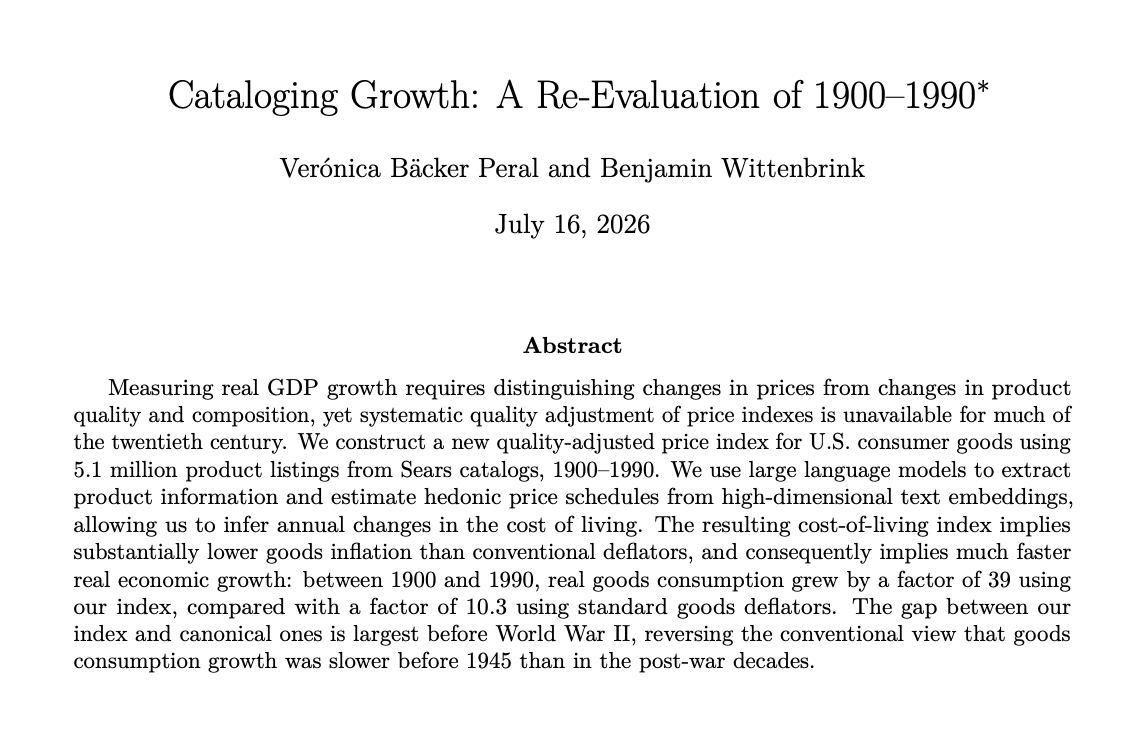
Excited to share our new working paper: how much did the US standard of living really rise over the twentieth century — and when? With @bhwittenbrink
Using 5.1 million Sears catalog listings, we build a quality-adjusted price index for consumer goods, 1900–1990. Two headline findings: growth was much larger than official statistics imply, and its peak came before WWII, not after. (1/9)
Surprised no one in the RCT vs development macro wars has mentioned yet a critical paper for both literatures: the Bloom @bennpeifert Mahajan McKenzie Roberts QJE showing management matters for firm productivity
Online higher education expanded access in Brazil—and made the country poorer. Total enrollment would fall 14% without online programs, but aggregate labor market value added declines 1.4% with them. How can more education be worse?
In response to Jesus Fernandez Villaverde. Fun discussion.
Yes, preferences are not given by God.
Learning how to appreciate food, taking the time to eat, sitting together at the dinner table, is definitely building consumption/leisure capital a la Becker-Murphy. The French do it from age zero, the Americans not so much. And, (my biased but experience based view) good food is one of the daily pleasures of life.
Institutions matter: That everybody takes August off makes for much easier coordination, and spending time with friends. The tax rate on labor income and not on leisure surely affects choices, although the argument that high taxes in the past is what explains current French behavior is not terribly convincing.
Institutions mostly reflect preferences but can go off the rail. I indeed think that going to 35 hours without reducing the wage, was a mistake in allowing people to think there was no trade off between income and leisure. It has proven costly. Labor regulations lead too many workers to involuntary retire too early.
Social norms matter. In France, dinners in Paris used to be very late. The idea is that, if you came back from the office before 8pm, you were clearly a nobody.
Events matter: Covid has led to substantial and apparently hysteretic changes in going to restaurants, seeing friends.
But the bottom line remains. The French are not lazy. For many reasons, some good, some bad, most are happy to work less and earn less. And it should not be seen as a sin, or as a crippling economic problem. France has problems. This is not the main one.
Olivier Blanchard (@ojblanchard1) had a provocative post yesterday about a higher preference of French people for leisure:
https://t.co/d8eSlXs6Y0
I have learned nearly an infinite amount of economics from Olivier since I was an undergrad, and he came to Spain to present a report on our unemployment problem, so I feel a bit intimidated about pushing back on this idea.
I am perfectly happy with the idea that preferences are heterogeneous: some people like leisure more than others. And the goal of economic policy should never be to maximize output, but to maximize welfare. If most people in France enjoy sitting in the beautiful sun of Provence while productivity increases, who am I to question their wisdom?
But perhaps one of the aspects of economics that I have always felt uneasy about is how little effort we have put into exploring the extent to which preferences are endogenous.
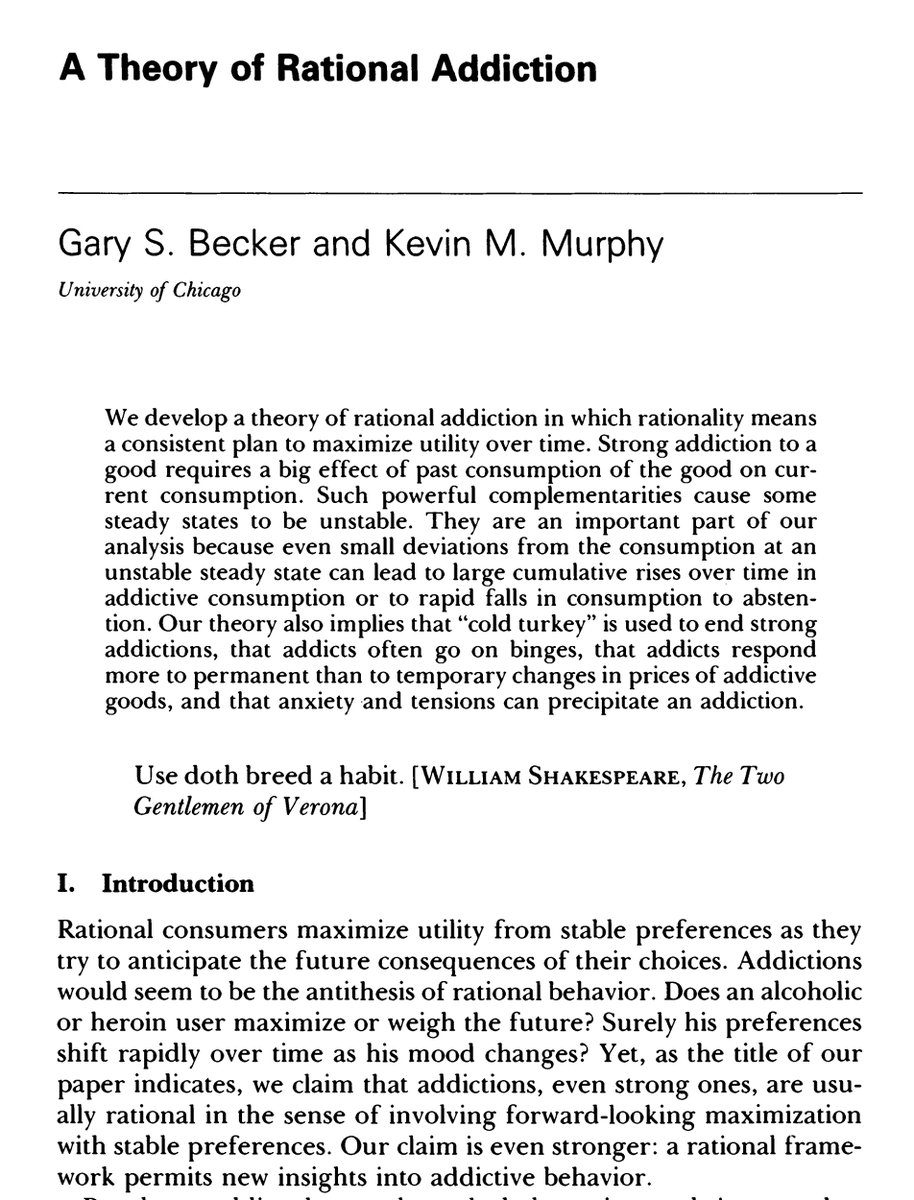
Let me borrow from an old idea of Gary Becker and Kevin M. Murphy (1988) in their classic “A Theory of Rational Addiction,” a beautiful piece of work all students of economics should read.
Becker and Murphy consider a model with two consumption goods: one that requires “consumption capital” to be enjoyed and one that does not. Think about fine wine: it takes some time and experience to truly enjoy a good bottle. In comparison, every kid enjoys candy on first taste, no experience required (nor much is gained from repeated tastings).
How much an agent invests in “consumption capital” determines whether increases in consumption of the first good in the past will lead to higher consumption of that good in the future. Many leisure activities belong to the former group, not the latter: going to the Opera, appreciating fine food, discovering the charming streets of a world-class city, ...
Based on that observation, let me extend Becker and Murphy’s framework to the work-leisure choice by introducing the notion of “leisure capital.”
Imagine a situation where, in France, taxes on labor income were high (or, equivalently, wages were lower than they should have been because of misallocation). This made leisure activities preferable in the past because their relative price was low (let’s assume the income effect was small), leading to an increase in the “leisure capital” of the French today and, therefore, in how French society takes advantage of increases in productivity.
Now, one could argue that this reasoning is a hyper-sophisticated form of rationality that does not resemble reality. But I have seen this phenomenon at a micro level: very rich people who made their own fortunes are often not very good at enjoying leisure, but their kids are extremely good at it, because they accumulated plenty of “leisure capital” when they were young.
More seriously, other observers of society would have found the reasoning natural, because there is a long tradition of analyzing labor supply decisions as embedded in social relations.
Let us start with Karl Marx. In historical materialism, consciousness follows the forces of production. When the forces of production generate a lower labor supply (for whatever reason), consciousness will follow through the multiple channels of the superstructure, starting with the creations of the culture industry that favor leisure. Having delightful bistros is an epiphenomenon of a deeper structure of relations of production.
In the opposite direction, E.P. Thompson, also from a Marxist perspective (though less orthodox), emphasized that the factory system required clock-based discipline and, therefore, that within a generation or two of the Industrial Revolution, punctuality became a cardinal virtue. Just reverse E.P. Thompson’s analysis.
And Émile Durkheim, with his view of how social facts shape the division of labor in society, might have agreed as well. For Durkheim, social facts are “every way of acting which is general throughout a given society, while at the same time existing in its own right, independent of its individual manifestations.” In this perspective, the French have absorbed a particular relationship to work through decades of participation in French economic life, which is not divorced from taxes and regulations.
Of course, one could reply that it might be the preferences for leisure that are behind higher taxes and regulations. For example, you can use regulations to move to a better coordination equilibrium: you do not want to take vacations if your spouse at another firm cannot take a vacation at the same time. This is what Max Weber would have called an elective affinity (Wahlverwandtschaft) of leisure and taxes. But that reply only reinforces my point that we probably want to think about preferences and economic policy as a simultaneous system, more than one driving the other.
The practical implication is that policy reforms may have effects far beyond what an analysis that takes preferences as given would suggest. If decades of high taxes built up “leisure capital” in France (which fits perfectly with Olivier’s observation that the French are better at leisure), lowering taxes tomorrow will not instantly undo that accumulation. Preferences have their own inertia. But by the same token, sustained policy changes can, over time, reshape what people want, not just what they can afford.
The real problem with all this reasoning, though, is that it makes welfare analysis a nightmare! I will leave that task to someone smarter than me.
Econ seminar culture is built on the assumption that the audience knows something that the speaker doesn't, and that the speaker values that information.
A very important thing the audience knows and the speaker doesn't: Is the speaker making any sense at all?
If nobody has any idea what you are saying, it's very helpful to be interrupted on slide 3. If you leave confusion for too long, you will lose your audience entirely.
To publish a paper / nail a presentation, you need to nail the elevator pitch perfectly. In a paper, this is the introduction, in a presentation it's the preview. If you get 50 questions in your paper preview, it's often a signal that you have work to do. It's a sign you're at risk of losing the reader in your introduction, it's not good.
If someone asks "are you going to address endogeneity?" Don't roll your eyes because it's coming on slide 12. The feedback is: "It's very hard to interpret the things you are saying without clarity on how you are thinking about endogeneity."
It's normal that junior presenters should face more questions. They have less presenting experience and the audience knows more relative to them as compared with a senior talk. (Though often juniors have better presenting skills)
After a presentation where I get bogged down at the beginning, I ask myself what were the key stumbling points, how can I make things tighter the next time.
Of course, the audience also has a responsibility to keep their interruptions value-adding. A good audience member assesses whether their interruption will add to the whole group's understanding more than remaining silent.
Some audience members are bad at this and waste others' time, and seminar organizers need strategies to prevent these people from being destructive. But in most econ seminar settings, policies that reduce interruptions on average (without discriminating low- vs. high-quality interruptions) are throwing out the baby with the bathwater.
Questions and interruptions are good. They keep everyone engaged and on their toes. They result in better understanding for everyone. The good econ seminars are the best seminars in the social sciences, and the good overwhelmingly outnumber the bad.
Let me explain why I believe modern economics is such a powerful tool for understanding the world. I’ll do this by discussing a great paper by Simone Cerreia-Vioglio, @UncertainLars, Fabio Maccheroni, and Massimo Marinacci, “Making Decisions Under Model Misspecification,” published in the Review of Economic Studies a few months ago.
Imagine I want to drive from UC San Diego to UCLA, but I’ve never driven that route before. I need to build a “model of the world” to guide me, which we usually call a map. Maps are simplified representations of reality. They can’t include every detail if they’re to be useful. Borges, in his short story On Exactitude in Science, makes this point beautifully. (In practice, I don’t draw the map myself—I use an app—but someone still had to make it.)
Because maps simplify, I can’t fully rely on them. Maybe last night’s storm knocked down a tree and closed a street, or there’s construction and the ramp off the highway in LA is shut down.
This uncertainty matters. Suppose I’m driving to UCLA for an important talk at 11 a.m. If the ramp is closed, I might need 15 extra minutes. When should I set my alarm to arrive on time, while still getting enough sleep to give a good talk?
The problem is that I can’t assign precise probabilities to all these contingencies. How likely is the fallen tree? Or new roadwork? Even the best traffic apps can’t capture every disruption, and some might happen after I’ve already left.
In economic terms, my “model of the world” (the map) is misspecified—and no matter how hard I try, I can’t fully fix that.
But sitting down and crying about misspecification doesn’t answer my basic question: when do I set the alarm? Too early, and I’m exhausted. Too late, and I’m late.
Simone and his co-authors offer a way to think about this. They start from the idea that we often hold several structured models of an economic phenomenon, grounded in theory. For example, a central bank might use a standard New Keynesian model and a search-and-matching model of money.
Yet, aware that each model is misspecified by design, the bank adds a protective belt of unstructured models—statistical constructs that help it gauge the consequences of misspecification.
The beauty of the paper is that it provides an axiomatic foundation for this protective belt (and even generalizes it to include a Bayesian approach). It shows that if a decision-maker’s preferences meet certain conditions —reflecting both rational and behavioral features— then those preferences can be represented by an augmented utility function that formally accounts for misspecification.
Crucially, we don’t assume that augmented utility function; we derive it. We start with general, plausible properties of preferences and prove that they imply such a representation.
That’s real progress. Instead of writing endless critiques of expected utility or rational expectations (as many have done for decades, with little to show), we now have a formal way to reason about misspecification—precise definitions, clear boundaries of validity, and awareness of what we still don’t know.
Take, for instance, a brilliant Penn graduate student on the market, Alfonso Maselli
https://t.co/rl2gu95V7t
His job-market paper pushes this frontier further. He studies cases where a decision-maker not only faces model misspecification but is also unsure which model best fits the data and can’t assign probabilities to them—what we call model ambiguity. In my example, the central bank is unsure whether the New Keynesian or the search-and-matching model fits better, and it worries that both might be incorrect.
If you read Simone et al. or Alfonso’s paper, you’ll see how misguided—and, frankly, cartoonish—many of the recent criticisms of economics on X have been.
First: the idea that economists don’t understand math or have “physics envy.” The math in these papers is subtle and advanced—utterly different from what physicists do (neither better nor worse, just distinct). An engineer transitioning into economics would find these tools unfamiliar.
Second: claims of ideological bias are unfounded. I have no idea about the political views of the authors, and I’d be surprised if anyone could infer them from the analysis—beyond vague guesses about typical academics.
Third: This has almost nothing to do with what one learns as an undergraduate, or even in first-year graduate school. If your knowledge of economics stops at an intro textbook, it’s best not to pontificate on the field’s frontiers.
Fourth: Is this science? Debating that word’s boundaries is pointless; every definition of “science” breaks down somewhere.
The Germans solved this long ago with the idea of Wissenschaft—the systematic pursuit of knowledge, whether of nature, society, or the humanities. By that measure, modern mainstream economics is clearly a Wissenschaft: a disciplined, cumulative, and highly useful effort to understand how the world works. Simone and his co-authors have demonstrated that beyond any reasonable doubt.
@_AlexanderBusch That's crazy: in the econ department at my uni, first-ranked usually has an average of 8-8.5 - meaning that virtually everyone applying will have a GPA of 3.0 for UMich