this is pure f*cking treasure
Netflix engineers posted 20 GitHub repos that turn your Opus 5.5 into a f*cking motion empire:
built for Opus 5.5
1. claude-motion: taste, checks its own frames, sound written in code. the author built it for Opus 5.5
https://t.co/TtBtU2nVrN
2. claude-motion-design: HTML, Playwright and ffmpeg, no Remotion. the demo was made on Opus 5.5
https://t.co/iOsyrWUvKE
3. motion-graphics-skills: 13 skills for launch videos. the README tells you to run it on Opus 5.5
https://t.co/yNZhCZO8wT
4. claude-remotion-skill: a Remotion editor from one prompt. captions, B-roll, sound
https://t.co/immhzwVP5i
5. klik-anim-skill-creation: the laws of animation and camera, built on Opus
https://t.co/XWqUnn4v7o
6. hyperframes-motion-reel-skill: a showreel cut to the beat at 120 BPM, on HyperFrames
https://t.co/E96s10io4Q
7. product-launch-motion: a full launch film. voice-over, camera, color grade
https://t.co/VBfllJ6j1K
8. animate: a short clip in one canvas file, storyboarded as it goes
https://t.co/xafT2UPXUe
9. motion-design-skills: timing, color, typography, logos, Remotion
https://t.co/gKUqO9P2Xe
10. hyperframes-student-kit: 14 skills and 406 motion graphics cards
https://t.co/fJmzb9I5z0
the engines these skills render with
11. hyperframes: HTML to MP4. the one almost everyone installs
https://t.co/4rIffGKusx
12. remotion: video written in React
https://t.co/o5zRdBgcS0
13. remotion skills: the official Remotion skills for your agent
https://t.co/EieoL5Quaq
14. GSAP: the timelines HyperFrames runs on. skills: npx skills add greensock/gsap-skills
https://t.co/LYRTAx5wvF
taste and everything around it
15. motion-design-skill: motion principles that work with any engine
https://t.co/Vgr318UX9h
16. awesome-motion-design-agent-skills: a map of GSAP, Remotion, Lottie and Rive skills
https://t.co/hF0ZxWyjcI
17. motion-graphics: B-roll built straight from your transcript
https://t.co/Gwi9SKlS9C
18. motion-dev-animations-skill: web animation on https://t.co/V19R87wQid, not video
https://t.co/YOL7zHaCB5
19. motion: Motion itself, formerly Framer Motion
https://t.co/Jp9AReFaWe
20. lottie-web: when you need Lottie, not MP4
https://t.co/TEG0FY4vFg
the stack in one line: Opus 5.5 writes the code, a skill sets the timing and the camera, an engine renders the MP4.
check each repo before you install. save this.
this is rare f*cking gold for Claude Code
give Claude Opus 5.5 its own engineering team
Sonnet 5.5 handles the legwork
Fable 5.1 checks the decisions that matter
plan on high → delegate on medium
bring in Fable before a mistake gets expensive
keep your Opus tokens for the hard calls
• give each model a clear job
> Opus 5.5, high - plans and writes code
> Sonnet 5.5, medium - runs the support crew
> explorer - reads the codebase
> worker - edits and runs tests
> researcher - fetches the docs
> Fable 5.1 - reviews the full session
> /advisor fable - adds that second opinion
• ask Fable where mistakes compound
→ before a plan: is this the right approach?
→ when an error repeats: are we looking elsewhere?
→ before "done": what escaped the checks?
JEV engineering handles the smaller calls:
> which file to open
> which tool to use
> whether to retry or stop
> bounded judgments in under half a second
the bigger models spend their attention
on decisions that deserve it
paste this into Claude Code ↓
"prepare a revised Claude Code setup
1. Inspect ~/.claude/agents and .claude/agents
Reuse agents suited to explorer, worker
and researcher; draft only missing roles
Use model: sonnet and effort: medium
List agents pinned to a different model
and preserve their configuration
2. Propose these changes in
~/.claude/settings.json:
effortLevel: high
advisorModel: fable
3. Report advisor blockers:
CLAUDE_CODE_DISABLE_ADVISOR_TOOL
DISABLE_TELEMETRY
anything blocking feature-flag fetching
Also report CLAUDE_CODE_EFFORT_LEVEL
Leave these settings untouched
4. Propose adding this rule to
~/.claude/CLAUDE.md:
consult the advisor before a major plan,
when the same error repeats,
and before declaring a long task complete
Show every proposed change as a diff
Wait for my 'go' before making any edits"
↳ https://t.co/shCH6sPzH5
1,415,206 views on a motion design course. 1 in 67 bookmarked it
21,063 bookmarks. 7,111 likes. almost 3 saves per like
one-line AI clip -> repeatable studio on opus 5.5, full build
12 steps. 4 parts. 8 repos
its claim: the prompt does a tenth of the work, the tooling does the other 90%
and that setup takes 10 minutes
full outline ↓
Creator of Claude Code Boris Cherny:
"I'm not prompting agents one by one anymore
I'm building a harness with loops and graphs - and the agents inside it are creating the next agents"
Agents → Harness → Loops → Graphs → Self-Improving Systems
"In 3-6 months, everyone will be building harnesses for their agentic systems"
In this 10-minute talk, Boris explains what the next era of agent engineering will look like
Prompting → Orchestration → Verification → Autonomous Workflows
Worth more than most $2,500 agentic AI courses
Bookmark it and watch today
Then read the complete guide to building an agent harness below
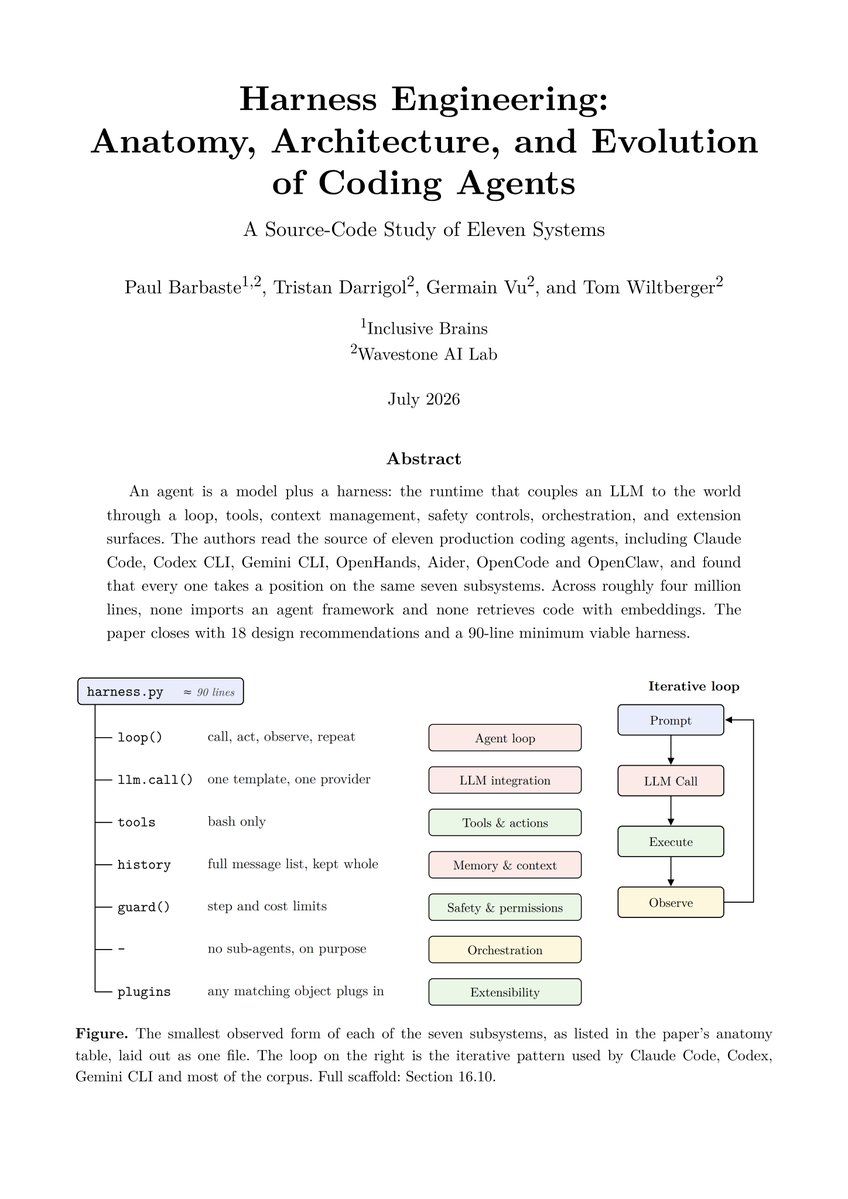
This might be the most useful paper on AI agents this year.
A team at Wavestone AI Lab took apart Claude Code, Codex and 9 more and found the 7-part blueprint every good agent is built on.
Their definition: an agent is a model plus a harness. All 11 agents build the harness from the same 7 parts. Only the size changes.
> Loop: Mini-SWE-Agent is a plain while loop. OpenHands logs every event so a run can be replayed
> LLM layer: one prompt template on one side, 29 provider profiles on the other
> Tools: some agents only have bash, the biggest has 43 typed tools loaded on demand
> Memory: from keep-the-whole-history to notes the agent maintains across sessions
> Safety: from a simple step limit to policy rules plus a reviewer model plus an OS sandbox
> Orchestration: Aider skips sub-agents on purpose, others fork them with their own context
> Extensions: hooks, skills and MCP. SKILL.md is in 9 of 11, MCP in 8
The paper ends with a 90-line harness covering all 7 parts, a solid starting point for your own.
Key pages:
> p.4: the 7-part map
> p.12: the 3 loop types, with Claude Code and Codex as examples
> p.53: why none of them use frameworks or embeddings
> p.67: 18 design recommendations
> p.71: the 90-line harness you can copy
Opus 5.5 + Jev make this AI stack look f…cking illegal
10 GitHub repos for building everything around the model
01 claude-code-router
▸ https://t.co/UZI1GghcZ7
→ routes every request to the model you pick, Opus only where it counts
02 litellm
▸ https://t.co/fximPH5s0P
→ one gateway in front of 100+ models, spend tracked per call
03 spec-kit
▸ https://t.co/Ro8VoLOGle
→ spec first, plan second, code last
04 claude-task-master
▸ https://t.co/VhiGpsJ3Kb
→ your PRD becomes tasks the agent works through one by one
05 superpowers
▸ https://t.co/E775mVeIsp
→ a full dev method built from skills: plan, test, then call it done
06 skills
▸ https://t.co/hUJwOXfsaw
→ Anthropic's own skills, folders Claude loads only when the job needs them
07 graphiti
▸ https://t.co/8Vs8Lh0fo9
→ memory as a temporal knowledge graph, not a dump
08 langgraph
▸ https://t.co/zVySuvYxJ1
→ agents as graphs: state, branches, back edges
09 E2B
▸ https://t.co/6Nt1nYwq6n
→ AI-written code runs in isolated cloud sandboxes, not on your machine
10 promptfoo
▸ https://t.co/97zsE7vKqt
→ evals and red teaming before anything ships
the architecture:
route → spec → tasks → skills → memory → graph → sandbox → evals
I'd split the stack like this:
route:
claude-code-router → litellm
plan:
spec-kit → claude-task-master
work:
superpowers → skills
state:
graphiti → langgraph
safety:
E2B → promptfoo
Opus 5.5 plans and ships. the forks in between, which file, which tool, retry or stop, go to Jev
everyone posts the model and the prompt pack
the stack around it decides whether your agent is still running next week ⭣
Anthropic shouldn't have revealed this plugin. Its name speaks for itself "You should know"
Its capability:
Opus 5.5 writes, the second agent reads, garbage aside: you get only important and reliable information
Opus 5.5 can run continuously for 60 minutes, generating long summaries that nobody checks
And this is what many miss:
> a test it skipped "for now" > a file it modified even though you didn't ask for it > a warning "this might break the system" hidden somewhere at the bottom
All of this is written there. You just never saw it
Now another AI checks the text for you
This is an automatic feature
Enabled with a single line:
/plugin enable cc-plugin-you-should-know@builtin
Do this when you start working:
> Open Claude Code
> Paste the line above
> Give Opus a long task and see how it analyzes the text and eliminates obvious errors
Now the agent won't waste your money: you will get the expected result
Bookmark this
Claude Opus 5.5 is turning GitHub into a playground for creators.
In just one week, people shipped everything from coded music videos to full 3D games.
1. PDoomVideo: the Opus 5.5 P(doom) music video, every frame in code (1.5k stars)
https://t.co/D3jokz8BXG
2. awesome-opus5-5-videos: 475 viral Opus 5.5 videos with their prompts (1k stars)
https://t.co/TN6YIciyfj
3. tidewater: a WebGPU fishing game built with Opus 5.5 (988 stars)
https://t.co/z2XcLNsrRU
4. claude-opus-5-5-demo: three 3D web games, one prompt each (937 stars)
https://t.co/M7pZr9DVcc
5. lemo-opuscar: 43 film styles, each a short film made in code (650 stars)
https://t.co/p6XbpEvjN5
6. ClaudeAnimationBase: starter kit for hand-painted cartoon animation (606 stars)
https://t.co/c0AEWKQ9jO
7. awesome-opus-5-5-videos: source-linked guide to 1,000+ videos (360 stars)
https://t.co/D4G56SEUlG
8. shipvideo: paste a URL, Opus 5.5 writes an HTML launch video (223 stars)
https://t.co/aSiiZ2tZTz
9. motion-graphics-music-video-skill: song in, motion graphics video out (71 stars)
https://t.co/xX14mLb8pN
10. opus-video-skills: one Claude Code skill per video style (36 stars)
https://t.co/MHJIuN4ow5
Follow me @ScaleWthAI for more AI builds, tools, and experiments.
This is the best collection on the internet for making videos with Claude Opus 5.5.
100+ prompts. Free. Completely.
🔗 https://t.co/w9nnEhkDYo
bookmark this page.
then read this ↓
475 Claude Opus 5.5 video demos in one GitHub repo. 🤯
Motion graphics, explainers, 3D scenes, and games built with HTML, Canvas, SVG, and Three.js.
Includes shared prompts and links to the original posts, so you can pick a demo and try building it yourself.
Repo in the comments.
OpenAI Dots is f*cking brilliant for building a 24/7 AI company...
here’s the bigger architecture I’d build around it:
one founder. one dot powered by GPT-6 Astra. 15 specialist jobs connected by work packets
the system has four loops:
BUILD
feedback + support repros → verified evidence → scoped spec → code branch → tested PR
LAUNCH
approved changes → explainers + demo clips + documentation → launch pack
REVENUE
account context → working POC → proposal → follow-up draft
objections and missing features go back into research
OPERATIONS
support triage + invoice drafts + status tracking → one queue of decisions for the founder
the connections are where this gets useful:
a support ticket can become a repro, a patch, updated docs and an answer draft
a finished feature becomes both launch material and proof for the next proposal
a sales objection becomes evidence for the next product decision
give every handoff a file:
→ source references
→ the actual output
→ checks run + open blockers
→ the next job and its exact context
the dot routes the work. specialists return artifacts. you review the decisions and feed corrections into the next task
start with one loop. make it work. connect the next one
save this, then build your company with Dots ⭣
Anthropic engineer:
"99% of our engineers run swarms of 300+ self-improving agents"
"Now everyone is building agentic graphs"
In a 20-minute session, an Anthropic team member breaks down how graph engineering turns isolated agents into systems that improve themselves
The real setup is Claude running through graph workflows, plan mode, and dynamic orchestration
Agents → Loops → Graphs → Self-Improving Systems
Better than most $300 graph engineering courses
Bookmark and watch the talk
Then read the article below
KARPATHY WROTE THIS DOCUMENT TO COMPLETELY AUTOMATE YOUR WORK WITH 24/7 AI EMPLOYEE
I was ready to abandon my second brain
manual cross-referencing was destroying my workflow, but finding this exact document opened my eyes to a completely different approach
it is incredibly convenient -> Karpathy's method turns the AI into a full-time maintainer for your Zettelkasten:
> the LLM reads every new source and integrates it into a structured wiki
> the agent runs automated checks to find contradictions across your notes
> your entire vault compounds automatically without you typing a single link
the friction is completely gone. I just feed it raw documents and the agent organizes my entire life
here is the official document from Karpathy explaining the architecture 👇
An Anthropic engineer packed his whole engineering workflow into agent skills, so anyone can copy it.
Addy Osmani, ex-Google, now works on Claude Code.
His repo turns a coding agent into a senior engineer.
Each skill is a structured workflow: when to use it, the steps, the excuses agents use to skip steps with a rebuttal for each, red flags, and the evidence required before it can call the job done.
25 skills, sorted by phase:
> Define: figure out what to build.
> Plan: break it into small tasks.
> Build: write it test-first.
> Verify: debug and prove it works.
> Review: quality, security, performance.
> Ship: rollout, CI, docs.
Skills also switch on by themselves.
Start designing an API and the API skill kicks in.
Useful if you ship with agents solo, or if you want every agent on your team held to the same bar.
npx skills add addyosmani/agent-skills
The full pipeline is in the article below, repo in the first reply ↓
An article for everyone who ships, buys, or signs off on software built on large language models (LLMs): engineers, product managers, and the CEO. Written in plain language, from the big picture down to the details. https://t.co/YaP414vR0u
holy sh*t. Sam Altman shows his personal dots setup
one dot. one job. it works the night shift so he doesn't have to:
-> reads everything that came in overnight: email, calendar, Slack, DMs
-> sorts it into urgent vs can wait, based on how he likes to work
-> drafts the replies and sends nothing
-> checks every action against his custom rules: proceed, ask him, or hand it off
-> before his day starts he gets one ping with only the urgent stuff, drafts attached
-> it reaches him in ChatGPT, Slack, Teams or by call
-> whatever he edits or ignores goes back into memory
runs 24/7 on its own cloud computer, through plug-ins he already connected
how i'd copy it:
> one job first
> read-only for a week
> sending always asks
> correct it out loud
included in Pro, Business Premium and Enterprise
give yours the night shift tonight