One of the things @officialABAT got wrong is replacing the Registar of @cacnigeria1
Since that Shagari's son was removed, we went from an improved agency to a undesirable one.
CAC's turn around got to 48 hours.
But what do we have now, back to the INGLORIOUS DAYS.
They started with the DISASTROUS switch in software.
We now have deal with queries running into months.
Dear @officialABAT, you got this appointment WRONG!!!!!
Dear Saint @PeterObi
It has gotten this bad that you are stealing other people's pictures and editing them.
The cleanest and most honest politician of all time is posting fake pictures of an event he didn't attend
Clock it.
I remember when I went to serve someone a letter and they locked me inside their compound and said I wasn’t leaving. I was an intern at a law firm, I wanted to cry😭😭
PRESS RELEASE
FEDERAL MINISTRY OF FINANCE
5 July 2026
𝐑𝐄𝐒𝐏𝐎𝐍𝐒𝐄 𝐓𝐎 𝐑𝐄𝐂𝐄𝐍𝐓 𝐌𝐈𝐒𝐑𝐄𝐏𝐑𝐄𝐒𝐄𝐍𝐓𝐀𝐓𝐈𝐎𝐍𝐒 𝐎𝐍 𝐏𝐔𝐁𝐋𝐈𝐂 𝐄𝐗𝐏𝐄𝐍𝐃𝐈𝐓𝐔𝐑𝐄
The Federal Government has noted recent public commentary alleging that approximately two percent of GDP amounting to over ₦8 trillion was spent outside the approved budget based on references to the IMF Representative in Nigeria and the Fund's 2026 Article IV Consultation Report. These claims are incorrect and risk misleading the public regarding the government's financial management.
For the avoidance of doubt, the Federal Government does not operate a "shadow budget" or expend public funds outside the constitutional and statutory framework established for public finance.
Under Sections 80 - 83 and 162 of the Constitution of the Federal Republic of Nigeria, 1999 (as amended), public funds may only be withdrawn and expended in accordance with the Constitution and laws enacted by the National Assembly. Accordingly, Federal Government expenditure is incurred pursuant to duly enacted Appropriation Acts, Supplementary Appropriation Acts, and other statutory authorities enacted by the National Assembly. In addition, multi-year capital projects which necessarily span multiple budgets are implemented in accordance with extant laws and approved provisions for capital rollovers where applicable. These are recognised features of public financial management and should not be misconstrued as expenditures outside the budget.
It is inaccurate to suggest that trillions of naira have been secretly spent outside legislative approval. Such allegations should have identified the specific projects purportedly executed without appropriation or legal authority and present credible evidence in support of the claim. To be meaningful, assertions of this magnitude must be supported by verifiable facts rather than conjecture.
For the purpose of public education, it is important to distinguish between appropriation, expenditure authorisation, financing, and fiscal reporting.
Nigeria's public finance framework contains several statutory transfers, first-line charges and intervention mechanisms established by Acts of the National Assembly. These include, among others:
- Statutory allocations and contributions to development commissions and other agencies created by law.
- Cost of collection and cost of administration retained by designated revenue-collecting agencies as expressly provided under relevant legislation.
- Capital expenditure approved in separate budgets for some agencies and the Federal Capital Territory by the National Assembly.
- Special interventions approved by law to address national priorities such as security, infrastructure, disaster response, and other strategic national programmes or emergencies.
- Debt service obligations and other statutory transfers that are authorised under applicable legislation.
These expenditures are neither secret nor illegal. They are established by law, disclosed in various fiscal reports, and subject to applicable oversight, audit and accountability mechanisms. Their treatment for reporting purposes may differ from their presentation in the annual Appropriation Act, particularly under international statistical and reporting standards adopted by the Federal Government. Such classification differences should not be misrepresented as evidence of unlawful expenditure.
It is equally incorrect to suggest that the reported amount represents an increase in budget deficit. A fiscal deficit is determined by the relationship between total government revenues and total government expenditures. Whether a capital project is financed through annual appropriations, supplementary appropriations, statutory transfers, approved intervention mechanisms, or other lawful financing arrangements does not, by itself, increase the fiscal deficit.
Indeed, the IMF's observation relates primarily to the comprehensiveness, timing and presentation of fiscal reporting rather than the legality of expenditure. Like many countries, Nigeria continues to strengthen the alignment between budget presentation and international fiscal reporting standards as part of ongoing public financial management reforms. As a matter of fact, His Excellency, President Bola Ahmed Tinubu, GCFR had himself formally requested the National Assembly to end the practice of running multiple and overlapping budgets, and rather harmonise into a single, cohesive framework during his presentation of the 2026 Appropriation Bill to a joint session of the National Assembly on December 19, 2025.
The Federal Government remains firmly committed to prudent fiscal management, transparency and accountability. Recent reforms have significantly strengthened public financial management with ongoing improvements in budget assumptions and credibility, transparent revenue administration, digitalisation of government financial processes, and stronger treasury management. These reforms have been acknowledged by the IMF itself and other multilateral institutions, as well as international credit rating agencies, major media organisations and investors.
Public debate is both welcome and essential in a democratic society. However, it should be based on facts and an accurate understanding of Nigeria's constitutional and fiscal framework. Mischaracterising technical observations as evidence of unlawful expenditure neither advances informed public discourse nor strengthens democratic accountability.
The Federal Government will continue to uphold the rule of law, maintain transparency in the management of public resources, and work with the National Assembly, oversight institutions, development partners and the Nigerian people to further strengthen fiscal governance in line with international best practices.
Signed:
Taiwo Oyedele
Honourable Minister of Finance and Coordinating Minister of the Economy
Federal Republic of Nigeria
President Bola Ahmed Tinubu, GCFR, today assented to the National Identity Management Commission (NIMC) Act 2026.
The new Act, which repeals and replaces the NIMC Act of 2007, is a landmark piece of legislation, signifying a transformative milestone in Nigeria's journey towards a secure, inclusive and digitally empowered nation.
WHAT IS NEW?
1. It provides robust data protection and privacy by introducing stronger safeguards for personal data in alignment with the Nigeria Data Protection Act (NDPA) and international best practices, ensuring that Nigerians' personal information is processed, stored and protected in accordance with globally accepted privacy standards.
2. The new law designates NIMC as the root certification authority for Nigeria's National Public Key Infrastructure (PKI) and Digital Public Infrastructure (DPI), establishing the Commission as the nation's trusted authority responsible for secure digital identity, authentication and electronic trust services.
3. It empowers NIMC to ensure secure, interoperable and seamless data exchange among Ministries, Departments and Agencies (MDAs), private organisations and other authorised entities.
4. It positions the NIMC General Multipurpose Card as a versatile identity credential for nationwide identity verification under the theme "One Card, Multiple Possibilities," among other things.
WHY IT MATTERS TO NIGERIANS
The implementation of the Act will deliver significant benefits by creating a trusted, secure and interoperable digital identity ecosystem that enables seamless access to services across both the public and private sectors while strengthening electronic trust across Nigeria's digital economy.
With this new law, Nigerians, even those in the diaspora, can expect wider, easier and more convenient access to identity services; stronger protection of personal data and privacy; enhanced cybersecurity and greater confidence in digital transactions; faster, safer and more secure identity verification and authentication; and a stronger foundation for Nigeria's digital economy, digital governance and long term national development.
Beyond words, this landmark accomplishment renews the trust of Nigerians in President Bola Ahmed Tinubu's, GCFR, commitment to building a one trillion dollar economy.
Subsidy Removal, you are against it.
Students Loan, you attack it.
Coastal Road, you talk down on it.
Tax Reform, you say it’s anti-poor.
Local Government autonomy, you say it’s a scam.
State Police, you still don’t support it.
What exactly do you want?
Which agenda is this one again...
In the 2023 election, was Peter Obi not the Candidate with the most church visits in Nigeria Political history?
Was he not welcomed in love at all these churches for political reasons in the run up to his 2023 election:
1) Assemblies of God Church - Okpoto, Ebonyi State - July 12, 2022
2) Family Worship Centre - Utako, Abuja - July 14, 2022
3) Dunamis International Gospel Centre - Glory Dome, Abuja - July 29, 2022
4) The Lord's Chosen Charismatic Revival Ministries - Ijesha, Lagos - June 12, 2022
5) Redeemed Christian Church of God (RCCG) - Redemption Camp, Mowe, Ogun State - August 12, 2022
6) Omega Fire Ministries - Auchi, Edo State - November 11, 2022
7) Salvation Ministries - Port Harcourt, Rivers State - November 19, 2022
8) Catholic Charismatic Renewal of Nigeria - Ubulu-Uku, Delta State - November 19, 2022
9) House on the Rock - TBS Square, Lagos - December 2, 2022
10) Living Faith Church / Winners Chapel - Canaanland, Ota, Ogun State - December 8, 2022
11) Eternal Sacred Order of Cherubim and Seraphim - Lagos - February 19, 2023
So how do organized Christian Bodies hate him?
Did anything happened?
Did anything change?
Or is this agenda?
🤔🧐
An alien who is in the U.S. temporarily and wants a Green Card must return to their home country to apply.
This policy allows our immigration system to function as the law intended instead of incentivizing loopholes.
The era of abusing our nation’s immigration system is over.
They say only a thief comes in the night.
But Access Bank also cometh. The bank was fined N1.8 billion by the CBN, recorded nearly 6,000 fraud cases, and paid shareholders zero dividend in 2025, all while posting record profits.
Here is what the financial statements actually say.
Pastor Sarah Omakwu, the Lead Minister of Family Worship Centre, Abuja, made this bold statement I expect other Church Leaders to emulate and collaborate 👏 🙌 👌 👍
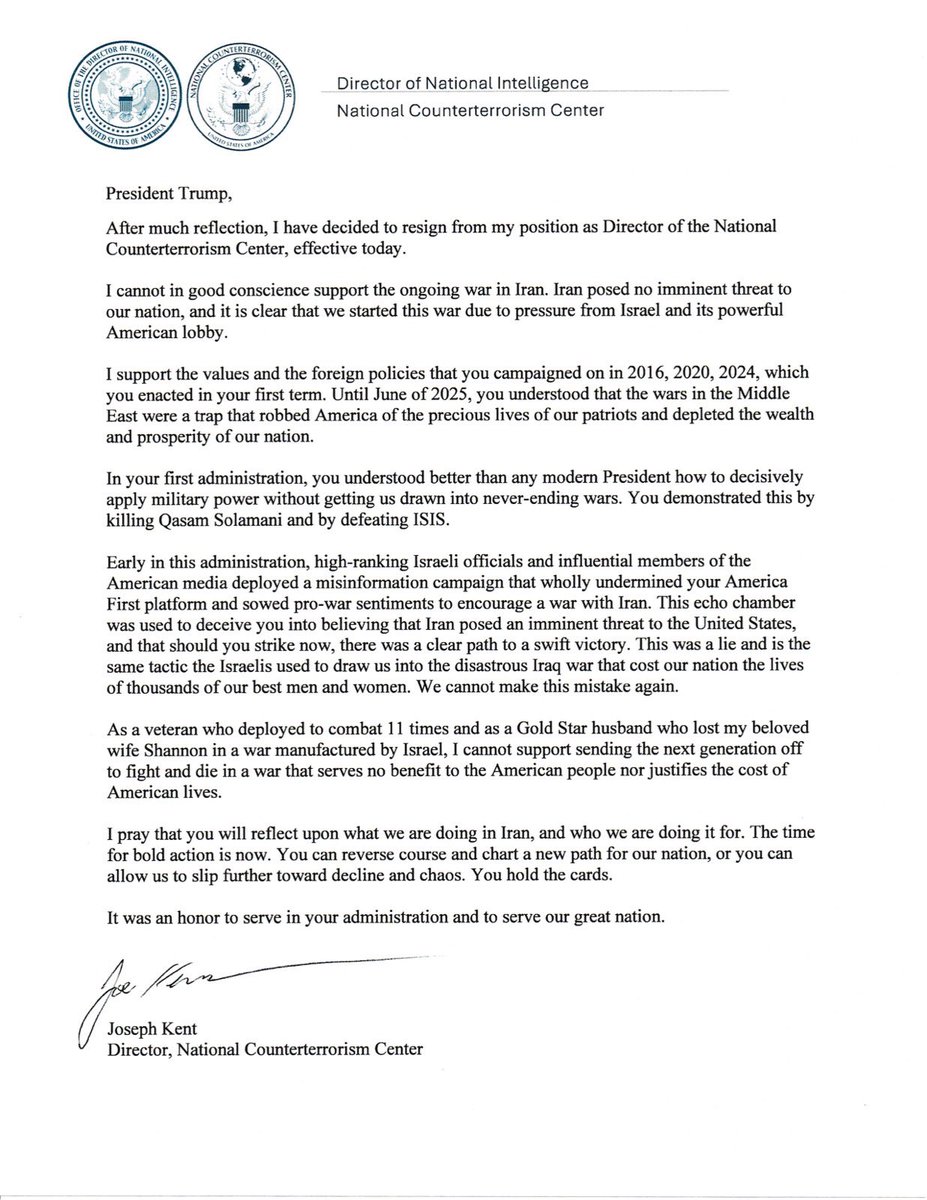
After much reflection, I have decided to resign from my position as Director of the National Counterterrorism Center, effective today.
I cannot in good conscience support the ongoing war in Iran. Iran posed no imminent threat to our nation, and it is clear that we started this war due to pressure from Israel and its powerful American lobby.
It has been an honor serving under @POTUS and @DNIGabbard and leading the professionals at NCTC.
May God bless America.