Alaska is staring down an electricity crisis that didn’t have to happen.
The Railbelt the 700-mile corridor that keeps the lights on for roughly 75% of Alaskans from Fairbanks to Homer has run on Cook Inlet natural gas since the 1960s.
That fuel source is running out due to lack of business security with our state and lack of exploration investment. So it’s correct the Proven reserves have crashed from 16 trillion cubic feet in the 1970s to under 2.5 Tcf today. Major utilities have already said supply contracts beyond 2028–2030 are uncertain.
The fallback being whispered about? Importing LNG from Asia or the Gulf Coast at three to five times the cost while we keep exporting coal to South Korea.
At the same time, the physical grid is one spark, quake, or equipment failure away from repeating the 2019 Kenai Peninsula disaster, when wildfire took out the Sterling-Quartz Creek line and the entire peninsula was islanded for four months, costing ratepayers more than $10 million in emergency diesel.
Right now the average Railbelt household pays $0.22–$0.28 per kWh.
That’s $2,200–$2,800 a year for a typical 10,000 kWh home.
Line losses of 17–20% on the long Fairbanks segments mean ratepayers already pay for power that never shows up.
Five active U.S. military bases depend on this fragile single-spine system. National security briefings have flagged it for years.
We own the coal… YES, Alaska holds about half of all estimated U.S. coal resources, with South-Central fields alone offering 800+ years of supply at the scale we’d actually use.
We own the Alaska Railroad that runs right past those fields. We have the right-of-way.
The only missing ingredient is the political will to build generation that serves Alaskans instead of outside shareholders and import terminals.
Want to hear another proposal to the energy crisis, we face and how it could actually save us money. Read the full Substack below.
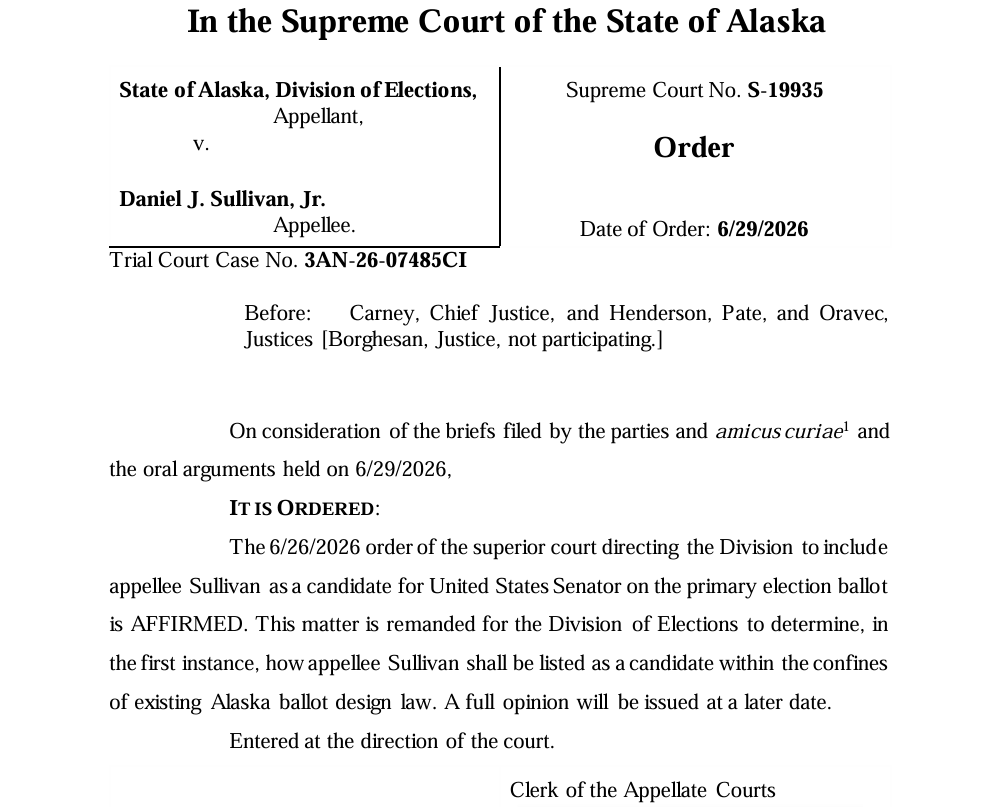
Petersburg’s Dan Sullivan Allowed on Ballot
After hearing oral arguments, yesterday, June 29, 2026, the Alaska Supreme Court has ruled that Daniel J. Sullivan Jr., a teacher from Petersburg with the same first and last name as incumbent Senator Dan Sullivan, is allowed to appear on the ballot as a candidate for U.S. Senate. Petersburg Dan will appear on the ballot simply as “Sullivan, Daniel J. Jr.” with no party affiliation. The incumbent Senator Dan Sullivan will appear as “Sullivan, Dan S. (Registered Republican) incumbent.”
The race for Alaska’s open U.S. Senate seat is a key race garnering keen media attention as Democrats spend big money to flip the seat. The major players are incumbent U.S. Senator Dan Sullivan (R-Alaska), who has been serving Alaska in the U.S. Senate for 10 years, and Democrat Mary Peltola, who represented Alaska in the House of Representatives from 2022-2024. Recently, a high-profile controversy resulted from the filing for candidacy of Daniel J. Sullivan, Jr., a teacher from Petersburg with the same first and last name as the incumbent Senator.
After Petersburg Dan filed, switched his party affiliation to Republican, ripped off the incumbent Senator’s campaign design, and seemed unwilling to distinguish himself from the incumbent, Republicans asserted that Petersburg Dan was not running with an intent to serve as senator, but instead with the intent to confuse voters and draw votes away from the incumbent.
Full story in reply!
@SenDanSullivan@MaryPeltola
We also need transparency Ask a hard question about HB 381 and a certain kind of response comes back fast: you don’t understand the full picture, we are privy to information you have never seen, trust the process. I have heard versions of that line from an administration official directly. This week, Alaskans found out exactly what some of that withheld information actually was, and it did not come from the administration. It came from a leak.
What They Were Actually Privy To
A handful of state senators obtained a leaked draft of AGDC’s own internal staff analysis of its confidential agreement with Glenfarne, a document titled a “lead party decision support package” that has never been published. Alaska Beacon’s reporting on it, confirmed against an independently obtained paper copy, shows the document contains a repurchase mechanism, often called a clawback, that could require the state to pay Glenfarne if AGDC ever needs to retake the project. Under that mechanism, Glenfarne proposes the repurchase price itself, based on the value it claims to have added, and if AGDC disputes that number, an outside investment bank settles it.
https://t.co/pK7WT9mkWT
Post of the day 🥇 read this thread three time then send it to everyone you know.
How do you know what you don’t know and how do you know if you never asked?
When there is no longer a way to satisfy the obligations placed upon the future, must a republic take what it cannot produce from another nation, whether through war or by exporting dollar inflation? Or must it stop, admit the mistakes it has made, and accept honorable defeat through restructuring? If it chooses neither, does it instead face the slow death of the vassal state?
What follows is a response to my question from an email-
This is the raw, unavoidable question at the end of unchecked obligation momentum.
When a republic, or any polity, has promised more future production, labor, and resources than it can realistically deliver without destroying its own productive capacity or its liberty, it faces a stark set of choices.
The Uncomfortable Options When Internal Obligations Become Unsustainable
Externalize the Burden
Through direct means: War, conquest, tribute, or resource extraction. History is full of empires that sustained internal overcommitment by expanding outward. Rome's later centuries combined currency debasement with continued military campaigns, while various European powers financed wars and mounting debts through colonial extraction.
Through indirect means, particularly as a reserve currency issuer: Export inflation or devaluation by creating and spending dollars that foreign governments, institutions, and markets are encouraged, or compelled by global trade, to hold. This shifts part of the real burden abroad through the gradual erosion of purchasing power. The Triffin dynamic and the United States' "exorbitant privilege" have enabled a version of this for decades, allowing persistent deficits while the rest of the world absorbs dollars. It can provide short term relief, but it steadily weakens the confidence that gives the dollar its unique status. Over time, it risks the loss of that privilege itself.
Admit the Limits and Accept an Honorable Defeat Through Restructuring
Transparent default, partial repudiation, debt restructuring, or negotiated haircuts.
Austerity paired with reforms aimed at restoring productive growth.
This path is painful and politically toxic because it requires current generations, or powerful interest groups, to bear the visible cost of past commitments. Yet it preserves moral and philosophical legitimacy. The republic acknowledges that it cannot bind the future indefinitely beyond its capacity or without the consent of those who must bear the burden. Rather than expanding power simply to preserve itself in name, it accepts its limits and seeks renewal within them.
Drift into Vassalage or the Gradual Loss of Effective Sovereignty
Decision making becomes increasingly constrained by creditors, demographics, rising interest costs, or external powers and institutions.
Internally, the state evolves into a mechanism for servicing accumulated obligations rather than preserving the liberty, prosperity, and future options of its citizens.
Externally, sovereignty is diminished through formal or informal dependence. Historical examples include states that, following default, came under foreign financial control or occupation. Modern forms may appear as IMF style conditionality or deep reliance on foreign capital accompanied by significant external influence.
This is often the quiet default outcome when neither externalization nor honest restructuring is chosen. The republic continues to exist in form, but its effective sovereignty gradually erodes, leaving behind the shell of self government while its substantive independence fades.
What follows is a response from unknow person about an essay I wrote on debt and its relation to the dilution of sovereignty.
Philosophical Take in Light of the Essay
The essay frames debt as a promise from the present to the future, one that must never extinguish the sovereignty from which legitimate promises arise. When obligations can no longer be met internally without crossing that boundary, the honorable response is to end the violation, acknowledge the overpromise, restructure on transparent terms, and return to first principles: restraint, consent, and the productive rather than consumptive use of resources.
Exporting the burden through war or dollar inflation may postpone the reckoning and preserve the outward form of the republic for a time, but it often hastens both moral and practical decline. It treats other peoples, or future holders of the currency, as resources to be drawn upon without genuine consent. That is fundamentally at odds with the principles of sovereign, limited government.
Honest admission and reform is the course most consistent with founding principles. It accepts that republics are mortal and that survival by becoming something else, an engine for servicing past debts at the expense of liberty, or an extractor of wealth from others, is not preservation. It is transformation into a different kind of political order.
Vassalage, whether internal or external, is usually the dishonorable outcome when the difficult choice is continually postponed. The state endures, but effective self government, political independence, and future freedom of action gradually diminish.
Your earlier proposals, strict growth caps, borrowing limits, and a well governed sovereign wealth fund serving as a buffer, are all attempts to preserve room for the honorable course before obligations become impossible to sustain. Their purpose is to prevent the point at which the only remaining options are predatory externalization or the quiet surrender of sovereignty.
Republics that have met this moment with integrity, acknowledging past mistakes, restructuring debts, and recommitting themselves to constitutional limits, have at times renewed themselves. Those that chose continual violation or perpetual extraction have generally lost the qualities that made them republics in the first place.
This is not a counsel of despair. It is a counsel of realism and courage. The longer reform is delayed, the fewer and more difficult the remaining choices become. The enduring question is whether a people still possess the discipline and the will to choose restraint and renewal while that choice remains.
OMG! We seriously folks, are we serious.
Is Eastman Back⁉️ if he is you need to
look at this chart, Alaska.
2023-2024 Legislature. Percent voting consistent with constitutional principles. Average? A weak 40%.
Most of the “Republican” pack huddled around 50% close enough to keep the base fooled, far enough to stay in the Uniparty club.
But that lone red dot way out at 100%?
That’s David Eastman. The only legislator in the entire building with a perfect constitutional voting record.
That’s exactly why the Uniparty GOP gangsters Hughes, McCabe, and Warfields and their Mean Girl crew came after him with Alinsky tactics and deceptive ads.
They couldn’t control him, so they hunted his district and knocked him out. Many Purple Republicans also donated to Underwood.
Now Eastman is filing to grab House District 27 back. 💯 we need the real one back in the game.
Constitutional conservatives the politically homeless who are done with RINO power plays and boss-girl politics this is on us.
Eastman answers to his Creator first, his family second, and his constituents third.
Not the lobbyists. Not the party bosses. Not the status quo.
The chart doesn’t lie. If you’re sick of Juneau’s Disneyland and want someone who actually fights for the Constitution instead of performing for it, get in the fight. Help David Eastman take back House District 27.
Principles over politics. Constitution over Uniparty. Alaskans First
#akleg
Ask a hard question about HB 381 and a certain kind of response comes back fast: you don’t understand the full picture, we are privy to information you have never seen, trust the process. I have heard versions of that line from an administration official directly. This week, Alaskans found out exactly what some of that withheld information actually was, and it did not come from the administration. It came from a leak.
What They Were Actually Privy To
A handful of state senators obtained a leaked draft of AGDC’s own internal staff analysis of its confidential agreement with Glenfarne, a document titled a “lead party decision support package” that has never been published. Alaska Beacon’s reporting on it, confirmed against an independently obtained paper copy, shows the document contains a repurchase mechanism, often called a clawback, that could require the state to pay Glenfarne if AGDC ever needs to retake the project. Under that mechanism, Glenfarne proposes the repurchase price itself, based on the value it claims to have added, and if AGDC disputes that number, an outside investment bank settles it.
https://t.co/pK7WT9mkWT
Alaska is staring down an electricity crisis that didn’t have to happen.
The Railbelt the 700-mile corridor that keeps the lights on for roughly 75% of Alaskans from Fairbanks to Homer has run on Cook Inlet natural gas since the 1960s.
That fuel source is running out due to lack of business security with our state and lack of exploration investment. So it’s correct the Proven reserves have crashed from 16 trillion cubic feet in the 1970s to under 2.5 Tcf today. Major utilities have already said supply contracts beyond 2028–2030 are uncertain.
The fallback being whispered about? Importing LNG from Asia or the Gulf Coast at three to five times the cost while we keep exporting coal to South Korea.
At the same time, the physical grid is one spark, quake, or equipment failure away from repeating the 2019 Kenai Peninsula disaster, when wildfire took out the Sterling-Quartz Creek line and the entire peninsula was islanded for four months, costing ratepayers more than $10 million in emergency diesel.
Right now the average Railbelt household pays $0.22–$0.28 per kWh.
That’s $2,200–$2,800 a year for a typical 10,000 kWh home.
Line losses of 17–20% on the long Fairbanks segments mean ratepayers already pay for power that never shows up.
Five active U.S. military bases depend on this fragile single-spine system. National security briefings have flagged it for years.
We own the coal… YES, Alaska holds about half of all estimated U.S. coal resources, with South-Central fields alone offering 800+ years of supply at the scale we’d actually use.
We own the Alaska Railroad that runs right past those fields. We have the right-of-way.
The only missing ingredient is the political will to build generation that serves Alaskans instead of outside shareholders and import terminals.
Want to hear another proposal to the energy crisis, we face and how it could actually save us money. Read the full Substack below.