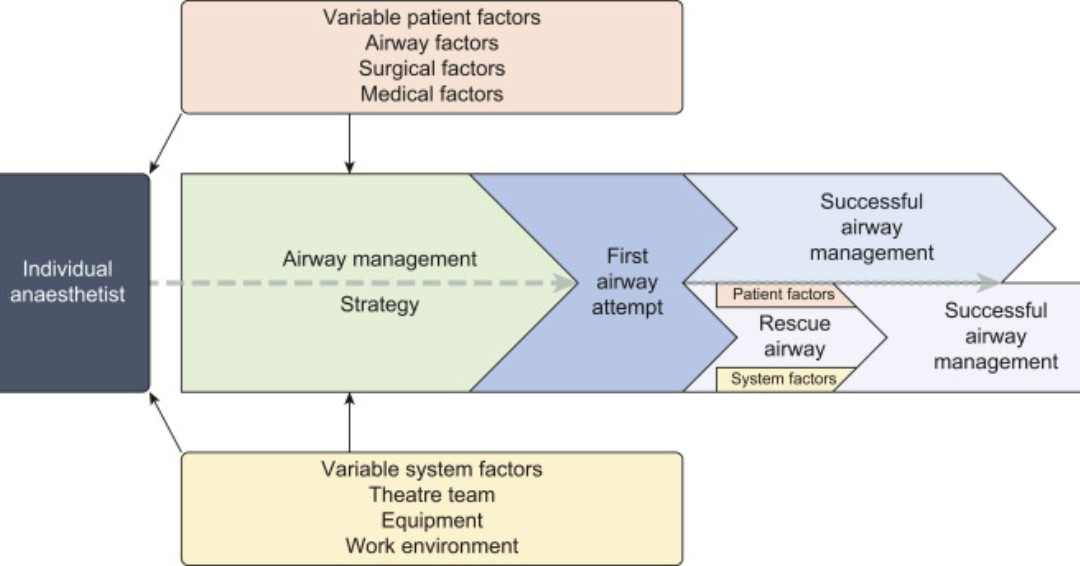
New #BJA#Editorial looking at how the 2025 DAS guidelines signal a shift from failure prevention to success engineering using a Safety-II view.
https://t.co/JoZILHssPG
A clinical trial published in JAMA Surgery showed that for patients with moderate to severe postoperative nausea and vomiting, wearable transcutaneous electrical acupoint stimulation was more effective than metoclopramide.
🔗 Read a summary in the SM&A: https://t.co/z31Cfq8BxY
In a new article, Scharffenberg et al. hypothesized that protective ventilation aiming at moderate lung expansion results in less mechanical power and lung injury than aiming at permissive atelectasis or maximum lung expansion.
🔗 Read more: https://t.co/uoF290U8rg
In a new Clinical Focus Review, Jabagi et al. propose an evidence-based, multiparametric framework for defining, diagnosing, and managing perioperative right heart failure in cardiac surgery. 🫀
📗 Read the article: https://t.co/LuJprTBNOD
✔️ Error field concordance analysis addresses key limitations of 4-quadrant plot and polar plot analyses to better distinguish strong concordance, loose concordance, total noise, and strong discordance.
https://t.co/PiMquSN1fw
Don't miss the editorial "The Myth of Depth of Anesthesia Monitors: When a “Normal” Bispectral Index Does not Mean What You Think It Means" from Drs. Paul Garcia and Peter Goldstein
Anesthetic “depth” and quality can’t be reduced to a single value: BIS cannot reliably ensure both optimization and safety. Recognizing monitor limits and adjusting care will.
https://t.co/Ydpp8MOCZU
🧠Can “adequate” BIS values between 40 and 60 occur with nonzero burst suppression ratios (BSRs)?
🧠Paradoxical BIS values of 40 to 60 with BSR≥5% can occur for sustained periods, in some cases for over 2 minutes, as well as low BIS values with zero BSR.
🧠 Anesthesiologists are advised to check both index values as well as the raw electroencephalogram (EEG) to guide anesthetic management, especially when BIS and BSR contradict each other.
https://t.co/7lSXrTsL8C
Monitoreo Hemodinámico con Bajos Recursos
Medir Delta de CO2 y DCO2/DavO2 (lo que algunos llaman “índice mitocontrial”, cringe sea de paso) NO se recomienda. Incluso cuando no tienes más recursos de monitoreo, NO se recomienda tampoco. NO aporta información relevante y solo puede ser confusora, además de costar y requerir una invasión innecesaria.
Es mejor usar los ojos y el tacto para medir el tiempo de llenado capilar, la onda de pletismografía, y si tienes, USG.
https://t.co/1kGTUxfsoO
Y bueno, llevamos más de un año diciéndolo, gracias a las autoras por citarnos 🙏🏼
🫀 Hemodynamics is not blood pressure... actually, It never was.
⚠️ The biggest mistake in perioperative & critical care:
👉 Treating numbers instead of physiology
📊 What we were taught
✔️ BP
✔️ HR
✔️ SpO₂
🔥 What actually matters
👉 Flow + oxygen delivery + tissue perfusion
🧠 Core concept
👉 Blood pressure ≠ perfusion
You can have:
▪️ Normal BP → low cardiac output
▪️ High BP → poor microcirculation
▪️ Stable vitals → ongoing hypoxia
💡 Why?
Because:
👉 BP = CO × SVR
Same pressure
→ completely different physiology
🧬 The real pillars of hemodynamics
✔️ Cardiac output
✔️ Stroke volume
✔️ Preload / afterload / contractility
✔️ Oxygen delivery (DO₂)
⚠️ Critical insight
👉 Oxygen delivery = CO × arterial O₂ content
Not:
❌ BP
❌ SpO₂ alone
🔥 This is where advanced monitoring changes everything
👉 From static → dynamic
👉 From guess → prediction
🧠 Dynamic parameters outperform static ones
✔️ SVV
✔️ PPV
✔️ PVI
👉 Predict fluid responsiveness
��� Avoid fluid overload
💥 Reality check
Only ~50% of unstable patients respond to fluids
👉 The rest get harm
🫀 Next level thinking
👉 Ventriculo-arterial coupling
👉 Cardiac power output
👉 Tissue perfusion markers
🚨 Final message
Stop asking:
❌ “What is the blood pressure?”
Start asking:
👉 “Is the patient perfusing?”
🧠 Because in critical care:
👉 Flow saves organs
Pressure just looks good on the monitor
📚 Demir et al., Aydın et al.
Turkish Journal of Anaesthesiology & Reanimation, 2025
DOI: 10.4274/TJAR.2025.251926
DOI: 10.4274/TJAR.2025.251925