Al lluny s'aixecaven exuberants les muntanyes del Pirineu, aquella blavor celestial...albirar el conjunt de les valls pallareses, Comiols, 1933, Joan LLuís
La tardor a la Coma Burg no té similar. La policromia d’ocres, vermells i carbasses s’estén per tot el paisatge, des dels boscos més alts, conquerits pel pi roig, fins al fons de la vall. No hi ha paisatge igual a tot el Pirineu.
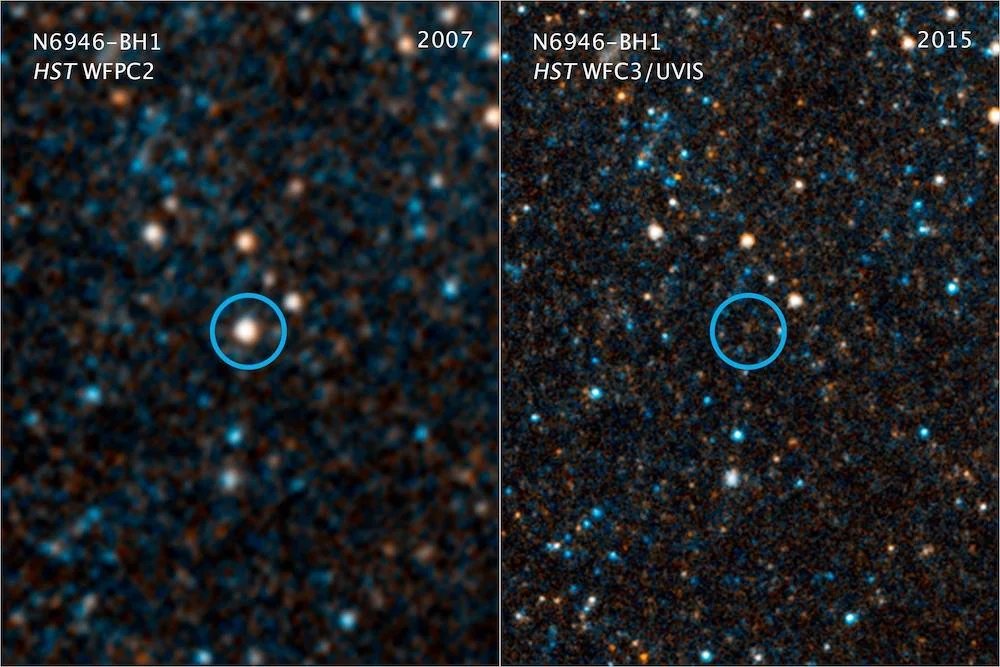
Hubble saw a star collapse directly into a black hole, no supernova.
When the most massive stars in the universe die, they often detonate in fiery supernovae, dramatically blasting most of their matter into space. The remaining stellar cores collapse into neutron stars and, sometimes, black holes.
However, theories suggest that some massive stars might die without a bang, instead directly collapsing inward to become neutron stars or black holes.
[Credit: NASA/ESA/C. Kochanek (OSU)]
The James Webb Space Telescope has been staring into the dawn of the cosmos and keeps finding the same strange freckles: tiny, fiercely red points of light that shouldn’t quite exist.
These “little red dots” are among the earliest objects we’ve ever seen, lighting up when the universe was less than a billion years old. At first glance they looked like impossibly massive baby galaxies or clusters of ancient stars. Spectral data told a different story. Hidden inside each compact crimson glow is a rapidly growing black hole, wrapped in an enormous, dense cocoon of hydrogen gas—sometimes large enough to span a solar system.
Astronomers have started calling them “black hole stars.” The black hole does the heavy lifting that nuclear fusion does inside a normal star, heating and ionizing the surrounding gas until the whole structure shines with a deep red light. The thick envelope also explains why these objects are so quiet in X-rays and radio: the gas swallows the high-energy radiation before it can escape.
They appear in huge numbers in the first billion years and then largely vanish, suggesting this is a short, violent growth phase. If the picture holds, these little red dots are the missing nurseries where the universe’s first supermassive black holes bulked up at speeds that standard models struggle to explain. Not cosmic death zones exactly—more like the chaotic, glowing incubators of the monsters that would later sit at the centers of galaxies.
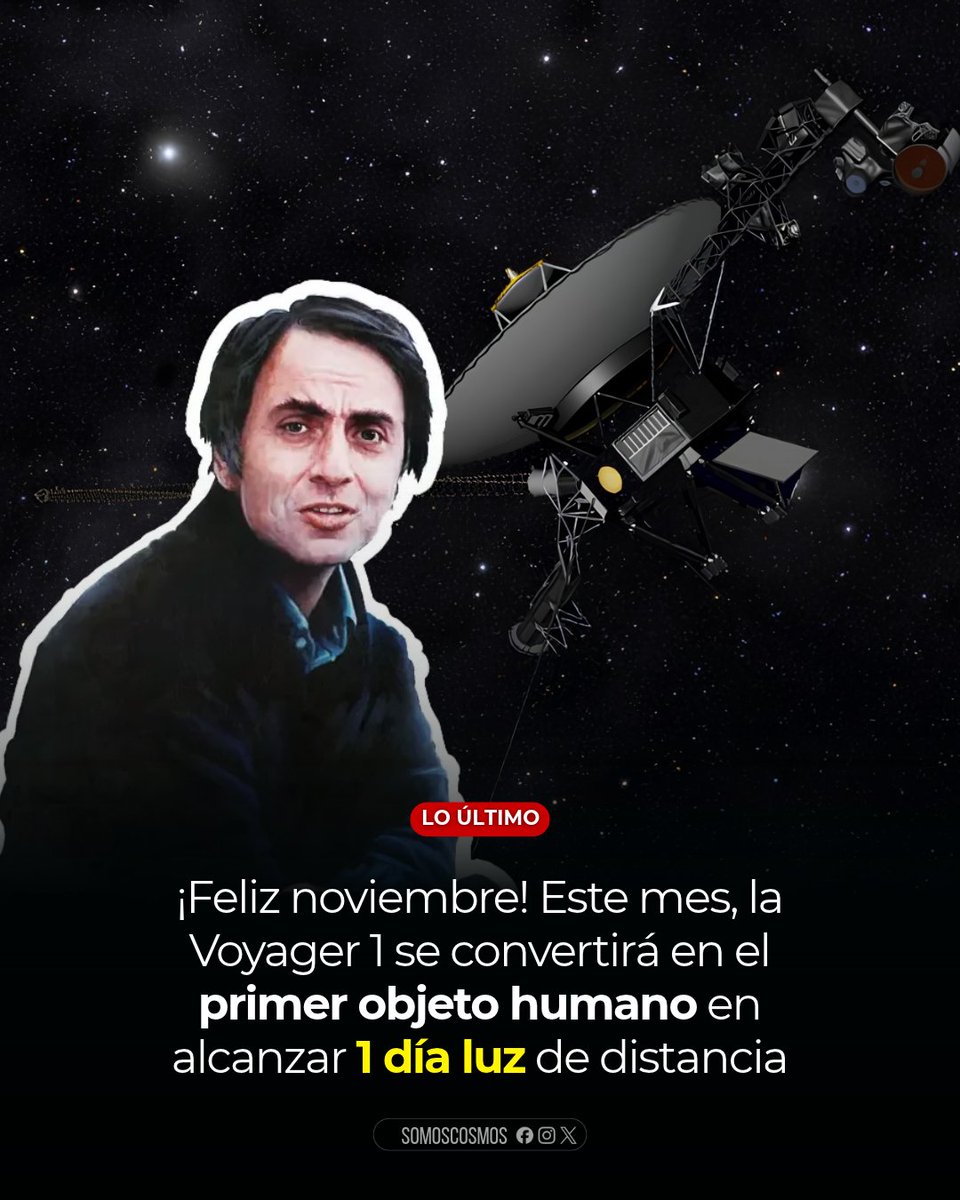
LO ÚLTIMO: La sonda Voyager 1 de la NASA se convertirá el 18 de noviembre en el primer objeto fabricado por humanos en alcanzar 1 día luz de distancia de la Tierra 🚀
Esa es la distancia que recorre la luz en 24 horas: unos 25.902 millones de kilómetros. Desde entonces, una señal enviada desde la Tierra tardará un día entero en llegar a la nave.
La sonda fue lanzada en 1977 y desde 2012 viaja por el espacio interestelar. Habrá tardado 49 años en alcanzar esta marca ✨
Because of the war, a 77-year-old Ukrainian grandmother was trying to escape her home and started walking alone down a road.
Fortunately, she was spotted by a drone, and because her escape route was under fire, they sent a UGV (unmanned ground vehicle) for her to sit in.
Descobert el sisè planeta nan del nostre sistema solar. Orbita més enllà de Plutó.
La troballa és de l'Observatori Vera Rubin, i l'objecte ha rebut el nom de 2026 ED138. Es trobaria a una distància 46 cops superior a la de la Terra amb el Sol i podria tenir un diàmetre entre 600 i 1.600 km (Plutó en té 2.380).
Aquesta mida fa sospitar que, per gravetat, 2026 ED138 serà rodó, la qual cosa el qualifica oficialment com a planeta nan, junt a Plutó, Ceres, Eris, Haumea i Makemake.
https://t.co/OiQn2kU2tY
Breaking News: Walter Koenig, who played Pavel Chekov, the baby-faced Russian navigator in the “Star Trek” franchise, has died at 90. https://t.co/Q0tTWhwKiT
És indecent el NO-TRACTAMENT dels mitjans "catalans" sobre l'escàndol de la socialista lleidatana Montse Mínguez.
El silenci selectiu també és censura.